Showing posts with label religion. Show all posts

Saturday, September 17, 2016

Moving in with Hate

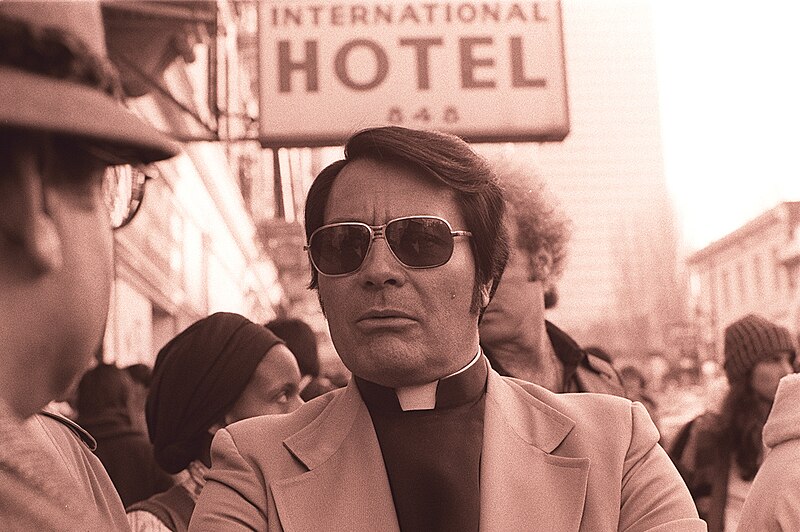
Reverend Jim Jones at a protest in front of the International
Hotel, 848 Kearny Street in San Francisco in 1977.
Photo by Nancy Wong
David Brooks feels the Democratic and Republican parties are undergoing a great realignment:
"....he most important social divide today is between a well-educated America that is marked by economic openness, traditional family structures, high social capital and high trust in institutions, and a less-educated America that is marked by economic insecurity, anarchic family structures, fraying community bonds and a pervasive sense of betrayal and distrust.... These two groups live in entirely different universes. Right now each party has a foot in each universe, but those coalitions won’t last."
He goes on:
"Just as the Trump G.O.P. is crushing the Chamber G.O.P., the Clinton Democrats will eventually repel the Sanders Democrats. Their economic interests are just different. Moreover, their levels of social trust are vastly different."
I don't know about Brooks' assessment of the disaffected right. For plenty of them I feel like it has less to do with economic or family realities, and more to do with a cultural, political ideology that creates a narrative of disaffection through its own logic and assumptions. Sure, it is appealing to uneducated, working class whites. But it is nearly as appealing to educated, upper class right-wing whites. The Republican party is hardly the party of the uneducated poor.
There seems to be such an emphasis on economic and social structures giving rise to this movement. While it makes sense, what about the notion that ideas can have a power of their own, and that ideologies can develop in which their own internal rules are self-perpetuating?
Examples of this would be Nazism, Communism, or Anarchism. Each of these movements capitalised on basic economic anxieties, but were much more largely about their own warped ideological assumptions. You might add any extreme movement: hyper-PC, religious fundamentalism. In each what draws people in is some basic anxiety, but it gets twisted into rigid thought control in which self-criticism and skepticism, nuance or flexibility isn't tolerated. There is a constant sense of threat, that there is a sort of war going on in which the "other side" is trying to get you at every turn. Extreme Christians have perfected this, referring to these sort of thoughts as literally being "from the devil".

Of course you have this type of extreme thought on the left.  Bernie supporters yelling about Clinton in the convention argued that if Trump had to be elected to prove a point, then so be it.  This stance was certainly extreme, and as such came at politics on a war-footing.  There are times when injustice is so clear that extreme protest is justified, but favoring a democratic socialist over a moderate neo-liberal in a center-right country isn't one of those times.  

But the extreme left is not nearly as ascendant as the extreme right.  Much of this is likely due to the reality that academia and media are indeed generally composed of liberals.  This allows the left to not feel so attacked, not so paranoid.  Liberalism in this sense is indeed more "respectable", and status quo, as Brooks claims.  However, the broader public's conservatism, and indeed the business class - whose influence is indeed immense, is just as much the status quo.  

So rather than false-equivalency, I feel it important not to ignore the peculiar qualities of extreme right-wing thought that may need some anxiety to get going, but has plenty of timber within its own logic and assumptions to burn brightly.  Just like any religion, there are particular, deep human needs which this ideology plays to.  Victims of cults or domestic abuse may be more susceptible to begin with, but the intrinsic structure of thought becomes reinforcing.  Cult leaders and abusive spouses masterfully manipulate their victims, spinning reality so that 2 + 2 = 5.

So too is the charismatic power of right-wing extreme media.  Listening to AM conservative radio is in many ways like attending a cult seminar, or for that matter an evangelical church.  Ideas that would otherwise seem preposterous or outright morally repugnant are delivered with a sweet, authoritative charm.  And the larger the audience, the more normalized this becomes.  The idea that Jews ought be exterminated wasn't hauled out on day one.  It was a slow process of getting people used to the idea that the master race needed to be cleansed.  Domestic abusers don't start off with intense abuse on the first date.  It is a slow process of control and domination.  Donald Trump couldn't have said what he says 20 or even 10 years ago.  But as the extreme right has ascended in its cocoon of fear and victimization, the space for his ideas was being prepared on airways and internet forums across the country.

By making external excuses for the extreme right, we are excusing its rhetoric of its intrinsic power.  Slavery, Jim Crow, segregation and antimiscegenation laws weren't the product of working class resentment, or changing traditional values - however much those anxieties might have helped at various points in time.  They were simply bad ideas which had their own internal logic and assumptions, and which were useful in their own right.  


Saturday, November 17, 2012

Homophobia is Irrelevant

After the recent election, it is increasingly clear that America has reached a tipping point in its acceptance of homosexuality as something natural, normal, healthy and acceptable.  Voters in Maine and Maryland approved same-sex marriage, and in Wisconsin the first openly gay US senator was elected.  Of course, the country remains divided, with gay acceptance being very limited among certain groups, especially in the Southern states.  But looking back over the last two decades, the progress of the gay rights movement has been rather stunning.

Gay rights is commonly compared with the anti-racist civil rights movement, which has now reached the point where it is entirely socially unacceptable to advocate against the equal treatment of ethnic and racial groups.  On its face, the similarities are obvious: an historically discriminated against minority group, subjected to irrational, unscientific hostility by a majority group whose main argument rests simply in an appeal to tradition.  Like blacks, gays have routinely been terrorized, ostracized, oppressed, discriminated against both informally and in law.  Pseudo-scientific theories have been invented to justify bigotry.

Yet proponents of discrimination against gays still cling to one key difference between gay rights and civil rights based on gender or race.  While interpretations of religious text have for centuries been used to justify the oppression of women and minorities, viewing them as deserving status second-class citizens, they have largely been abandoned as backward and misguided.  This owes in large part to the paucity of clear references in religious texts to the subordination of these groups.  While with some work, cases can be made for interpretations that support bigoted views, modern progressive opinion, at least in the West, has largely abandoned such explicit justification.  Discrimination surely still exists, as minority and female representation in positions of power is still limited.  However, defense of this status quo rarely appeals to religious text, instead preferring the subtleties of other cultural traditions or social norms.

With homosexuality, things are quite different.  Religious texts still stand as the primary justification for viewing homosexuals as second-class citizens.  The reason for this is clear.  Religious texts, especially the Old Testament, very clearly condemns homosexuality as specifically immoral and unnatural.  Combined with centuries of unquestioned cultural norms of anti-gay discrimination, the verses seem clear as day.  While many other practices are explicitly prescribed in religious texts that would be seen as beyond the pale (at least in most societies), their practice ended so long ago that it is easy to think of them as antiquated and retrograde. 

So it may go with interpretations of religious texts that explicitly view homosexuality as sinful.  However, especially in light of the passion with which so many conservative religious groups seem to have invested themselves in the condemnation of homosexuality not only as an individual sin, but the acceptance of which is emblematic of a larger social and cultural decline word-wide, religious-based opposition to homosexuality seems especially intransigent.

It is undeniable that there has always been a component of hatred to the tradition of anti-gay cultural norms.  Anti-black, or anti-female sentiment has always been expressed not only in codified discrimination, but in literal violence against those groups, whether through rape or lynchings.  History is replete with justifications of bigotry generally rooted in nothing more profound than simple feelings of disgust at some innate quality of women or blacks.  This disgust is a feeling that becomes so powerful that it gives rise to outward expressions of discrimination or even physical violence.

However, the interesting question is where this feeling has come from.  It certainly isn't something innate.  Rather, it is a social construction.  While there is good reason to believe that as a species, we have a tendency towards a fear of the "other" in cultural relations, there is also plenty of evidence that through social construction, we can overcome this fear by mitigating it with patterns of cultural conduct that both pre-emptively inhibit what may be perfectly natural, yet irrational dispositions towards xenophobia and the fear of the unknown.  Further, we can establish norms of social and self-reflection that seek to provide a continual "check" on current social norms, ensuring that they are rational, moral and just.  Looking over the centuries, it isn't hard to see an arc of moral progress in which old social norms have died away, and been replaced by enlightened perspectives.  As such, old "disgusts" that we may have felt in prior centuries past - say, at seeing a woman bathing in a two piece swimsuit or driving a car, a child arguing with a parent, a black man kissing a white woman - would be hard to imagine today.  Their social context has changed, and the construction of assumptions and expectations has been altered in such a way that disgust has been de-activated.

Yet in churches and radio stations across the country, the social construction of homosexuality as immoral and sinful is being activated on a regular basis.  While at the same time it is being deconstructed by a continuous march of reality - one in which homosexuals engage in public activity no differently, and with no different effects than heterosexuals - there exist wide swaths of society that refuse to acknowledge its benevolence.

With feminism and minority rights, there was less for the religiously conservative to lose.  Little in religious texts explicitly calls them inherently sinful.  Religious interpretations that called for the subjugation of women and minorities could be slowly forgotten, or at least, as in the case of women, re-imagined in more benign terms - in rhetoric women could indeed be powerful, however the more enlightened among them would make an honest attempt to stick closer to home and define themselves within the context of traditional marriage.  Having a female or black president wasn't necessarily a threat to civilization as we know it, as long as the general order of patriarchal and Christian supremacy was assumed.  The union of man and woman, under God producing the next generation of Christian youth was intact.

But homosexuality undermines this vision.  Not only do religious texts repeatedly describe homosexuality as outright unholy, but as a social norm, it calls into question the larger holy alliance of male and female procreation under God.  This institutional construction is seen as at the very core of the faith itself.  Breaking it would call into question the fundamental purpose of life on Earth, under God's plan.  The implications extend far beyond homosexuality: sex-before-marriage, a woman's place in the home, a parent's relationship with his child, traditional gender roles - all of these are possibly under threat.  Nothing less than a total realignment could possibly be in store if one were to go down the road towards accepting homosexuality as something neither sinful nor immoral.  As Maggie Gallagher, prominent conservative critic of gay marriage, wrote apocalyptically after the recent election, "The Obama electorate defeated marriage."  Gays didn't win marriage.  Heterosexuals lost it - the entire institution
a
This is not to say that a massive shift cannot occur.  History is filled with examples of religious interpretation shifting alongside social changes.  Plenty of religious people today have found ways to reconcile an understanding of homosexuality as something perfectly natural with their faith.  But unlike gender and racial equality, homosexuality is going to cause much more soul-searching.

In the meantime, there will be a debate as to whether religious intransigence represents mere principled devotion to faith, or a post-hoc religious justification for homophobic bigotry.  This is a question that is impossible to answer clearly.  We just don't have the opportunity to peer into the mind of our fellow man with the resolution required to determine from where his convictions arise.  Without a textual case to be made, when anti-gay feelings are expressed, there is little to explain them other than simple homophobic disgust.  Yet religious texts, by definition, are powerful sources of ideological guidance. 

The original purpose of gender and racial equality arose not from rational, doctrinal interpretation, but from the supremely personal, human experience of inequality and injustice.  This was the only truth that mattered - that which was real and felt in the minds and hearts of millions.  Despite religious prevarication, so the truth of gay rights lies not in the words on any printed page, but rather in the lived experience of millions.  The only question, in the end, is whether or not to trust in the loving bonds we cannot help but feel for our fellow man.  When asked, in an honest, deliberate comparison of our feelings of hateful disgust versus our capacity for empathy, empathy will win out, especially in the context of widespread social pressure.   However, the attempt must be made, either forced by social pressure or otherwise.  Will the tide of gay acceptance reach the church walls, overwhelming calculation and fear with love and truth?  Or will polarization drive the walls ever higher?  My guess is, eventually, the former.  But given the implications - real or perceived - for religious conservatism's driving against the liberalism it sees homosexuality as representing, the road will be a long one.


Friday, July 8, 2011

The Moral Imperative of Taxation

Peter Bruegel the Elder - Greed

 "For the love of money is the root of all evil: which while some coveted after, they have erred from the faith, and pierced themselves through with many sorrows." Timothy 6:10

Like any biblical passage, there can be many interpretations to the meaning of the passage above.  This particular passage has become a popular saying, reduced to the shorter, and even more generalizable, "Money is the root of all evil".   However, there are two main ways in which the phrase is likely read.

In the first, the emphasis is placed on a condemnation of greed.  Money should not be worshiped, but instead take its place behind more important things in life, such as friends or family.  To become greedy is to become enslaved by selfishness, and prone to losing sight of proper values.

The second, an extension of the first, holds not only that greed is wrong, but that it is what often drives social ill.  One man's greed, to the extent that it must be fulfilled,  becomes an issue of power over others, whom he ends up treating not as real humans whose lives he affects by his decisions, but as a sort of background noise to his ambition.  Other humans, whom he should feel compassion for, become at best uncomfortable distractions, at worst, tools to exploit.

While most people would agree with the former interpretation, it is the latter that raises the issue of social inequality as an extension of greed.  There is an implication that we all strive toward economic justice.  Yet there are many who have a vested interest in maintaining the morality of social inequality.  To return to the bible, the gospel according to Mathew 19:23 echoes Timothy, in which Jesus is claimed to say,
“Truly I tell you, it is hard for someone who is rich to enter the kingdom of heaven. Again I tell you, it is easier for a camel to go through the eye of a needle than for someone who is rich to enter the kingdom of God.”

Or maybe, "it is easier for a camel to go through the eye of a needle than for a defense of inequality to be predicated on the interpretation of Timothy 6:10 as merely being about greed and not not about a larger social truth"!

Some would ask whether it is really true that the more the rich have, the less others have.  Surely the hard work of one individual does not result in the poverty of another.  Yet this is certainly not always so.  What if some people don't have access to the means of obtaining wealth, whether physically or because they lack the know-how.  Is their taking part in the same economic system not reinforcing their limited position?  Just because there is someone out there willing to work for peanuts, does it mean that he or she is making the most of him or herself, and not being taken advantage of by the larger system?

What would Timothy have said to this? I suppose the beauty of religious teaching is that it is ultimately about moral authority, as in doing what is right. The individual is asked to look within himself and find an integrity between his actions and his beliefs.

Of course, we are all flawed, "sinners" (in my atheistic sense), who regularly choose the less righteous path. Peter Singer speaks very well on the ethics of distance, in that saving a dying man directly before you is obvious, where as a man across an ocean is not. There is a direct correlation between concern for those less fortunate and physical proximity to their suffering.

I've seen no better illustration of this that the scene in Schindler's List, in which he, realizing that the lives of Jews had literally come down to payments rendered, looks down at his gold ring and realizes that he could have saved just one more.

I suppose this is why I cringe when calls for the rich to pay their "fair" share are so frequently reduced to mere expressions of jealousy or resentment. I think there are plenty of principled reasons why one might prefer that the rich not have their wealth taken from them in the form of taxation - government is inefficient, some programs are counter-productive, etc. I find those positions variously wrongheaded or mistaken, but they are at least only political or philosophical judgements.

The real question that the wealthy need to ask themselves is what is the point of life here on Earth? As an atheist, it may be easier for me to slide into selfish materialism, with no regard for my fellow man. But where some would say God created us in his image, and thus compels us to sacrifice for the less fortunate, I simply believe that evolution - both biologically and culturally - gave us the ability to empathize and feel compassion for fellow man.

Thus, the dying man before me is in stark contrast with my feelings of solidarity with him, and my ability to help him. Therefore morally, I am required to act. So whether I pay my taxes so that the sick may be healed, or invest all extra moneys into business, or charity, I am bounded morally to every man woman or child alive - each of their consciousnesses floating around in each of their skulls - not yet able to realize the potential that I realize in myself.

As I said before, we are all "sinners". With my $1500 how much good could I have done? The emotional, behavioral and psychological calculations we do are complex. Does the happiness the TV brings me allow more to be more productive? Did striving to have it in the first place make me work harder? In this way, do I get to consider my luxury night out a charitable contribution, in the form of future productivity. My, how we could rationalize ourselves into oblivion there!

So, I suppose, let us make these determinations individually. But let us do it within reason. I would argue that the return on investment, the ratio of productivity for monetary gain to productivity for other reasons (sense of accomplishment, security, enjoyment, etc.) bends rather limply towards personal excess. Does the man who makes an extra million for a personal yacht really need that yacht to work hard? We must remember that the wealthy have long since passed the point of needing to worry about enjoying the simple things in life. There is a reason for the term "luxury".

And again, this is discussion is twofold: it asks a moral question of the individual, but it asks a moral question of society as well. We must, as citizens of a democratic government, ask ourselves what we think is fair for our members to contribute to our vision of the common good - whether military, roads, schools, etc. It is certainly a question that requires looking at individuals and their wealth, and making a judgement as to what is fair for them to contribute, and thus what is fair for them to possess.

We cannot refrain from making that determination. As voting citizens, we are by definition responsible for judging our neighbors. As long as it is our duty to uphold the welfare of our state, a welfare that depends on the actions of its citizenry, we take a position by merely living within the state. We can decide to completely leave them alone, and to demand no taxes from them, but that is just as moral a position as demanding 100% of their wealth. Both have direct impact upon the state we share.

Returning to Timothy's claim, the individual morality cannot but imply a social morality. Each individual must decide for himself what is right, in terms of his brief life on this planet. But, as a citizen of a democratic state, he now must apply that morality to his neighbor, to the extent that it directly affects the business of the state.

Am I OK with my lifestyle, and the degree to which I care for my fellow man? Maybe, maybe not. That is an issue of integrity, and by no means an easy question. It is one that is asked and answered with every decision we make - or do not make - every second of the day. Yet because of the realities of governing, we must try and find our best moral position when we enter the voting booth.

And so if I, as a human, sinning man, sometimes find it difficult to act with integrity to my moral values, what effect should this have on my voting? Should I vote my morality, or my reality? For instance, I think it is wrong to make animals suffer before they die. I try and buy humane meats and dairy. But sometimes I find it hard to resist. So how should I vote? Should my voting reflect my lack of integrity, or should it reflect my aspirations?

And so when I see others living in ways in which I know - were I them - could be better spent reducing suffering and promoting liberty, should I cast judgement upon them at the ballot box? Do I have a right to hold them accountable to my own moral principles? To not do so would seem to be an expression of a lack of integrity just as profound as were I to be in their position. In my perfect world, they would either be paying taxes to government programs that guarantee access to services I deem important, or at least giving that money to charities or invest it in job-creating businesses.

But I know that doesn't happen. They do not act in accordance with my moral beliefs, with how I believe it is right to act in our state, and that all citizens ought to act in order to ensure my vision of the common good. If I have the right to ask them to be taxed at all, I ought to have the right to have them taxed at an amount I deem morally correct. Like Timothy, I can ask them to pass judgement on themselves. But as a citizen, I must pass judgement on them myself. __________________

Wednesday, May 4, 2011

Invoking the Sacred

Since the death of Osama Bin Laden, I've found myself in the somewhat precarious position of standing on the principle of "Love thy enemy", a biblical reference. Yet I'm atheist. In a way, by using that phrase I'm sort of lazily employing an appeal to moral authority. I don't use it out of obedience to God, but as a touchstone of timeless human wisdom and intuition about social relations.

But what does that phase mean - love thy enemy? I guess for me, in my naturalistic worldview, it is is the humble recognition of human frailty, that due to events beyond our control any one of us could have been OBL - whether genes or environment. Interestingly, I've always found this to dovetail nicely with the Christian notion that we are all "sinners", in that humans are imperfect and face daily "trials" that challenge our attempts to have moral integrity. (There is a reason we refer to people who are able to pull this off as "saints".)

Maybe it is not even the "enemy" that is to be loved. Maybe it is the process of life's unfolding, and the recognition that there is no real reason for any of it, and thus nothing to dwell on. This is definitely not something that fits with religious tradition. Unless, you replace "no reason" with "divine reason" - which I think actually is a substitute that makes a lot of sense. In both, there is a demand of transcendence and acceptance that somethings simple are, despite our feelings either way.

And maybe the final emphasis is on the word love, the verb. There is an implicit selflessness, bravery and wisdom in that word. It is a word that binds us together, again in transcendence. It reminds us, by definition, of a joy in living. It reminds us to look for it in every aspect of life, including in the hearts of our enemies. Because in every man, even the cruelest and most "evil", there is love. We were all children once - "God's children", innocent, pure, hopeful and beautiful. And at some level we are all still children. We are reminded of that, especially when we want to forget it, whether by only looking at the worst in a fellow man, objectifying and dehumanizing him.

Religious phrases have great meaning for so many people, and reflect such ancient and honored traditions. I suppose that is why I find myself making my appeal in religious terms. These sacred words were written with deliberate purpose. They are not by themselves proof or an argument really, of anything. But they have meaning and a power that ordinary language does not have the benefit of holding.

Sunday, March 27, 2011

Compatibilism and Religion

Soft determinism, or compatibilism, is the belief that while we all have an ability to make choices in life, the choices we make will always ultimately have been determined by genetic and environmental factors that have shaped who we are.  It just feels like a kind of personal freedom.  As Schopenhauer famously wrote, "Man is free to do what he wills, but he cannot will what he wills".  As we learn and grow, our sphere of choice, or agency, expands or contracts, depending upon experiences.  So, for instance, a self-reflective insight into one’s psychodynamic tendency to allow others to take advantage of oneself because of a history of ill-treatment by family members might enlarge one’s freedom, in the sense that in the future, this new consciousness will allow one to make choices that were before unknown.  Or, in an opposite instance, a traumatic experience involving a breaking of trust between close friends might cause one to become overly skeptical of the motives of future acquaintances, and thus reduce one’s sphere of choice.

There are of course countless interpretations of the various religious doctrines.  Yet what all religions have in common is their primary concern with the moral behavior of man.  That is, they are concerned with right and wrong, good and evil.  What they offer, their own unique claim, is a path towards moral righteousness.  This assumes, at least, the conscious ability of man to make a moral choice. 

This is not necessarily at odds with determinism.  In the Eastern religions, where the concept of karma is the basis for reincarnation, one’s soul is on a journey towards ultimate enlightenment.  Built into this notion is the idea that the Earthly experience, through which souls continuously cycle, is the plane of consciousness wherein souls will incarnate bodies in order to grow and ultimately transcend them.  Implicit in this dynamic process is the idea that no soul should ever be able to go through this journey in a single lifetime, much less any given moment, when a choice is required for action.  Because in doing so, there would be no point to the soul’s journey to begin with.  The journey is thereby deterministic, in that a process of cause and effect is continuously occurring, such that each choice will have been influenced by the process of having grown and experience prior choices.   This process of learning from and being influenced by the past is embodied in the concept of karma.  The choices that we make become actions, which then have effects in the world which in turn inform our future choices.

Reincarnation, like any religious framework for morality, is a closed system.  It is a natural law, an inescapable reality.  One simply cannot step outside its boundaries – wherever that may be, depending on the religion.  In the Judeo-Christian universe, the soul has but one incarnation, and one life in which to learn obey the religious teachings, moral and otherwise.  This makes the concept of determinism more difficult.  Unlike reincarnation, where the soul has in theory an infinite number of lifetimes to “get it right”, so to speak, emphasis is placed on the individual’s moral choices within one lifetime.  This makes the logistics of learning and growth much more difficult.  

One way that this problem is solved is by foregoing the notion of cause and effect almost entirely, at least in terms of moral justification.   Moral questions are framed not in terms of a connection between the soul and an Earthly plane, where actions have real consequences, but between the soul and God himself.  One does not necessarily follow moral law in the context of an Earthy cycle in which bad deeds create bad, while good creates good, and thus one’s actions are accountable – maybe integral – to a harmony in the universe.  Instead, one’s actions are judged in relation only to whether or not they are morally correct.  One does not do good in order to receive good, or so as not to spread evil in the world, but simply to follow the word of God as spoken. 

The various Judeo-Christian faiths differ of course in their views on ultimate judgment and eternity.  But they are unified in their monotheism, and their conception of the soul as having one lifetime within which to achieve moral righteousness.  This has the effect of “upping the ante” on each choice, placing onto it the full weight of eternal consequence.  (Having been raised in a quasi-Hindu family, I remember well my mother’s wry response to my expression of skepticism towards the faith, “That’s OK, son.  You always have your next life to find the right path.”)   So within reincarnation, enlightenment is inevitable.   But within Judeo-Christianity, there simply is not the time to “get right with the Lord”, as it were.  And in most popular sects, failure to choose correctly directly results in some form of eternal damnation and penance.   There would seem to be no stronger opposition to determinism than the idea that one would spend an eternity in hell for a choice made in life.  This would seem to preclude all such Judeo-Christian faiths from determinism, compatibilist or not.

So what Judeo-Christian interpretations would be compatible with a determinist view?  A good place to start would be as far away from anything like eternal damnation as possible.  Likewise, one must also avoid the concept of eternal reward, or heaven.  A determined choice would mean that the moral consequences of the religion must not exist as ends unto themselves.  For if a soul’s fate has already been determined, then what sense is there in rewarding or punishing it for something it had no choice but to do?  If the goal is merely to pass a test of obedience, the idea that the will to choose is not really free would make the test meaningless.

In the Eastern concept of reincarnation, the act of choosing would be compatible with morality because it is process-oriented, not result-oriented.  That is, by going through the process of spiritual awakening, lifetime after lifetime, the soul gradually finds itself in something like unity with the spiritual universe.  To achieve sudden enlightenment would not only be impossible, but it would defeat the internal logic of reincarnation.

Something like this can be found in Judeo-Christian religions.  If the emphasis is placed on the process of living, in that there is learning to be had, then it would not ultimately matter if we were to have been determined.  If “getting right with God” does not mean merely following a linear set of rules so as to earn eternal salvation, but instead  to open one’s consciousness to a higher reality and experience of the “divine”, then a soul could be entirely determined yet still able to fulfill it religious destiny.

If religion is compatible with determinism, there are still many questions to ask.  For instance, why would some souls be destined for such short lives of seeming misery, in which little is learned?  Why are other souls allowed to live lives of sheer ignorant bliss?  Yet these are questions that must remain within each faith, asked and answered by those who accept that particular universe.  From an outside perspective, the question is one of finding common ground, and whether it is possible that the ways in which we are all trying to find our own paths in life might overlap in more ways than we might assume. 
 
Scientific materialism cannot help but find more and more evidence of a determined world.  And the study of the human mind will undoubtedly be no different.   We know more about the ways in which we are determined, or at least limited and stimulated, than ever before.  This will increasingly place science at odds with those for whom the idea of a determined life clashes against ancient traditions, philosophical and religious assumptions.  There will no doubt be gaps that remain forever unclosed.  But we may find that instead of gulfs between us, they lie only at our side, and our paths point towards the same horizon.

Sunday, October 3, 2010

Cleaning Out the Old Souls

I was raised in the quasi-hindu religion of Rhada Soami Satsang Beas.  A tenet of the faith being the concept of karma and reincarnation, I grew up with my mother frequently telling me that I was an "old soul".  A childhood book I have fond memories of called, The Journey of the Soul, illustrated the mythology.  In one page a heavenly region was depicted as a sea of teardrop-shaped souls, themselves teary-eyed at the painful, sad thought of having to return to their next sojourn in some Earthy, corporeal form.  Another page showed the concentric circles of terrestrial life spiraling outwards, and upwards, from the lowliest plant toward the higher mammalian forms.  This hierarchical concept was illustrated again as a sort of golden ladder, with two small human children sitting playfully on the top rung, below them the "lower" orders, the classic lion and tiger - "kings of the jungle" directly beneath.

There is an intuitive common sense to all of this.  At its core it is about consciousness, or the ability of a life form to be self-aware.  It is obvious that humans are the most conscious beings on the planet, followed by other mammalian forms, along with a few other forms with highly-developed brains such as corvids (crows) or cephalapods (octopi).  However, it is obviously highly unscientific.  Of what did any of the gurus know of science?  They simply delivered "inspired" teachings, largely derived from religious cultural memes. 

While we can devise an objective measure of consciousness, we have a long ways to go before we come close to understanding what is really going on within the neural networks of the brain.  But there is a lot that we do know.  We know for instance that the brain goes through a period of intense cognitive development in the early years of life.  We know that environment is very important to the brain's growth.  We know that there are multiple areas of specialty within the brain, and that what we think of as one "thought", is actually the product of a diverse range of structures.  The brain is not only responsible for coordinating what we think of as conscious thought, but also a vast unconsciousness.  Our base emotions, such as anger, pain, joy, fear, excitement, etc. are all interwoven with conscious thought, pushing it and pulling it in different directions, sometimes making it entirely impossible.  Just imagine trying to contemplate your weekend plans while fleeing a burning building.

So consciousness arises from an impossibly complex organ, estimated to be made up of over a million miles of neuronal connections.  Douglas Hofstadter describes the ultimate result as a sort of "strange loop", in which the sum of our processing capabilities folds back upon itself, allowing for self-awareness.  Yet while a healthy human is capable of such a feat, most of one's day is spent not in a state of self-awareness, but generally focused on various external loci.  The act of making the bed, tying shoes, fixing dinner, repairing a car, etc. requires a level of acuity that would be impossible to maintain while completely self-aware.  This is best stated in degrees, however, as every task requires a specific level of mental engagement.  We've all likely had the experience of reading a book or driving our car "absentmindedly", suddenly realizing that we've gone an entire paragraph or block while seemingly completely lost in some abstract thought.

I profess no expertise in the theology of Rhada Soami Satsang Beas, or any other religion that espouses the concept of reincarnation.  But I do know enough to critique its core belief that any soul can be "older" than another.  There no proof of reincarnation, obviously.  But the concept of reincarnation through evolution of consciousness is deeply troublesome for some very pragmatic reasons.  Human conscious development is entirely dependent on biological and environmental interaction; your brain is a product of your genes, plus the environment you were born into, from your appearance as a zygote up through the parenting you received, the house you live in, the job you have, the friends with which you comport today.

Now, this presents a problem for reincarnation of consciousness.  If we are determined by the biological/environmental world into which we are born, then how is it that we gain anything from our experiences here?  If one were to live life as an abused child who grows up into a deranged sociopath, that would surely require a "do-over", the work of a very "young" soul.  And if one were to be born into the arms of a loving family, and encouraged to grow into a compassionate, intelligent, well-adjusted adult, that would likewise be the mark of an "old soul".  Yet how were these two different souls given any opportunity to do other than they did?  Were they somehow supposed to have been applying consciousness from past-lives to their present reality, and rising above circumstance?  Seems the child who was loved had a considerably unfair advantage, no?

In many ways this mythology mirrors that of those who have a libertarian concept of free will: we all make our own choices in life and must suffer the associated rewards and punishments.  Fundamentally, this view presents a classic authoritarian view of existing social power dynamics.  For in society there have always been winners and losers.  Those at the bottom are subject to downward pressures on their consciousness that those at the top will never experience.  Returning to the concept of trying to plan one's weekend while running from a burning house, the pressures placed on those at the bottom include access to nutrition, health care, education, dysfunctional family structures, etc., and generally make the evolution of consciousness much more difficult.  Underdeveloped and caught up dealing with numerous life-stressors, the brain is unable to expend precious resources processing higher-order meta-cognition.

And yet while the modern authoritarian might only view those with underdeveloped capacities for consciousness as responsible for their own earthly existence, those who accept the doctrine of  reincarnation of consciousness take it a step further and doom them not only to their fate in this world, but that of the great beyond as well.  In this manner of hyper-punishment and judgment they are not alone.  The Judeo-Christian faiths do them one better and imagine a literal hell from which there is no possible redemption.  And all this merely because they happened to be born out of the wrong DNA, the wrong uterus.

In my own life today I wonder how much I've internalized this variation on the concept of original sin.  How much do I hold myself up to an impossible standard of thought and action?  How much of my consciousness is in perpetual recoil from the idea drummed in to me as a youth that I was indeed an "old soul", apart and "holier" than my fellow man?  At some basic level, even the Christian knows that while he may be a sinner, there is salvation in Jesus Christ and that he will be rewarded for his labors with eternal peace.  The reincarnated are in a sense eternally condemned to wander the earth, ghost-like, never quite good enough, but always better than their neighbor.

I like to think that I've left all this behind.  And rationally I have.  But what length of that million-mile length of neurons is devoted to self-criticism and self-doubt?  There is no way to know.  Religion has an awesome power to shape one's sense of self, sending its insidious tendrils deep into the psyche and holding fast.  Ironically, my religious instruction in the evolution of consciousness now exists entirely in my unconscious.  Like the golden rungs of that hierarchical ladder, it descends downward into the very depths of my reptilian brain, churning levers I can only begin to comprehend.

Monday, August 2, 2010

Cumberland Cavern Claustrophobia

I had a very interesting experience recently.  With my father and brother, I visited the famous Cumberland Caverns in Tennessee - one of the largest in the nation!  Although the Cumberland Mountain State Park is nearby, the caves themselves are privately owned.  That was not my impression on arrival.  The traditional color scheme for state and national parks is yellow lettering on  a brown background.  The entrance sign in the parking lot, painted in like fashion, was misleading to say the least.

The caves themselves were quite beautiful.  Our tour guide, a young man with short curly hair and sensible sandals, was knowledgeable and able to provide a good deal of insight into the cave's geology.  As we climbed deeper, the features became more magnificent, culminating in the "mountain room".  An amazing cascade of flowstone featured prominently, and a small seating area had been built so that our group of twenty might rest and take in the mineral splendor.

The young guide the informed us that he would be turning the lights off and entertaining us with a brief light show.  I don't recall his exact words, but he mentioned something about a "pageantry", and "God's glory".  All went black.  A deep and authoritative voice came out of the blackness.  "In the beginning..."

The light show was nothing more than a few colored lamps placed in a few different sections of the wall feature before us.  First a red glow to the right, then a green glow to the left, then blue and red on the right again.  Objectively, it was kind of pathetic.  By light show standards.

My knowledge of the bible is limited, but I could make out that, if not word for word, the narrative generally followed the Genesis account of Earth's creation.

At this point I was considerably uncomfortable.  I began to fear that I would have to say something.  The impropriety of a state park delivering what amounted to a sermon, the assumption that the audience would have the same world view, the arrogance in assuming that there would not be those who might have wished to experience the profundity of an extraordinary environment in a non-Christian, or even just non-religious manner, the audacity to think it appropriate to attempt any kind of conversion 3/4 of a mile beneath the Earth's surface, in pitch-black darkness.

At some point the rhetoric of the deeply intoned voice began to ask how any one might not see the obvious connection between the cavern's splendor and accept the Christian God.  I could resist not longer.  "Because I'm an Atheist!," I blurted out, obviously loud enough to be heard above the righteous din.  How could one not see this place as a preview of things to come in heaven?  "Because I'm going to Hell!", I loudly protested.

When the lights came back on the guide said a few words - none of which I recall.  My body had been long since flooded with adrenaline and other stress hormones.  My heart was racing.  My limbs were quivering.  Look what I had been reduced to!

At this point it I must pause and admit that my reaction to preceding events was likely inflated by my own sense of moral justice, and ideas of social propriety.  There is nothing about atheism that would necessarily lead one to feel the way I did, or to take the actions I chose to take.  In fact, the tour guide admitted to me later that he had long since stopped forewarning groups of the religious nature of the "light show".  Apparently, when he failed to do so he noticed no protest from the audience.  This was likely due to the cultural homogeneity of the visitors.

But nonetheless, it is certainly not easy to step forward and stand up for what you believe, especially when doing so disrupts any assumed social cohesion.  Your protest simultaneously accuses the offender of moral infraction, and claims for yourself the moral high-ground.  The onus then falls immediately on you to establish the correctness of your convictions.  Failing to do so risks at best embarrassment, at worst, great offense.  Often times the decision of whether or not to speak up must be made within literally seconds' time.

Further complicating things, during events in which the offense was prolonged for a period of time, the decision must be undertaken and then carried out in a brain environment of rapidly deteriorating cognitive function.  As the brain stem recognizes increased stress, mental activity is re-routed from brain structures responsible for higher-order reasoning, and autonomic stress responses come to the fore.  Thus, anger, fear and anxiety get in the way of productive communication.

So I spoke up.  I told the tour guide that, as an atheist, the light show made me uncomfortable.  I thought it was offensive.  And I thought it inappropriate for a state park.  To my embarrassment, at this point he informed me that the cave was actually privately owned.  I pointed out that the design of the entrance sign gave the opposite impression.  And there was nothing either on the website, brochure or around the park that indicated any sort of Christian theme at all.  He said that surprised him.  I asked whether he would have thought it appropriate to feature an ode to the glory of Allah, or maybe a Hindu god, or maybe Zeus.  At this point a fellow member of our group turned to me and said, "OK, thanks.  I think we get your point."

One wonders after such events what the point of it all was.  My speaking up felt cathartic.  Fuck those weasels!  But what did they learn from me?  Was there a net positive gain?  Maybe I came on too strong?  Maybe I made them angry and acrimonious.  Maybe it was OK for them to have there little ceremony.  It was a private park after all.  It was rural Tennessee.  This is a majority Christian country.

But I was uncomfortable.  As would I assume any other atheist, or Jew or Muslim.  The show had an explicitly Christian narrative.  If they wanted to have that kind of show, they should have posted some form of notification.  As it was it felt deceptive and arrogant.  Maybe my protest caused them to rethink their operation.  Maybe other members of the group were empowered in some way by my courage - even if they didn't entirely agree with my position.

In no small way what I did that day was what America represents.  A nation is heterogeneous and must take great care to respect and affirm the right of each citizen's liberty of mind.  Structures which serve to support only one group's way of thinking over another, to bully via their majority or any other inequitable influence, only serve to weaken a nation.  The founders understood this - at least in principle, and we've been struggling ever since to live up to such lofty ambitions.  While it may be unfair, it is the burden of every minority group to assert its civil rights.  It may not always go so smoothly.  It may sometimes be poorly planned or carried out.  But we must never be afraid to stand up for ourselves.  Not only are we better for it, but so too are all our fellow citizens and future generations.

Friday, July 9, 2010

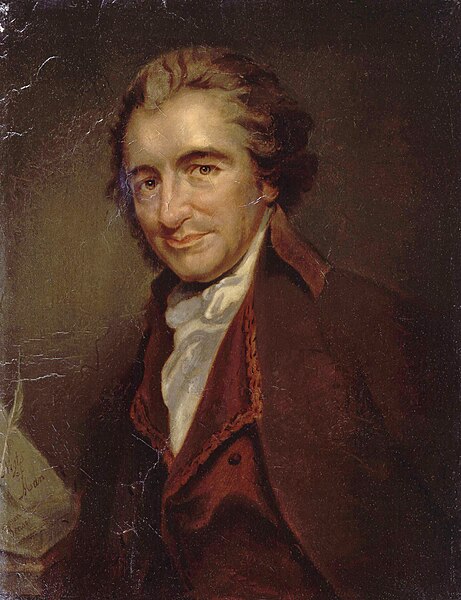
Thomas Paine and the Debunking of Religion

I've been reading Thomas Paine's pamphlet, The Age of Reason, and am struck by how incredibly radical it still seems today.  Sure, times have changed (he wrote it in 1794).  What he would have thought of as "the church" in many contexts would now be more applicable to "megachurches".  But his fundamental debunking of religion, specifically Christianity, is as damning as ever.

A few good quotes:
On the bible as mythology
It is, however, not difficult to account for the credit that was given to the story of Jesus Christ being the Son of God. He was born when the heathen mythology had still some fashion and repute in the world, and that mythology had prepared the people for the belief of such a story. Almost all the extraordinary men that lived under the heathen mythology were reputed to be the sons of some of their gods. It was not a new thing at that time to believe a man to have been celestially begotten; the intercourse of gods with women was then a matter of familiar opinion. Their Jupiter, according to their accounts, had cohabited with hundreds; the story therefore had nothing in it either new, wonderful, or obscene; it was conformable to the opinions that then prevailed among the people called Gentiles, or mythologists, and it was those people only that believed it. The Jews, who had kept strictly to the belief of one God, and no more, and who had always rejected the heathen mythology, never credited the story.
 On the silliness of the creation story:
Why it has been called the Mosaic account of the creation, I am at a loss to conceive. Moses, I believe, was too good a judge of such subjects to put his name to that account. He had been educated among the Egyptians, who were a people as well skilled in science, and particularly in astronomy, as any people of their day; and the silence and caution that Moses observes, in not authenticating the account, is a good negative evidence that he neither told it nor believed it.
 On the misinterpretation of language:
All the remaining parts of the Bible, generally known by the name of the Prophets, are the works of the Jewish poets and itinerant preachers, who mixed poetry, anecdote, and devotion together--and those works still retain the air and style of poetry, though in translation.

There is not, throughout the whole book called the Bible, any word that describes to us what we call a poet, nor any word that describes what we call poetry. The case is, that the word prophet, to which a later times have affixed a new idea, was the Bible word for poet, and the word 'propesytng' meant the art of making poetry. It also meant the art of playing poetry to a tune upon any instrument of music.

We read of prophesying with pipes, tabrets, and horns--of prophesying with harps, with psalteries, with cymbals, and with every other instrument of music then in fashion. Were we now to speak of prophesying with a fiddle, or with a pipe and tabor, the expression would have no meaning, or would appear ridiculous, and to some people contemptuous, because we have changed the meaning of the word.

We are told of Saul being among the prophets, and also that he prophesied; but we are not told what they prophesied, nor what he prophesied. The case is, there was nothing to tell; for these prophets were a company of musicians and poets, and Saul joined in the concert, and this was called prophesying.

It occurred to me as I read how obvious it felt to me when I was young to critique the religion in which I was raised. This was no doubt due in large part to Hinduism and reincarnation being such alien concepts to my social network (although, in Santa Cruz, maybe not so much).  In my early thoughts, as I neared a conclusion that religion and God were human inventions, I came upon such arguments as I was able fashion alone.

Off the top of my head, I try and recall a few:
  • Infinite Regression: If God created the universe, then who created God.  Science faces the same problem.  But science doesn't invent an all-powerful entity.  It simply says we don't know. 
  • Suffering: There's no explanation for it. 
  • Multiplicity: There are so many religions, how could one possibly know which one is correct?  The vast majority of people simply follow that they were born into.
  • Ego: Humans love to invent things.  Our recorded history is nothing if not one big exercise in magical thinking.  This seems much better explained by the limitations of our complicated mind than evidence that one of these ridiculous stories happens to be true.
  • Evidence: There isn't any.

While I won't go as far as to say that religion is necessarily a force for evil in the world, I will say that it is largely stupid and unhealthy.  While many will find it comforting and helpful, and in many cases it is probably better than any practical alternative, it contains inherent procedures of thought that are at best constricting and at worst, deadly and oppressive.  On the whole describing it as in many ways a cancer upon the human race is quite justified.  While it has also been helpful, it is a habit that would be best replaced with a  more reasonable world view and program for living.

Thomas Paine was a deist, likely in the manner of what would later come to be described as pantheism.  I'm not sure yet why he chose to stop there.  Although writing two hundred years ago, he would have far fewer sociological and scientific resources from which to level a critique of the very notion of God itself.  But in his deism he was able to find all the goodness and spirituality he seemed to have needed.  It was in fact from a place of profound moral righteousness that he drew the courage to challenge the religion he thought was a source of evil in the world.

Atheists too often get stuck bickering with the silliness of religionists, instead of staking out new moral ground and claims of righteous humanity.  In the end, it will be this philosophical bedrock upon which future Atheists people will feel comfortable resting.  And what is more, the questions there seem much more interesting and challenging than arguing about whether one or another magical fantasy exists.

Saturday, June 26, 2010

Spirit and Atheism

As an Atheist, one is often forced to grapple with how to define one's experiences in the absence of a preconceived narrative.  So, for instance, what does morality mean without an appeal to religious text or authority?  Often times, the process of becoming atheistic itself created the alternative conceptual language.  For something as vital to daily existence as questions of morality, this was likely the young Atheist's early order of business: in the absence of God, morality must come from human emotion and intellect, and as such any original religious teaching was thus informed; morals are relative to human experience and can only ever be based in it.  This of course is somewhat more complicated than simply appealing to text, saying, "it is true because it is written."  But such mindless dogmatism isn't serious anyway, and true religious thinkers know that interpreting sacred texts presents its own complications.  Atheism, almost by definition (at least by its radical place in today's discourse), demands a degree of non-dogmatic critical thought from the outset.

But there are other experiences that, once removed from a religious narrative, the Atheist struggles to define.   The term "spiritual" presents a special problem.  By definition, it refers to the "spirit", a concept traditionally thought of in metaphysical terms.  This need not imply that no such thing exists.  Many concepts we find useful are descriptions of phenomenon that, while not taking direct physical form, are very real and indirectly observable.  In philosophy, they are organized into different categories.  For instance the concept of action is not a "thing", with physical form, but a description of a series of events that can occur.  I suppose if one really wanted to be specific, all things are merely molecules in motion, and that an action could be thought of in similar terms, of molecular structure operating within a system of  physical forces.  So in the way that a pane of glass is actually a sheet of silica in gradual free-fall, a dance is merely an orchestrated series of motions involving an organized, organic body of molecules.  Where pane of glass implies the actions of gravity, dance implies the set of neural instructions signaling muscular performance.

So what is a spirit?  What is spiritual?

This is a question that perplexes the Atheist because, while the term has a specific meaning in a religious context, it explains a human experience that seems to lose much of its meaning when removed from that narrative.  But it also seems to explain an experience that seems equally universal to human existence.  To the religious, the spirit is everything; indeed without it, man's life would have no purpose.  In the Atheist this question might provoke profound existential angst - if there is no God, there is no spirit, there is no purpose to life.  Sartre hinted at this seeming paradox:

God is absence. God is the solitude of man.
But once God is gone, is man really alone?  If God was only ever a manifestation of human experience, could not human experience simply replace God?  In this sense, God is merely a middle man between man and his quest for meaning.  Man's conscious experience is one of seeing himself as connected, yet apart from the physical universe.  There may be no more essentially human experience than that of grappling with one's place in the universe.  The obvious antidote to this angst throughout history has been the mythology of religious narrative.  Not only a rational explanation for the what and why of existence, it provides a framework upon which to hang all of the intangible feelings as well.

The concept of spirit can be thought of as describing this (categorically immaterial) process.  A somewhat nebulous placeholder concept, like "mind" or "emotion" - it describes a fundamental reality the conscious mind faces.  So while there may not be any such thing a "soul", or "spirit" in the religious sense, there is certainly a human experience that seeks to transcend one's corporeal existence and find a deeper connection to the larger universe.  Implicit in this concept is a basic, ineffable incomprehensibility.  There are obvious limits to conscious understanding.  We encounter experiences in our lives that have real meaning for us, yet we have great difficulty explaining.  Some of them are painful and tragic.  Some of them are profound and beautiful.  And we can adjust, orient our lives in order not only to avoid or to seek out such experiences, but also to understand them better alone or by sharing them with others.

Human culture is replete with activities designed to facilitate this sort of transcendence.   Art, sport, ritual, celebration, ceremony, and of course sex, we create normative pathways in which to access states of consciousness that are otherwise inaccessible.  If we think of spirituality as the degree to which our engagement in these activities facilitates transcendence, especially as a positive-sum progression towards greater knowledge or understanding of self and the universe, no matter how consciously articulated or  synthesized, it seems just as useful in an Atheistic context as in a religious one.


 So does an Atheist have a spirit?  Can an Atheist be spiritual?  To the religious, with faith in a strict dogma in which God is thought of as a very real entity, the answer must be no.  However, my hunch is that to many religious people, this conception of spirituality is entirely sufficient to describe their own relationship with their chosen dogma and teachings.  To this way of understanding, the conceptual meaning of God or spirit is less relevant than the actual human experience of transcendance - intellectual and emotional self-understanding and hyper-corporeal connection to the universe, in whatever traditional or non-traditional form it may take.

Tuesday, May 18, 2010

What is a "Christian Nation"?

 “Go back to what our founders and our founding documents meant — they’re quite clear — that we would create law based on the God of the bible and the ten commandments. What in hell scares people about talking about America’s foundation of faith?  It is that world view that involves some people being afraid of being able to discuss our foundation, being able to discuss God in the public square, that’s the only thing I can attribute it to." - Sara Palin, on the O'Reilly Factor
It's a common, reactionary trope on the right that America is a "Christian Nation".  The defensiveness is in response to a perception that the left, by upholding secular values, is seeking by degree to infringe upon their Christian principles.  So when it is argued, say, that the ten commandments not be hung in a court room, or that we ought not to mention God in national pledges, or favor one or another religion (or even religion at all) in any other way, it is not to preserve everyone's right to spiritual respect, but rather an assault on their specific Judeo-Christian values. 

This position is not just paranoid, but intellectually dishonest. Instead of an attempt to hear the opposition's arguments fairly, a motive of aggression is being assumed where there is none.  We can all agree that the founders were Christians and that they derived much of their constitutional ideas from Judeo-Christian tradition. But that has zero to do with whether any of it is correct. The only reason any of it is still around is that we, as a democracy, have agreed to it. We finally figured out that slavery was wrong and so we changed that. Ditto with women's suffrage, etc.

The intellectually dishonest part is when conservatives play the "Christian Nation" card. Because they aren't saying anything contrary to what I said in the last paragraph - but they mean to. Because by "Christian Nation" they mean a specifically Christian nation, where biblical law has bearing on constitutional law. It's an appeal to theocracy. Yet they can't come right out and say this (at least publicly) because it's so obviously bullshit that they'll never get anywhere politically. So what they do is fiddle around the edges, weaseling in 10 commandments in the courthouse here, "under God" pledges there, all with the implicit intent of establishing the codification of biblical law.

The real question, when any one brings up this "we are a Christian nation" crap, is what does that actually mean? Because the founders were a lot of things that we wouldn't agree with today. That's why we have laws, and this is a democracy. We sort things out through reasoned arguments, not dishonest and hubristic declarations of half-true rhetoric. If you truly want this to be a "Christian Nation" - not a secular nation of Christians, Muslims, Atheists, Jews. etc. united under common law - then you have your work cut out for you.

Friday, March 12, 2010

Beckology

Apparently Glenn Beck has been harping on the entire concept of social justice, specifically as when thought of in religious terms.
"I beg you, look for the words 'social justice' or 'economic justice' on your church web site," Beck urged his audience. "If you find it, run as fast as you can. Social justice and economic justice, they are code words. Now, am I advising people to leave their church? Yes!"

Who better to unify the inherent conflict between Randian Capitalism and Christian humility than Glenn Beck?
This was an excellent examination of the man’s psyche. Part of me hopes he doubles down on his brave mission, if only to reveal a special sickness within the heart of American political evolution. But another part, perhaps the realist, recalls Mencken when reminded to never underestimate the willingness of Americans to cast intellect aside in favor of cheap emotional and spiritual reward.

No less than a Mormon, Becks ascendancy seems to fit perfectly into the tapestry of this country’s historical fascination with social and political providence. From Smith to Hubbard, we seem to churn these folk out with frightening regularity. There is certainly nothing new about demagogues or charismatic figureheads, but the simple geological fact of our location, its resources, and political serendipity seem to conspire to bring out a real fervor among our more adventurous citizens.

The moment is ripe for Beck to really start something big. Of course, there a million reasons why this will never happen. But it has before – and yet with less dangerous consequences.

Thursday, January 14, 2010

The American Vodou of Pat Robertson

By now we've all heard Pat Robertson's comments on Haiti:
"Something happened a long time ago in Haiti and people might not want to talk about it. They were under the heel of the French. Napoleon the Third and whatever. And they got together and swore a pact to the devil. They said, 'We will serve you if you get us free from the prince'. True story. And so the devil said, 'OK, it’s a deal.' They kicked the French out, the Haitians revolted and got themselves free."

Something I've been thinking about these comments is how they might fit into our other social narratives about "terrible things", especially as Pat Robertson is a conservative, and how his perspective draws upon a broader trend in conservative thinking.

One critique of religion is that it arises from a human need for creating meaning out of the unknown. Thus you had early humans basically creating stories for phenomena that they had no system of knowledge to rationally comprehend. By creating reason where there was none, these stories would have been emotionally satisfying.

In the modern world, science has provided a rational structure for natural disasters. We have come to believe in a generally rational world, dependent on natural, not supernatural laws. So mudslides, earthquakes, volcanoes and other natural disasters are the effect of geological forces. There is no need to appeal to any God for a rational explanation of events.

Although in human affairs, the need for rational clarity still seems to be found wanting. People still wonder why men do such terrible things. Even as science has been able to pinpoint neural mechanisms that are responsible for much of brain function and behavior, we still seem wary to apply the same sort of mechanistic understanding to human action as we do to the rest of the world. When a tidal wave strikes an island, or a mountain lion attacks, we do not call them "evil". Yet this somewhat magical word is invoked frequently whenever an action is committed which we find ourselves asking "how could someone do such a thing?!"

In truth, we have no where near the theoretical sophistication in our conceptual framework of the mind that we do of natural events. So it is understandable that we still appeal to metaphysics for a rational explanation. But how rational is the term "evil"? There is a certain logic to explaining a flood by describing the anger of the Gods. Angry people do mean things. Yet to the modern mind this explanation is preposterous, in that, aside from the fact that it ignores material laws of nature, it assumes the possibility that there are magical creatures in the heavens with powers over the natural world. To the extent that we do not know precisely all the mechanism at work behind a flood - the exact way clouds form, or maybe the saturation of certain rock layers, the function of gravity, etc., we certainly know enough to be reasonably satisfied that a scientific explanation is sufficient. And when such events have devastating consequences, it this rational understanding that gives us comfort. Where in the past comfort was had in the form of appeals to magical stories for rational satisfaction, we now take comfort in the rationality of scientific laws. The story may be different, but the emotional effect is the same.

And now let's return to Pat Robertson. I would argue that his quest for a religious narrative is hindering his ability to to find solace. If a tree fell in a rainstorm and crushed your house, you would certainly be upset, but because of your modern rational understanding of science, you are able to take comfort in knowing that the world operates according to certain laws. And you just happened to be unlucky. You would experience loss, yet it would likely not occur to you to become angry and resentful of the tree that fell (it was not, of course, the tree, it was the wind, which came from the storm, which came from the heat and the cold and the water, etc.).

Yet if your house was burned down by a man with a can of gasoline, you would experience not only loss but profound anger toward the man who did it. You would likely want revenge - at least in form of justice, to see the man locked up in prison. Who would do such a thing?! There would be no clear chain of causality. You would be filled with unresolved questions - and then the sense of hopelessness at your inability to find answers. There is a good chance that asking the arsonist himself may not provide relief - as he may not even know (how many of us truly know why we do what we do?

A more simplistic illustration of this difference in emotional response is well illustrated by the sensation one has had in accidentally stubbing a toe on a piece of furniture. The anger and pain one immediately feels is only matched by the sense embarrassment after taking "revenge" on the thoughtless table leg by kicking it. The human mind can be truly idiotic.

Pat Robertson, instead of chalking up the tragedy of the Haitian earthquake to the rationality of perfectly knowable geological forces, is rationally compelled by his own fundamentalist Christian narrative to invoke the magical powers of the devil to explain the events. One must wonder whether he is introducing an added level of personal anguish. Remember, in the context of his comments, he was highlighting the historical nature of Haitian poverty - something much less explainable than fault-line earthquakes. While there are certainly many broadly agreed-upon narratives as to why Haiti has suffered such tremendous poverty, the specifics begin to become less clear as you delve in the the assorted political perspectives. At the most basic level, there will have been individuals who through their actions were responsible for events leading to the present economic conditions. There is a lot of human failure at work. And attached to this human failure is a sense of incomprehension. By invoking the devil, Robertson was seeking a rational answer not only to the earthquake, but also to Haiti's troubled past.

A principle belief of conservatism is in the free will of man, and therefore a high tolerance for both social inequality and retributive justice. If man is perfectly free to make his own choices, then he should suffer the consequences of his actions. Yet implicit in this philosophical assumption is the problem of causality. If man is perfectly free to act, then discovering why he does what he does becomes impossible: causality ends at his moment of action. Whereas in nature you can follow a clear line backwards through the infinite chain of causal connections, man is thought of as somehow arriving at his actions a blank slate. If man is successful it is because he and he alone achieved it. Social inequality is a simple matter of action versus inaction. If man does wrong it is because he and he alone did it. Retribution is a simple matter of following through on deterrence.

Yet because this philosophical narrative is implicitly uncertain, if man is "free" to act and thus the originator of causality, why he did what he did is unknowable - except through asking him, by nature an unreliable witness. Thus we have born the concept of "evil". What better way to define the difference between why a man does ill and why a tree does ill? The man is the magical originator of action, while the tree is simply the last domino to fall. And so while we can stand before the ruins of our tree-crushed house and feel no anger towards it, we feel compelled to lash out at the criminal.

Our level of emotional pain is in direct correlation to the uncertainty of causal clarity. And yet the philosophical assumption of free agency, a core assumption of conservatism, has this capacity for emotional anguish built in. As a liberal, while I may feel the impulse to react violently toward one who has done me wrong, I know that there - somewhere - is a perfectly good reason for why they did what they did. In a biological and cultural sense, they are no different than a tree in a rainstorm.

Maybe I am fooling myself. Maybe “evil” does exist, perhaps in some intra-dimensional plane accessible only to the powers of human cognition. But then again – would that not imply some manifestation of causality? Alas, scientific materialism is a tautological construct, in that truth must be truth. In the meantime I’m always thankful when I am able to console myself with the reminder, in the worst of times, that there is indeed a “reason for everything”. A scientific one, mind you, and one that includes my fellow man.

Sunday, January 10, 2010

Darwin & Meaning

Ross Doubthat wonders what all the fuss is about Darwin's bicentennial last year. I'm not sure what his own worldviews may be, but his tone seems generally dismissive of the degree of jubilation surrounding the occasion. For him, today's Darwinism is

"at once an unchallenged scientific paradigm and a wildly contentious theory of everything; a Church militant warring against creationists and fundamentalists and a debating society of squabbling professors; a touchstone for the literary intelligentsia and a source of secularist kitsch."


As a conservative, one wonders whether Doubthat isn't simply miffed that Darwinism has always been a nasty thorn in the side of the anthropocentric religiosity that buttresses his philosophy.

Personally, I find Darwin's synthesis of evolutionary theories profoundly spiritual, something I have difficulty finding elsewhere. Where in the past spirituality took for granted that the world was unknowable, modern man doesn't have this luxury.

Traditional forms thus seem like narcissistic self-involvement, or fantastical religious dogma. If the answer to the question "What is the meaning of life?" is "To continue asking the question", then Darwin has opened for a us a profound insight into not only where that road leads, but from where it comes.
(img: The 'Evolution' of Darwin - Peter Bond)

Friday, October 23, 2009

The New Atheism Pitchforks


Occasionally there is heard from certain New Atheist quarters a good deal of vitriol against all forms of religion. It is one I fully understand - ever since I first heard Sam Harris on book TV a number of years back, boldly calling for an unflinching response to the sheer absurdity of religion and asking why we are always asked to approach it with kid gloves.

And soon after we began hearing about the New Atheists and their supposedly radical agenda. Although whatever that agenda was was a matter of debate. To some, it simply meant "coming out" and actually openly declaring themselves atheist, or dropping the agnostic moniker that has served as a sort of spiritual cover - a sort of peace offering to bridge the gap between the absurd and the agnosticist "possibility of the absurd".

And others began to go further. Instead of simply adopting a principled, yet passive posture, they went on the attack. They sought to actively promote their Atheism to the blindly religious masses. The famous books were written making the case that, while quite difficult to offer proof that God does not exist, there is actually ample evidence that he is an entirely human construct, and what's more a contradictory and illogical drawn one at that. Articles were written engaging the New Atheists in dialogue. Movies were made. Billboards erected.

I cheered them on. I still do. I admit I had always felt a need to hide my atheism. The history of oppression and social ostracism is real and powerful. But as science has steadily built up a vast body of data and theory on what people are and why we do what we do, people are more and more becoming skeptical of religion and its increasing anachronism.

But there was also a sort of self-righteousness that irritated me. It seemed like the old human game was being played where people feel like they need to take sides and form teams. This has long been a part of any social struggle - regardless of its legitimacy. There's an aspect of strategy and tactics to it: strength in numbers, hold the line, surround the enemy, put them on their heels, distract them.

This can all be very effective. But it draws its strength from a deeper human emotion and can end up bypassing reason. Part of its strength lies in just this fact. When reason and reflection come into the equation they can dampen that raw emotional energy and cause people to question whether they ought to keep up the fight. This is what demagogues have always exploited. Pitchforks don't pump as vociferously through calm rationalism as they do through certainty and allegiance to the cause. And of course we all know what happens when arguments lose reason.

A powerful idea emerged from the New Atheism that, while maybe not originating through emotion, has certainly been weakened by it - effective as it has been as a sort of dark magnet for the cause. This is the idea that religion is not just a negative force, but dangerous. So dangerous in fact that it presents an urgent threat to modern civilization. I think this was triumphantly illustrated by Bill Maher's Religulous, when near the closing credits images flashed across the screen of religious zealotry and violence while a rousing score blasted (was it Wagner?), tied together in a modern propagandist display of fearmongering. This was the bypassing of reason at its most forceful.

I personally don't buy it. Sure, I think religion, combined with desperation and ignorance that leads to fundamentalism, can do horrific things. I also thing it is, on its face, stupid. It encourages magical thinking, when thinking should be anything but. It codifies oppression and degradation. It sews division and dischord.

But it is also incredibly human. That is, evidenced by its near universal adoption throughout human history, it seems to come directly out of the way our brain is wired for consciousness and processing of external stimulus. One must begin then to tease out what religion is. In one sense it is a very rational set of rules and beliefs that have their own internal logical structure. But in another it is a purely sensory and irrational experience that allows one to quiet the mind and exist in a state removed from the confines of ordered consciousness.

Religion is both of these things. One exists to serve the other. What are different religions but different ways of organizing how one might tap into that "spiritual" state of unconsciousness. These are all accomplished in degrees. At one end you might have a simple and short re-framing of a conscious experience by appealing to a magical thought, i.e. "That bastard just stole my parking spot. Sweet Jesus have mercy on his soul."

Now, this example could highlight two very different responses to the same event, with two very different conscious outcomes. The driver, obviously angered by being wronged, appeals to her religion to salve the wound. Instead of allowing the complex to linger, continuing to affecting her conscious state, she does a sort of jedi-mind trick on herself, in the form of obedience to religious teaching, and she moves on.

But two people could perform the same ritual with two very different outcomes, based largely on interpretation owing to emotional and cultural development. Person A might curse and make the same "prayer", and self-comfort with the notion that "we are all God's children" and that "they know not what they do". Situation explained, cognitive dissonance resolved. Persona B might also self-comfort, but instead with the notion "they will burn in hell because they are sinners". Situation explained, cognitive dissonance resolved.

Both appealed to the same religion, but different versions of the dogma. One could be said to have left with kindness, while the other with anger and hostility. While a simple parking-lot annoyance is quite trivial, at the other end of the spectrum we have serious matters such as war and conflict. Yet one could also make the case that for every warmongering Osama Bin laden, or George Bush, there are those who identify with the religious traditions highlighting pacifism and diplomacy. For every Palestinian suicide bomber or Jewish settler, there are aid groups in Africa or soup kitchens downtown.

Ayan Hirsi Ali, no doubt owing to her personally horrific religious experience, finds many examples of ways in which the Koran explicitly lays out suggestions that only require a simple interpretation to lead believers to commit heinous acts. This may indeed be true. But while religious texts may be dangerous, and magical thinking may lead to conflict, it also has the power for much good. In many cases, religion may be the one thing that is keeping more harm from coming.

Now, the bad may certainly outweigh the good, and thus as a philosophical position is principled. But the reality is that we just aren't anywhere close to the eradication of religion. We live in a world in which religion is tied up in ethnicity, and cultural tradition is tied up in a complex web of reason and spirituality that does good and harm simultaneously.

This is why I find the argument that some in the New Atheist movement make, that religion is urgently dangerous and needs to be cast completely out of society, both false and impractical. It is certainly sometimes dangerous, but also often very helpful, and in any event deeply tied into cultural and ethnic patterns of thought that aren't easily separable. For this reason it just isn't practical to rid society of religion, even if the threat it posed warranted such hostility.

Religion has been compared to other social ills, such as racism, or unjust political movements. But this is reductionist nonsense. Sure, there are specific tenets of specific religious dogma that one can certainly call unjust
and wrong, and intolerable (homophobia being a prime example). But to cast a net over the entirety of religious thought is reaching a bit.

People will always be ignorant and small-minded, with or without religion. They will really on logical fallacies in their thought, they will ignore complexity for easy answers. Religion can certainly contribute to this behavior. But it can also offer people a way to transcend it, or at least the complexities of consciousness that would encourage it.

And so in this way I think it should be given respect. At the very least as a part of one's cultural behavior that they should not be made to feel ashamed of having accepted. By doing so we are not tolerating any specific ideas or practices that are unjust or directly cause harm. We are tolerating the right of each individual to find their own way in peace.