Showing posts with label politics. Show all posts

Friday, October 6, 2017

The Noble Savages Across the Tracks

The Death of General Wolfe,
Benjamin West,1770
The iconoclastic Thomas Chatterton Williams goes after Ta-nehesi coates in today's NY Times.  His main beef is the racial essentialism he feels Coates embraces, and which mirrors that of explicit racists.

This, more than anything, is what is so unsettling about Mr. Coates’s recent writing and the tenor of the leftist “woke” discourse he epitomizes. Though it is not at all morally equivalent, it is nonetheless in sync with the toxic premises of white supremacism. Both sides eagerly reduce people to abstract color categories, all the while feeding off of and legitimizing each other, while those of us searching for gray areas and common ground get devoured twice.

My beef with Coates has always been something else.  He's a great writer.  There is a lyricism in his words, and a brash, unapologetic embrace of colloquial manners, albeit never sacrificed for imprecision.  But his passion and craft are hamstrung by a lack of nuance in the larger project of deconstructing the system he rails against.  

Much of the heft of his words lazily harkens back to civil-rights era tropes that just don't fit the times.  Racism is alive and well today, but it is of a much different sort.  Whereas before, the question of racial equality was actually on the table, and people took explicit positions against it.  This isn't true today.  Right wing leaders publicly praise Martin Luther King.  They talk about "not seeing color", and in a belief that everyone should live together as equals.

So what to make of the present, then, when inequality obviously persists, and white people behave in ways in which they seem to value minorities less?  

For black liberals like Coates, the easy answer is racism.  White people are discriminating against blacks in employment, in school, in policing.  Sure, blacks may be misbehaving more often that whites - but this is because of how racist whites are.

The problem with this critique is that it is superficial and naive.  It skips over the deeper questions about how our social and economic system is organized in ways that limit historically marginalized groups' access to and development of societal capital.  Instead, it chooses to focus in on explicit acts of white racism, as if once white people stopped acting racist, that the problems of the black community would be solved.  If only whites became more "woke" and no longer engaged in microaggressions like assuming light-skinned people are white, or wanting to touch black hair.  Or supposed macroaggressions such as moving into black neighborhoods.  Or moving to neighborhoods where the schools are "good" (read: non-minority).

The focus is always on the personal, the individual - the conscious-raising.  But as much as microaggressions are certainly real, and workplace discrimination, teacher prejudice and police brutality exist, they are not the cause of black disadvantage.  They are ugly, obvious issues.  But they aren't close to the source of the problem.

In white liberals' prostration before Coates, there is something of a Noble Savage act. Our deep guilt and uncomfortableness drive us to embrace a ritualistic display, in which, by allying ourselves with a black authority, we no longer have to be uncomfortable or guilty.
Instead of seeing native peoples as complex - even flawed at times, white anthropology sought to absolve itself from dealing with the foreign other on equal terms. It was an overcorrection, a way to make-believe that cultural understanding could happen in a sort of historical and value-free vacuum.
So too with the black "other". My hunch is that minority critics of the Coates variety find themselves torn between enjoying the attention that their broadsides against "White Supremacy", "Intersectionality" and "Privilege" enjoy among white liberals, and the suspicion that their critiques aren't actually understood all that well - that their harsh speaking of truths is a sort of Kabuki that whites are attending as a form of cheap penance that absolves quickly rather than requiring an advanced interrogation of both sides.
I've always felt that this style of white guilt is dangerous, as a vapid understanding ultimately hurts those who would benefit most from a true discourse. Poor minorities who suffer the actual disadvantage in all this become mere shadow puppets in a theater of faux-deconstruction. All the while, the actual gears of oppression churn on. 

While personal identity politics is interesting, and important, it too often gets in the way of a larger discussion about a system which depends on and reinforces disadvantage.  Solving that problem may in fact raise many more uncomfortable questions about privilege, and how we may need to radically alter some of our social structures going forward so that we can finally end disadvantage once and for all.

Sunday, July 9, 2017

The Flat Earth Society and the Art of Conversation

I came across this very strange article today on a meeting of a Flat Earth Society in Fort Collins, CO.

The Fort Collins group — mostly white and mostly male, college-age to septuagenarian — touts itself as the first community of Flat Earthers in the United States. Sister groups have since spawned in Boston, New York, Houston, Philadelphia, Phoenix and Chicago.
Before I knew it I was watching one of their youtube videos. I'll just leave out the substance of their bizarre belief for now. Something else piqued my interest. The video was - as one might imagine - very conscious of the fact that what was being said sounded crazy. And so special attention was given to the notion of civil discourse. You can only imagine how much ridicule these people must face.

“Believe me, there’s only humiliation in this. We do it because we believe it.”

But this stood out to me as a very good point.

I find the notion of a flat Earth ridiculous and disturbing on many levels. But there is no reason I can't also be respectful and kind to people I disagree with. We can never be reminded enough to lead with love. If I've learned anything in the last decade or so of the internet age, it is that changing people's minds is nearly impossible, and that nothing good ever comes from being disrespectful or ungracious.

I've come to be very hesitant in engaging in argument online because I only seem to be the worse for it. When someone types something I find insulting or needlessly offensive towards me or my ideas, my emotions rise. I can either choose to respond, hopefully alleviating the discomfort by delivering a well-placed rejoinder. What sort of relief, I'm not sure. Maybe it is that my words will stand as a corrective, showing the individual and the world that they were wrong and I was right - worthy, respectable, smart, etc. after all. My identity, my pride, was restored. However, this is rarely the case.

The conversation - limited in expression by the nature of the online, text-based format - more often becomes even more heated. My sense of offense increases. And of course, during the time in which I have typed my reply and the response appears (sometimes, minutes, sometimes hours, sometimes days) my discomfort lingers. It gnaws at me. I'm personally offended. I'm offended for my fellow thinkers. I'm offended for the world. This feeling is the product of what people often describe on the internet as toxic.

So what is really the point, then? What are we doing, hammering away at our keyboards?

The New York Times has a great feature in its comments section. You are able to sort the comments into "readers' picks", or "Times Picks". The former distinguished by number of upvotes a comment receives, the latter by having been chosen as interesting by Times staff. I find myself often times spending as much time exploring the comments as the piece itself. The comments give a quick-take on what average readers think of the subject - what stood out to them, what they agree or disagree with. They sometimes share an anecdote that confirms a perspective in the piece. Or they might add a perspective that was missing. The number of votes a comment receives telegraphs how much the point resonates with the public. There is a reply feature, however the design of the comments doesn't really provide for any real back-and forth.  

And I'm fine with that.  There is a special kind of person that enjoys internet bickering.  In theory, the formation of thoughts, the civil exchange and mutual quest for knowledge is a good thing.  But it is so rare.  The anonymity of the internet, even just the constrained nature of the written word, makes friendly, compassionate dialogue difficult.  Tone is lost.  Nuanced inflection is gone.  Uptilted, winking, eyes-rolled, wincing, knowing smirks - all of the saucy, spicy bits in human communication are lost.  In the real world (the "meat world", I've recently heard it put, which I think is brilliant), this is all quickly and deftly added to language as spoken.  Great writers can capture this spirit, but only with difficulty and great labor.  Children learn it before they learn to speak.

So, hamfisted internet commentariate, let that be a thought for thee: no matter the brilliance and depth of your thought, before you click "submit" on that comment, remember that even a 2 year old likely has you beat in nuance of delivery.  Something even a Flat-Earther can teach us.


Saturday, July 16, 2016

Notes from the Fever Machine

I liked the article at first. The attention grabbing Vox lede "Bernie Sanders is right the economy is rigged. He’s dead wrong about why" suggested a dose of reality to the naive succor of a populist rhetoric built on falsehood.  Bernie and the Koch brothers agree on the rigging - Bernie says it's plutocratic electoral influence over elections (the article helpfully offers a video in which Bernie explains it for himself), the Koch's say it's regulatory capture.  Instead, it's something more complex.  I love complexity.  Quick, post to facebook!

Wait a second... instead of debunking both as I would have hoped, the article generally ended up agreeing with the libertarian emphasis.  After debunking the notion that the system is dependent on corruption of money in politics, in which the rich rig the system for themselves (as many rich actually support Democratic policy; evidence of the marginal futility of political contributions can be found in the millions wasted on establishment Republicans - folks the evil Kochs and diabolical Carl Rove personally favored).  Rather, the article laid out a straightforward case in which regulations at all levels are designed by special interests that end up favoring the petite (and grand) bourgeois in their economic dominance.  OK, I'll buy it as far as it goes.  But is campaign finance the Bernie-left has in mind when it complains about the system being rigged?  Is this the extent of the rigging going on?  If we were to get rid of these regulations, would wealth inequality disappear, or at least severely fade, the immoral rigging having been cut?  Uh...

Rats!  Things have gotten confusing.  

Fever swamps annoy me, whether it's right wing talk radio or left wing chai-tea fueled paranoia. They are defined by simple answers to complex questions, which require you to indulge paranoia and ad hominem - the toxic stew that defines the fever swamp.  The real problem with this type of thinking is that it distracts from the *actual* function of what is going on, which could lead to real solutions.  However, that is only a primary effect.

The secondary effect is the response.  Like good participants in political discourse, we bravely meet flawed ideas with demolishing counterattacks.  Go Vox!  But a good argument against a flawed argument doesn't actually get us anywhere, we merely tread water.  If I spend an hour convincing someone that taking the exit that goes off the cliff is a bad idea, I may have saved us from imminent death, but I haven't actually provided any insight into where we should be driving.

OK, so the system isn't dependent on a rigged system of political influence.  But i
s this what is meant by "rigged" to Bernie supporters?  Campaign finance is part of it, but I would argue a far larger interpretation of the term is that the system is "rigged" so that the more capital you have, the easier it is to get and hold on to capital.  This process is incredibly complex and generally baked in to our economic system.  It is much easier to sell people on a simple, paranoid concept of manipulation, rather than a deeper philosophical argument that attacks notions of property rights. 

---

There is a tension at the foundation of politics in a democracy: what is good policy versus what is politically possible.  You can have the best policy in the world, but it is worthless without the former, which is built on the fact that actual voters need to vote and/or elect representatives who will vote their interest.  This requires good old fashioned compromise and persuasion.  A good democracy is designed to be slow and deliberative, in order to protect this process.  In a small car with only a few passengers, an argument over which exit to take can be accomplished relatively simply and quickly.  However, in a nation of millions, there are a lot of perspectives to consider.  It can't be quick.  It can't be simple.

But, alas, simple is so much easier.  The world is complicated enough.  Simple is also more satisfying.  It fits on a bumpersticker.  It fits in a sentence.  

How much talking is going on?  How much listening?  How much thinking?  What do people discuss?  

Friendships.  Family.  Children.  Sports.  Material items.  God, the material items!  Have you ever found yourself in a conversation which felt as if it was ripped from a commercial?  I personally have no desire to engage in such discussion for more than a minute.  But apparently many people are.  He did this.  She did that.  I just bought this.  Oh, did you do that to?  I'm going to do this.  I just love that.  Are you going to eat this?  I just ate that.

Do I sound like a moral scold?  I don't mean to be.  Morality implies obligation.  I could be mistaking that people are obligated to not engage in such discussion and instead talk about deeper things.  I don't think they are.  It is just that I personally find them dull, and am much more interested in deeper discussions - explorations of metaphysical concepts and meanings that transcend specific times and space and make broader connections.  I like to think critically.  I like to think about why I am thinking.

But so what?  I think this sort of thinking is more useful in some ways.  It is useful in better understanding the world.  It useful in better understanding yourself.  It is also enjoyable to me.  I find its new colors and emotions captivating.  I like the way one idea washes against another, merging and bending, or sometimes crashing into bits.  I value being someone who is wise, whose waters can mix and swirl through the world with integrity and clarity.

But I also have problems.  I can be hot-headed.  I can be selfish or arrogant.  I can focus on the weaknesses of others to the exclusion of their strengths.  I can forget to communicate my appreciation for them.  Yet none of these things are exclusive of an existence that emphasizes the profane, or of one that emphasizes the metaphysical.  I can have all of those problems and refrain from a discussion of simple things.  Likewise, one who discusses little more than simple things, who thinks little more than simple thoughts, can be cool-headed, self-less, humble, compassionate and appreciative.  

And yet, we live in a complicated world, with complicated problems that require complicated solutions.  Deep metaphysical thought is requisite for an adequate response.  What then to do, if you are one who spends 99% of their day thinking of flowers, footballs and foibles, and only 1% pondering the differences between atheism and deism, capitalism and socialism, civil rights, climate change, criminal justice or tax policy?  

And you vote.

---

But does political engagement require deep, complex metaphysical thought?  When I think of all the simplistic political sloganeering out there, and those repeating it, I think of large numbers of people who are actually incredibly politically engaged.  They are all over the internet, spouting all kinds of ridiculously simplistic political ideas.  They are listening to a lot of talk radio.  They are watching political news programs.  They are attending campaign and protest rallies.  But they are not necessarily thinking deeply about anything.  Rather, they are passionate.  They are convinced of the glory of their cause.  They are morally indignant.  They are righteous and they are enthusiastic.  And they are as likely to be correct as incorrect: Hillary Clinton and Donald Trump are neck and neck in the polls.  

So to the list of simple things - flowers, food, footballs and foibles, we can add politics.  But this kind of politics is not grand analysis, self-reflective or policy oriented.  It is personal, tribal, reactive, and identity driven.  It is about rooting for your side and booing the other.  It is a sort of high-stakes game in which the consequences aren't merely winning or losing, but about the fabric of life as you know it.  Yet this is a perilous perch from which to root.  Imagine attending a football game in which the winning team got to pick a supreme court justice that would define your basic rights or pass laws that dictated the balance of your bank account  Passions would indeed brighten.  Identity would take on a severity of consequence.  The other team is not merely supporting an arbitrary event, but through their votes become an active force in your life poised to threaten everything you hold dear.  

---

We can't all be experts.  We can't all be deep thinkers who revel in metaphysical complexity for personal enjoyment.  In fact most of us are not.  Most of us are are simple people with humble interests.  Yet we are asked, again and again, to pretend to not be so.  We are asked to have opinions on a nearly endless list of complicated issues.  Today, more than ever before, we are inundated with controversy staring at us from our morning screen, with comment fields literally asking us to chime in - tweeting, liking, commenting, sharing.  And with every tap and click, we are contributing a bit of ourselves, our identity, to the fever machine.   This is citizen democracy, is it not.  Call your congressman! Write him a letter!  Don't have time.  OK, just click this link.

Because what would happen if we didn't?  What if we didn't click or like or tweet?  The other side will win, of course!  Our identity will have diminished.  There, that devilish picture of Donald Trump goads us into mocking his trickery.  That evil stare of Hillary Clinton plotting another Benghazi, reminds us to loosen our guns.  

Complexity takes too long.  It requires thinking, which can be hard.  It requires ignoring your reactive self, and pausing to listen.  It requires placing bookmarks on your assumptions and indulging hypothetic situations in which what you thought was correct might not have been.  It requires putting your identity to the side and instead of attacking a caricature of your opponent, instead stepping into his shoes and trying to view things from his perspective.  It requires beginning from a place of trust and compassion, not suspicion and anger.  

It isn't as quick.  It doesn't provide immediate gratification.  It might not reinforce a comfortable identity.  It might be scary or leave you feeling silly.  But it will bring peace.  It will create better policy.  It will create a more lasting civil society.  It will allow the time and space for good ideas to bloom and make it into the sunlight of acceptance.  But first the fever must clear.


Sunday, October 21, 2012

Unicorn Politics

Virgin and Unicorn, Domenichino (1605)
One of the fundamental disagreements in politics today is over the degree to which society can afford to spend tax dollars on social goods.  In some areas, such as welfare or food stamps, it is argued that the spending itself is counter-productive because it promotes negative behavior; it promotes dependency instead of forcing people to create their own productivity.

But in most areas, government spending isn't argued to be promoting bad behavior.  Instead, it is simply argued to be a luxury we cannot afford.  Things like bridges (such as the project New Jersey Governor Chris Christie famously axed "because we can't afford it"), schools, libraries, parks, police, firefighters, social security or medicare are all forms of government spending that nearly everyone supports.  Yet while they are valued, it is argued that they must be limited because we cannot afford them.  As Mitt Romney famously said, "I love Big Bird... but I don't want to borrow from China to pay for him".

So, is our fate then, according to those with this view, to live in a chronically underfunded state, with over-crowded classrooms, dilapidated libraries and parks, inadequate roads and bridges, clogged courts, and thinly stretched police forces, and denial of health care and social security to millions of seniors?

Here's where we get into the realm of unicorn politics.  Depending on which brilliant economist you ask, the government can either afford these things or it cannot.  Some will say that, like many Western countries, we can have all of these things through better regulations and higher taxes.  Others will say that more regulations and higher taxes will only inhibit growth, reducing the tax base even further and limiting our ability to spend.  The details are enormously complex, and it is nearly impossible for a layperson to realistically discriminate between the competing perspectives.  "Common sense" is irrelevant to such complexity.

So what do we do?  We have faith in our own intuitions.  We all have basic moral instincts about the role of government and social justice, what is fair.  For instance, if you tend to feel that one's income and net-worth is an accurate expression of his real worth - how hard he has worked and what he thus justly deserves - then you are more likely to feel that asking him to pay more of his money in taxes for the good of the rest of society is unfair and immoral.  If you feel that his income and net-worth have been determined not only by his hard work but by larger social forces that have enabled him to attain more wealth at the expense of others, then you are more likely to feel that he ought to pay a higher tax rate back to the society in which has privileged him so.

Unpacking the mechanics of these two very different assessments is complicated.  Serious economic and sociological arguments can be made to support either, but much of it seems to be intuition about one's fellow man.  Asking someone why they are a liberal or a conservative rather than vice-versa, is akin to asking a Catholic why they are not a Protestant, or for that matter a Muslim or Hindu.

To what extent do we simply have intuitions about what is fair, and then find post hoc rationalizations to make them fit into something that feels reasonable?  Sure, I can (and regularly do, on this blog) make a compelling case for why my perspective is based more on reality than on mythology.  But to what extent is the unicorn grazing beside my eloquence?


Saturday, October 13, 2012

Letting the Light In

According to Wikipedia, the psychological phenomenon known as confirmation bias works thusly:
[it] is a tendency of people to favor information that confirms their beliefs or hypotheses. People display this bias when they gather or remember information selectively, or when they interpret it in a biased way. The effect is stronger for emotionally charged issues and for deeply entrenched beliefs. For example, in reading about gun control, people usually prefer sources that affirm their existing attitudes. They also tend to interpret ambiguous evidence as supporting their existing position. Biased search, interpretation and memory have been invoked to explain attitude polarization (when a disagreement becomes more extreme even though the different parties are exposed to the same evidence), belief perseverance (when beliefs persist after the evidence for them is shown to be false), the irrational primacy effect (a greater reliance on information encountered early in a series) and illusory correlation (when people falsely perceive an association between two events or situations).
We see this both on the left and right, as especially partisan liberals and conservatives often seem immune to facts.  The stories they tell, their ideological narratives seem both lacking in nuance and introspection.  In the Bush administration, the president was evil incarnate, a racist xenophobe intent on establishing a Born-Again Christian Caliphate.  Today, the president is a Socialist Muslim.  In both cases, policy objections are based on legitimate political and social philosophies.  Yet these deeper convictions become buried in unserious, often outright untrue and tribal attacks.

So, where does this come from?  It seems to be a cognitive style, and one that can be consciously guarded against.  If my view on an issue is quite strong, confirmation bias theory would predict that I would be more accepting of facts that seem to support it, and less accepting of facts that seem to contradict it.  Positive facts will reinforce my pre-existing narrative, as I will remember and incorporate them into my story.  Negative facts, on the other hand, will be more likely to be dismissed and forgotten. 

No one wants to be biased.  They want to be thinking clearly, bravely adjusting their beliefs according to evidence and reality, not illusion.  Yet given the universal nature of biased thought, and its terribly insidious nature, we must all admit that it is an unavoidable part of being a thinking human.  Because of its unconscious nature, unless we are actively setting ourselves on guard against it, recognizing its patterns in our own cognitive habits, its work will go unnoticed.  Daniel Kahneman talks about fast and slow thinking, in which most of our thought - conscious as though it appears to be at first glance - is actually being prepared in a largely unconscious manner, cooked up in the hidden kitchens of our primal brain, our conscious perception of it only served up as a final product at the last second.  Studies have shown that these pre-conscious, pre-formed thoughts actually begin their creation up to multiple minutes before they reach consciousness.  Yet our awareness of them feels instantaneous. 

One of the remarkable feats of he human mind is its ability to simulate multiple orders of consciousness.  Not only can we self-reflect on our own person-hood, we can imagine in others a model of person-hood.  We can assume, for instance, that if a piece of sweets tastes good to us, another person would also find it delicious.  We can then take this further, and imagine that another person has the same capacity, and imagine in them an ability to anticipate the response of a third party.  In his book, Unconscious, Leonard Mlodinov describes how writers often do an amazing set of mental gymnastics in not only imagining their reader's perspective, but imagining their reader's imagining of the story's narrator's perspective, and in turn of the perspective of the characters in the book.  Quite a hall of mirrors.

This capacity for imagining the other, maybe loosely described as empathy, is generally a highly-valued human trait, begetting wisdom and fostering trust and authority.  What more do we often desire in others than their ability to understand, to "get" us? 

And it is difficult.  As similar as most humans are, our different cultures foster different experiences.  Our different personalities and temperaments find us emerging as often quite dissimilar.  This can make empathy hard to develop.  Imagining second, third and fourth order personhood is often utterly impossible.  If we cannot understand another, to get into his mind and imagine life from behind his eyes, how can we imagine how he might imagine what lies behind our own?  How strange we must seem to him?  How might the extrovert imagine the world of an introvert, and how might the extrovert imagine an introvert might perceive him?

In learning theory, new thoughts, ideas and facts are more likely to be retained if they are placed within context of one's prior knowledge.  New information is more readily incorporated into old if there is a context within which new connections can be made. If one is unable to develop even second order empathy with sufficient accuracy with another, how is one to incorporate their ideas into their own? 

If every one was the same, it would be rather easy to accomplish this task.  This explains why we so enjoy hanging around people who are similar to us, who see things the way we do.  All we have to do is imagine what we would think if we were them, and - presto! - we get a fairly accurate idea of what they might be thinking.  When we meet someone of sufficiently different personality, culture or temperament, our capacity for empathy is suddenly lost.  Climbing into the space behind their eyes, it is as if we are climbing into the abyss.  Their words come at us as if from the darkness, attached to nothing we can relate to in our own experience.

Politics is the process of sharing power.  When we engage in political thought we are not only developing our own responses to how we want to shape society, but at the same time developing our response to the desire of others to shape society as they see fit.  If we believe that truth and facts are essential to shaping a society that is good, fair and just, then we must seek the most honest accounting possible of whence our ideas come.  Because we have no alternative but to rely on second, third, etc. imaginings of person-hood, we must endeavor to develop empathy with constant vigilance.

Unfortunately, this process is not only difficult when attempted with conscious purpose, it is hard to remember to attempt in the first place.  Therefore we must develop it as a cognitive habit.  In order to truly see the world as others see it, our minds must be as open as possible.

A number of obstacles stand in the way of developing an empathetic imagination.  As we saw earlier, confirmation bias makes empathy difficult from the outset, keeping us from being open to new ideas.  The more rigid we are, the more prone to reinforcement of preconceptions, even if the preconceptions are wrong.  If we surround ourselves only with those who think like us, we may feel more comfortable emotionally, and feel less taxed by the process of having to constantly negotiate unfamiliar personhoods.  Engaging with those who have very different and contradictory sets of values and beliefs can often leave one feeling numerous negative emotions such as frustration, confusion, anger and even sadness.

So it makes sense for us to choose to spend our time with those with whom we feel a kinship.  Yet what then to do when we are faced with political thought that has direct bearing on the society we all share?  If we cannot bear to actually be friends with others who see the world so differently, how are we ever to understand them well enough to experience their truth?

I think much of the answer lies in developing a cognitive style that is able to both and give and to receive political thought that is purposefully open-minded and attune to natural proclivities towards bias, not just in others but in ourselves.  We must in a sense develop our own second-order person-hood that resides within ourselves and exists in constant dialogue with new thought.  Much like an objective moderator of a debate, this "person" acts as an impartial arbiter of truth not by pronouncing on the accuracy of a given thought, but rather as a referee who's job it is to be on the look out for bias and other forms of mental laziness.

In order to develop such a cognitive style, however, one must expend extra time and mental energy.  This type of thinking is necessarily "slow" - it requires not just thinking the first-order thought, but performing the calculations for the second-order construct, and then in turn processing it and incorporating it into the original ideation.  In much of daily life it simply isn't practical; decisions and responses must occur more rapidly than time for sufficient second-order processing might allow. 

Fortunately, through sustained development, this type of slow-thinking cognition becomes more adept and itself becomes a piece of first-order thinking.  That is, it becomes less and less conscious.  New ideas are sent directly to this kind of "quality control" for processing as matter of course.  As we age and develop, we all become wiser; children have limited capacity for second-order thinking (however this is an important skill that can be fostered to a great degree in the earliest years).  When we think of "wisdom", what we generally envision is both an incorporation of slow thought processing such that it is nearly automatic, but at the same time a patient vigilance towards steady observation of nuance.  The more you know, the wise phrase goes, the less you know.

But how much of a role does ideology play a role in one's development of cognitive style?  As mentioned previously, both the left and the right have their share of fast-thinkers, both with a subsequent array of embarrassingly retarded ideas.  Yet the two ideologies seem to directly engender different levels of cognitive processing.  The left seems in many ways to be almost designed for slow-thinking, while the right does not.  One would think that this would not be something to be proud of, however the right actually promotes itself, and denigrates the left, as being just so. 

Right-wing critiques of the left are often that it is too open-minded, "relativist", or tolerant.  These are seen as weaknesses.  The left is seen as being too compassionate, too forgiving, too willing to cooperate with others, to let down its defenses and accept others.  These are all critiques that, at their core, are about empathy, or second and third-order thinking.  When Supreme Court Justice Sotomeyer was in the nomination process, Obama's publicly stated desire for a judge with "empathy" was pounced on by conservative critics as emblematic of everything wrong with liberalism. 

There is a reason religious fundamentalists are right-wing, not left-wing.  They are enormously rigid.  They see the world in black and white.  They abhor nuance and embrace literalism.  Their main cause is protecting what is traditional, preserving what is known and familiar. 

Progressivism is anathema to this state of mind.  It seeks to challenge existing dogmas and the concept of "common sense".  It promotes the new, the process of change, the deconstruction of old ideas and the concept of reinvention.  It embraces nuance and reinterpretation.  It abhors literalism and revels in the unknown and unfamiliar.

Of course, these are two poles, and most of us are somewhere between them.  But the driving impulses are real enough, and inform both ideological perspectives.  And both have serious implications for one's cognitive style.  The degree to which one embraces nuance, relativism, change and challenges to existing paradigms, one will be more comfortable with slow thinking.  The degree to which one embraces rigidity, literalism, tradition and conformity, one will be less comfortable with slow-thinking.

In this sense, one's degree of bias is built-in to their political ideology.  Liberals will indeed be more biased to the degree to which they, whether consciously or not, adopt the right-wing principles of rigidity and conformity.  Conservatives will be less biased to the degree to which they adopt left-wing principles of change, nuance and relativity.

All of us, if we agree that knowing truth is dependent on seeing reality - and seeing our own seeing of reality - from as many angles as possible, will endeavor to be vigilant against mental laziness and cognitive bias, to open our minds and let the light in.


Saturday, September 29, 2012

Entitled to Our Dependency

A longstanding conservative critique of what it calls "big government" is that by providing services to the public, you increase a sense of dependency and entitlement, as people make a rational choice to do less for themselves and come to expect "handouts" instead. This appeals to a sense that personal responsibility is being destroyed, and frustration by those who neither receive nor want to receive these services, that their tax dollars are being spent on others for things that they should be doing themselves.

Conservatism differs, however, on where to draw the line at government services.  Traditional conservatives have been OK with things like reasonable regulation of food and safety standards, infrastructure projects such as roads and bridges, public education, parks, libraries, etc.  They have also been amenable to spending on the so-called "safety net" - services targeting the poor and needy, designed to roughen the edges of capitalism, granted they are of a temporary nature, needs-based, and unlikely to contribute to a "culture of dependency".

More recently, modern conservatism has experienced a shift, as reflected in the platform of the Republican party and mainstream conservative rhetoric, towards much greater hostility towards government services in general, and a demonization of government itself as well as those who might be receiving so-called "handouts" (the implication being a handout is undeserved, as opposed to deserved benefit).  This type of thinking is much more in line with traditional libertarianism, which at the extremes views all government save military and security concerns as not merely economically ineffective, producing weak growth and stagnation, but ultimately immoral and unjust taxation and regulation of private property.  To this line of thought, a man's money or business is his own, and he should not be responsible for paying taxes to a government that redistributes resources to the undeserving.

Interestingly, the political philosophy of libertarianism shares its name with the philosophical position on human agency known as libertarian free will.  Libertarian free will, an increasingly minority view in the philosophical and scientific community, assumes that the human mind, owing to the fantastic complexity of consciousness, has a special property that exists no where else in nature, namely that humans are able to make choices entirely free from prior causes or impulses, or at least free enough that something like free will can be said to exist. 

This is in direct opposition to the views called determinism or compatibilism, both of which acknowledge that human do indeed make choices, but that those choices originate in prior causes.  Ultimately no different than computers or anything else in nature (as uncomfortable the prospect may be to some), these prior causes extend back in time in what is referred to as a "causal chain", and which human conscious can ever only be only partially aware.  Thus, when we make choices, we understand some of what impulses have given rise to our final decisions, but because we are only ever aware of these impulses after the fact, and furthermore only ever partially aware of them, we simply can't claim any ultimate responsibility for them.  This implication for the destruction of personal responsibility and intention is usually the greatest problem most people have with the view that no one is his own agent.  The determinist response is actually quite simple, but instead of laying it out here, I'll link to Tom Clarke's excellent essay on it.

Given conservatism's emphasis on personal responsibility, it would make sense that conservatives would embrace libertarian free will.  I know of no direct polling on the question (a difficult proposition, given that the term "free will" is fraught with philosophical complications that need to be teased apart), but I would guess that most would be quite uncomfortable with a determinist account of human agency. 

And this shows up frequently in conservative rhetoric.  "Liberals" are routinely characterized as assuming that people have less agency than they really do.  Calls for being tough on crime, increased personal responsibility, accountability, and moral clarity are rooted in the notion that "excuses" are being made for people.  The "nanny state" is metaphor that describes government provision of services to an infantilized public, unable to think for itself, without the free will and agency of mature adults.  "Helping" people fosters dependency in the same way that a nanny taking care of a child hinders his ability to become self-reliant. 

Yet here we come to a strange tension in the conservative worldview.  At once people are assumed to have greater free will and agency, but at the same time these same people are supposedly in danger of, in the form of provided government services, a weakening of  self-agency.  One might easily imagine that if people already had greater levels of agency, they would be likewise less prone to having their agency sucked out of them by a reliance on the state for some service or another.

I don't mean to completely dismiss the prospect of people's agency being weakened by government services.  Indeed, there are points at which government services crowd out social, cultural or economic structures what would otherwise operate at the behest of motivated citizens.  We do, after all, live in a generally capitalist, not communist, society.  The state certainly does not provide for our every need.  The vast majority of Americans have jobs and earn money with which we buy food, housing, utilities and consumer goods.  If any of these were given to us for free, many of us would likely not  - simply out of rational self-interest - opt to purchase out own. 

So, what exactly is this "culture of dependency" that conservatism seems increasingly interested in?  While there is still diversity of opinion among conservatives on this issue, it is quite telling that their leading candidate in the '12 election, Mitt Romney, was recently recorded engaging an audience of wealthy donors with an extended monologue in which he invoked audacious claims of a 47% of the population essentially mooching, suckling at the government teat,
"who are dependent upon government, who believe that they are victims, who believe the government has a responsibility to care for them, who believe that they are entitled to health care, to food, to housing, to you-name-it. That that’s an entitlement. And the government should give it to them."
The 47% he so infamously referred to are those who do not pay income tax.  However, most indeed pay payroll taxes or are retirees on social security who had ostensibly paid into it all their lives, and all pay sales tax.  Romney seems to be wildly conflating two very different categories of people: those who receive government services yet are otherwise hard-working and self-reliant, and those who simply want to take and never contribute.  This second category is the group that conservatives have historically demogogued, expending the majority of their ire on them and the liberals who "enable" them.

Yet is it unclear who these people are or ever were.  "Welfare queen" was once a popular image, a thinly racialized shibboleth, evocative of a inner-city black woman sitting around in her government-provided housing, sleeping with multiple partners and having babies "just to receive their welfare".  Now, I've actually spent a good deal of time among the inner city poor, both in my work in their neighborhoods, as well as educating their children, enough to examine this portrait with my own eyes.  These individuals do indeed exist, however they are exceedingly rare.  And the story is far more complicated. 

Most families in these communities are working, however only at low-wage jobs (a student in my class yesterday just mentioned that her mother has been working at Del Taco for 9 years).  Government provision of food stamps, day care or health services merely supplement fragile economic circumstances, and in no way are an incentive to remain poor.  The reality of our economy is that a large segment of it runs on low-wage, low-skill labor.  This creates a market in which opportunities for higher pay will always be limited only to those with the human capital (developing out of societal capital) to acquire the necessary skills.  It must be remembered that no one wants to be poor. 

Here might be a good place to dig deeper into the psychology of agency.  Why is it that one person stays working at Del Taco for nine years, while another quits after one day?

True story: At the tender age of 17, Super Vidoqo was once hired to work at Taco Bell.  After a brief training session, I was set to work scrubbing hardened bean crust off dirty pans.  The second time the manager took a rude tone of voice with me, ordering me to "scrub harder", I walked right out the back door, never to return.  I would rather apply for $150 in monthly food stamps and sleep on couches - which I then did -  than subject myself to such indignities.  Aha, you say, the government supported your idolatry - err, ...idlety!  Well, in the short term, it did.  But no longer wasting time scrubbing beans for a grease-angered manager, I was free to apply my capital elsewhere, namely by networking myself into a romance with a college-track lass who's wealthy father paid her rent (and by proxy, mine), while she and I entered college.  10 years later, after a number of decidedly low-wage, low-skill jobs, and countless hours of night school, I left university with a Master's degree.

But as I stood there in my black shoes and Taco Bell baseball cap, deciding whether to stay or go, what motivated my reasoning?  If you asked me then, it was clearly the supervisor's humiliating management style.  But despite the humble aura of the tale, I should admit that I was a rather bright young man.  Naturally so?  Maybe.  But mind this: both of my parents graduated college and had professional careers.  My childhood was richly endowed with quality literature, enrichment activities and cognitively advanced conversations with adults.  My school was largely filled with other middle-class children of educated and professional parents, and my neighborhood was largely safe and promoted a sense of community peace and harmony.  There were successful neighborhood businesses and the parks, roads and libraries were clean and well-funded.

All wasn't perfect.  There were psycho-dynamic family issues involving depression, anger, hostility and rebellion.  But within the larger structure of societal and human capital, my siblings and I have all turned out quite well, educated and professionally-tracked.  No one works at a fast-food franchise.

But what of my student's mother?  Nine years ago her daughter would have been around 5 years old, just entering kindergarten.  She's mentioned her father.  She told a story last week of his altercation with a repo-man in which he punched the man in the face.  My student proudly recounted her defense of her "dad's [expletive] truck", by jamming a screwdriver in the ignition.  That's about all I know of her story, other than her being in a low-level science class, struggling to maintain focused on her studies.

Sadly, family income and education is highly correlated with generational poverty.  Poor students are at much higher risk for a host of social problems - delinquency, drug abuse, teen pregnancy.  They tend to have lower levels of cognitive development, emotional regulation, vocabulary and general world and academic knowledge.  Their development is not only hindered by a lack of stimulating input, but a range of life struggles that actively hinder development, not the least of which is increased levels of stress brought about by the effects of poverty on the family unit.

These things are all directly determinative, and in aggregate are highly predictive of life outcomes among different sectors of society.  It is simply factually incorrect to assume that everyone have similar levels of agency.  They may have opportunities, hypothetically, but in reality their ability to take advantage of those opportunities is dependent on their agency, which in turn is dependent on the kinds of societal and human capital I have discussed. The social science literature is replete with evidence for this. 

Which returns us to the question of government's effects on human agency.  Given the large amount of data on social structures that, through human development, determine agency, to what extent do government services affect it?  The conservative argument is that it creates a shift in human behavior away from self-determination and towards dependency.  But what evidence is there of this?  And how does it stack up against an individual's lifetime experience, the amount of human capital he has developed, and which affects his entire conscious perspective every waking moment of his life?

A simple thought experiment would be to simply imagine that no government services are on offer, and ask whether he would make any different decisions.  Given the fact that most of the working poor receive very little in the way of government help, it's hard to imagine any real difference at all.  The elderly might indeed have to work longer before retiring.  But are these the moochers conservatives have in mind?  I don't really think so.  Republican Vice Presidential candidate Paul Ryan has been accusing Obama of wanting to cut medicare and social security spending (a rather ironic charge, considering the self-professed Ayn Rand devotee and opponent of moochers everywhere had previously pushed those very cuts himself).  In line with Romney's 47% comments, Obama is currently being referred to as the food stamps president, many prominent conservatives arguing his giving states more leniency over federal welfare subsidies being a back-door attempt to "encourage dependency".

Who is the average food stamp recipient?  Is the paltry welfare they get from the government encouraging their sense of dependency and entitlement?  What if we refused them food stamps?  What effect would this have on the poor?  My guess would be that the poor would still be just as poor, only a few hundred dollars a month poorer.  There might be some tiny portion of individuals for whom that small amount of cash was in some subliminal way contributing to a subtle lack of extra effort to maybe fill out a community college application, or save a little bit harder, or maybe scan the job listings for work that was a tad more challenging.  Maybe.  But one could as easily make the opposite case: that in a real way the extra cash allowed them to get out of debt, buy some better food, take their kid to the movies or a museum, or some nicer clothes, thereby increasing the societal capital that in aggregate promotes within the family a sense of upward mobility.    Subliminally, it could likewise be argued that, some portion of stress being relieved, new possibilities and horizons might open up that were heretofore nonexistent.

"Dependency" is an interesting word.  It is generally used to characterize a sort of psychological, behavioral disposition in which personal agency is sacrificed for a "free ride".  But are we not all dependent?  As I have detailed, I can personally attest to the privileges I have enjoyed in my life - entirely predicted in the social sciences literature - that I have in a very real sense been "dependent" on for my relative life success.  I was dependent on my educated, professional parents.  I was dependent on the love I received from my father who played catch with me even though he was tired after a long day at work.  I was dependent on my mother's interest in facilitating my sense of agency as she allowed my help her in the kitchen, all the while developing my cognitive capacities by engaging in complicated dialogue and inquitive conversation.

It seems dependency can be thought of in two ways.  One, as a crutch in which agency is not developed but rather allowed to stagnate without stimulation, and another in which the act of development itself is dependent on stimulation.  When conservatives speak of dependency, they refer to a lack of stimulation that one's agency might have received were it required to progress unaided.  But is the development not then dependent on something else?  Those of us who have been fortunate to have had our agency developed by stimulation from high levels of societal capital - friends, a family, community - can get by pretty easily without dependency on government welfare.  (However, it must be said, we are still hugely dependent on the many varieties of modern state infrastructure, things like roads, schools, police, fire, libraries, parks, safety inspections, etc.)  And we are still enormously dependent on the social and human capital we continue to enjoy.  I am dependent on my work ethic.  I am dependent on my emotional regulation and self-control.  I am dependent on the subtle sense of confidence that comes from being a relatively handsome white male with a professional occupation, a wonderful wife and charming, intelligent daughters.  These are things of anti-despair.  On them I depend.

Liberals often describe all of this as "privilege".  Privilege is leveraged, and it is a form of dependency.  Just as a businessman is dependent on his stock of product to sell, man is dependent on his human and societal capital to leverage, to "sell" himself in the world.  Inherent in the concept of privilege is dependency.  In the children's game "king of the hill", one's titular position affords considerable advantage.  Advantage is dependent on a privileged position. 

Another word conservatives decry is "entitlement", as in the entitlement programs and the sense of entitlement that is said to be engendered among recipients.  Yet what of the sense of entitlement felt by the privileged who refuse to acknowledge their entitlement, and pretend to have somehow "earned" it or "deserve" it.  Witness Republican candidate Romney, heir to a vast fortune, who after leveraging his own privilege, expresses explicit disdain for those with a sense of "entitlement".  Witness his remarks to a reporter when asked how he feels about his income being taxed at a lower rate than others.  His lower rate was the
"right way to encourage economic growth -- to get people to invest, to start businesses, to put people to work."
Talk about a "culture of entitlement".

The fact that today I make a middle class income and am not still working at Taco Bell is dependent on my privilege, it is my dependency.  I do not know whether my student's mother has ever received food stamps.  But the fact that she has been wrapping burritos for nine years is dependent on her lack of privilege.  So when conservatives speak of "a culture of dependency" - if such a thing as they envision it even really exists, much less has anything but those most marginal import in society, given the numbers of actual citizens one could even describe as such - they might expand their understanding of the term's insight into human behavior and the ways in which society works, as evidenced by what decades of social science data tells us.  They might expand their conceptualization of who is a "maker", and who is a "taker".  Might they also see the complexity of human nature and the development of agency as something far larger and more subtle than that which a paltry bit of government aid could ever have much of an effect upon. 

A Buddhist exhortation asks that we, in the end, point our "rivers of compassion" inward, not merely projecting kindness outward, but into ourselves as well.  So too might conservatives turn their "rivers of ire" inwards, recognizing the role of privilege in their own lives, and hopefully find in those waters some humility and compassion still afloat. 


Monday, September 3, 2012

False Enlightenment

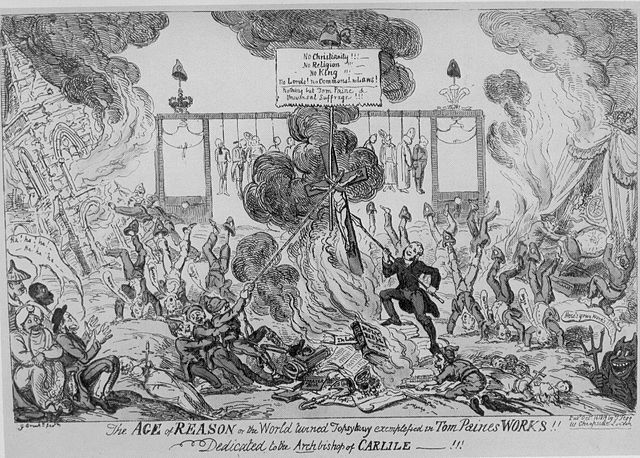
The Age of Reason, Cruikshank (1819)
Jonathan Zasloff reminds us that the GOP wants to return to a time much further back in history than the halcyon days of black and white television and Leave It To Beaver.  He has in mind the days of Social Darwinism and, even further, pre-Enlightenment.
....what the Republicans want on economics is the century before last, the 19th, when Social Darwinism flourished.  And what they want on social issues is the 17th, when theocracy was the order of the day.

I'm not so sure.  Is not enlightenment widely seen as the ultimate manifestation of the concept of free will and the self-made man, through reason arriving as the sole controller of his own fate?  Within an environment of limited government that confines itself to the rule of law and leaves markets alone, the classical liberal interpretation sees the enlightened man as achieving his greatest potential. 

I've heard more than one conservative praise the notion of Social Darwinism.  I highly doubt these folks had spent much time considering the term.  But the instinct to embrace a concept is telling.  Some may quietly embrace a cryptic racialism, or a sense that successful people have better genes.  But embrace of meritocracy is also widely valued.  And it trades in similar assumptions.  The more generous conservative avoids biological explanations.  He instead embraces an immaterial, unexplainable - almost magical - notion of "initiative", that arises not from prior structural development (either genetic or social), but rather believing such a thing to be entirely the product of the universal capacity for enlightened man to create his own destiny, available to him at any second were he only to "choose" it.

The fact is that there is zero evidence for any such capacity in man; all evidence points to initiative being the sole product of structural development, and thus forces apart from one's control.  However, due to this fact being both uncomfortable and seemingly counter-intuitive, we tend to cling to the notion of ourselves as free agents.  Nowhere more so than in the current republican slogan, "We Built It".  While purposely taken out of context, as a response to a Democratic president's emphasis on structural development as opposed to personal initiative, the slogan powerfully illustrates underlying intuitions about popular conception of agency, and the ramifications for social and economic justice. 

While most Democrats likely also embrace the myth of personal initiative, they intuitively understand how important a role larger determinative factors are in its development.  In many ways, the Republican and Democratic parties represent the interests of the haves vs. the interests of the have-nots, respectively.  Whether by race, gender, ethnicity, family education, wealth, or sexual identity, one party emphasizes the import of structural egalitarianism.  The other denies that structure (genes or socialization) have much to do with one's agency; failure and success are the result of a personal initiative located apart from any constraints.  To the extent that the Republican party views initiative as constrained by social institutions, the constraint is merely due to there being a sub-optimal choice on offer that crowds out that which is correct.  At no point, however, is the correct choice not on offer.  In the end, the individual could *always* have avoided the sub-optimal choice.  Again, this assumption rests on the notion of an immaterial, unexplainable source of agency for which there is zero evidence, as opposed to the endless supply of evidence for agency as solely determined by structural sources.

Friday, August 10, 2012

How Can Smart People Be So Wrong?

The Flying, Anchise Picci (1982)
This morning I was thinking about cases where otherwise smart people believe crazy things.  I wonder if the common variable isn't the degree to which they have a strong ideological "feeling" about something.  We've seen cases where enormously smart/educated people seem immune to facts - anthropogenic climate change deniers, vaccine skeptics, creationists.  In some sense, one wonders if their intelligence doesn't allow them to create ever more elaborate rationalizations.

I'm not sure what that "feeling" really is.  It's obviously an unconscious bias; it's as if their reasoning is a rope you follow along until you come to a dark cave, beyond which there is nothing but darkness.  This is the point at which conscious reason disappears.

Yet we can find interesting patterns when we zoom out and examine the larger context of their ideology.  There are correlations between the likelihood of specific beliefs and larger attitudes.  Religious fundamentalists might be the easiest to understand, because they have a scriptural interpretation that they insist is the final authority.  It becomes more difficult when dealing with something like homeopathy, or 9/11 "truthers" where there is no specific scripture they are required to obey. 

But maybe these two aren't so dissimilar.  What if we assumed that scriptural fundamentalism wasn't really about the text, but rather about a socially normative relationship between one and their community - friends, family, congregants, pastor, etc.?  We could assume the same about the homeopathist.  They too are following certain communal norms.  A striking commonality among these groups is how frequently they live in an insular world, in which they are rarely challenged.  And when they are, it is likely by someone who is an "outsider" to their special community.  Immediately, they are a "traitor to the cause".

So, I think we're getting to tribal and identity politics, which largely exist at the unconscious level. 

Maybe something interesting to think about is the individual who is allergic to these sort of ideological "feelings", those who seem to be reasonable and level-headed, better able to think objectively.  They too might live within insular communities, yet somehow don't feel the same strong sense of allegiance that promotes unconscious tribal bias.  How is it that they have been able to establish within themselves a sense of comfort with breaking tribal norms?  Do they have some special self-esteem?  Do they not feel the same fears?

In thinking about myself, I am objectively a pretty reasonable person - at least in terms of your standard political bogeymen.  I have a lot of nuanced views, and understand both sides pretty well.  But it is enormously difficult to self-analyze this stuff.  Reaching into one's unconscious is hard - where to even begin?  I'm sure I've got plenty of tribal bias.  And how much is any of it affecting my cognition at any given moment?

Friday, July 20, 2012

Voices of Crowds

Political gaffes are interesting less because of what is said, but by how their interpretation on both sides of the aisle illustrates larger political themes.  When Romney said "corporations are people too", he was likely talking about the shareholders and workers, who deserved to be included in the conversation.  But this mattered less than the way it seemed to succinctly illustrate the left's perception of conservatives caring more about the profits of big business than their negative, corrupting effects in society.

Obama's recent gaffe about what small businesses - taken out of context to mean that small businesses are wholly reliant on government, likely in fact meaning that they are not wholly unreliant (two quite different claims) - illustrate what different political sides want to focus on.

In much of our political discourse, we have arguments over gut feelings, or larger narratives with implicit assumptions, not by debating those grand philosophical ideals, but rather by quibbling with details by proxy - raising anecdotes, emphasizing facts that support our side, etc.

Romney/conservatives think liberals over-emphasize the importance of government.  Obama/liberals think conservatives underestimate importance of government.

I suppose in the end all of this stuff, marginal as it appears at the time, nibbles away into the formation of political movements over the decades.  But in the moment, it all feels a bit too much like we're all caught in a sort of molasses-like political ether in which much of what we communicate to one another is merely an expression of larger, intangible forces.

Saturday, February 4, 2012

Origins of Compassion

A small child slips and falls down a well, breaking his arm.  We feel a strong pang of compassion for the boy.  A grown man, after a night of drinking, walks out onto the thin ice of a pond and falls when it breaks, nearly drowning before he is finally rescued.  We feel very little sympathy for him.  In both cases, someone has experienced great pain and anguish, yet our emotional response is different.  Though they may seem to come to us almost instinctively, an expression of our purest selves, our emotions in fact precede from a framework of logic and reason, albeit one that is often hidden in our unconscious and only discoverable through careful analysis.

So why the different emotional responses to the circumstances of boy and the man?  The question is one of agency.  There is little a child can do to control his reality.  Even if it was unwise for him to have been playing near the well, his actions can be viewed in terms of a clear lack of intellectual and behavioral development.  Past a certain point, we cannot blame him for acting in the manner he did.  We would be assuming in him too much agency.

Like wise, our lack of compassion for the adult stems directly from the sense in which we assume in him greater agency.  He should have known better, i.e. because of his age, he should have been intellectually and behaviorally developed enough to have made different choices, and not gotten so drunk and taken a walk on think ice.

Interestingly, when human action is viewed in terms of agency, as a matter of intellectual and behavioral development, it becomes difficult not to have compassion for everyone; if there is a clear cause of their actions (their relative cognitive and behavioral agency), there is no reason not to mourn any suffering they cause, either to themselves or anyone else.

But I'm getting ahead of myself.

It is logical to feel less compassion for one who brings suffering on himself.  Which brings us to Mitt Romney, whose most recent campaign gaffe was to appear to be saying that he did not care about the poor.  It's debatable what he was actually saying, whether he was literally making that claim.  I'm inclined to believe that he - a profoundly religious man running for president of the free world - did not intend, in public remarks, to say that he didn't care about the poor.  We all know that sounds terrible.  But here's the thing: it is true.

Well, in large part.  It is an incontrovertible fact that Republicans embrace a view of human development and behavior that tends to view the poor as responsible for their own lack of success.  They will be the first to point to all the opportunities for success out there, and how this or that individual overcame great personal difficulty to find it.  The implication is that if you are poor, you are probably to blame for your own situation.  It is entirely logical with someone who has such a view to have little sympathy for the poor, i.e. to "not care about them".

Thus, much like our drunken man who falls through the ice, and relinquishes a good deal of our compassion, Republicans feel the poor have given up much of their claim on our collective sympathy.  In so much as this is true, there is no real moral weakness on display, just as there is no moral weakness on display when we feel more compassionate towards an innocent, suffering child than a stupid adult who "should have known better".

Now, we can argue against this naive view of human development by pointing to any number of empirical facts about how the brain develops, and how this process is determinative of individual human agency.  But until we win that argument, Republicans will continue to be perfectly morally coherent in not feeling compassion for those who they genuinely feel have brought pain on themselves. 

We can imagine a number of ugly reasons for why Republicans might stubbornly hew to this view.  Many of those reasons no doubt reside in the unconscious as biases, and are self-reinforcing and appeal to the worst of human nature.  But as with any unconscious process, because of its inaccessibility, it cannot be said to be a freely-chosen line of reasoning.  It is greatly ironic that the same appeal to the unconscious nature of human development and thought that points to compassion for those who seemingly make bad choices, is no less forgiving to those who fail to find their own compassion, as they too are likely caught in a causal web of unconscious bias.