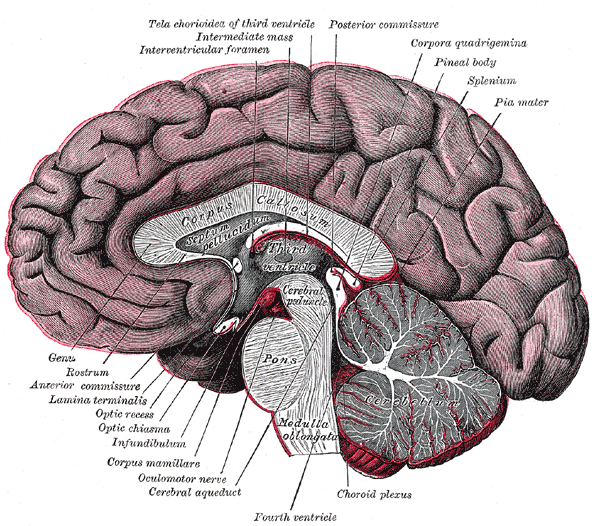
As a longtime sufferer of depression, I've relied on pills designed to treat chemical imbalances in my brain. These pills are controversial, with conflicting opinions on whether they are really more effective than placebos. Millions of people swear by them, many claiming that they have clearly been effective in treating their depression. Of course, such data is anecdotal, as would be any that I could offer. I can say anyhow, that my depression has been somewhat reasonably managed for years.
When I first began taking the medication, about seven years ago, I did recall a significant feeling that my conscious state had been altered. Almost impossible to describe, it was as if a kind of numbness came over me, taking "the rough edges" off of things. My psychological history in the subsequent years was complicated. In some ways I did seem to feel a certain sense of relief. Yet a couple of years later, shortly after my first daughter was born, I attempted suicide. I had certainly entered a deeply depressed state, one in no small part induced by geographic and social isolation, as well as the stress of being the primary caregiver for a colicky infant, all while suffering from devastating chronic neck pain.
So in one sense the medication failed me, or at least was not effective enough to prevent suicidal depression. But the trouble with measuring the efficacy of antidepressant medications is that the population being treated suffers from an illness that is very difficult to properly diagnose, properly quantify, and much less understand the pathology of. To what extent was my depression and my behavior driven by brain chemical imbalances, and to what extent was it driven by my habit of mind, or cognitive framing of the world?
Philosophically, the debate over what consciousness is, or to what degree we can understand it, is contentious. Much of conscious human experience is not well understood, and little data exists to support hypotheses as to either what causes it, or what it even is. Thomas Metzinger, director of the Theoretical Philosophy Group and current president of the Association for the Scientific Study of Consciousness, defines consciousness as "the appearance of a world". It is a good start, but doesn't offer much of a clue as to where it comes from or what it in fact is.
There are many phenomena that we can't really
explain very well, and yet must start somewhere if we are to hypothesize
- especially if there are real-world consequences of our assumptions
either way. Critiques of materialism usually see people as assuming too
much, relying too readily on a physical framework as a best guess.
Critiques of the opposite - immaterialists? - see people as ignoring
what seem to be perfectly reasonable logical conclusions drawn from our
knowledge of the physical world.
I tend to fall into the latter camp. I'm reminded of the old
creationist thought experiment, the clearly "designed" phenomenon in the
natural world, such as Mt. Rushmore or a house in a desert, in which
physical processes are assumed to be incapable of such complexity. This
can be contrasted with a thought experiment designed to illustrate
Occam's Razor, where a broken, blackened tree is found in a field - in
the absence of clear evidence, one might assume any number of
explanations, some more fantastic than others. Yet the most likely, the
most reasonable explanation would be that lightening has probably
struck it down.
Surely, many biological processes - certainly those involving the brain
and/or consciousness - are lacking in a great deal of evidence. But
there is also much that we do know, and would be remiss in not taking
into full account, if not inferring even further material hypotheses. For my part, I look forward to advances in this exciting area of science. Not only for what medical breakthroughs it might provide in the treatment of psychiatric illness, but for what it might tell us about broader, older philosophical assumptions about human behavior and the social structures they inform.
A bastard's take on human behavior, politics, religion, social justice, family, race, pain, free will, and trees
Showing posts with label pain. Show all posts
Sunday, November 27, 2011
Tuesday, February 1, 2011
For the Good Times
For all the tragedy and complaints I might have about the ways in which the continuation high school isn't meeting the needs of my students, it does do a lot of good. At least for troubled kids, it's certainly much better in many ways then mainstreamed classrooms. Many drop-out, and many do little work, and most are mainly interested only in sex, drugs and violence. But they're out of the teacher's hair, and with the individualized attention we can meet more of their needs. It isn't perfect. And some days they seem to do no work at all. But for many of them they are simply in a safe environment in which they can let their guard down.
I had an interesting talk with the counselor yesterday about meeting the emotional portion of their needs, which for at least 50% of the students is the main barrier to academics. They've tried providing one-on-one counseling sessions, but the population has trouble making appointments. Then the bigger problem is being able to build rapport. Many students are so emotionally closed off that it takes weeks or even months to get comfortable with any adult.
I'm reminded of this story in the NY Times, in which a psychiatrist argues that one of the most crucial aspects of any kind of therapy is simple human connection - something that surely won't happen in a class of 40 kids. Then again there was the study which seemed to find that the real therapeutic effects of placebos were in the doctor's relationship with the patient - that they were being paid attention to, as patients who were informed of the placebos did as well as those who were blinded!
Anyway - a bit tangential. But goes to the concept of making meaningful interventions in students lives, meeting not just their "academic" needs but looking at their whole story. There are a lot of cumulative effects of poverty that wear a kid down over the years - whether it's the wrong crowd, stress at home, drugs, violence, etc. By high school many have simply reached the breaking point. And I honestly don't blame them for wanting to punch someone in the face.
Tidbit from the trenches: yesterday I was talking with a group of young mothers/mothers-to-be who I'm trying to design a sort of parenting elective for. One of them is rolling her eyes as she describes a girlfriend of hers who has 3 kids by 3 different guys, while her boyfriend has 4 kids by 3 different girls.
I turn to one girl - heavy eyeliner, sort of chola-style - who has previously discussed her deeply dysfunctional relationship with her boyfriend ("I hate him but he says he'll hurt himself if I leave"). I ask her, "You don't have a baby do you?" She shakes her head non-nonchalantly and replies, "Nah, but we're trying."
"What?!!", I reply, shocked. "Is this the same boyfriend you're always talking about hating?"
"Yeah," she says, "I know we're prolly gonna break up... but this way I have something to remember the good times by, you know?"
I had an interesting talk with the counselor yesterday about meeting the emotional portion of their needs, which for at least 50% of the students is the main barrier to academics. They've tried providing one-on-one counseling sessions, but the population has trouble making appointments. Then the bigger problem is being able to build rapport. Many students are so emotionally closed off that it takes weeks or even months to get comfortable with any adult.
I'm reminded of this story in the NY Times, in which a psychiatrist argues that one of the most crucial aspects of any kind of therapy is simple human connection - something that surely won't happen in a class of 40 kids. Then again there was the study which seemed to find that the real therapeutic effects of placebos were in the doctor's relationship with the patient - that they were being paid attention to, as patients who were informed of the placebos did as well as those who were blinded!
Anyway - a bit tangential. But goes to the concept of making meaningful interventions in students lives, meeting not just their "academic" needs but looking at their whole story. There are a lot of cumulative effects of poverty that wear a kid down over the years - whether it's the wrong crowd, stress at home, drugs, violence, etc. By high school many have simply reached the breaking point. And I honestly don't blame them for wanting to punch someone in the face.
Tidbit from the trenches: yesterday I was talking with a group of young mothers/mothers-to-be who I'm trying to design a sort of parenting elective for. One of them is rolling her eyes as she describes a girlfriend of hers who has 3 kids by 3 different guys, while her boyfriend has 4 kids by 3 different girls.
I turn to one girl - heavy eyeliner, sort of chola-style - who has previously discussed her deeply dysfunctional relationship with her boyfriend ("I hate him but he says he'll hurt himself if I leave"). I ask her, "You don't have a baby do you?" She shakes her head non-nonchalantly and replies, "Nah, but we're trying."
"What?!!", I reply, shocked. "Is this the same boyfriend you're always talking about hating?"
"Yeah," she says, "I know we're prolly gonna break up... but this way I have something to remember the good times by, you know?"
Saturday, August 8, 2009
The Depression Suggestion

Yesterday I felt somewhat depressed. I had woken up with pretty intense pain - maybe a 5 or 6, which for me is above my normal 3 or 4. My thoughts also had begun to turn towards the impending return to school, the pressures of my boss and the daunting prospects of teaching something almost completely new. And my mood was altered.
I realized a common issue I agonize over when depressed is what might be "causing" it. I inevitably have been dwelling on some element of present dissatisfaction. These generally fall into the categories of neck pain, interpersonal or professional troubles. The neck pain I have generally come to understand as beyond my control - despite the poisonous notion in various circles that the original source of the pain is psycho-dynamic dissonance, its remedy being of course intensive self-reflection and scrutiny. (This is utter nonsense. While psycho-dynamics do exist, they only contribute to overall stress, which in turn exacerbates an underlying physical condition. The idea that they are themselves the root cause of physical pain is a deeply distressing invalidation.) To the extent that the physical pain promotes the depressed mood, I must simply carry on and make my peace with it.
And yet the interpersonal and professional troubles are not - in theory - beyond my control. There are legitimate concerns that, were they to be properly addressed, could cease to be a source of continued stress. The trouble is that in a depressive state, legitimate concerns become obscured by illegitimate ones. Perseveration is a frequent symptom.
Something interesting to note regarding the depressive mood is that it mirrors the mood that accompanies genuine loss. As with other disorders, such as anxiety, it may be true that the mind confuses a physiological reaction with a mental one. For instance, it is said that symptoms of anxiety such as sweating, rapid breathing, quickened pulse can actually trigger the onset of an attack, as if the mind associates these feelings with panic, follows its own fear of panic into real panic. With depression, could it be that the mind interprets the physiological experience of depression, similar as it is to a genuine state of loss, as requiring "justification", and thus inventing mental activities to recreate a similar experience. So while the body feels as if a loved one has just died, in reality there is no real mental anguish. Thus it is invented to create the illusion of unity between body and mind.
Unfortunately there often are reasons to experience some level of mental anguish. And frequently they are in fact the original stressors. Yet the problem is the degree to which they justify reasonable levels of anguish. While one may be justified in worrying about an upcoming job interview as it is important and performance is critical, feelings of depression would not be appropriate. And yet if this normal stress induces a depressive state, the mind is then faced with the cognitive dissonance of events not matching physiology, and introduces a sort of synthetic anguish. In this state, the rectification of causes for worry (Yes, I am qualified; No, they will not think I am too slovenly) will almost certainly not alleviate the depression. And so the mind often becomes even more determined to find some explanation for the mood, and turns up the volume, escalating the conflict.
Subscribe to:
Posts (Atom)

