Showing posts with label democracy. Show all posts

Monday, September 5, 2016

Values Voters

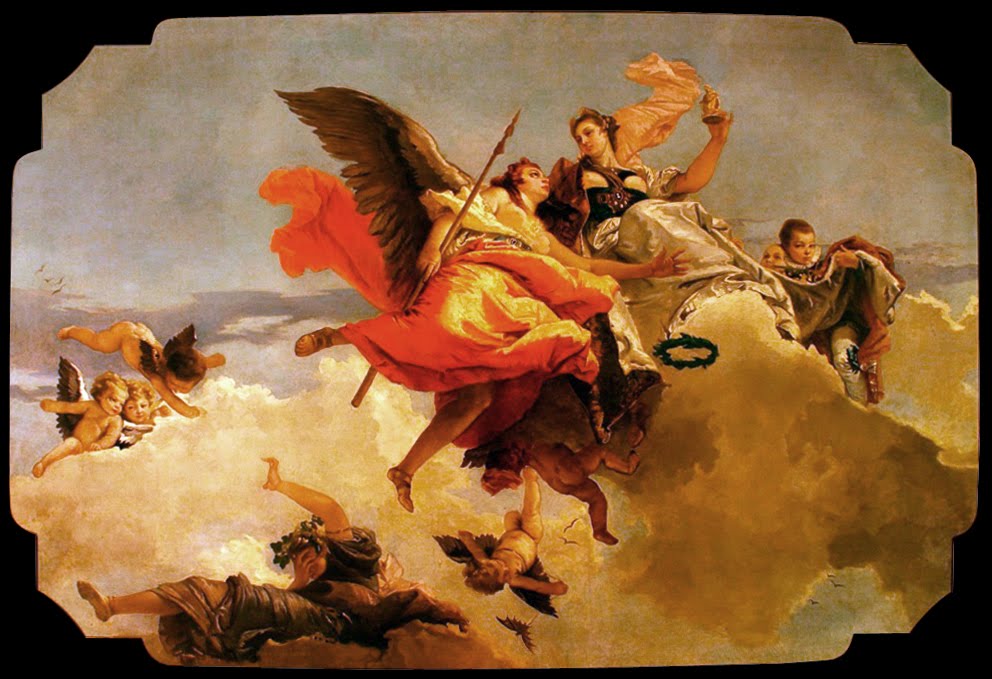
"The Triumph of Virtue over Ignorance"
(1745) oil on canvas by G.B. Tiepolo.
Cultural rebellion.

Traditional masculine identity under threat.

The nytimes today describes the "rolling coal" phenomenon, in which emissions limitations are removed from trucks to make political statements in thick clouds of exhaust.  The cover photo shows an event populated by blue collar white Americans in traditional garb - jeans, t-shirts and baseball caps, standing around a dirt pile while a suped-up pick-up belches thick black smoke.

I keep trying to empathize, to understand.  But core values of mine are being denied: feminism and the freedom for men to not have to embrace strict conceptions of gender; our obligation to not pollute the planet.  These are questions of morality.  What these people are doing is thus immoral.  Is their expression a defense of immorality: that one ought to be able to pollute, and that men need be defined by a strict gender code?

I can't help but see a picture of non-inclusive identity built of values that creates suffering among the marginalized:

  • homophobia leads to dehumanization and bullying not just of gays but of sensitive boys and men
  • patriarchy limits women's equal rights and leads to domestic abuse and lower pay
  • white identity denies multiculturalism and relegates minorities to "other" status leading to discrimination and lack of empathy
  • denial of science results in climate change that is devastating the planet
  • revelling in selfishness and the principle of "might makes right" promotes authoritarian, undemocratic values, leading to dismissal and exploitation of the disadvantaged
Much has been made this election of the sense of anger among the white working class.  It is claimed that their anger is legitimated by globalization which has devalued their work.  But what of the cultural narrative which has counselled not an embrace of change but stubborn rebellion and adherence to toxic values? 

America has a long history embracing values that today most would find repugnant, but in their time resulted in horror:
  • publicly condemnation of homosexuality as immoral
  • waterboarding
  • denial of women's place anywhere other than in the home
  • condemnation marriage between races
  • promotion of segregation
  • Japanese internment
  • destruction of vast forests leading to extinction of plant and wildlife
  • eradication of Native American peoples
  • slavery
All practices that were rooted in assumptions, principles, beliefs.  They were not engaged in out of anger, but of ideas that were embraced and taken to logical conclusions.  If one does not first hold the value, one will not engage in the behavior.  To the extent that people in this picture have embraced immoral values, they will engage in immoral actions.  Their actions - gratuitous pollution, ostracisation of non-traditional masculinity - will not be individual cases of moral failure, but the product of a system of values.


Sunday, November 20, 2011

Give Us Our Freedom Back

Kevin Drum reflects on a NY Times article on the pattern of economic segregation and polarization over the last few decades.
    "It was similar in my neighborhood. My father was a university professor. Our neighbor on one side worked at a local factory. Our neighbor on the other side owned a machine shop that made airplane parts. Our neighbor across the street was career Navy. My best friend's father was a Caltrans engineer.
    "You don't see that kind of thing as much anymore. Today the middle and working class folks have stayed or perhaps moved down, while the dentists and stockbrokers and professors and engineers all live together in upper middle class neighborhoods with great schools and great services. And this self-segregation works in other ways too. I remember reading once that if you have a college degree, the odds are that virtually all your friends do too. So I tested that once. At a party with about 20 of our friends, I mentally went around the room and ticked off each person. Sure enough, all but one of them had a college degree, and about a third had advanced degrees of one kind or another. Given all this, it's hardly surprising that the report finds that 65% of families lived in middle-income neighborhoods in 1970 and today only 44% do."
He finishes his piece without any suggestions for either what might have caused the problematic phenomenon, or what we might do about it.
It's a toxic trend, and it's one that's increasingly reflected not just in our social lives, but in our economic lives and our political lives too. It's not clear what, if anything, can slow it down.

I don't know that I can do much better.  There have obviously been major shifts both in culture and the economy in this period.  The right wing explanation for the phenomenon, as usual, avoids structural critiques and pins the blame on secularism, progressive loosening of mores, and well-intentioned yet ill-conceived government interventions, and of course, a basic lack of personal responsibility.  Government, it is claimed, has contributed to this breakdown in traditional values by removing moral hazard from personal responsibility, via welfare or other forms of social safety netting.

Charles Murray, darling of the right, and infamous author of the Bell Curve, which argued that some races are genetically superior in IQ to others, thus explaining disproportionate poverty rates, is coming out with a new book on the issue.  At a recent talk at the American Enterprise Institute, he expanded upon his thesis.  Conservative blogger Roger Selbert outlines Murray's description of the problem:
"Marriage: In 1960, 88% of the upper-middle class was married, versus 83% of the working class, a negligible 5% gap. Today, 83% of the upper-middle class is married, but among the working class, marriage has collapsed: only 48% are married. That’s a revolutionary change, as is the percentage of children born to working class single women (from 6% to nearly 50% in the last 50 years).
Industriousness: The percentage of working class males not in the workforce went from 5% in 1968 to 12% in 2008. Among those with jobs, the percentage working less than 40 hours a week increased from 13% in 1960 to 21% in 2008.
Religiosity: The percentage of Americans saying they have no religion increased from 4% in 1972 to 21% in 2010. A substantial majority of the upper-middle class (58%) retains some meaningful form of religious involvement, whereas a substantial majority of the working class (61%) does not.
Honesty: The great increases in crime and incarceration over the past decades have overwhelmingly victimized working class communities, while hardly touching upper-middle class communities."
It's hard not to see this outline as a portrait of traditionalist, authoritarian values.  If people, it asks, were simply married, more industrious, religious and honest, they would be more successful.  What's missing, however, is a larger picture of social and economic realities.  While it is true that marriage is a valuable form of social capital, it isn't necessary for life success.  Divorce rates have obviously increased, especially among the working class, but this could just as well be explained by an increasing social consciousness and individual cultural independence that fosters dynamism.  Think of the added value successful women have brought to the workplace.

It isn't at all clear that iIndustrious as measured by declining work hours represents a lack of industriousness.  It is a well-known fact that many businesses purposefully limit their employees hours and rely on temporary labor to maximize profits.  This has had a devastating impact both on salaries and eligibility for health care.

While religion can be a powerfully motivating and empowering social institution, it can also severely limit free thought, again acting as a bulwark against the dynamism and social progress that is fundamental to economic growth.  A strong case can also be made that it is a fairy tale.  Useful maybe, but a fantasy nonetheless.

As for honesty, it isn't at all clear that working class people have become less honest.  If anything, crime is a function of social debasement and perceived lack of opportunity.  Blaming poverty on crime is like blaming a cold on a runny nose.

What seems to be at the root of this analysis his less an attempt to find explanations for rising inequality, and more about an attempt to reinforce and define traditionalist values and identity.  Amanda Marcotte speaks eloquently to this authoritarian obsession:

I won't pretend to have any good answers as to why income inequality and geographic and cultural isolation is happening, much less give anything more than an off-the-cuff prescription. But I would begin with looking at human social capital - those elements upon which real social mobility is always leveraged, and then look at structural issues that our system faces.  People have not chosen to become less successful, less honest, or less industrious.  Marriage as an institution has certainly weakened, but only as horizons for personal identity and ambition have risen.  Traditional careers, especially those in low-skill yet high-paying areas of the economy have disappeared.  Cultural, social criticism has grown, and people are less credulous.  We are less provincial, more expansive, less likely to have as much in common with our neighbors than we once might have.  Our system of property values has steadily solidified geographic "classification".

As I said, I'm not comfortable assigning causality, less comfortable prescribing solutions.  Yet we can ease these modern burdens: family planning, child care support, better access to health care, cleaner streets, parks, libraries, differentiated public schooling - all paid for with more progressive income taxes.  Each of these, while not a solution, is a clear path to increasing the equal distribution of social and human capital.  We cannot stop progress, whether for good or ill, but we can strive to fashion it into more of what is really important.  Instead of vainly crying for a nostalgic, rosy vision of the past, we must look to our core values of liberty, equality and egalitarianism, and embrace solutions that truly aid in their revivification.

Thursday, November 25, 2010

What Country Are You From?

Fulgencio Batista, 1940
Recently, Terry Gross interviewed Carlos Eire, a Cuban exiled at the age of 12, now a professor of religious studies at Yale, about his new memoir, Learning to Die in Miami.
In 1962, 11-year-old Carlos Eire was one of thousands of children airlifted out of Cuba and sent to Florida to escape Fidel Castro's regime. His parents thought he would be back as soon as Castro was deposed.
But Eire never returned home. Shortly after he arrived in the United States, the Cuban missile crisis shut down Cuba's borders, and his parents were unable to leave the country. For the next several years, Eire would be shuffled between foster families around the country before joining his aunt and uncle in Chicago.
I'm always torn when thinking about the politics of Cuba.  On the one hand, of course, the Castro regime is terrible in its totalitarian communism, denial of rights, etc.  And Cuban exiles have an an understandable resentment at losing their way of life and family, their country.

But on the other hand pre-revolution Cuba was not a democratic paradise.  It was a post-colonial dictatorship with all the classic remnants of a history of social injustice: a large racial underclass, exploitation by foreign interests, mass poverty, a light-skinned, hegemonic plutocracy that held nearly all the wealth and propped up the corrupt regime.  The government was ruthless and not only controlled the media but punished dissent violently.  John F. Kennedy described Batista's Cuba thusly:
 Fulgencio Batista murdered 20,000 Cubans in seven years ... and he turned Democratic Cuba into a complete police state - destroying every individual liberty. Yet our aid to his regime, and the ineptness of our policies, enabled Batista to invoke the name of the United States in support of his reign of terror. Administration spokesmen publicly praised Batista - hailed him as a staunch ally and a good friend - at a time when Batista was murdering thousands, destroying the last vestiges of freedom, and stealing hundreds of millions of dollars from the Cuban people, and we failed to press for free elections
The Marxist revolution, against all odds, succeeded in its fundamental goal: overthrowing the existing political and economic order and redistributing land and power into the hands of the underclass.

In his interview with Gross, Eire struck me as either being unaware of, or at least uninterested in this latter narrative of the revolution.  I can't possibly understand how painful his experience was; he never saw his father again.  But one wonders to what degree this pain exists unburdened by the idea that despite his personal sacrifice, the context of the situation was one in which there may have been no "good" options.  And that while his family may have born a larger portion of the suffering, this was in part because it had previously born a larger portion of the benefits of the previously existing power structure.

Apparently Eire, blond-haired and with a perfect American accent, came from considerable wealth.  At one point in the interview he describes the Cuban government coming to his home and inventorying their possessions, a process that took nearly three days, owing largely to the vastness of his father's art collection. The great pain in this - the loss of personal property - depends on an explicitly non-Marxist analysis of property.  While a certain human impulse of attachment to one's possessions is unavoidable, if one acknowledges that the attainment of possessions through unjust means weakens one's ownership of them, then this impulse is likewise weakened.  The singular goal of the revolution could be summed up as an effort to correct an inequitable distribution of power from the hands of a few to the many, from a minority who's position depended on the preservation of an historical order that oppressed a majority.

What does "power" mean?  We generally think of political power as having the ability to vote and express oneself.  Yet the ability to express oneself is dependent on many things, not the least of which are the rule of law, equitable education, proper health care, and civil rights.  I would also argue that democracy also depends on the distribution of economic power.  Not only because of increased access to actual levers of power, such as unions, trade groups, or other lobbying organizations that make up a form of social capital, but because of the increased human capital that economic success provides.


When an individual is successful economically, he or she not only has more options personally, but is able to grant others similar access to power.  Family and friends are able to leverage that power in myriad ways: through he education system, through neighborhoods and peer groups, business and co-worker networks.  These are all forms of social capital to others in the community, but they represent human capital in the individual.  By his attitudes and behaviors, he develops a mutually beneficial feedback loop of leveraged success that acts and is acted on in the community.

When an individual is not successful, the options likewise diminish.  The feedback-loop of social capital runs in the opposite direction.  Family and friends have diminished leverage, neighborhoods and peer groups suffer in quality.  The sum adds up to a total downward pressure in the community - increasing and retrenching poverty and lack of success.  Add into this picture cultural memes of race and class, and socioeconomic transcendence becomes quite difficult.

At the individual, experiential level, life-lenses across demographics become very different.  Levels of human capital  in areas such as intelligence, vocabulary, cognitive skills, behavioral and emotional wisdom depend in large part upon an investment of social capital.  Without levels sufficient to achieve proper perspective, the same opportunities will not appear to exist, whether or not they in fact do.  So for instance a low-cost, state-subsidized college, or small business loan can be made available, yet without sufficient social capital, individuals will lack the human capital to take advantage of the opportunity they provide.

At the state-level, this dilemma goes to the concept of democracy itself: without equitable distribution of social capital, there will be an inequitable distribution of human capital, and subsequent inequitable civic engagement among the populace.  The degree to which one can express oneself politically is thus tied directly to one's human capital, which is of course preceded by social capital, which is itself dependent on equitable distribution of economic power.

In this way the Cuban revolution was essentially democratic - it sought to extend economic and political freedom to the previously oppressed people of Cuba.  The great irony of course is that - for whatever reason, whether paranoia, dogma, hubris, etc. - the Castro regime never embraced democracy as a political system in the decades that followed.  Yet for Eire to speak in the way that he did, seemingly oblivious to the extent that his country was fundamentally a different one than the majority of his countrymen, reminds us of the subjectivity of each of our own life-lenses.

In many ways, we are each from different countries.  Owing to the strength of our political and economic system, our fortuitous place both in geography as well as history, in many ways - the ways that really matter - we are from the same country.  But many of us, because of socioeconomic disadvantage, live in different countries altogether.  While the same opportunities exist in theory - indeed in reality, because the means to see and take advantage of them is lacking, they might as well not exist at all.  They might as well be living in another country.

So the question we must ask ourselves is, "What country am I from?"
Tuesday, August 10, 2010

The Plight of the Baron

I think it's a safe assumption that some of the least interesting writing on the internet can be found in any given website's commentary.  Of course, there are wonderful exceptions to this rule to be found on any number of blogs, especially the smaller ones where actual discussion takes place and is frequently enlightening.  The New York Times commentary, owing to the size of its readership, is too large for dialogue.  But through a recommendation system provides both a somewhat edited digest of responses as well as an (admittedly unscientific) feel for the value readers place on the expression of particular views.

So, where the hell am I going with all this?  OK, so the times did an editorial today championing the Obama administration's commitment to enforcing the National Voter Registration Act of 1993, the requirement for voter registration at state food stamps and welfare offices.  Popularly known as the "Motor Voter" act, it mainly focused on registration at DMVs, and thusly was widely praised.  The welfare part, not so much. 

I remember as a young man in the mid-90's working for a company that delivered meals to people with AIDs, driving around the streets of San Francisco listening to conservative schlock-jock Michael Savage.   A memorable moment came - oh, but weren't there many?!!! - when during an interview with then Republican presidential hopeful Pat Buchanan, the two just couldn't seem to get over the idea that we should actually be trying to get poor people to vote.  I suppose that there is a logic to the fact that poor people tend to vote Democratic, especially in the city, and that you wouldn't want to support your political opponent in any way.  But if your ideology depends at least in part on the disenfranchisement of certain sectors of the public, you may need to rethink your ideology.

Well the fangs came out in the NY Times commentary section today.  The first 20 responses were almost entirely along these lines:
"Maybe everyone should quit trying to find employment and just go down to the blasted welfare office...
The Democrats need to start caring about working Americans...
Every voter needs to remember that our very freedom is at stake...
The Democratic Party - the party of dependency....
I think that spoon feeding registration to citizens who are otherwise unwilling to independently pursue it dilutes an electorate that seems only marginally civic-minded as it is...."

You get the point.  (Remember, part of my writing this blog is the hope that by inflicting my witness to insanity on you, dear readers, knowing that you've now experienced the insanity might give me catharsis.  Is there a word for such a thing?  Schadenfrarsis?)  But I was taken aback by the sort of FOX-frenzyishness that apparently had penetrated my New York Times.  I thought this was my bastion of liberal elitism?  Anyway, it's not usually quite this bad. 

But just when I thought it couldn't get any worse, I came across a particularly eloquent comment that seemed to say what the others wanted to, but likely lacked the proper combination of historical ignorance, anti-democratic illiberality, and crude hatred:
I totally agree with all the posters saying that voting should be a conditional right. In fact, I think votes should be earned and apportioned in exactly the following way:                                       1) No job or education -- 1/5 vote.
2) Get an education through college -- 2/5 vote.
3) Have a job but no education -- 2/5 vote.
4) Have education and a job -- 3/5 vote.
5) Have a job and don't own property -- 4/5 vote.
6) Have a job and own property -- 1 vote.
7) In prison, on the street, mentally ill, 0 votes.

Then there are the situations where people contribute more than their fair share, and therefore have more of a stake in ensuring things go correctly. Of course, these people should have more than 1 vote. So I suggest this:

1) One vote per every post-graduate masters degree earned (not including professional degrees).
2) Two votes for every professional degree (MD, JD, MBA, etc). Obviously someone with a professional degree has a higher stake in ensuring the government runs smoothly.
3) One vote per home owned. So if a person owns 2 homes they get 2 votes, 3 homes 3 votes, etc.
4) If a person owns a business where they employ other people, they get 1 vote for each employee. So a person with one hundred employees gets 100 votes, one with a thousand employees gets a thousand, and so on.
Talk about taking it old-school.  This guy is going medieval.  I mean, to his credit, this is an improvement on the Magna Carta.  Hey, Republicans may not be aiming very high, but no one can say they aren't classy.

*** Interesting to note, there is much in this argument that conservatives extend into free speech, specifically with regard to money and politics.  Unfortunately on that issue this logic has been taken seriously, by no less than the supreme court.  Just as corrupting and undemocratic when applied to free speech, this argument has similar consequences: by allowing unlimited money in politics, the outcome is no less than mass-manipulation of the process of democratic enfranchisement. 

Saturday, June 5, 2010

What's In a Name

Here in California, the primaries are just about upon us and campaigns are in full swing.  Boulevards are awash in the garish reds, blues and yellows of political signage.   Surnames jockey for eyeballs in thickets of 4, 5, 10 at a time.  There isn't much room to craft a message on a 1'x2' card - especially for drivers whizzing by at 40mph.  So simplicity is key.  Candidate's name, office sought.

We have no idea who these people are.  As a conscientious voter I always make an attempt to try and find out.  The voter's guide gives them a profile and brief summary of their philosophy.  They're always hardworking, honest, dignified - real pillars of the community.  Which I have no doubt they are.  Local politics may be the one arena in which personal ambition is not at the top of the agenda.  But the problem comes in actually deciphering the difference between the candidates.  Often times there is no profile for a particular office; only the candidate's name is listed.  Thanks to the internet the task is now somewhat easier.  Most candidates have a website.  But even then it's hard to make out what they really believe.

So I think what many of us end up doing is looking at endorsements.  We find an organization with whom we tend to share a political philosophy, and then trust that they know something about a candidate that we do not.  We make a little checklist (who's really going to remember who all these people are, anyway?!!) and head off to the polls.

But I have a hunch that this isn't how many voters operate.  And this would explain the signs.  Most voters at least know who the big guys are.  They know which senator they like.  They know which governor.  They might not have a very clear understanding of why, if the average campaign ad is any indication.  But they at least know something about the candidate.  And I'll wager seeing nothing but a name on a roadside sign isn't going to really push them one way or the other.  To the extent that you see a big name on a sign, it's likely advertising the identity of the resident more than anything else.

But the sheriffs and judges, comptrollers and water board members - these are the guys you see staggered along main drags, their lonely names signifying little more than coherent little strings of letters.  But in the polling booth, once the main candidates are chosen, these signs come alive.  From deep within the cerebral tissue, filed away somewhere between a radio station's call letters and the password to an email account, this specific alphabetic arrangement suddenly bursts forth and there, what to the wondering blue pen should appear, but
"TONKS for COMMISSIONER"
 And just like that it is gone.  By the end of the next week the signs are packed up and carted away in the middle of the night.  The appellate judges go on judging, the school board members go on membering.  The auditors go on auditing.

Wednesday, April 7, 2010

A Republic of Disinterest

Kevin Drum has some thoughts on the radio listening habits of conservatives and liberals.  He points to an article showing how NPR has been enormously successful in the past decade.
NPR's listenership has nearly doubled since 1999, even as newspaper circulation dropped off a cliff. Its programming now reaches 26.4 million listeners weekly — far more than USA Today's 2.3 million daily circ or Fox News' 2.8 million prime-time audience. When newspapers were closing bureaus, NPR was opening them, and now runs 38 around the world, better than CNN. It has 860 member stations — "boots on the ground in every town" that no newspaper or TV network can claim.
He writes that it basically comes down to taste.
A common question on the left is, "Why is there no liberal talk radio?" That is, no wildly popular liberal version of Rush Limbaugh or Sean Hannity or Laura Schlesinger. And the answer is: there is. It's called NPR. When lefties listen to the radio, that's what they listen to.

Noticeable absent is figures for Rush Limbaugh's audience.  Clearly the largest conservative draw on radio, the Washington Post puts him at somewhere around 14 million.  What's interesting is that if you combine the numbers for your average conservative and liberal audiences, you're still at under 50 million.

Yet according to the US Census Bureau, about 131 people voted in in the 2008 presidential election.

So the question appears to be: where are people getting their news?  My hunch is that most people aren't all that interested in news.  They have opinions, but they're largely based on vague ideological narratives that thrive in an environment devoid of factual information.  Because they are already uninterested in politics or political philosophy, actively listening to the news would require a critical analysis that would then require more even more listening. 

Modern political philosophy is complex - involving numerous competing premises.  The more one learns, the more one finds out one doesn't know.  And not knowing is uncomfortable, especially if you possess no natural curiosity to begin with.  So the easiest thing to do would be to forget the whole thing entirely.  This sort of political carelessness makes for a much more conciliatory and socially lubricious attitude.  Conflict is kept to a minimum, and happiness ensues.

Interestingly, this dynamic can also apply those who do, for some reason, have an interest in politics.  These people actively consume media, and engage in subsequent discussion with others.  However, the problem remains that political philosophy still rests on a complicated set of premises.  In order to take a particular position on the political spectrum, one must have confidence in their choice. 

It seems this can happen in one of two ways: either one has done the heavy lifting of understanding the array of premises across the spectrum, from which they rationally choose their own opinion, or they simply hew dogmatically to one perspective, and avoid contact with views that might cast doubt on the correctness of their choice.  The former model requires both perseverance and critical thinking.  As the time is taken to digest the entire spectrum of premises upon which competing political philosophies are built, one must also possess the capacity for self-reflection and evaluation, as new information will no doubt present dissonant challenges to one's accepted truths.

The latter model is much easier, and a better fit for those who do not wish to invest the required political intellectual rigor.  There could be any number of reasons for this.  Perhaps they aren't that interested in politics, or intellectualism in general.  Maybe they have difficulty accepting the self-criticism required to properly digest inevitable cognitive dissonance.  Maybe they have strong cultural traditions that dissuade them from making the tough choices that critical reasoning often requires.  In the end though, they will no doubt tend to be much more dogmatic and partisan, as their lack of broad political knowledge puts them at a disadvantage when faced with the prospect of leaving their narrow, scripted narrative.

All of this seems to point towards a depressing portrait of democracy.  A relatively informed electorate is the fundamental premise under-girding its viability as a political ideal.  Yet even if we were to some how get every citizen to some basic level of political and social education, the intellectual work required to grapple with important issues in a serious way seems something only a small minority of voters will ever be capable of performing.  This elite class of individual with have an extraordinarily outsized influence over the rest.

Currently, if we are to assume that barely half of voters consume news media on a regular basis, and of that group, maybe half still are operating from a non-dogmatic, non-partisan perspective in which new information is critically consumed and old premises are challenged, we're down to a quarter of the voting public.  That's about 13 million people, on the left and right who engage the issues with patient and determined objectivity.  There are about 218 million adults in the US.  That's 1 in 4 voters, and about 1 in 16 people.


Now, that may be all it takes to effectively drive public thought.  But I doubt it.  How much influence do these people really have.  Of the 3 in 4 voters, how many are really paying attention - as driven by partisan dogma as they are?  The grim reality is that politics is fumbling blindly forth, with no rational direction.  Is it any wonder then, that so many are outraged by colossal nature of our failings?  This despite the hypocrisy of having no one to blame but ourselves. 

In the end, the question seems to be how we manage to do as well as we do.  Within that small elite of individuals who truly possess the capacity to drive serious discussion, there does exist robust debate.  And our literature is filled with examples of wonderful political thought.  As long as this process is allowed to continue - and in the modern world it thankfully has been enshrined as a human right, we will no doubt continue to prosper.  Yet to the extent that people are not engaged in a serious way in the issues that they vote on, they present an obstacle to progress.

Friday, February 12, 2010

An Island of Thought

Our absurdly large amount of defense spending, and the fact that Republicans rarely criticize it (where are you Ron Paul?!!), is fascinating to me.  Especially because it presents such a good refutation for many conservative arguments about big government. 

Basically, if they don't believe in a government program, they say the "market" can do it better.  Yet if they believe in it, the fact that the market can't is simply assumed.  So, the silliness of relying on a private military to protect every citizen is off the table.  Yet expecting private health care, parks, libraries, schools, mental health services, forestry, etc., etc. to guarantee equal access doesn't seem silly at all.

It seems fundamentally childish to not accept that in a democracy we have different preferences, yet this is what conservatives are always arguing.  Defense spending = good, everything else is socialist pork.  Yet liberals could just as easily make the exact opposite argument.  To the extent that liberals don't, at the risk of sounding superior, I honestly feel that it is a simple lack of chauvinism on the part of liberals.  In fairness, this ad hominem suggestion has less to do with an innate character flaw in modern conservatives, but that the conservative philosophy deprives from those who accept it many of the means of thought from which temperate, reasoned thinking is derived.  The absolutist nature of conservative thought is contrary to the relativist aspects of liberalism, thereby always pushing it into a didactic posture of defensiveness.  Not only is the philosophical trajectory one of enormous self-infatuation, but it puts the self in the position of always having to put up a "fight".  In other words, "I am right, therefore you are wrong and a threat to me."

Conservatives have much more difficulty with heterogeneity.  Certainly on an individual level, with regard to specific issues, they can be very "tolerant".  But it is no coincidence that the most boorish, chauvinist opinions are always found in higher levels on the right.  Pick any social issue and you'll find a tendency toward myopia, not plurality. 

This is of course, conservatism's strength.  Conservatism is frequently exactly what is needed to temper liberalism's more dangerously deconstructive tendencies.  But to the extent that its insular traditionalism is its weakness, it can make for a very undemocratic political and social conversation.

Friday, February 5, 2010

Fox, Hen, Uncle Sam

Some conservative commentators are positing a conspiratorial theory in which the government is unfairly punishing Toyota in order to gain an advantage either indirectly via UAW interests or directly for its majority shareholder stake.  This is largely infantile and intellectually dishonest partisanship.  But it raises the question, does not a government have a conflict of interest in regulating business interests in which it itself has a stake?

This may be a nice pivot in the government/business divide.  The business owner in theory acts out of self-interest.  The government administrator in theory acts out of "common good".  At this point in history, it is obvious now that too much faith in the latter is foolhardy.  The former, owing to basic human nature, is more precise.  Although while business is often well-regulated by either the market or the owner's sense of benevolence, neither are generally up to the task.

The general messiness of all this makes default partisan crankiness on either side all the more disheartening.  Government is in so many ways not only necessary but very well-implemented, if only for the element of honor and sacrifice integral to the particular task at hand - one only needs to think of the cop, the fireman, the teacher, the librarian, the inspector, the researcher, etc.  Yet this is not enough, and corruption must be guarded for structurally.  In the same way the business corruption must be guarded for structurally. 

Ultimately then, government must be relied upon to police both itself as well as business.  The best solution we have to this "fox/henhouse" dilemma is democracy.  And to the extent that democracy fails, so to does government.  Yet how much of our time is spent debating our democratic process?  How well do our citizens know it?

Saturday, November 21, 2009

Citizens vs. Representatives

As a sometime citizen-who-contacts-his-elected-representatives, I often ask myself if it really matters if I do so. Sure, if they’re a democrat and I have a bone to pick with their stance on some issue, I might be interesting to hear from. But what would a republican care if he votes opposite me?
I had a robocall recently urging me to stop by the office of Rep. Mary Bono (R-CA) and give her a piece of my liberal mind regarding the health care vote. Mind you – this was after the house passed its version – without her vote. I’ve corresponded with my Republican state senator regarding the legalization of marijuana.
But these people were elected by a majority, and thus – we’re going big picture here – are supposed to express their point of view. Sure – a brilliant twist of pen might sway them into my camp. But I doubt it. In fact I would hope I’m not the lone citizen out here that is the difference between them shifting on a position. This is after all, what they get paid to do.
Who the hell am I?

Saturday, November 14, 2009

Have Obama Liberals Embraced Realpolitik?


It seems to me there is still a rather large difference between the Kissinger/Kirkpatrick model and the sort that some liberals embrace. With the former, you would favor propping up this or that regime for reasons of both economic and political principle - namely to defend against foreseen anti-imperialism or communism.

Support for vicious, undemocratic brutality was justified by the greater threat of where these leftist movements were imagined to lead. Yet there was always a good deal of sympathy for the plutocratic regimes. Not only were they acting as proxies for western interests that stood to lose substantial investments, but their very existence was in large part a natural extension of the capitalist narrative: that in markets there are winners and losers, and pity he who ends up on the losing side.

Yet with modern liberal realism, concerned as it is inherently in the progressive concept of social justice, it seems you have less an apology for the propping of regimes’ right to exist, and more a pragmatic, short-term avoidance of instability so as to increase not only future democracy and economic prosperity but social equality. When undemocratic Afghanistan is given aid to go after the Taliban or Al Queda, no apologies are made for the paradigm – within the logic of liberalism it is certainly illegitimate.

What’s more, it is hard to compare the brutality of the Taliban & Al Queda with the Sandinistas or most other communist revolutionaries (although you could draw reasonable comparisons between the Taliban and Latin American Death Squads). Going further, Hamid Karzai – or even Gen. Musharaff are hardly Samoza or Pinochet.

Saturday, August 22, 2009

Health Care Is Not A Right


I've thought about this occasionally, but only recently have I come upon what I believe is a truer expression of a liberal philosophy of health care.

The political argument is obvious: by calling health care a "right", you automatically justify guaranteeing coverage to everyone. By evoking a natural principle, you are fundamentally answering opponents by claiming that health care is a moral, not economic issue.

But this is not generally how we think of rights. We usually think of them as simple freedoms that require little in the way of effort on the part of others. Freedom of speech, movement, worship, or privacy all require little other than being left alone. Of course, the definition of a social contract includes the quality of living with others. Thus it implies a level of engagement with one's fellow man.

It is within this expansion into the social realm that the liberal inserts an added clause: duties. Duties are all the things we must do for one another to maintain our individual freedoms, or "rights". They are of course more difficult to define, much less to achieve. But they are as elemental to the provision of man's rights as the established state itself.

Throughout our nation's history we have defined them differently, as have other modern democracies: We reserve the right to draft men into military service to protect from foreign threats. We reserve the right to declare martial law. We reserve the right to tax income and commerce. We reserve the right to guarantee things like education or legal defense. Though at times they may be defined differently, they are the same in that they represent an expression of duty towards the common good. Each requires a level of sacrifice - often different depending on the individual - to the idea of the "common good".

Universal access to health care is now being called for by liberals. It is being argued that, by virtue of being a citizen (for many like myself, simply a human being) one should be guaranteed a minimum standard of free health care. Or to put it another way, it is the DUTY of every citizen of this country to contribute in some way to ensuring universal health care coverage to every man, woman & child.

Health care is a duty.