I took issue with very little of what he said. But near the end of the conversation, he made a statement reflective of a common view among my fellow leftists.
“Evidence of racial inequities (whites have more wealth, are incarcerated) are explained by: Either those disparities that are all around us are the result of black inferiorities or they’re they are the result of racist policies.... the only other explanation for all these inequalities is that our country is racist.”
This is the false dichotomy I've been decrying on this blog for years, and unfortunately informs a view shared by both the right and the left when discussing racism. Minority disparities are either genetic or caused by racist policy.
The right-wing response is to argue that because very few people are explicitly racist, and no explicitly racist laws are on the books, that the cause must be be black people themselves. However, they don't want to admit to any genetic inferiority, so instead say it is "cultural".
The left wing response is to agree that no genetic inferiority exists, but that no "cultural" problem exists either. Instead, the answer must be racism.
Now, there are at least three words that need unpacking here: racism, culture, and policies. Because each could be interpreted different ways.
Racism could mean explicit, active racism (not hiring a black sounding name, not moving to a black neighborhood, etc.). But it could also be passive (not supporting policies with disparate impacts, not feeling as "generous" towards minorities, developing prejudices, etc.). But it could also be historical racism, which is not currently active, yet has previously occurred and left a mark (discriminatory hiring, policing, red-lining, etc. could have happened a generation ago yet still be impacting family members today). Or it could be all of the above.
Culture could mean the customs and traditions of an ethnic group (music, dance, conversation, style, etc.). But it could also mean micro-level or family or neighborhood level norms (not cleaning up trash, engaging in risky behaviors, not doing schoolwork, etc.). The latter type of culture is trans-ethnic, meaning it is less reflective of any particular ethnic group than a segment within that group, usually relating to class or privilege.
Policies could mean explicit laws pertaining directly to skin color, enacted for racist reasons, which actively target certain ethnicities for persecution (colored bathrooms, schools, profiling, etc.). But they could also mean policies that create implicit effects through inaction, which cause disparate impacts. For example, if majority minority neighborhoods are located next to polluting factories, and you pass laws eliminating regulations, the law is not explicitly discriminating, but the impact will be.
Now, to use the terms racism, policy and culture loosely is to cut conversation off at the kneecap. And yet this is exactly what we tend to do. I would argue that most conversations on race, policy and economics involve incredibly loose use of these terms. Even when the subject is broken down, as Kendi did in the interview, his use of the term racism and policy were too loose as to be meaningful in any deeper, more functional way.
Because if we are ever going to get anywhere in understanding the divide between right and left on racism and poverty - two fundamental problems of history itself, and to come together in our understanding of truth, we are going to need to dig into the weeds of what these ideas mean. As readers of this blog will note, the question of why we behave the way we do is incredibly complex from an epistemological standpoint. And how are we ever going to get to that if we can't agree on common language? Furthermore, how are we going to take steps to solve the problem if we don't know how to properly discuss it in an objective, orderly fashion?
Writing in the Root, Michael Harriot discusses finding that minority and poor students received harsher discipline than whites and well-off students. Glossing over the very real issue that lower-SES students are indeed at higher risk for behavioral problems, he writes that “the problems of racial inequality in the criminal justice system begin in the educations [sic] system.”
I would say they continue, but do not begin there. They begin in our embracing an economic system in which low-skill work is paid a poverty wage. This creates ghettos, destroys families and depletes capital (financial, emotional, cognitive, safety, health, transportation, modeling, etc.). Historically marginalized, low-capital ethnic groups will get caught in the trap of being forced into working these jobs, and thus sucked into a generational system of oppression as an underclass, as geographic isolation concentrates the effects of poverty, nowhere more so than in neighborhood schools. Dominant ethnic groups will find racism a convenient rationalization for the structural economic system which requires the dehumanization of fellow citizens in order to excuse their continued exploitation. Politicians and pundits will find that demogoguery is an effective tool to gin up support for their personal or political ambition.
The way out is simple in theory, yet difficult in practice: raising wages for this type of work, thus detaching it from ethnic marginalization and geographic segregation. To truly dig out racism from society, we must go deeper, indeed to the root.
Years ago on this blog I made the argument that conservative ideology actually promotes racism. Because of its assumption of free will, it sees disproportionate dysfunctional behavior among certain minorities as a function of inner, intrinsic qualities, as opposed to external, structural forces.
New results from the General Social Survey (GSS) from the National Opinion Research Center at the University of Chicago seem to confirm my argument. As reported in the Washington Post:
"The biggest yawning gap between Democrats and Republicans is on the issue of motivation and will power. The GSS asks whether African Americans are worse off economically “because most just don't have the motivation or will power to pull themselves up out of poverty?”
A majority — 55 percent — of white Republicans agreed with this statement, compared to 26 percent of white Democrats. That's the biggest gap since the question was first asked in 1977 — though the gap was similar (60-32) in 2010."
An interesting question, not asked in the survey, might be whether conservative Republicans would also say that economically disadvantaged whites lack motivation and willpower. A charitable view would hold they would, assuming no racial animus and instead following the logic of their dualistic view of human nature.
Yet how then, with this individualistic worldview, do you make sense of the fact that certain minorities are economically worse-off? If they are "making the choice" to be worse off, and there is no appeal structural disadvantage, a racialized view begins to make more sense.
An interesting fact: many Trump supporters voted for Obama in the past two elections. This would seem prima facie evidence that Trump's racism couldn't have held appeal for them. However, we need to remember that most racism is not a conscious dislike of minorities. Most people who engage in racism do not identify as racists and legitimately believe they have no problem with them. BUT. Racism is a tendency to not treat minorities as equals. For instance, having higher standards for their behavior, or not trying as hard to put oneself in their shoes, or being quicker to judge them more harshly, or not cut them as much slack as they deserve. The classic example of this for me is the grammarian who hates it when blacks say "axe" a question and demands they speak "proper english", yet ignores they many ways whites engage in improper english, such as when as saying "ummana" instead of I'm going to. To the extent that one is applying a different standard to blacks, they are engaging in racism.And we all do it, in many ways, from major to minor biases. In this way I can see someone voting for Obama, but then buying into birtherism, or ideas that he he a Muslim, or that he hates white people. All of these depend simply on cutting him less slack as a member of a historically oppressed group which he has unconscious biases against. I can see him becoming more and more incensed at the notion that illegal immigrants are parasites who are taking our jobs and suckling at the government teet, as opposed to desperate people who merely want the best for their families who are OK with breaking a few abstract rules in order to work hard to give them a better life, all the while paying taxes and receiving zero government assistance. And yet because they are Spanish-speaking, brown skinned, and not "his people", he finds it easier to be less empathetic, less kind, less compassionate: in other words behaving words towards them because of their ethnicity. Ditto for Muslims. Ditto for gays. The standard definition of racism is put thusly:
"the belief that all members of each race possess characteristics or abilities specific to that race, especially so as to distinguish it as inferior or superior to another race or races."
By this definition, most Trump supporters are not racists: they do not profess this belief.
But what is the moral problem with racism? Sure, it is an incorrect assessment of the biology of fellow man. It is an incorrect belief. But isn't the real problem the actual way we treat one another? When racism was enshrined in law, it had actual effects. But that was only a formal oppression. The daily lived harm came when minorities were not treated as equals. Their foibles were not forgiven at the same rate. They were held with more suspicion. They were kept at arms length. They were the other.
What if instead we were to define racism like this:
"acting as if all members of each race possess characteristics or abilities specific to that race, especially so as to distinguish it as inferior or superior to another race or races."
That is to say, to treat different races differently. There need be no master plan. There need be no calculations and tabulations. There need only be thought and deed. Or maybe just deed...
This is the racism we see perpetrated all across America everyday. This is the racism that people are accused of, and then deny. They're defense: they are not racists: they believe everyone is equal. But like the lover who professes his love but doesn't show it, or the friend who pledges loyalty but acts otherwise, racism is deeds not words. As the old phrase goes, everyone is above average. Jerks don't believe in being jerks. Assholes don't set out to be assholes. They believe in kindness and consideration.
Why won't they just speak English? Why don't they have better control of their kids? Why won't he pull his pants up? That's not how you say "ask"....
Hardly anyone is explicitly racist anymore - that takes a lot of guts. But we all have biases, and it is common to treat groups of people differently by engaging in any number of small slights - not affording them the same respect as they would another group in the same position.
It happens quickly, is often reasonably deniable, and difficult to pinpoint or quantify. When I treat my mother-in-law a little bit differently, say, bristle a bit more at her foibles, my lack of respect towards her is hard to define. But it is a result of a bias I have, and comes through in my interactions with her.
These are the kind of untidy thoughts we can all fall prey to with any community who has historically been the target of discrimination. Disreputable narratives develop about them which, we absorb from the larger culture, and that we are often unaware of.
...Why should people be required to speak English in America? Maybe they have good reasons for not learning it yet. Maybe they just weren't talking to you.
...Maybe they are having a bad day. Maybe plenty of white parents let their kids run all over.
...Maybe that's his style - his way of expressing himself through rebellious fashion? Why do you pull your pants up over your bellybutton?
...Maybe because that's how she pronounces the word ask. Do you articulate all of your words perfectly? Do you never say the word "gonna", or "I'm-unna"?
Maybe in each of these examples you are treating them differently because of their race, by not giving them the benefit of the doubt, by jumping to conclusions, and by not having reflected on your own choices. Maybe you are behaving in a racist way without even knowing it.
Adam Serwer writes of continuing conservative denial of racism as an ongoing issue in society - that discrimination and racial bias are persistent threats to equality. He points to a recent spate of rhetoric claiming that the real threat is actual minority-on-white hate crimes. Conservatives pretending that racism isn't a problem is nothing new. Many seem unable to grasp its basic nature, and importantly the concept of unconscious bias. As Serwer writes,
Moreover, the notion that explicit racial violence is the only accurate
barometer for bigotry ignores the uncountable ways institutional
prejudice can sustain itself without explicit violence. Even if hate
crimes in 2010 were slightly higher in 2008 instead of being lower, that
wouldn't alter the fact that more young black men were "randomly"
stopped and frisked in New York City than there are young black men in New York City.
However, in laying out the basic conservative position on race, Serwer makes an interesting claim. He writes that conservatives believe
"disparities in wealth, employment, and education are simply manifestations of self-perpetuating discrepancies in human capital".
Yet as a pretty radically
progressive. I think this is largely true. How can this be?
All three of these disparities - wealth, employment, education - are tightly woven into SES,
which is more of a predictor of income mobility than anything else. Upper
SES minorities will do very well. To the extent that certain
races/ethnicities are disproportionately lower-SES, this is indeed a
function of historical racism. But its lasting effects have little to
do with discrimination, and much to do with ghettoization and the effect
of entire communities of people lacking in human and societal capital.
So how does this play out politically? I've long felt that the national conversation on education is confused and misguided. Yet the confusion may lie in a larger misunderstanding of the way our society works, specifically with regard to poverty and class. Our general political polarization both feeds and is fed by this misunderstanding, and I think Serwer's assumption is illustrative of the confusion on both the left and right.
For at least the past 40 years, the left and right in America have been at odds over race and class. The civil rights movement made it clear to all that racism is wrong (at least consciously), and yet deep disparities continue to exist. The right long ago adopted a stance that racism, no longer codified and thus eradicated, was no longer an issue, and that minorities were now free to succeed in America. The fact that they haven't been is proof not of racism but of either bad genes or simple lack of will or choice. A popular, third explanation relies on the ironic notion that it has actually been progressive welfare policies that have kept minority groups poor by removing the threat of failure, which ostensibly would have forced them to "pull themselves up".
This explanation is interesting because it relies on an acceptance of environmental, behavioral mechanisms, which historically have made up the core of the progressive critique of capitalism; our system of property and economy is by nature oppressive because it relies on the perpetual exploitation of lower-capital individuals by the higher-capital, inevitably reinforcing class, or capital stratification. A central component of this argument is the role of the environment, especially education, in cementing class immobility through the limiting of societal capital resources and thus human capital development. The right-wing claim that welfare creates class immobility essentially mimics the progressive argument, yet flips it on its head and indicts not the capitalist system as a whole, but attempts to reform it.
Both visions see the problem as environmental and behavioral, yet the right see no problem with capitalist class stratification itself, and imagine that left to their own devices, people ought to be able to attain any level of success they so desire. So they acknowledge government intervention as a negative behavioral factor, necessarily limiting human will and potential, yet disregard class itself, including the notion of human and societal capital, as a limiting factor. Considering the epic, total scope of behavioral effects of class on human potential, one wonders how limited government intervention could possibly compete as a negative influence on capital development. The notion on the right is that people are choosing to live off of food stamps and government assistance instead of choosing paths of success. Yet without the larger, pervasive effects of limited human and societal capital, how could the siren song of food stamps have much pull? Who for instance, in a middle class family sets out to live a life "as many conservatives might put it" of suckling at the government teet?
Unfortunately, when race comes into the picture, we seem to have trouble dealing with these deeper issues of class and capital. Because of a right-wing backlash against left-wing charges of extant social racism, many seem still to be stuck hashing out battles from decades ago. Progressives look at ethnic disparities in income, employment and education and can't help but see it in racialized terms. There is obviously a racial component to this injustice, especially since it was only a few decades ago that these disparities were all but codified by law. Conservatives, loathe to admit structural problems endemic to capitalism, and feeling assaulted culturally by the post-Southern left, with their pointy-headed talk of the unconscious and continued critiques of cherished tradition, point to the fact that racism has all but been denounced by society at large, and that they can't be held responsible for continued failure of low-SES minorities to succeed.
A back-and-forth reactionaryism ensues, in which progressives - correctly - charge conservatives with race-denialism, and conservatives - correctly - charge progressives with using race to avoid talking about individual responsibility in minority communities. Neither is completely true, but neither completely false either.
Progressives, like Serwer, do disservice to their larger, progressive moral claim when they pretend that the problems facing minorities are all about race. They clearly aren't. At core, the issue is a failure to develop human and societal capital. This disparity of capital began with race, but now has become so entrenched after multiple generations that it can perpetuate itself on its own, without discrimination to drive it. That doesn't mean that there still isn't discrimination. And at some level, unconscious bias pervades our politics and drives disagreement over whether or not low-SES minority communities deserve extra help.
A productive discussion would begin with the acknowledgement on both sides that human and societal capital are lacking in poor communities. We can both acknowledge that it was, at least originally, established by a legacy of racism. We can then have the debate about what we as a society should do about it. If conservatives see government assistance as a problem, they can then put forward a narrative of how these communities would be expected to find success on their own, given the cycle of capital depletion they face. Progressives can make the case for government interventions that will not foster dependency but build capital.
As it stands, race is a polarizing distraction from what really matters: equal access for all to economic and social justice. In education - arguably the most important leverage point for social equality - progressive reliance on racism as a substitute for class critique has led them to the belief that poor educational outcomes in poor minority communities is a function of teacher quality, with the implicit, unspoken assumption that racism must be a factor. This has allowed them to partner with conservatives, as a group uninterested in social critiques or government intervention, to also see the teacher as the locus of dysfunction, with the implicit, unspoken assumption that a large number of minority students have themselves to blame for their dysfunction, and don't deserve assistance.
A couple of days ago, I spent a morning looking for articles on continuing education and teaching poor students. While promising at first, what I found eventually led me into the weird old world of the nineteen nineties ethnic studies and radical liberalism. I read works like Herbert Kohl's classic "I Won't Learn from You", about minority student defiance. I read a paper from a UCSC grad student recounting his experience studying goings on at a poor migrant continuation school in Northern California. On a whim, I ordered a copy of Subtractive Schooling: U.S.-Mexican Youth and the Politics of Caring, by Angela Valenzuela. But I started to have a problem with the direction these articles were taking. They seemed to be framing the struggle of poor students as if the real problem was not the student's behavior or cognitive/emotional development, but rather the teachers and the curriculum's biased or cultural chauvinism. When the Valenzuela book arrived at my doorstep today, and I quickly glanced through it, the narrative was essentially the same: misunderstood kids being oppressed by "uncaring" teachers. Oh, brother. After slaving away trying to reach the most brutally screwed up kids you'll ever meet, I'm going to read this for insight into trying to help them?
The following is my Amazon review:
Depressingly Dated
OK, I have to start out by saying that I get the whole ethnic studies thing. I majored in liberal studies and am actually pretty sympathetic to the dialogue on class/race/gender/culture politics dynamics. It's much of why I got into teaching. There is a lot of inequality and oppression in society, with poor schools as the front lines. I blog about it frequently, and live it daily in my science class at an alternative education school, where most students are poor, minority and otherwise disadvantaged.
But the problem with this book, and the mentality behind it that was so in vogue 20 years ago, is that it misses larger issues in society, and ironically contributes to those problems not getting addressed. This school of thought basically believes that racism and cultural imperialism are what are keeping minority students down. Now, if you take a hugely macro view, and look at history going back centuries, yes, it does originate in active racism. But the problem today is not racism, or biased teachers, or biased curriculum. It is a lack of human and social capital development. Minorities are not disproportionately failing in school, in prisons, or stuck low paying jobs because of discrimination. They are there because of a structural inertia that has sapped their communities of social resources for so long that children are growing up without the kind of cognitively rich and stimulating, loving environments that create successful adults.
This isn't about their culture (well, mostly - there is an issue of identity and defiance there, but it is rooted in larger structural impediments). Black or Hispanic culture is perfectly suited for academic, middle class success. The ethnic studies school from which Valenzuela hails actually has more in common than it realizes in the actual white cultural conservative nationalists who would denigrate minority ethnicities by blaming their lack of success on an intrinsic incompatibility with middle-class, "Western" values. This is poppycock. The lack of success isn't to do with ethnicity, but lack of knowledge and social capital with which to leverage their families out of the ghetto. When 16 year old girls get pregnant and the dads run away, and the grandmother can't offer much support, the child gets raised in a woefully inadequate household. I see this daily in my classroom.
So, is it their fault? Hell no! They are completely disadvantaged and caught up in a system which is a direct descendant of racism. But it is also a natural byproduct of capitalism and the tendency for property values to create geographic ghettos, with correlative low levels of human and social capital. All the poor kids get shunted into the same schools. Their parents are struggling. They are struggling. There is stress. There is tension. Parents work crappy jobs. Kids resent society and feels like outsiders. They rebel in any way they can - which for boys often means fighting and gangs, and for girls it means having babies. For everyone it means getting high and not doing their work.
But this is an old story. It is the story of the underclass. Poor minorities are no different from poor whites. Poor whites have it easier in many ways, but many of the exact same disadvantages in human and social capital play out the same way. The old ethnic school doesn't realize it undercuts this larger issue by narrowing its gaze and playing guilt politics.
Look at what is happening to teachers in America today. Conservatives love to blame the government and unions, not to mention poor people themselves, instead of larger structural problems that trap the poor and hold them down. Liberals, having bought into much of the ethnic studies framing, wish to take a sort of noble savage view of minorities, and pretend that if only teachers would "care more", as Valenzuela might have put it, the achievement gap between whites and minorities in education would close. But by far most teachers do care. You wouldn't last more than a year or two in a poor school, dealing with that population of students if you didn't care. Sure, most teachers are still white. But the vast majority of us care deeply for and empathize deeply with our students.
But we can't do it on our own, with budgets slashed, and class sizes ballooning. There needs to be a larger national dialogue. Not on race, or ethnicity. I think we're actually doing OK there. But we still won't talk about class, and how it sets up generation after generation of kids to fail, especially those historically discriminated against and disenfranchised. Poor schools need massive investments that will dramatically reduce class sizes and pay for enrichment activities that their community just can't afford. Poor mothers need home visits from nurses and social workers who will help guide them toward better education and parenting practices. More than anything, poor kids feel like no one outside their community cares about them, and that the world is against them. They take their frustration out on individuals, not understanding the bigger picture of what is really conspiring to force them down. But individuals are actually pretty OK. It is the system we much change, and demand that real policies be put in place that guarantee more help for struggling communities.
As Ron Paul surges in the polls, old questions arise about his involvement with racist publishing. A particularly ugly quote from one of the articles published in his newsletter:
Given the inefficiencies of what DC laughingly calls the criminal
justice system, I think we can safely assume that 95 percent of the
black males in that city are semi-criminal or entirely criminal.
Paul denies culpability, but Ta-Nehisi Coates doesn't buy it.
Had I spent a decade stewarding an eponymous publication steeped in
homophobia and anti-Semitism, I would not expect my friends and
colleagues to accept an "I didn't write it"excuse.
I really can't say I'm surprised by any of it. Much of conservatism is predicated on the same assumptions that would
predicate racism. This is why it has always made perfect sense for
there to be considerable overlap between racists and conservatives. I
think the vast majority of conservatives despise the idea, yet privately
rue the dogged logic that much of what they believe is entirely
consistent with the racist cognitive framework. It’s a dirty truth, and
the conservatives have two options: live in denial, or live dirty. The
Ron Pauls, Pat Buchanans, Rush Limbaughs, Charles Murrays, etc. of the
world have merely found themselves on the dirty end.
The story in Norway is just breaking, but it appears as if Islamophobic far-right gunmen have killed scores of people, possibly in retaliation against a Liberal Norwegian government. I just finished listening to a great bloggingheads dialogue between Farhana Khera and Aziz Huq, a fascinating albeit depressing discussion on the continuing rise of Islamophobia, eclipsing even that of early post-9/11, and largely fueled by Tea party/et. al. political opportunism of ’10 and recession populist demagoguery.
However, upon entering the comments forum for the dialogue, I bore witness to a stunning descent into ugly, Islamophobic Muslim-bashing by the right-wing commenters there – who are generally much more reasonable than your garden variety conservative.
I just watched This Is England last night, which I highly recommend to those who have not seen it. It’s the story of a young, poor English kid who loses his Dad in the Falkland Islands war, and finds support in a group of non-racist skin head misfits. However, a schism in the group develops when a racialized skin-head comes back from prison, and begins agitating for far-right English Nationalism, and to lead the skin heads in racial violence against the”Pakis”, the Muslims, and generally the foreign, brown-skinned invaders.
It occurred to me during one particularly brutal scene where he’s ranting against foreigners and the threat they pose against English sovereignty, that were you to merely remove the racist nouns, it wouldn’t be a far cry at all from what is becoming more and more mainstream in American political rhetoric.
It is the same exact paranoid, conspiratorial, fuzzy logic bullshit that has always motivated right-wing nationalist hatred. There are obviously degrees, and certain people have their particular bogeymen, whether it is the “illegals” or Muslims, or various forms of non-”real” Americans. But that seed still lurks, and its scary. The bloggingheads forum was filled with evidence of the kind of thinking that follows. (And these are usually the more reasonable conservatives).
I’m not sure what to call it. I’m not even sure what it is. Is it a feeling that then creates false-cognitions? Is it false thinking that creates these feelings, which then lead to even worse logic? With Muslims, people who should know better, liberals who understand quite well things like racism and patterns of cognitive bias, get caught up in Islamophobic Muslim-bashing. Heck, I just finished Sam Harris’ The Moral Landscape, and he seriously raised the possibility of Europe falling to a new Caliphate. His desire to attack religion overwhelmed his ability to reason, in a freaking book about the ways in which reason gets blindsided by emotion!”
A critique one occasionally hears from the right is that the left is hypocritical when it stands behind the banner of "tolerance", yet seems awfully intolerant of right-wing attitudes or opinions.
It's an interesting straw man, similar to reverse racism or moral relativism. The meaning of tolerance, racism and moral relativism is intentionally misunderstood (or at least, intentionally not endeavored to be understood), thus able to be shot down and dismissed.
Interestingly, by never taking the time to understand the original critique embedded in these concepts (or the complexity of critique they have come to signify), one remains blind both to their objective debate, as well as the possibility that one might be engaging in behavior or thought that is wrong.
For instance, the concept of tolerance means (from UNESCO):
"Tolerance is respect, acceptance and appreciation of the rich diversity of our world's cultures, our forms of expression and ways of being human. Tolerance is harmony in difference."
The concept has been embraced by liberals largely in response to the historical wrongs committed due to assumptions of superiority by white, male, Christians, etc. It emphasizes a power dynamic in which other groups have historically been disempowered, and assumed inferior, or at least less important. It is fundamentally democratic, in that by rejecting majoritarian dominance, it seeks to place every citizen on equal footing, equal enfranchisement, regardless of race, gender, class, disability, etc.
To ignore this critique, or to fail to understand it in all its complexity, is to leave oneself open to fulfilling its prophecy - assuming it has merit. Yet in order to determine whether merit exists, one must first fully understand its logic.
Quite relatedly, racism and moral relativism deal in similar historical critiques. Racism is not merely a belief in the superiority, or a preference for, one skin color over another. Because what does that mean? Why is that wrong? A comprehensive understanding of racism sees a much larger historical narrative of cultural and racial dominance and oppression that relies on the prejudice of cognitive bias to enforce group dominance. This pattern of enforcement, of real and brutal oppression is what makes racism so ugly. Saying you like white people better than blacks is, by itself, not so terrible. But place it in historical socio-political context and it becomes downright evil.
A decontextualized view of racism not only ignores likely motivations, but it prepares a path towards the repetition of history. By denuding racism of proper context, it diminishes its import. The concept of "reverse racism" (or reverse sexism, etc.) does exactly this. It defines racism so narrowly as to suck much of its meaning away. A black man who hates white people, or a woman who hates men, simply do not have the centuries of oppression behind their thoughts and actions that we have come to despise and that the concepts racism and sexism embody. They do not represent exponentially larger movements of ingrained social prejudice and cognitive bias that have infested our patterns of thought for generations.
Of course there are many critiques of these narratives of race and tolerance. There certainly are among those who accept their basic accuracy as descriptors of historical reality. Yet to ignore the deeper premises upon which they are based, and to redefine them into meaninglessness is at best sloppy thinking, and at worst outright dishonesty. It is an easy task to attack an opponent's argument after having mischaracterized it. It is much more difficult - yet mandatory - to attack it head on.
Mark Kleiman points to another example of the right's obliviousness to its own tendency towards racial cognitive bias. He links to Jeffrey Goldberg, who has this to say about a Fox News feature on Obama's meeting with the president of Gabon:
This is psychologically fascinating: The mind of Fox Business host Eric Bolling, when confronted with images of President Obama meeting with Gabon's president, Ali Bongo, instantly recalls other black people who have met with President Obama, and comes to the conclusion that Obama feels deep love for black "hoodlums."
Racism is a beast. Even in the past, when it was largely socially acceptable for people to be explicit about it, their motivations were largely unconscious. Even when pseudoscientific claims began to be made in the late 19th century, it was nothing but an attempt to find evidence for pre-existing hatreds. Did the Germans know why they hated the Jews so much? Their conscious rationale was based on bizarrely fantastical assumptions. So to with most forms of hatred - whether anti-gay, anti-woman, anti-minority, etc.
If racists were conscious of where their racism came from, what motivated it, they likely would not be racist.
So, now we have the modern "politically correct" world, where everyone knows we shouldn't traffic in "off-color" assumptions, stereotypes, or any of the other forms in which hatred has historically thrived. This has generally coincided with the understanding that racism, sexism, etc. are wrong and untrue.
Yet what is it about modern society that is able to grasp how these hatreds are wrong, while previous generations were unable to? Have we found some special evidence that has proven these hatreds false, that we can point to and agree on? To some degree, I think we have. Much of the evidence is less scientific - in terms of biological differences in race or gender. (We are still working on evidence that homosexuality is not a "choice", even while claims that there is anything wrong with it even if it were have long been demolished.) The "evidence" I think would largely come from the social sciences, and their work in laying out not only the historical roots of hatreds, and the idiotic viciousness with which they were perpetrated, but as well the psycho-social ways in which they were propagated.
The most difficult task has been to show the ways in which hatred, which is ultimately wrong because of the pain, injustice and inhumanity it creates, has persisted despite - what we now consider to be obvious - its incompatibility with the universal human impulse towards compassion, tolerance and empathy. How could otherwise rational and caring humans treat each other this way? A good portion of the explanation for this has been the fact that historically oppressed (hated) groups had been marginalized and thus banished from cognition, where they would have been subject to natural human impulses to treat them with fairness. Theoretical frameworks have been developed that try and explain this through the function of social structures such as patriarchy, class, ethnicity, religion, etc. - the interplay of social power and dominance being dynamics that alter cognition.
Obviously, much of this is pretty high-order analysis, largely still confined to and emanating from academia. In popular culture, aside from that which had been filtered down from universities, the main deconstruction of these historical hatreds came through the civil rights movement, which was certainly working with academia (and its student movements), but was also merely about the standing up to oppressive elements in society by the oppressed, for whom the hatred was very real and personal. The oppressed had no problems with cognition (except in the case of that which had been internalized, although that was a serious yet less central problem). Instead, it was the cognition of the oppressors, those in mainstream society that had been raised on stereotypes and other forms of unconscious hatred that had crippled their ability to properly process empirical reality.
It took a massive, multi-decade campaign of relentless, in-your-face protest both on the streets, in the media, in the arts, and likely most importantly, at dining room tables and backyard barbecues. (The most practical results being, of course, change in the courts and legislature). A good portion of the movement’s efficacy lay in shame.
Because once it was accepted that these forms of hatred were wrong, that was only the beginning. The real work lay not in establishing what should have always been an obvious empirical question, but in taking on the popular mythologies and habits of mind that had always been the real levers and gears of hatred's propagation. It may not have been understood as such, but what had to happen was a mass re-examination of cognitive bias. For most, what this first meant in practice was an end to ethnic or sexist jokes. However, it was not the joke itself, but the habit of mind that produced it. It was the critical deconstruction of the idea that you could reduce someone's humanity so as to not only ignore it, but to twist an empirically false reality in such a way that you could find humor in it.
Take for instance an old-fashioned joke about blacks being lazy and eating watermelon. Both are empirically false, but behind them is the reality of centuries of racial hatred and oppression. By laughing at the joke, you are reducing blacks' humanity, inventing realities about them that are wrong, then using that fantasy to punish and laugh at them, all of which is a propagation of their historical suffering - in that this is the precise mindset that apologized for and excused their continued oppression. And you can replace that joke with any joke about women, gays, minorities, etc.
Now, then there was a backlash to all of this, generally known as "anti-political correctness". Much of it was – and still is - likely motivated by defensiveness to the allegation that one is motivated by an unconscious hatred. Because, once it became established that these hatreds were actually wrong, the cultural patterns and habits of mind were still there, whether people wanted them or not. Many in society were essentially walking right into a sort of trap: a massive cultural transformation had just taken place which revolutionized thought, and they were now expected to monitor nigh-every word or thought they had. In this context, cries of “thought police” were not entirely inaccurate.
Of course, there really were no thought police. But there was intense pressure bearing down on individuals to change how they thought and spoke. Yet how else would the transformation, the movement to end these inarguably evil patterns of historical discrimination, prejudice, oppression – all of which essentially being forms of group hatred, come to pass? It would have to be messy. There would have to be dispute over what was and was not an expression of hatred?
Many felt that the charges level against them were unfair: how could some simple comment – mere words – a joke! – prove that one was what would come to be one of the most damning charges in modern life, a racist? Well, now we’re faced with a definitional issue. What is a racist? A slave-owner was certainly a racist. A Nazi was certainly a racist. A KKK member was certainly a racist. Uncle Bob, who openly referred to blacks as “ni**ers” was a racist.
But what about the coworker who merely said she was afraid to go into black neighborhoods? What was she expressing? What was she feeling? Did she feel that black people were somehow more dangerous than whites? Did she hear all the reports about black crime and assume that the neighborhood was more dangerous than it really was? Was she subject to any of the many cognitive biases that we know contribute to false cognition about racial issues?
Add to this her genuine belief that she was in no way a racist. The idea that she might be disgusted her! Yet what if she was just a little bit wrong? What if she had grown up with mistaken ideas, assumptions and prejudices about black people? Maybe her view of race relations was informed by old patterns of racial bias and misinformation – yet she was consciously convinced, and firmly believed that racism was wrong? She never took an ethnic studies course. Sure, she watched Oprah and understood that much of our history had been whitewashed, groups marginalized. But she didn’t have the “chops” to properly analyze every last one of her own views and assumptions before they flew out of her mouth.
And now she’s being accused of racism? Well, this can’t be. Because she’s not. So what she said must not have been racist. How could it be, when a non-racist person said it? Everyone is just being too sensitive. It is they who have the cognitive bias. They have become so overtaken by their own white guilt that they are now attacking their own race. In fact, it is they who are the real racists. Why are they so obsessed with race? Why do minorities get to make sweeping statements about whites? This is reverse-racism!
Maybe some of what she is saying is true. Maybe white guilt has driven people to be a bit too cynical. Maybe some of it is simply rebelliousness – parents would surely attest to this among teenagers. (How many charges of racism were made towards parents in the sixties, and dismissed as teenage rebelliousness?)
In the end, we don’t really know what lurks in the mind of every person. We have a hard enough time knowing what lurks in our own minds. But these patterns do exist: these biases, these prejudices and assumptions. And we know that they have formed the backbone, the cognitive framework, for historical hatreds. We simply cannot take them lightly. We must investigate them and provide push-back when they are written off as harmless or insubstantial. On their own, or depending on what exactly they are expressing, they might be. Under examination, it may turn out that they meant nothing. But it also might be the case that they represented a real instance of cognitive bias, some tendril of hatred, no matter how small.
One thing we must be very careful of, if we are to ultimately continue to make progress against what may be a universal human susceptibility to patterns of hate, is to avoid alienating the very people we wish to teach. Because teaching is truly what we are doing, regardless of how we go about it. Whether it is to politely suggest, or firmly denounce and shame, the ultimate goal is always to stop the behavior, to cut off the falsehood before it can grow any larger.
Many will say that the problem is mostly gone. It has been decades now since explicit expressions of hatred have been considered shameful to the overwhelming majority of Americans (homophobia is just now getting there). So too, one would assume, the practical consequences of hatred – that which effects people’s ability to acquire housing, employment, and otherwise live in society as equals. Certainly cases of discrimination have dropped substantially. We aren’t there yet, and it is an ongoing struggle, but most people seem pretty fair.
Yet are they? One can be an avowed anti-racist, and still be subject to cognitive bias. One can feel that all gays are perfectly nice people, but worry that there is still something “wrong” with them. One can vote to limit their rights. One can feel that blacks are no different than whites, yet have bad “cultural habits”. One can then choose to avoid their application.
More damning, one can fail to fully embrace attempts by society to rectify historical wrongs. If one opposes more money for poor (read: black) schools, or welfare benefits, or healthcare – to what degree might cognitive bias enter into the picture? Surely there are principled philosophical arguments to make against such endeavors. But to what extent would opposition to such programs be informed by the presence of cognitive racial bias? If one feels that blacks have a “culture of laziness”, then would one be less likely to support the provision of social services perceived to be offered to blacks rather than whites? Surely they would. Yet because this doesn’t mean that opposition to such programs is motivated by cognitive bias (the tendrils of historical hatred), as there are perfectly reasonable arguments against these programs (they are too expensive, ineffective, etc.), the determination of the extent to which their opposition is due to bias is extremely difficult.
Suffice it to say, because of the possibility that bias may still play a considerable role in politics and the structure of government, the stakes are quite high. It is with this consideration that those who understand the fundamental role cognitive bias has played in historical hatred approach issues of race, gender, class, sexuality, etc. with heightened skepticism. Furthermore, the skepticism increases when any are involved who are known to have an opposition to attempts by society and government to correct for historical patterns of oppression through regulation or social programs. Precisely because it is difficult to know one’s motivations – whether principled or biased, it becomes all the more important to take a skeptical stance. This is warranted by the mere possibility that one’s cognitive failings might be informing their determination of highly consequential social outcomes. This is all the more true when the subject in question is not merely a voting citizen, but a public figure with a much determinative influence.
After decades of accusations of racism, conservatives have gotten pretty fed up. Their views on a variety of economic and social policies are often attacked by liberals as being informed by racial bias. Yet it is extremely rare for a conservative to openly admit to racist feelings, the only ones openly doing so found in white-supremacist groups or on the "racialist" fringe of academia.
That racism correlates with conservatism is an empirical fact. Aside from psychological research findings, the prevalence of racist political expression amongst conservatives is well-known. The Southern Strategy, Willie Horton, Welfare Queens, the Macaca Moment, just to name a few, along with countless others leading up to the modern "carnival of racism" surrounding the Obama presidency - birthers, racist posters and emails, intonations of "Hussein", and "secret Muslim" conspiracies. While many of these expressions are controversial, in that they are often denied as racist either in intent or content. But taken in sum, along with many other instances, there is undoubtedly a tendency on the right to appreciate racist expression. To be sure, white-supremacist and racialist movements are otherwise entirely conservative.
Racial prejudice is usually impossible to prove, as it draws from multiple cultural patterns and themes, and almost every modern expression of racism is categorically denied. People simply never admit to racist expression. To take two recent examples of undeniably racist expression, the authors claim complete innocence. In 2008, a California Republican women's group included in a newsletter to its 200 members this image:
The president of the group apologized, yet denied any racist intent:
"I didn't see it the way that it's being taken. I never connected," she said. "It was just food to me. It didn't mean anything else."
In 2009, the mayor of Los Alamitos, CA sent out this image in an email:
The mayor issued an apology, yet, again, intent was denied.
"He said he was unaware of the racial stereotype that black people like watermelons."
What seems more likely, is that the mayor, along with many others in the country, are simply unaware of their own unconscious racial bias. This becomes a big problem, because if we are ever going to root out this unconscious bias, especially when it correlates with certain political views, we must first acknowledge that it exists. Yet every time we see evidence of it, excepting maybe the most explicit displays, it is denied or discounted.
Here’s a thought experiment. Assuming racism correlates with conservatism, think of what those expressions might be. Then ask whether the people involved admitted they were being racist. I challenge you to find a single instance of someone admitting it. So now we have a phenomenon: large numbers of people engaged in racism who refuse to admit it.
The next step is to ask how much of this phenomenon underlies conservative beliefs that impact racial issues. Imagine a republican voter who never actually emailed watermelon or fried chicken jokes, or who went to a birther rally, or held a poster of Obama with a bone through his nose, or intoned “Hussein” when saying his name. Yet at some level they appreciated the sentiment behind those stereotypical and prejudiced attacks. So, when thinking about immigration, Islamic rights, welfare, or affirmative action, or whether poor minorities are disadvantaged while rich white people are privileged, and thus should be obligated to pay more in taxes, these racist appreciations – likely unconscious and not understood – of course would affect other wise “rational” decisions.
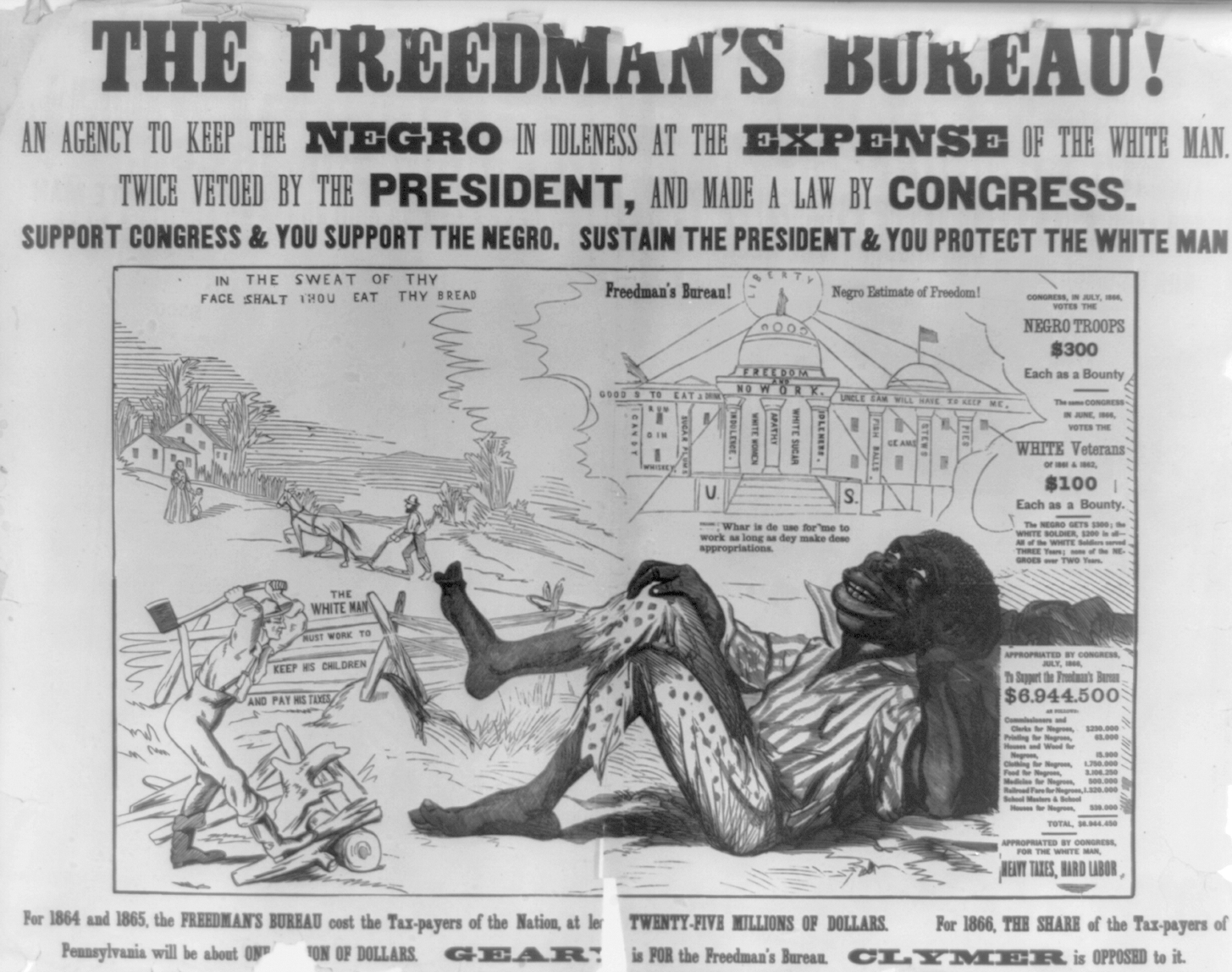
An anti-Lincoln campaign poster making the rounds on the internet prompted a commenter at Matt Yglesias' blog to make this observation:
The similarities between "Negro worship" and mockingly calling Obama his supporters' Messiah intrigues me.
They really do need to get some new material.
Fascinating. The conservative relationship with racism is very strange. It has become conventional wisdom that liberals accuse conservatives of racism simply because that is what they do. Therefore any suggestion is dismissed out of hand. And since modern man knows that racism is unequivocally wrong, it can never be admitted or stated explicitly.
But we know that hatred is largely an unconscious and unreasoned phenomenon (otherwise it would no longer exist). Yet to the conservative, who has never been interested in understanding its roots (how many conservative scholars or intellectuals have set out to understand it; how many have sought to point it out?), racism is largely a matter of conscious belief - "Are blacks or minorities racially inferior, yes or no?"
If the answer is no, then there is no racism. So one can literally have a poster of the president with a bone through his nose, or watermelons on the white house lawn, and if they claim not to be racist then they must be taken at their word - certainly if they honestly don't believe they are.
Yet the problem with this is that hatred has always largely existed in these sort of nebulous, ill-defined boundaries of human consciousness. People feel hatred, and it colors how they view the world, how they express themselves. But they don't know why. How could they? Many people will say outright that gay sex makes them feel disgusted. This was a common feeling among whites with regard to blacks in prior decades. They didn't know why, and yet it was still acceptable to express explicit racism.
In modern society, where being racist is one of the worst sins, one must never admit to such feelings. So what to do if they exist? And further what to do when a part of you wonders if they are hateful, yet a cultural norm of political incorrectness gives you a pass and says it is OK to go right on expressing them?
Most people probably don't feel outright disgust, which is maybe one of the strongest forms of hatred. But there are many ways in which hate can bubble around in our unconscious without quite making itself known. Even the most open-minded among us will experience such feelings, and the degree to which we allow them to influence our thoughts can be modified by conscious examination of how hatred works - what cultural and historical forces drive it, what premises and cognitive biases it operates from, etc.
Yet these are exactly the sort of tactics that conservatives A)deny are necessary and B) unlikely to have been trained in. So, now you have a situation in which conservatives can view racism as wrong, yet like anyone experience hateful feelings, and then lack the cognitive skills to keep them from influencing their ideas. In fact attempts to do so are countered by a cultural norm of political incorrectness which provides a sort of foil under which to allow hate to flow freely.
What is more, conservatism as a movement can adopt broad platforms based upon hate-influenced premises, even though the degree to which the hate is coloring the assumptions is not understood. An example of this would be the Arizona law legalizing the profiling of illegal immigrants. White people who believe themselves to not be racist, rationally consider Hispanics their equals, nonetheless support a law the burden of which falls grossly on Hispanics. But because they lack the understanding of how racism and hatred have historically operated, they don't know how to critically examine the assumptions underlying their support of the law. And when liberals criticize the law on racial grounds, conservatism - having experienced this accusation throughout its history (including when it was defending explicit hatred, and today with homosexuality), closes ranks and denies the mere possibility that race "has anything to do with it".
So we get stuck in these cycles in which two competing narratives are built in reaction to the other, and objective examination of the specific issue is almost impossible. If liberals have become the movement of people seeking to root out racism and hate, conservatives have become the party of denying its existence in all but the most explicit possible cases. Even if hate has never worked, and never will work this way.
Humans have demonstrated a limitless capacity to fall victim to hateful bias, and therefor must be on constant guard for its infiltration of our unconscious. This requires understanding how hate works, the structure of its formation within society. It also requires active resistance, in the form of meta-cognitive analysis, or as the poet Ice Cube famously put it, "Check yourself before you wreck yourself".
Glenn Loury and John McWhorter are back with their usual arch commentary on race in a recent Bloggingheads. Both express great boredom with the endless cycles of this hoary American Dialogue. I grant that it is perpetually juvenile and superficial. But when John calls the whole enterprise "unnecessary", I entirely disagree.
I would distinguish between what could be learned and the tendency for little to be learned. I agree that much of it tends to be theater - but that doesn't mean there isn't anything of substance to be learned, or discussed. The problem is that so much of our political discourse is simply hackish in general. Partisanship, talking points and scorekeeping take the day.
So when Glenn and John say there is nothing to be learned (again, I prefer "discussed"), I think that's really not true. For instance let's take the Rand Paul flap. The libertarian/tea party willingness to even entertain such foolishness speaks volumes about their priorities, and especially their view of race and class in America.
This is how I see it being important: Paul's anti-civil rights view diminishes the legacy of racism, resulting current social and human capital in minority communities. He and Tea Party's homogeneity and claims of "government intrusion" largely framed around minority/welfare issues, specifically in regard to social programs. Granted these are pieces of a puzzle, but I think you can draw a pretty straight line from his statement to his party platform. Ditto the Macaca (?) comment. And generally the large number of racist Tea Party crap ever published.
Glenn points to "structural problems" driving minority poverty. But how can he divorce this from Republican opposition to government intervention? He can't seriously by the BS notion that these communities will pull themselves up without targeted government help? And that's exactly what modern conservatism does not want. They may pretend that they want smart government - but they never show any platform but cuts. They basically have zero to offer minority communities. Their one proposal for ending generational poverty through education - vouchers/charters - is aimed solely at parents motivated to escape the ghetto. This is not a scaleable solution, it is a band-aid for certain parents who already have enough human/social capital to succeed and are stuck sending their kids to school with other ghetto kids.
The dialogue on race needs to be better. It is definitely stuck in a sort of racist vs. non-racist framework that is absurdly inadequate to what we're dealing with in the 21st century. Race is no longer just about racism, but about justice. Most Americans want to be there, but they have no idea how to get there. There are still many unconscious assumptions and prejudices that will eventually need to be exorcised. We need to get back to looking at causality and practical steps we can take to move the country forward.
With Arizona's looming implementation of the notorious sb 1070 law, which allows police officers to detain anyone they "reasonably" suspect is an illegal immigrant, the question has been just what "reasonable suspicion" might really mean. The concern for possible civil rights violations revolves around a scenario in which a fully naturalized citizen is considered suspicious, and therefore must then be required to show proof of citizenship. If you happen to forget your wallet, or otherwise fail to present proper ID, arrest and/or detention is implied.
I was able to find some specifics at the Arizona Peace Officer Standards and Training Board website. According to the site, the following are considered valid proof of citizenship:
A valid Arizona driver license.
A valid Arizona nonoperating identification license.
A valid tribal enrollment card or other form of tribal identification.
If the entity requires proof of legal presence in the United States before issuance, any valid United States federal, state or local government issued identification.
It isn't hard to think of situations in which American citizens might be arrested and/or detained because they weren't able to prove residence. While the bill explicitly prohibits racial profiling, the obvious fact is that light-skinned or otherwise ethnically non-hispanic looking citizens will not face the same level of risk at all. So, there is little reason to think that a blond-haired blue-eyed Peter Anderson might be mistaken for an illegal immigrant.
But the real question still remains: what does "reasonable suspicion" entail? Does eating a burrito count? Thankfully, the APOSTB website offers this help:
FACTORS WHICH MAY BE CONSIDERED, AMONG OTHERS, IN DEVELOPING REASONABLE SUSPICION OF UNLAWFUL PRESENCE
Lack of identification (if otherwise required by law)
Possession of foreign identification
Flight and/or preparation for flight
Engaging in evasive maneuvers, in vehicle, on foot, etc.
Voluntary statements by the person regarding his or her citizenship or unlawful presence
Note that if the person is in custody for purposes of Miranda, he or she may not be questioned about immigration status until after the reading and waiver of Miranda rights.
Foreign vehicle registration
Counter-surveillance or lookout activity
In company of other unlawfully present aliens
Location, including for example:
A place where unlawfully present aliens are known to congregate looking for work
A location known for human smuggling or known smuggling routes
Traveling in tandem
Vehicle is overcrowded or rides heavily
Passengers in vehicle attempt to hide or avoid detection
Prior information about the person
Inability to provide his or her residential address
Claim of not knowing others in same vehicle or at same location
Providing inconsistent or illogical information
Dress
Demeanor – for example, unusual or unexplained nervousness, erratic behavior, refusal to make eye contact
Significant difficulty communicating in English
So, basically, whatever the fuck the officer feels like pulling out of his ass. "Gee, judge, I just sort of thought those shoes looked kinda.. you know... Mexican. And he appeared to be nervous".
Julian Sanchez describes the limits to which scientific understanding can assuage our strongly held beliefs. He describes how homosexuality's removal from the DSM, psychiatric manual on mental disease, owed as much to more general social progress than to the scientific evidence.
I’m glad, of course, that we’ve dispensed with a lot of bogus science that served to rationalize homophobia—that’s a pure scientific victory. And I’m glad that we no longer classify homosexuality as a disorder—but that’s a choice and, above all, a moral victory. It ultimately stems from the more general recognition that we shouldn’t stigmatize dispositions and behaviors that are neither intrinsically distressing to the subject nor harmful, in the Millian sense, to the rest of us.
I think this is true. It also explains the persistence of irrational bigotry, as we are seeing coloring (no pun intended) the debate around immigration, social programs, not to mention our black president. People no longer have any scientific, rational justification for their biases, yet they persist. This is best evinced by the person who has no religious or moral problem with gays – but just thinks they’re “gross”.
I think the discussion on racism, sexism, etc. would benefit greatly from a transition from the dogmatic – you “are” or “are not” a bigot – to the nuanced – are your feelings/opinions being informed by social patterns of bias? I think in the past, when bigotry was largely acceptable, the unconscious biases were still there, and just because we decided as a society to make them taboo – the underlying drivers of bias didn’t simply vanish into thin air. The problem now is in identifying ways in which we are still being driven by them.
This is always incredibly dicey. People worked up over illegal immigration always hate any suggestion that racism/ethnocentrism/nativism/etc. might be playing a role in the anger they feel over the issue. This is justified in the sense that no one’s political beliefs should be declared illegitimate from the start, especially if they aren’t explicitly bigoted. But at the same time, there is a historical pattern of bias, built on cultural structures, against poor immigrants. So it is an important conversation to have.
Wikipedia has an excellent list of cognitive biases that provide a nice framework for understanding how this pattern might have historically developed. http://en.wikipedia.org/wiki/Cognitive_biases. It’s actually a pretty frightening as a look into the frailty of the human psyche. But it’s also disarming in that by explaining why we err, we offer our ego forgiveness.
Of course, the next step is to remain vigilant. And that is a lifelong process that will never achieve perfection. As humans, we are all prone to be led by our fears, angers and prejudices. I think larger social diseases such as bigotry can be thought of as on the same spectrum of behavior as, say, being rude to a store clerk, or acting selfishly towards a roommate or spouse. We are flawed and we are all (hopefully) engaged in an endless struggle to “be better”. The way we do this is always the same: we reflect, we untangle the root of the problem, and then we try to develop the cognitive tools so that should the behavior arise in the future, we have the ability to keep it in check.
As part of Charlie Rose's ongoing Brain series, the most recent panel discussion involved negative human emotions such as fear and aggression. What stood out to me at one point was during their dialogue on how aggression - a fundamental emotion in all animals - is regulated both by genes and environment. And while early childhood development is very important, and negative experience at an early age can have lasting consequences, that the process is also ongoing through the establishment of social norms. What peers and society deem acceptable provides a framework for one's own emotional barometer.
So in Nazi Germany it was much easier for people to go along with the holocaust when their friends and neighbors seemed OK with it as well. This sort of group think was perpetuated by a cultural and institutional rhetoric that viewed Jews and gypsies as subhuman, notably via language and imagery that compared them to "rats" who were "unclean", "breeding" and "infesting" Europe. This language is common throughout historical examples of genocide. In Rwanda, the Hutu referred to Tutsi as inyenzi, or "cockroaches". This language, apart from the obvious negative association, also simply serves as an efficient way of dehumanizing and objectifying a human being. If a person no longer represents one with whom one might reasonably empathize, it becomes that much easier to deny them rights, marginalize them, or even cause them direct or indirect harm.
It has been common and widely acceptable in America to use the term "illegal" to refer to illegal immigrants, itself a term lending somewhat to human objectification. "Illegals" are often spoken of solely in disparaging terms, i.e. their negative effects on the economy, crime, social spending, wages, and the rule of law itself. The term seems to roll all of that bitterness and anger into one easily digestible phrase. Conspicuously absent from it is any acknowledgment either of the fact that these are real people with real lives, or that a narrative might exist that provides any mitigation of the unlawful behavior.
Combined with a tendency towards ethnic resentment and misinformation, the continued use of dehumanizing language and rhetoric to describe illegal immigrants has lead to increased racial resentment of Hispanics in general. Heidi Beirich, director of research at the Southern Poverty Law center has described a dramatic rise in anti-immigrant hysteria.
Nativists view Latinos as destroying American society and replacing it with an uncivilized and inferior foreign culture. Many also believe there is a secret plot by the Mexican government and American Latinos to wrest the Southwest away from the United States in order to create “Aztlan,” a Latino nation.
In Arizona, senate bill 1070 and its high support among white Americas has already demonstrated a profound willingness to tolerate higher levels of aggression towards Hispanics, historically an ethnic minority. If this sort of dehumanizing rhetoric becomes even more normative, the possibility for increased oppression and even violence seems likely.
Before sitting down to write my last post on racism, which ultimately evolved into quite the beast, I had been thinking a lot about the fundamentally incorrect way we think about racism in America. It occurred to me that the discussion generally revolves around whether or not one is "a racist". Since we've largely gotten to the point in society where we've established that racism is wrong, it's not only taboo to express it but to think it. And while this is unquestionably good, it has in a way created a weird sort of space for racist thought to exist in a manner that is almost impossible to speak of. As such it has become a sort of undercover disease.
Basically, most racism now exists as an expression of the unconscious. It takes the form of subtle biases of thought, leading to prejudice and faulty assumptions about race and ethnicity. People (aside from a very small minority of avowed racists) are no longer racist with a capital R, but expressers of racism. They are not actual racists, but some of their behavior is racist. Some more than others, of course. And a good case could be made that we are all indeed subject at times to hidden racist biases that course through our hidden minds.
So the question ought not be whether one is a racist, but whether one's behaviors might represent an expression of unconscious racism. One of the big stumbling blocks to dialogue on racial issues is a feeling that one must either be a racist or not. So when accused of racist expression, the subject often feels as though they must either choose between being labeled as a "Racist", or not.
Yet if we acknowledge that the unconscious is an integral part of the mind, and that it will inevitably acquire biases of many sorts, then racism is in many ways a natural outgrowth of this structure.
No one could possibly function without unconscious bias. We are biased towards helping small children, or those in need. We are biased to fear dangerous situations. We are biased to let our guard down with loved ones. Unless absolutely necessary, we don't think. We just act. In his book, The Hidden Brain, Shankar Vedantam details just some of the many ways in which the human brain creates and depends upon biases throughout its life cycle.
Fortunately, we can learn to recognize our tendency towards bias and try and control it. In many ways, what is commonly referred to as political correctness is our attempt to do this at the societal level. Obviously, people have taken the concept too far, and created a harmful atmosphere of over-censorship. But the essential tone of the movement is to try, as a society, to come to grips with our historical tendency towards bias that has unquestionably resulted in a great deal of oppression. It is an acknowledgment that these biases exist in our unconscious and are, by definition, difficult to control.
The greatest opposition to political correctness has come from those who seem to deny outright that unconscious bias even exists at all. Yet this is rather absurd. It is one thing to feel insecure about one's knowledge of self, but quite another to deny the possibility that unconscious bias exists at all. Now that we've moved beyond racism, they'll often argue, the matter is settled. But is it?
I would argue that even decades ago, when racism was seen as perfectly healthy and normal, people were even less conscious of their bias. Sure, if you asked them to own up to it they would oblige. But if you asked them to explain it they wouldn't have a clue! There have been attempts throughout history to provide some sort of legitimate, rational explanation - whether religious or scientific. But this was ad hoc. They were merely making up stories to justify these unconscious emotions and attitudes they simply felt. The fact that they were so unaware of where their bias came from just made it that much more of an unconscious process.
The civil rights movement was nothing if not dependent upon people taking it upon themselves to self-reflect and question their own traditional assumptions. And just because today we as a society have finally decided that racism is wrong, it doesn't mean that our hidden biases have suddenly disappeared overnight. The phrase "old habits die hard" may have never been so true. We are humans and we are imperfect. Each and every day we wake to face new challenges to our magnanimity, or compassion, our selflessness and kindness. It doesn't come naturally. It is something that takes steady, relentless work to maintain. We can be thankful that we have realized that racism is our enemy. But now we must do the difficult work of being vigilant every moment, and making sure we smite it when it slithers out from within.