It must be nice.
That is, having faith in God to pull you through. Having faith that there is a plan for you, having faith that there is a meaning in the universe and a reason for everything.
Of course, no one is without doubt. Even the most devout believers must at times struggle to hold on to their faith. But they have a faith to hold on to. They have a deep and enduring story that, at least in theory, accounts for everything in their lives. It tells of a universe designed with them in mind, with special details and guarantees that promise not only an ultimate reward in the afterlife, but a better life now. It spins tragedy into harmony, grief into glory, pain into love. There may not be any specific answer to specific problems, but in faith it is promised that a deeper purpose exists, and faith will carry one through.
Unfortunately, I have no such reassurances. As an Atheist, I have no reason to believe that there is any higher purpose to my life. The universe was not designed with me in mind. It simply exists, according to a relatively limited set of physical laws. These laws have set in motion an unbelievably vast and complex series of interactions, my body and mind composed of elements forged in the ebb and flow of stellar supernovae, brought together by interactions of gravity and electromagnetics, propelled by energies as distant as the Milky Way galaxy within which our Sun orbits, and as close as the very bonds that hold my sub-atomic particles together. Within this vast cosmic dance, I do my thing.
So, what is "my thing", and more importantly, why do I do it? A question for the ages, right? What is the meaning of life? What is the purpose of life? Having already declared my Atheism, I have already submitted that there is no purpose.
Seven years ago, I tried to kill myself by overdosing on prescription pills. For twenty five years I have gone about my daily life in varying degrees of chronic pain. Sometimes it feels like the walls are closing in all around me. It is all I can do to focus my mental powers like invisible rods and struts, holding back the vice grip of gnawing muscle tension. At other times the pain is barely noticeable, lurking in the background but easily ignored. My life has been torn apart; who knows how it could have been had I not had that surfboard accident in 1989.
In my darkest moments - which thankfully, are much further far and in-between than they used to be before the suicide came as somewhat of a watershed - I do not have God to comfort me. My footsteps are my own. I cannot bend my knee and take solace in a faith that there is a purpose to my pain. There is no "lesson" that I am to learn. There were no sins that I am paying for now, redeemable for a ticket into heaven when I die. There is only the cold machinery of the universe, of which I have been on the receiving end of misfortune.
It is true that we all need purpose. I know as well as anyone what it feels like to reach the end of the tether which attaches me to my will to live. We need a reason to live. We need a reason to push on despite horrible pain, anguish and tragedy. We cannot live without purpose. Purpose is what gives our lives beauty and reminds us in moments of challenge that there is much to be thankful for. Purpose is what drives us to be better, more honest, more caring, more supportive people, to do better things, to set ambitious goals and struggle to accomplish them. Without purpose, our lives become aimless and superficial, stumbling over minor obstacles and sidetracking us towards short-term satisfactions.
If there is no God, or supernatural story within which our lives are fixed, which gives ultimate purpose to our lives, carrying us through the pain and propelling us towards the fulfillment of our best natures, how is it that the Atheist is not destined for all that accompanies a life devoid of purpose?
Some might take solace in the notion that it is Atheism itself which destroys purpose. After all, how can one ever prove that there is no God, or supernatural force that guides our destiny? Partly a semantic issue, Atheism is not incompatible with such agnosticism. It can as easily be said that one can never really prove a negative. Two plus two may equal four this time, but no one can know the future. Just because there is no evidence for God at all, and an inexhaustible supply of evidence for causal mechanisms in the natural world that need no creator to be explained. Aside from the creation of natural laws themselves, we have every reason to believe they are enough in and of themselves to explain everything that exists in the universe. Agnosticism should be the basis not only for supernatural questions, but our stance towards reality itself. However, it is merely a baseline. Acting with purpose requires so much more. While nothing may be able to be completely disproven, we live in a practical world and Occam's Razor requires us to make practical decisions. I may not know that two plus two will always equal four, but I can't sit around waiting to find out. There is just as little purpose in agnosticism as there is in Atheism.
While Atheism can give us no purpose, it makes a stronger statement about purpose in general: that we make our own purpose. In fact, in Atheism we see that all religious faiths (all but one of them being untrue, by default) are in fact man-made. Therefore, the purpose that they purport to offer the faithful is man-made as well.
Unfortunately, as a non-believing Atheist, I cannot simply adopt the purpose of the faithful as my own. And thus I cannot collect the rewards - the comfort, the inspiration. And so I must find my own. Limited to the natural world, I cannot simply invent convenient stories, hiding away in the mysticism that "everything happens for a reason", knowing full well that it doesn't. We offer no such hubris to the billions of animals that die of starvation or predation each year in the wild. The reason? That's life.
But maybe the stoicism of the natural world offers us a clue in how to make sense of a harsh reality. It has been theorized that at root, humanity's existential despair comes from our larger cognitive capacity. Our brains have evolved as sense-making machines. And yet, when faced with senseless tragedy, we are at a loss. Our brain is a hammer looking for a nail, and unfortunately one does not exist.
Or does it? In our quest to make sense of the world, we have invented powerful mythologies with the ultimate goal of finding purpose where there seems to be none. It is a highly useful story to tell, yet everyone knows all but one are wrong - Atheists simply claim that one is wrong too.
But what if we had a story to tell about purpose that didn't require the supernatural. Is there not enough to live for here on earth? Is there not enough to get us through the tragedies, the hardships, to inspire us with ambition, to want to make the world a better place?
When I look into the eyes of the woman I love, I feel a purpose. When I laugh along with my two daughters, I feel purpose. When my family and friends remind me of our shared memories, I feel a purpose. When I see my smiling neighbor walking past my house everyday after returning from the bustop after work, I feel purpose. When I pull weeds in my garden I feel purpose. When I finish writing a new song with my guitar I feel a purpose. When I listen to a new record that inspires me to go back and write again, I feel purpose. The roadrunner that struts across my garden wall gives me a sense of purpose. The way the tendrils of the grapevine reach out in slow motion for a new handhold, I feel purpose.
Of course, I will forget all of these things. I will become overwhelmed. I will allow negative thoughts to creep over my consciousness and push away all of the good things in my life. But time will pass, and I will overcome. I will be reminded of all of these things that give me purpose, and I will embrace them. I will have faith in their ability to change my life. I will have faith that they do indeed exist, that I will come to feel their effects again. These things are real. They exist in the natural word. I can touch them. I can make real connections with them. I have faith in these things, and through them, I have faith in Atheism.
A bastard's take on human behavior, politics, religion, social justice, family, race, pain, free will, and trees
Showing posts with label atheism. Show all posts
Wednesday, November 21, 2012
Monday, December 20, 2010
Putting the Christmas Back in Christmas
As an Anglo atheist who is married to a Jewish atheist, with whom I share two daughters, my feelings around "the holidays" are complex. We both come from traditions of Christmas celebration - mine through agnostic/hippie/Hindu parents who were raised Christian, hers an agnostic Jewish mother raised non-practicing and father non-practicing Christian.
We both treasure our traditional memories growing up - the tree, the family, the food, the "spirit", the sense of peacefulness and kindness, the decorations, the music, the Santa, the frosty, the presents, etc. If we were to not engage in the ethnic rituals of Christmas we would be denying an enormous part of our culture. Yet as atheists, we obviously feel it is all just a mythology. We both actually love the concept of the baby Jesus, the manger scene, the wise men bringing gifts, etc. - all very bucolic and tender. But a mythology nonetheless.
So when I hear people speak of putting the "Christ back in Christmas", to the extent that I feel I am being addressed - or at the very least not addressed but consciously excluded, I'm offended. I feel I should have a right to celebrate what is a shared cultural ritual in the manner I choose - especially if I am not a part of the Christian faith and have my own worldview. And let us not even begin to speak of what this means for my two daughters, for whom I hope Christmas to continue to represent the same joys it has always for their parents.
So, it is one thing for Christians to speak to other Christians about the place of the religious in Christmas - that is none of my concern. But when I am being told that I cannot celebrate my own traditions because they don't really belong to me, it feels oppressive. If the conversation is simply about whether we are becoming too commercial, then I'll probably agree. My feelings on the "true meaning" of Christmas are probably very similar to those of most Christians. And if focusing on the religious element of Christmas helps Christians get back to that place, all the better. But I can come to almost the exact same place without the God-bits (if I thought otherwise, I probably shouldn't be an Atheist, right?).
I love that America is multiculturalism exemplified. I love it that we can all have our own traditions and find what is meaningful in our own way. I love it that America is explicitly not a "Christian" nation. I love it that to us, tolerance means not simply refraining from mistreating each other, but actively seeking to understand the world through one's frequently exotic neighbor's eyes, and trying to learn what the world is like to him. In this way, the "true meaning" of Christmas to me is exactly this - loving your neighbor, creating peace on Earth through humility, and emphasizing warmth and compassion.
As many have often remarked, "We should live each day as if it were Christmas". Let us also let Christmas itself be for everyone - Jew, Muslim or Atheist. Because as long as we are caring for one another, sharing and being joyful, that's what the spirit is all about anyway.
We both treasure our traditional memories growing up - the tree, the family, the food, the "spirit", the sense of peacefulness and kindness, the decorations, the music, the Santa, the frosty, the presents, etc. If we were to not engage in the ethnic rituals of Christmas we would be denying an enormous part of our culture. Yet as atheists, we obviously feel it is all just a mythology. We both actually love the concept of the baby Jesus, the manger scene, the wise men bringing gifts, etc. - all very bucolic and tender. But a mythology nonetheless.
So when I hear people speak of putting the "Christ back in Christmas", to the extent that I feel I am being addressed - or at the very least not addressed but consciously excluded, I'm offended. I feel I should have a right to celebrate what is a shared cultural ritual in the manner I choose - especially if I am not a part of the Christian faith and have my own worldview. And let us not even begin to speak of what this means for my two daughters, for whom I hope Christmas to continue to represent the same joys it has always for their parents.
So, it is one thing for Christians to speak to other Christians about the place of the religious in Christmas - that is none of my concern. But when I am being told that I cannot celebrate my own traditions because they don't really belong to me, it feels oppressive. If the conversation is simply about whether we are becoming too commercial, then I'll probably agree. My feelings on the "true meaning" of Christmas are probably very similar to those of most Christians. And if focusing on the religious element of Christmas helps Christians get back to that place, all the better. But I can come to almost the exact same place without the God-bits (if I thought otherwise, I probably shouldn't be an Atheist, right?).
I love that America is multiculturalism exemplified. I love it that we can all have our own traditions and find what is meaningful in our own way. I love it that America is explicitly not a "Christian" nation. I love it that to us, tolerance means not simply refraining from mistreating each other, but actively seeking to understand the world through one's frequently exotic neighbor's eyes, and trying to learn what the world is like to him. In this way, the "true meaning" of Christmas to me is exactly this - loving your neighbor, creating peace on Earth through humility, and emphasizing warmth and compassion.
As many have often remarked, "We should live each day as if it were Christmas". Let us also let Christmas itself be for everyone - Jew, Muslim or Atheist. Because as long as we are caring for one another, sharing and being joyful, that's what the spirit is all about anyway.
Monday, August 2, 2010
Cumberland Cavern Claustrophobia
I had a very interesting experience recently. With my father and brother, I visited the famous Cumberland Caverns in Tennessee - one of the largest in the nation! Although the Cumberland Mountain State Park is nearby, the caves themselves are privately owned. That was not my impression on arrival. The traditional color scheme for state and national parks is yellow lettering on a brown background. The entrance sign in the parking lot, painted in like fashion, was misleading to say the least.
The caves themselves were quite beautiful. Our tour guide, a young man with short curly hair and sensible sandals, was knowledgeable and able to provide a good deal of insight into the cave's geology. As we climbed deeper, the features became more magnificent, culminating in the "mountain room". An amazing cascade of flowstone featured prominently, and a small seating area had been built so that our group of twenty might rest and take in the mineral splendor.
The young guide the informed us that he would be turning the lights off and entertaining us with a brief light show. I don't recall his exact words, but he mentioned something about a "pageantry", and "God's glory". All went black. A deep and authoritative voice came out of the blackness. "In the beginning..."
The light show was nothing more than a few colored lamps placed in a few different sections of the wall feature before us. First a red glow to the right, then a green glow to the left, then blue and red on the right again. Objectively, it was kind of pathetic. By light show standards.
My knowledge of the bible is limited, but I could make out that, if not word for word, the narrative generally followed the Genesis account of Earth's creation.
At this point I was considerably uncomfortable. I began to fear that I would have to say something. The impropriety of a state park delivering what amounted to a sermon, the assumption that the audience would have the same world view, the arrogance in assuming that there would not be those who might have wished to experience the profundity of an extraordinary environment in a non-Christian, or even just non-religious manner, the audacity to think it appropriate to attempt any kind of conversion 3/4 of a mile beneath the Earth's surface, in pitch-black darkness.
At some point the rhetoric of the deeply intoned voice began to ask how any one might not see the obvious connection between the cavern's splendor and accept the Christian God. I could resist not longer. "Because I'm an Atheist!," I blurted out, obviously loud enough to be heard above the righteous din. How could one not see this place as a preview of things to come in heaven? "Because I'm going to Hell!", I loudly protested.
When the lights came back on the guide said a few words - none of which I recall. My body had been long since flooded with adrenaline and other stress hormones. My heart was racing. My limbs were quivering. Look what I had been reduced to!
At this point it I must pause and admit that my reaction to preceding events was likely inflated by my own sense of moral justice, and ideas of social propriety. There is nothing about atheism that would necessarily lead one to feel the way I did, or to take the actions I chose to take. In fact, the tour guide admitted to me later that he had long since stopped forewarning groups of the religious nature of the "light show". Apparently, when he failed to do so he noticed no protest from the audience. This was likely due to the cultural homogeneity of the visitors.
But nonetheless, it is certainly not easy to step forward and stand up for what you believe, especially when doing so disrupts any assumed social cohesion. Your protest simultaneously accuses the offender of moral infraction, and claims for yourself the moral high-ground. The onus then falls immediately on you to establish the correctness of your convictions. Failing to do so risks at best embarrassment, at worst, great offense. Often times the decision of whether or not to speak up must be made within literally seconds' time.
Further complicating things, during events in which the offense was prolonged for a period of time, the decision must be undertaken and then carried out in a brain environment of rapidly deteriorating cognitive function. As the brain stem recognizes increased stress, mental activity is re-routed from brain structures responsible for higher-order reasoning, and autonomic stress responses come to the fore. Thus, anger, fear and anxiety get in the way of productive communication.
So I spoke up. I told the tour guide that, as an atheist, the light show made me uncomfortable. I thought it was offensive. And I thought it inappropriate for a state park. To my embarrassment, at this point he informed me that the cave was actually privately owned. I pointed out that the design of the entrance sign gave the opposite impression. And there was nothing either on the website, brochure or around the park that indicated any sort of Christian theme at all. He said that surprised him. I asked whether he would have thought it appropriate to feature an ode to the glory of Allah, or maybe a Hindu god, or maybe Zeus. At this point a fellow member of our group turned to me and said, "OK, thanks. I think we get your point."
One wonders after such events what the point of it all was. My speaking up felt cathartic. Fuck those weasels! But what did they learn from me? Was there a net positive gain? Maybe I came on too strong? Maybe I made them angry and acrimonious. Maybe it was OK for them to have there little ceremony. It was a private park after all. It was rural Tennessee. This is a majority Christian country.
But I was uncomfortable. As would I assume any other atheist, or Jew or Muslim. The show had an explicitly Christian narrative. If they wanted to have that kind of show, they should have posted some form of notification. As it was it felt deceptive and arrogant. Maybe my protest caused them to rethink their operation. Maybe other members of the group were empowered in some way by my courage - even if they didn't entirely agree with my position.
In no small way what I did that day was what America represents. A nation is heterogeneous and must take great care to respect and affirm the right of each citizen's liberty of mind. Structures which serve to support only one group's way of thinking over another, to bully via their majority or any other inequitable influence, only serve to weaken a nation. The founders understood this - at least in principle, and we've been struggling ever since to live up to such lofty ambitions. While it may be unfair, it is the burden of every minority group to assert its civil rights. It may not always go so smoothly. It may sometimes be poorly planned or carried out. But we must never be afraid to stand up for ourselves. Not only are we better for it, but so too are all our fellow citizens and future generations.
The caves themselves were quite beautiful. Our tour guide, a young man with short curly hair and sensible sandals, was knowledgeable and able to provide a good deal of insight into the cave's geology. As we climbed deeper, the features became more magnificent, culminating in the "mountain room". An amazing cascade of flowstone featured prominently, and a small seating area had been built so that our group of twenty might rest and take in the mineral splendor.
The young guide the informed us that he would be turning the lights off and entertaining us with a brief light show. I don't recall his exact words, but he mentioned something about a "pageantry", and "God's glory". All went black. A deep and authoritative voice came out of the blackness. "In the beginning..."
The light show was nothing more than a few colored lamps placed in a few different sections of the wall feature before us. First a red glow to the right, then a green glow to the left, then blue and red on the right again. Objectively, it was kind of pathetic. By light show standards.
My knowledge of the bible is limited, but I could make out that, if not word for word, the narrative generally followed the Genesis account of Earth's creation.
At this point I was considerably uncomfortable. I began to fear that I would have to say something. The impropriety of a state park delivering what amounted to a sermon, the assumption that the audience would have the same world view, the arrogance in assuming that there would not be those who might have wished to experience the profundity of an extraordinary environment in a non-Christian, or even just non-religious manner, the audacity to think it appropriate to attempt any kind of conversion 3/4 of a mile beneath the Earth's surface, in pitch-black darkness.
At some point the rhetoric of the deeply intoned voice began to ask how any one might not see the obvious connection between the cavern's splendor and accept the Christian God. I could resist not longer. "Because I'm an Atheist!," I blurted out, obviously loud enough to be heard above the righteous din. How could one not see this place as a preview of things to come in heaven? "Because I'm going to Hell!", I loudly protested.
When the lights came back on the guide said a few words - none of which I recall. My body had been long since flooded with adrenaline and other stress hormones. My heart was racing. My limbs were quivering. Look what I had been reduced to!
At this point it I must pause and admit that my reaction to preceding events was likely inflated by my own sense of moral justice, and ideas of social propriety. There is nothing about atheism that would necessarily lead one to feel the way I did, or to take the actions I chose to take. In fact, the tour guide admitted to me later that he had long since stopped forewarning groups of the religious nature of the "light show". Apparently, when he failed to do so he noticed no protest from the audience. This was likely due to the cultural homogeneity of the visitors.
But nonetheless, it is certainly not easy to step forward and stand up for what you believe, especially when doing so disrupts any assumed social cohesion. Your protest simultaneously accuses the offender of moral infraction, and claims for yourself the moral high-ground. The onus then falls immediately on you to establish the correctness of your convictions. Failing to do so risks at best embarrassment, at worst, great offense. Often times the decision of whether or not to speak up must be made within literally seconds' time.
Further complicating things, during events in which the offense was prolonged for a period of time, the decision must be undertaken and then carried out in a brain environment of rapidly deteriorating cognitive function. As the brain stem recognizes increased stress, mental activity is re-routed from brain structures responsible for higher-order reasoning, and autonomic stress responses come to the fore. Thus, anger, fear and anxiety get in the way of productive communication.
So I spoke up. I told the tour guide that, as an atheist, the light show made me uncomfortable. I thought it was offensive. And I thought it inappropriate for a state park. To my embarrassment, at this point he informed me that the cave was actually privately owned. I pointed out that the design of the entrance sign gave the opposite impression. And there was nothing either on the website, brochure or around the park that indicated any sort of Christian theme at all. He said that surprised him. I asked whether he would have thought it appropriate to feature an ode to the glory of Allah, or maybe a Hindu god, or maybe Zeus. At this point a fellow member of our group turned to me and said, "OK, thanks. I think we get your point."
One wonders after such events what the point of it all was. My speaking up felt cathartic. Fuck those weasels! But what did they learn from me? Was there a net positive gain? Maybe I came on too strong? Maybe I made them angry and acrimonious. Maybe it was OK for them to have there little ceremony. It was a private park after all. It was rural Tennessee. This is a majority Christian country.
But I was uncomfortable. As would I assume any other atheist, or Jew or Muslim. The show had an explicitly Christian narrative. If they wanted to have that kind of show, they should have posted some form of notification. As it was it felt deceptive and arrogant. Maybe my protest caused them to rethink their operation. Maybe other members of the group were empowered in some way by my courage - even if they didn't entirely agree with my position.
In no small way what I did that day was what America represents. A nation is heterogeneous and must take great care to respect and affirm the right of each citizen's liberty of mind. Structures which serve to support only one group's way of thinking over another, to bully via their majority or any other inequitable influence, only serve to weaken a nation. The founders understood this - at least in principle, and we've been struggling ever since to live up to such lofty ambitions. While it may be unfair, it is the burden of every minority group to assert its civil rights. It may not always go so smoothly. It may sometimes be poorly planned or carried out. But we must never be afraid to stand up for ourselves. Not only are we better for it, but so too are all our fellow citizens and future generations.
Friday, July 9, 2010
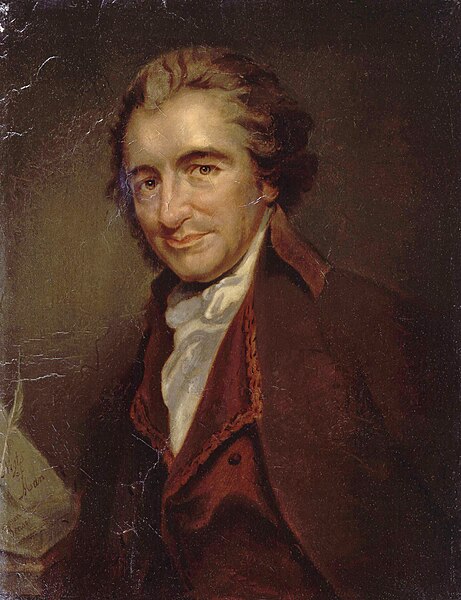
Thomas Paine and the Debunking of Religion
I've been reading Thomas Paine's pamphlet, The Age of Reason, and am struck by how incredibly radical it still seems today. Sure, times have changed (he wrote it in 1794). What he would have thought of as "the church" in many contexts would now be more applicable to "megachurches". But his fundamental debunking of religion, specifically Christianity, is as damning as ever.
A few good quotes:
On the bible as mythology
It occurred to me as I read how obvious it felt to me when I was young to critique the religion in which I was raised. This was no doubt due in large part to Hinduism and reincarnation being such alien concepts to my social network (although, in Santa Cruz, maybe not so much). In my early thoughts, as I neared a conclusion that religion and God were human inventions, I came upon such arguments as I was able fashion alone.
Off the top of my head, I try and recall a few:
While I won't go as far as to say that religion is necessarily a force for evil in the world, I will say that it is largely stupid and unhealthy. While many will find it comforting and helpful, and in many cases it is probably better than any practical alternative, it contains inherent procedures of thought that are at best constricting and at worst, deadly and oppressive. On the whole describing it as in many ways a cancer upon the human race is quite justified. While it has also been helpful, it is a habit that would be best replaced with a more reasonable world view and program for living.
Thomas Paine was a deist, likely in the manner of what would later come to be described as pantheism. I'm not sure yet why he chose to stop there. Although writing two hundred years ago, he would have far fewer sociological and scientific resources from which to level a critique of the very notion of God itself. But in his deism he was able to find all the goodness and spirituality he seemed to have needed. It was in fact from a place of profound moral righteousness that he drew the courage to challenge the religion he thought was a source of evil in the world.
Atheists too often get stuck bickering with the silliness of religionists, instead of staking out new moral ground and claims of righteous humanity. In the end, it will be this philosophical bedrock upon which future Atheists people will feel comfortable resting. And what is more, the questions there seem much more interesting and challenging than arguing about whether one or another magical fantasy exists.
A few good quotes:
On the bible as mythology
It is, however, not difficult to account for the credit that was given to the story of Jesus Christ being the Son of God. He was born when the heathen mythology had still some fashion and repute in the world, and that mythology had prepared the people for the belief of such a story. Almost all the extraordinary men that lived under the heathen mythology were reputed to be the sons of some of their gods. It was not a new thing at that time to believe a man to have been celestially begotten; the intercourse of gods with women was then a matter of familiar opinion. Their Jupiter, according to their accounts, had cohabited with hundreds; the story therefore had nothing in it either new, wonderful, or obscene; it was conformable to the opinions that then prevailed among the people called Gentiles, or mythologists, and it was those people only that believed it. The Jews, who had kept strictly to the belief of one God, and no more, and who had always rejected the heathen mythology, never credited the story.On the silliness of the creation story:
Why it has been called the Mosaic account of the creation, I am at a loss to conceive. Moses, I believe, was too good a judge of such subjects to put his name to that account. He had been educated among the Egyptians, who were a people as well skilled in science, and particularly in astronomy, as any people of their day; and the silence and caution that Moses observes, in not authenticating the account, is a good negative evidence that he neither told it nor believed it.On the misinterpretation of language:
All the remaining parts of the Bible, generally known by the name of the Prophets, are the works of the Jewish poets and itinerant preachers, who mixed poetry, anecdote, and devotion together--and those works still retain the air and style of poetry, though in translation.
There is not, throughout the whole book called the Bible, any word that describes to us what we call a poet, nor any word that describes what we call poetry. The case is, that the word prophet, to which a later times have affixed a new idea, was the Bible word for poet, and the word 'propesytng' meant the art of making poetry. It also meant the art of playing poetry to a tune upon any instrument of music.
We read of prophesying with pipes, tabrets, and horns--of prophesying with harps, with psalteries, with cymbals, and with every other instrument of music then in fashion. Were we now to speak of prophesying with a fiddle, or with a pipe and tabor, the expression would have no meaning, or would appear ridiculous, and to some people contemptuous, because we have changed the meaning of the word.
We are told of Saul being among the prophets, and also that he prophesied; but we are not told what they prophesied, nor what he prophesied. The case is, there was nothing to tell; for these prophets were a company of musicians and poets, and Saul joined in the concert, and this was called prophesying.
It occurred to me as I read how obvious it felt to me when I was young to critique the religion in which I was raised. This was no doubt due in large part to Hinduism and reincarnation being such alien concepts to my social network (although, in Santa Cruz, maybe not so much). In my early thoughts, as I neared a conclusion that religion and God were human inventions, I came upon such arguments as I was able fashion alone.
Off the top of my head, I try and recall a few:
- Infinite Regression: If God created the universe, then who created God. Science faces the same problem. But science doesn't invent an all-powerful entity. It simply says we don't know.
- Suffering: There's no explanation for it.
- Multiplicity: There are so many religions, how could one possibly know which one is correct? The vast majority of people simply follow that they were born into.
- Ego: Humans love to invent things. Our recorded history is nothing if not one big exercise in magical thinking. This seems much better explained by the limitations of our complicated mind than evidence that one of these ridiculous stories happens to be true.
- Evidence: There isn't any.
While I won't go as far as to say that religion is necessarily a force for evil in the world, I will say that it is largely stupid and unhealthy. While many will find it comforting and helpful, and in many cases it is probably better than any practical alternative, it contains inherent procedures of thought that are at best constricting and at worst, deadly and oppressive. On the whole describing it as in many ways a cancer upon the human race is quite justified. While it has also been helpful, it is a habit that would be best replaced with a more reasonable world view and program for living.
Thomas Paine was a deist, likely in the manner of what would later come to be described as pantheism. I'm not sure yet why he chose to stop there. Although writing two hundred years ago, he would have far fewer sociological and scientific resources from which to level a critique of the very notion of God itself. But in his deism he was able to find all the goodness and spirituality he seemed to have needed. It was in fact from a place of profound moral righteousness that he drew the courage to challenge the religion he thought was a source of evil in the world.
Atheists too often get stuck bickering with the silliness of religionists, instead of staking out new moral ground and claims of righteous humanity. In the end, it will be this philosophical bedrock upon which future Atheists people will feel comfortable resting. And what is more, the questions there seem much more interesting and challenging than arguing about whether one or another magical fantasy exists.
Saturday, June 26, 2010
Spirit and Atheism
As an Atheist, one is often forced to grapple with how to define one's experiences in the absence of a preconceived narrative. So, for instance, what does morality mean without an appeal to religious text or authority? Often times, the process of becoming atheistic itself created the alternative conceptual language. For something as vital to daily existence as questions of morality, this was likely the young Atheist's early order of business: in the absence of God, morality must come from human emotion and intellect, and as such any original religious teaching was thus informed; morals are relative to human experience and can only ever be based in it. This of course is somewhat more complicated than simply appealing to text, saying, "it is true because it is written." But such mindless dogmatism isn't serious anyway, and true religious thinkers know that interpreting sacred texts presents its own complications. Atheism, almost by definition (at least by its radical place in today's discourse), demands a degree of non-dogmatic critical thought from the outset.
But there are other experiences that, once removed from a religious narrative, the Atheist struggles to define. The term "spiritual" presents a special problem. By definition, it refers to the "spirit", a concept traditionally thought of in metaphysical terms. This need not imply that no such thing exists. Many concepts we find useful are descriptions of phenomenon that, while not taking direct physical form, are very real and indirectly observable. In philosophy, they are organized into different categories. For instance the concept of action is not a "thing", with physical form, but a description of a series of events that can occur. I suppose if one really wanted to be specific, all things are merely molecules in motion, and that an action could be thought of in similar terms, of molecular structure operating within a system of physical forces. So in the way that a pane of glass is actually a sheet of silica in gradual free-fall, a dance is merely an orchestrated series of motions involving an organized, organic body of molecules. Where pane of glass implies the actions of gravity, dance implies the set of neural instructions signaling muscular performance.
So what is a spirit? What is spiritual?
This is a question that perplexes the Atheist because, while the term has a specific meaning in a religious context, it explains a human experience that seems to lose much of its meaning when removed from that narrative. But it also seems to explain an experience that seems equally universal to human existence. To the religious, the spirit is everything; indeed without it, man's life would have no purpose. In the Atheist this question might provoke profound existential angst - if there is no God, there is no spirit, there is no purpose to life. Sartre hinted at this seeming paradox:
The concept of spirit can be thought of as describing this (categorically immaterial) process. A somewhat nebulous placeholder concept, like "mind" or "emotion" - it describes a fundamental reality the conscious mind faces. So while there may not be any such thing a "soul", or "spirit" in the religious sense, there is certainly a human experience that seeks to transcend one's corporeal existence and find a deeper connection to the larger universe. Implicit in this concept is a basic, ineffable incomprehensibility. There are obvious limits to conscious understanding. We encounter experiences in our lives that have real meaning for us, yet we have great difficulty explaining. Some of them are painful and tragic. Some of them are profound and beautiful. And we can adjust, orient our lives in order not only to avoid or to seek out such experiences, but also to understand them better alone or by sharing them with others.
Human culture is replete with activities designed to facilitate this sort of transcendence. Art, sport, ritual, celebration, ceremony, and of course sex, we create normative pathways in which to access states of consciousness that are otherwise inaccessible. If we think of spirituality as the degree to which our engagement in these activities facilitates transcendence, especially as a positive-sum progression towards greater knowledge or understanding of self and the universe, no matter how consciously articulated or synthesized, it seems just as useful in an Atheistic context as in a religious one.
So does an Atheist have a spirit? Can an Atheist be spiritual? To the religious, with faith in a strict dogma in which God is thought of as a very real entity, the answer must be no. However, my hunch is that to many religious people, this conception of spirituality is entirely sufficient to describe their own relationship with their chosen dogma and teachings. To this way of understanding, the conceptual meaning of God or spirit is less relevant than the actual human experience of transcendance - intellectual and emotional self-understanding and hyper-corporeal connection to the universe, in whatever traditional or non-traditional form it may take.
But there are other experiences that, once removed from a religious narrative, the Atheist struggles to define. The term "spiritual" presents a special problem. By definition, it refers to the "spirit", a concept traditionally thought of in metaphysical terms. This need not imply that no such thing exists. Many concepts we find useful are descriptions of phenomenon that, while not taking direct physical form, are very real and indirectly observable. In philosophy, they are organized into different categories. For instance the concept of action is not a "thing", with physical form, but a description of a series of events that can occur. I suppose if one really wanted to be specific, all things are merely molecules in motion, and that an action could be thought of in similar terms, of molecular structure operating within a system of physical forces. So in the way that a pane of glass is actually a sheet of silica in gradual free-fall, a dance is merely an orchestrated series of motions involving an organized, organic body of molecules. Where pane of glass implies the actions of gravity, dance implies the set of neural instructions signaling muscular performance.
So what is a spirit? What is spiritual?
This is a question that perplexes the Atheist because, while the term has a specific meaning in a religious context, it explains a human experience that seems to lose much of its meaning when removed from that narrative. But it also seems to explain an experience that seems equally universal to human existence. To the religious, the spirit is everything; indeed without it, man's life would have no purpose. In the Atheist this question might provoke profound existential angst - if there is no God, there is no spirit, there is no purpose to life. Sartre hinted at this seeming paradox:
God is absence. God is the solitude of man.But once God is gone, is man really alone? If God was only ever a manifestation of human experience, could not human experience simply replace God? In this sense, God is merely a middle man between man and his quest for meaning. Man's conscious experience is one of seeing himself as connected, yet apart from the physical universe. There may be no more essentially human experience than that of grappling with one's place in the universe. The obvious antidote to this angst throughout history has been the mythology of religious narrative. Not only a rational explanation for the what and why of existence, it provides a framework upon which to hang all of the intangible feelings as well.
The concept of spirit can be thought of as describing this (categorically immaterial) process. A somewhat nebulous placeholder concept, like "mind" or "emotion" - it describes a fundamental reality the conscious mind faces. So while there may not be any such thing a "soul", or "spirit" in the religious sense, there is certainly a human experience that seeks to transcend one's corporeal existence and find a deeper connection to the larger universe. Implicit in this concept is a basic, ineffable incomprehensibility. There are obvious limits to conscious understanding. We encounter experiences in our lives that have real meaning for us, yet we have great difficulty explaining. Some of them are painful and tragic. Some of them are profound and beautiful. And we can adjust, orient our lives in order not only to avoid or to seek out such experiences, but also to understand them better alone or by sharing them with others.
Human culture is replete with activities designed to facilitate this sort of transcendence. Art, sport, ritual, celebration, ceremony, and of course sex, we create normative pathways in which to access states of consciousness that are otherwise inaccessible. If we think of spirituality as the degree to which our engagement in these activities facilitates transcendence, especially as a positive-sum progression towards greater knowledge or understanding of self and the universe, no matter how consciously articulated or synthesized, it seems just as useful in an Atheistic context as in a religious one.
So does an Atheist have a spirit? Can an Atheist be spiritual? To the religious, with faith in a strict dogma in which God is thought of as a very real entity, the answer must be no. However, my hunch is that to many religious people, this conception of spirituality is entirely sufficient to describe their own relationship with their chosen dogma and teachings. To this way of understanding, the conceptual meaning of God or spirit is less relevant than the actual human experience of transcendance - intellectual and emotional self-understanding and hyper-corporeal connection to the universe, in whatever traditional or non-traditional form it may take.
Sunday, January 10, 2010
Darwin & Meaning
Ross Doubthat wonders what all the fuss is about Darwin's bicentennial last year. I'm not sure what his own worldviews may be, but his tone seems generally dismissive of the degree of jubilation surrounding the occasion. For him, today's Darwinism is"at once an unchallenged scientific paradigm and a wildly contentious theory of everything; a Church militant warring against creationists and fundamentalists and a debating society of squabbling professors; a touchstone for the literary intelligentsia and a source of secularist kitsch."
As a conservative, one wonders whether Doubthat isn't simply miffed that Darwinism has always been a nasty thorn in the side of the anthropocentric religiosity that buttresses his philosophy.
Personally, I find Darwin's synthesis of evolutionary theories profoundly spiritual, something I have difficulty finding elsewhere. Where in the past spirituality took for granted that the world was unknowable, modern man doesn't have this luxury.
Traditional forms thus seem like narcissistic self-involvement, or fantastical religious dogma. If the answer to the question "What is the meaning of life?" is "To continue asking the question", then Darwin has opened for a us a profound insight into not only where that road leads, but from where it comes.
(img: The 'Evolution' of Darwin - Peter Bond)
Labels:
atheism,
religion,
scientific naturalism,
spirituality
Friday, October 23, 2009
The New Atheism Pitchforks

Occasionally there is heard from certain New Atheist quarters a good deal of vitriol against all forms of religion. It is one I fully understand - ever since I first heard Sam Harris on book TV a number of years back, boldly calling for an unflinching response to the sheer absurdity of religion and asking why we are always asked to approach it with kid gloves.
And soon after we began hearing about the New Atheists and their supposedly radical agenda. Although whatever that agenda was was a matter of debate. To some, it simply meant "coming out" and actually openly declaring themselves atheist, or dropping the agnostic moniker that has served as a sort of spiritual cover - a sort of peace offering to bridge the gap between the absurd and the agnosticist "possibility of the absurd".
And others began to go further. Instead of simply adopting a principled, yet passive posture, they went on the attack. They sought to actively promote their Atheism to the blindly religious masses. The famous books were written making the case that, while quite difficult to offer proof that God does not exist, there is actually ample evidence that he is an entirely human construct, and what's more a contradictory and illogical drawn one at that. Articles were written engaging the New Atheists in dialogue. Movies were made. Billboards erected.
I cheered them on. I still do. I admit I had always felt a need to hide my atheism. The history of oppression and social ostracism is real and powerful. But as science has steadily built up a vast body of data and theory on what people are and why we do what we do, people are more and more becoming skeptical of religion and its increasing anachronism.
But there was also a sort of self-righteousness that irritated me. It seemed like the old human game was being played where people feel like they need to take sides and form teams. This has long been a part of any social struggle - regardless of its legitimacy. There's an aspect of strategy and tactics to it: strength in numbers, hold the line, surround the enemy, put them on their heels, distract them.
This can all be very effective. But it draws its strength from a deeper human emotion and can end up bypassing reason. Part of its strength lies in just this fact. When reason and reflection come into the equation they can dampen that raw emotional energy and cause people to question whether they ought to keep up the fight. This is what demagogues have always exploited. Pitchforks don't pump as vociferously through calm rationalism as they do through certainty and allegiance to the cause. And of course we all know what happens when arguments lose reason.
A powerful idea emerged from the New Atheism that, while maybe not originating through emotion, has certainly been weakened by it - effective as it has been as a sort of dark magnet for the cause. This is the idea that religion is not just a negative force, but dangerous. So dangerous in fact that it presents an urgent threat to modern civilization. I think this was triumphantly illustrated by Bill Maher's Religulous, when near the closing credits images flashed across the screen of religious zealotry and violence while a rousing score blasted (was it Wagner?), tied together in a modern propagandist display of fearmongering. This was the bypassing of reason at its most forceful.
I personally don't buy it. Sure, I think religion, combined with desperation and ignorance that leads to fundamentalism, can do horrific things. I also thing it is, on its face, stupid. It encourages magical thinking, when thinking should be anything but. It codifies oppression and degradation. It sews division and dischord.
But it is also incredibly human. That is, evidenced by its near universal adoption throughout human history, it seems to come directly out of the way our brain is wired for consciousness and processing of external stimulus. One must begin then to tease out what religion is. In one sense it is a very rational set of rules and beliefs that have their own internal logical structure. But in another it is a purely sensory and irrational experience that allows one to quiet the mind and exist in a state removed from the confines of ordered consciousness.
Religion is both of these things. One exists to serve the other. What are different religions but different ways of organizing how one might tap into that "spiritual" state of unconsciousness. These are all accomplished in degrees. At one end you might have a simple and short re-framing of a conscious experience by appealing to a magical thought, i.e. "That bastard just stole my parking spot. Sweet Jesus have mercy on his soul."
Now, this example could highlight two very different responses to the same event, with two very different conscious outcomes. The driver, obviously angered by being wronged, appeals to her religion to salve the wound. Instead of allowing the complex to linger, continuing to affecting her conscious state, she does a sort of jedi-mind trick on herself, in the form of obedience to religious teaching, and she moves on.
But two people could perform the same ritual with two very different outcomes, based largely on interpretation owing to emotional and cultural development. Person A might curse and make the same "prayer", and self-comfort with the notion that "we are all God's children" and that "they know not what they do". Situation explained, cognitive dissonance resolved. Persona B might also self-comfort, but instead with the notion "they will burn in hell because they are sinners". Situation explained, cognitive dissonance resolved.
Both appealed to the same religion, but different versions of the dogma. One could be said to have left with kindness, while the other with anger and hostility. While a simple parking-lot annoyance is quite trivial, at the other end of the spectrum we have serious matters such as war and conflict. Yet one could also make the case that for every warmongering Osama Bin laden, or George Bush, there are those who identify with the religious traditions highlighting pacifism and diplomacy. For every Palestinian suicide bomber or Jewish settler, there are aid groups in Africa or soup kitchens downtown.
Ayan Hirsi Ali, no doubt owing to her personally horrific religious experience, finds many examples of ways in which the Koran explicitly lays out suggestions that only require a simple interpretation to lead believers to commit heinous acts. This may indeed be true. But while religious texts may be dangerous, and magical thinking may lead to conflict, it also has the power for much good. In many cases, religion may be the one thing that is keeping more harm from coming.
Now, the bad may certainly outweigh the good, and thus as a philosophical position is principled. But the reality is that we just aren't anywhere close to the eradication of religion. We live in a world in which religion is tied up in ethnicity, and cultural tradition is tied up in a complex web of reason and spirituality that does good and harm simultaneously.
This is why I find the argument that some in the New Atheist movement make, that religion is urgently dangerous and needs to be cast completely out of society, both false and impractical. It is certainly sometimes dangerous, but also often very helpful, and in any event deeply tied into cultural and ethnic patterns of thought that aren't easily separable. For this reason it just isn't practical to rid society of religion, even if the threat it posed warranted such hostility.
Religion has been compared to other social ills, such as racism, or unjust political movements. But this is reductionist nonsense. Sure, there are specific tenets of specific religious dogma that one can certainly call unjust
and wrong, and intolerable (homophobia being a prime example). But to cast a net over the entirety of religious thought is reaching a bit.
People will always be ignorant and small-minded, with or without religion. They will really on logical fallacies in their thought, they will ignore complexity for easy answers. Religion can certainly contribute to this behavior. But it can also offer people a way to transcend it, or at least the complexities of consciousness that would encourage it.
And so in this way I think it should be given respect. At the very least as a part of one's cultural behavior that they should not be made to feel ashamed of having accepted. By doing so we are not tolerating any specific ideas or practices that are unjust or directly cause harm. We are tolerating the right of each individual to find their own way in peace.
Subscribe to:
Posts (Atom)