Showing posts with label capitalism. Show all posts

Monday, December 27, 2010

Gucci Bags in Wartime

David Halperin and Katherine Mangu-Ward discuss the role of the government in higher education.  Mangu-Ward argues the libertarian position - that rather than a force for good in helping striving Americans achieve a better life through college by subsidizing student loans, the government is not only driving up the cost of college tuition, but devaluing the credential itself by over-extending it in the market.  What's more, it is doing inefficiently what private banks could do on their own.  (One almost waits for her to then start in on the dubious line about how these dumb "wannabes" don't deserve to college anyway.  But thankfully she resists).


A commenter on the interview defended her point of view, framing those who would argue for government subsidies as essentially saying this:
"Shut up and pay up so people like me can go to school for free."
Ignoring the absurdity that anyone is "going to school for free", the general idea is that the moochers are weaseling the rich out of their money by getting federal and state college subsidies.

I'll get right to the point.  Success is largely social determined.  This is so overwhelmingly born out in the research it's not disputable (although, be my guest).

So, social structures are thus leveraged by the advantaged.  The fact that there are large demographic trends in college admissions makes this a pretty obvious point.  If this is true, then who has actually received the subsidy, the poor kid from a crappy neighborhood or the rich kid who's daddy and mommy both graduated from college?

You can argue this sort of "redistribution" is inefficient (as Mangu-Ward does).  But that applies just as well to every "common good" service, aka that which is for the good of the society at large.  Schools, parks, military, roads, libraries, etc. are more efficient in every way except one: doing it for the public good.  Democracy requires legislation, accountability, etc.  Not to mention provision of service with the express belief in the right of citizens to some level of access.

So, public libraries have to spend more to clean up after the homeless people you allow in.  Police have to answer every 911 call.  Schools have to provide special services to the disabled.  And they have to do it all in conditions of incredible revenue uncertainty.  This can severely hamper asset allocation.  Much of the time government is spent in a mad scramble after a fickle public.

These sort of inefficiencies might be too high a price to pay for some.  But they should at least acknowledge behind the sacrifice.  We all have values and we seek to align our government along side them.  I happen to think that the mentally ill have gotten a raw deal in life and ought to receive the very best treatment society can pay for - at least while there are still luxury goods being consumed.  That's my America.

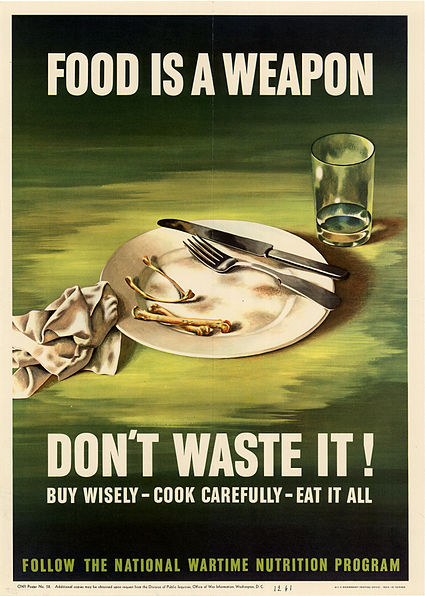
A better, more "values-neutral" position might be on an alien invasion (I imagine the prospects of being enslaved by a bloodthirsty alien race seeking to harvest our organs would be pretty universally uncomfortable).  So would we not want every last available resource martialed toward defending against the invaders?  Of course we would.  Gucci bags in wartime are most conspicuous.

OK, well maybe aliens are a stretch - but we only have to go back to WWII to see what a nation is willing to sacrifice when they feel the cause is worth it.  In that case, the only alternative was certain Nazi subjugation.  I can guarantee you that anyone foolish enough to raise a fuss about "big government" and insisting the war be fought by private armies because of their efficiency would have been given a swift kick in the arse.

Maybe I need to get very specific here: being enslaved by the Nazis is about as anti-freedom as you can get.  Especially if you're Jewish, right?  Death isn't very liberating.  And neither is totalitarianism or torture.  The point is that these experiences were so frightening that we were willing to sacrifice just about anything to avoid them happening to us.

How different then is growing up in poverty, or sleeping under a bridge because of the voices in your head?  Or how about being a single mom who can't afford childcare for her kids?  Or needing health insurance but not being able to afford it - or denied it because of a pre-existing condition?  Or being old and not having money to pay the heating bill?  Or even just not being able to go to college and better yourself because there is no practical way to do so without government help.  I've worked plenty of minimum wage jobs and they felt nothing if not oppressive.  There is always the trades, but even then, being forced into a lot in life that you were forced into choosing seems the antithesis of freedom at best.

Yet when the liberal response to these social problems is government intervention, the specter of "big government" is raised.  The basic premise being disagreed with is the specific quality of each form of suffering.  Nazis = bad, lots of death and rape = government intervention OK.  But poverty, food stamps, drug addiction = not really so bad, maybe they deserve it = government intervention not OK.

I think what is most troubling for liberals is that we see these problems as just being very sad and we feel a moral compulsion to respond in a way that no one should have to experience them, even if it requires paying for an expensive and possibly inefficient infrastructure.  The moral case is just that strong.

There are certainly philosophical principles that lead us here.  We don't believe, for instance that these people truly chose their fate, as many (all?) on the right do.  Neither do we feel that everyone should be given everything for free; it is hard to find a liberal these days that doesn't believe in a strong market system in which much of life is indeed ruled by the market.

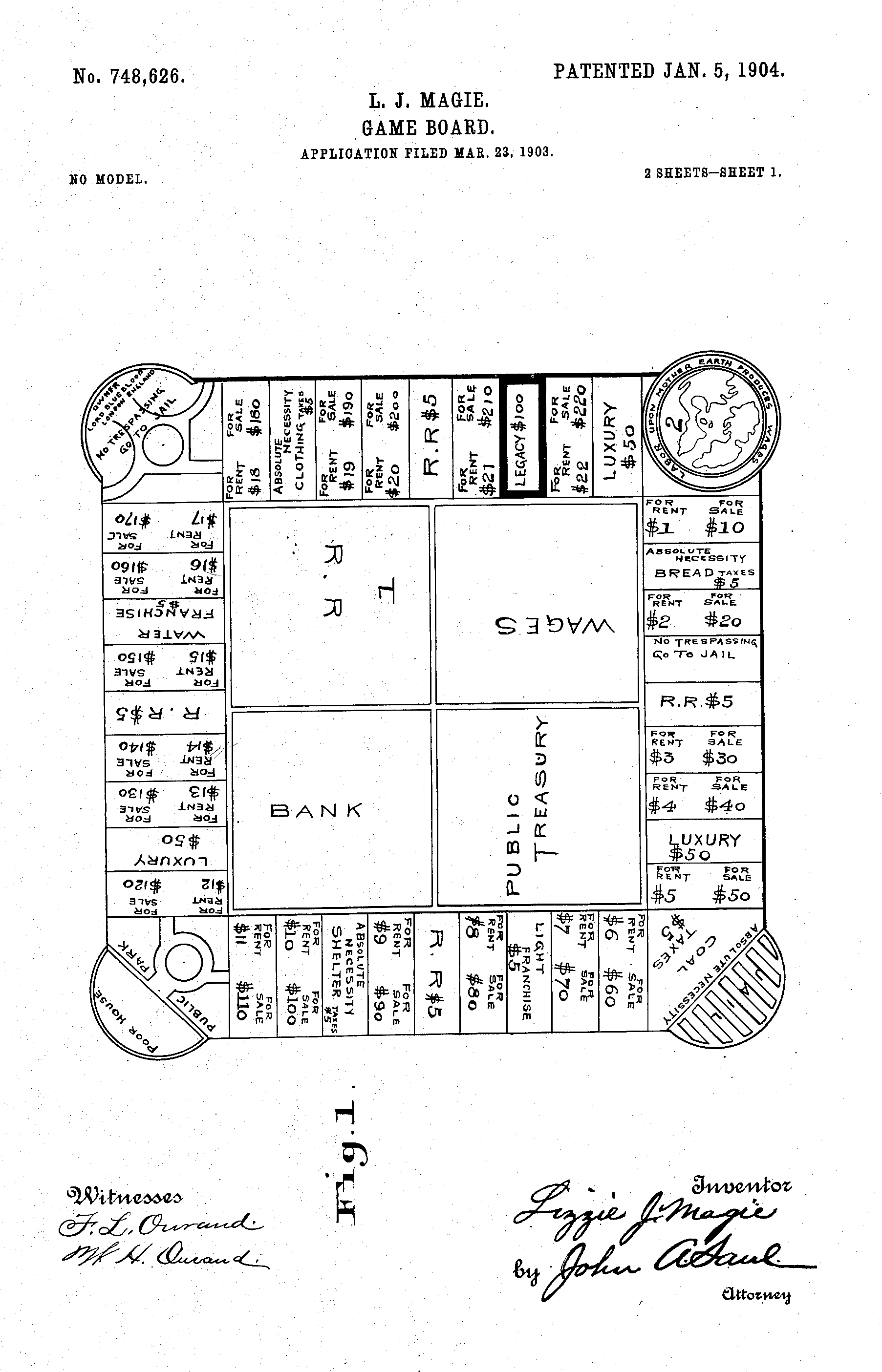
But what liberalism is definitely not is a solution in search of a problem: that we aren't really concerned with social problems and just want more government for the fun of it - or to waste the money of the rich!  This would be akin to claiming the right wants to spend money on the military and war just for the fun of it.  Actually, one might say there is something sort of fetishistic about guns on the right.  Maybe one day the left will get food stamp Barbie.  I'm reminded now of the game Monopoly being so fun as a celebration of pure greed and competition.  Games involving empathy, humility and sharing - values glorified on the left - are few and far between.  (Ironically, Monopoly itself was popularized by Quakers and based on The Landlord's Game, a board game designed to show how rents "enriched property owners and impoverished tenants".)


And so, I suppose we've come full-circle - back to who owns what, and where we come from.  The evidence for distinct structural mechanisms for class-determinism in America is really unassailable.  Although many will continue to try.  The reason for this is clear: to acknowledge it would generate a considerable amount of cognitive dissonance within the right-wing mind.  If people are not freely choosing their lot in life, then a moral wrong is occurring.  In the end, it is all about liberty.

Saturday, April 17, 2010

The Inherent Immorality of Health Insurance

Matt Yglesias points to one of the main pieces of Health Care Reform.
One of the most important elements of the Affordable Care Act is the requirement that insurance companies maintain a “medical loss ratio” of at least 85 percent—which is to say, spend at least 85 percent of what they take in in premiums on purchasing health care, rather than on profits and salaries for insurance company employees.

He provides the following chart:


The strange thing to me about the entire health care debate (or gosh, is it over?) is that there is an enormous conflict of interest inherent to the health insurance business.  In order for businesses to be successful, they need to, well, be businesses - in other words to try to make money.

But unlike just about every other business, health care determines people's lives.  I mean, if people don't get proper treatment they get sick and die.  But that can get really expensive, thus caps and pre-existing condition lock-outs.  So now, to try and make things more moral (i.e. not force people into dangerous ER situations and the cost-shifting that involves), we require equal access.  But as businesses, this is terrible for the industry.  It basically means sacrificing profit for morality. So then you get the mandate, the subsidies, the 3-legged stool, yadda, yadda. 

But all of this to account for the fact that insurance companies, to provide a social good, must sacrifice profitability.  We don't ask other businesses to do this.  It would be like, in the absence of a public school system, requiring private schools to take on charity cases from the neighborhood.  The only reason we wouldn't dream of that is that we allow for a certain level of decency to children that we don't adults.  (Although many people have been perfectly willing to allow kids to go uninsured.  These people are sick.  And Republican.  And they wonder why they get a bad rap?).

It seems reasonable that in markets where there is a moral obligation to sacrifice profit, morality will lose out.  It isn't as if some noble insurance companies decided to open their doors to pre-existing conditions "out of the good of their hearts".  They wouldn't be very good businesses if they did.

Tuesday, January 12, 2010

Moral Growth

Economics has always given me a headache - especially because despite being difficult, even the big boys get incredibly partisan. Someone has to be right, but one is skeptical when their economic theories seem to match up so nicely with their sense of social fairness and human behavior.

But one thing that is always particularly irksome to me, as a leftist, is the degree to which the right blames leftist policy for a lack economic lack growth. So you have a principled opposition to redistribution as being illiberal, which then just happens to be bad for economic growth. Those to me seem like two distinct problems. If redistribution was illiberal, yet good for economic growth, it would still be wrong. And likewise, if redistribution was necessary for freedom, but bad for growth, it would still be right.

Of course, the devil is in just how far one influences the other. If any policy is bad enough for growth, leading ultimately to a decline, then whatever freedom gained would be irrelevant. And here is where, I believe, the right gets its wedge in: the immorality of social inequity is always justified by the larger emphasis on growth - the rising tide and all that. And to the degree that the tide just doesn't rise high enough for those at the bottom to be considered truly free, well, that battle can be fought another day.
"Look at all the generational poverty!"
"Yes, but they have COLOR TVS!"
So here we have the "rising tide", the "trickling down", being philosophical gold. So much of conservatism's economic and moral construct becomes dependent upon the validityof this premise: not only is redistribution wrong, it is actively harmful to the economy. Redistributive social spending, while well-intention, is actually hurting people by dragging down the entire economy. At the far end of this spectrum, you get the wingnuts claiming that any day now the hammer and sickle will replace the stars and stripes.

But what would a moderate increase on taxation really do? We know for certain that it would be helpful to many struggling Americans. There are any number of ways to do it effectively. There are also many ways to do it poorly, but the fact is that concrete things can be done if we believe in the idea. (Much of the outrage over wasteful spending has more to do with the fact that it is unwanted then that it is poorly executed).

But what we do not know for certain is how much of a drag any of it really is on the economy. It may be unfair, or immoral, but does that make it that bad for the economy? If I steal from my neighbor, and invest the money in something that creates growth, I've just done something wrong for one person, yet something right for the economy.

We can argue all day about whether social spending represents a better investment than private business investment. But the two are not mutually exclusive. Considering how much better - from a left perspective - Europe is on social initiative, I'm pretty happy about the margins of real disagreement on who is better at growth. One thing is certain, Europe isn't painting a hammer and sickle on its flags any time soon.

Thursday, January 7, 2010

I Don't Understand My Fellow Americans


I don't understand my fellow Americans.

If many of them had their way there would be no justice system. There would be good-doers and evil-doers. Period.

The concept of "rule of law" to them is a joke. Our founding principles of fairness, nuance, tolerance and human dignity, subsequently substantiated by science again and again, are foreign to them.

It's as if there's this large artery of evil, pumping out anger, fear, pridefulness, resentment, and other reptilian emotions responsible for everything wrong with the world. And they just mainline it, along with the the xenophobes, the racists, the majoritarians, the theocrats, the homophobes, etc.

They got theirs. Good and evil. Black and white. Fuck everyone else.

Our prison system is a festering nightmare of cruelty. We can't decide whether to punish or rehabilitate, so we just let people rot - subjected to daily humiliation, brutality and threat of death. Then we wonder why recidivism rates are so high. To many convicts, life inside isn't so different than the outside - with it's "game" mentality, dysfunctionally anti-love and anti-life.

But we didn't really care about them before they went to jail. So why care now? We set them up to fail and then kick them while they're down.

The whole mindset of American conservatism makes me physically ill. The pomposity. The callousness. The knee-jerk assumptions. The cowardice. The narrow-minded ignorance. The hypocritical values. The selfish greed. The impatience. The failure to put themselves in the shoes of others. The uncritical embrace of tradition. The acceptance of inequality. The self-satisfaction.


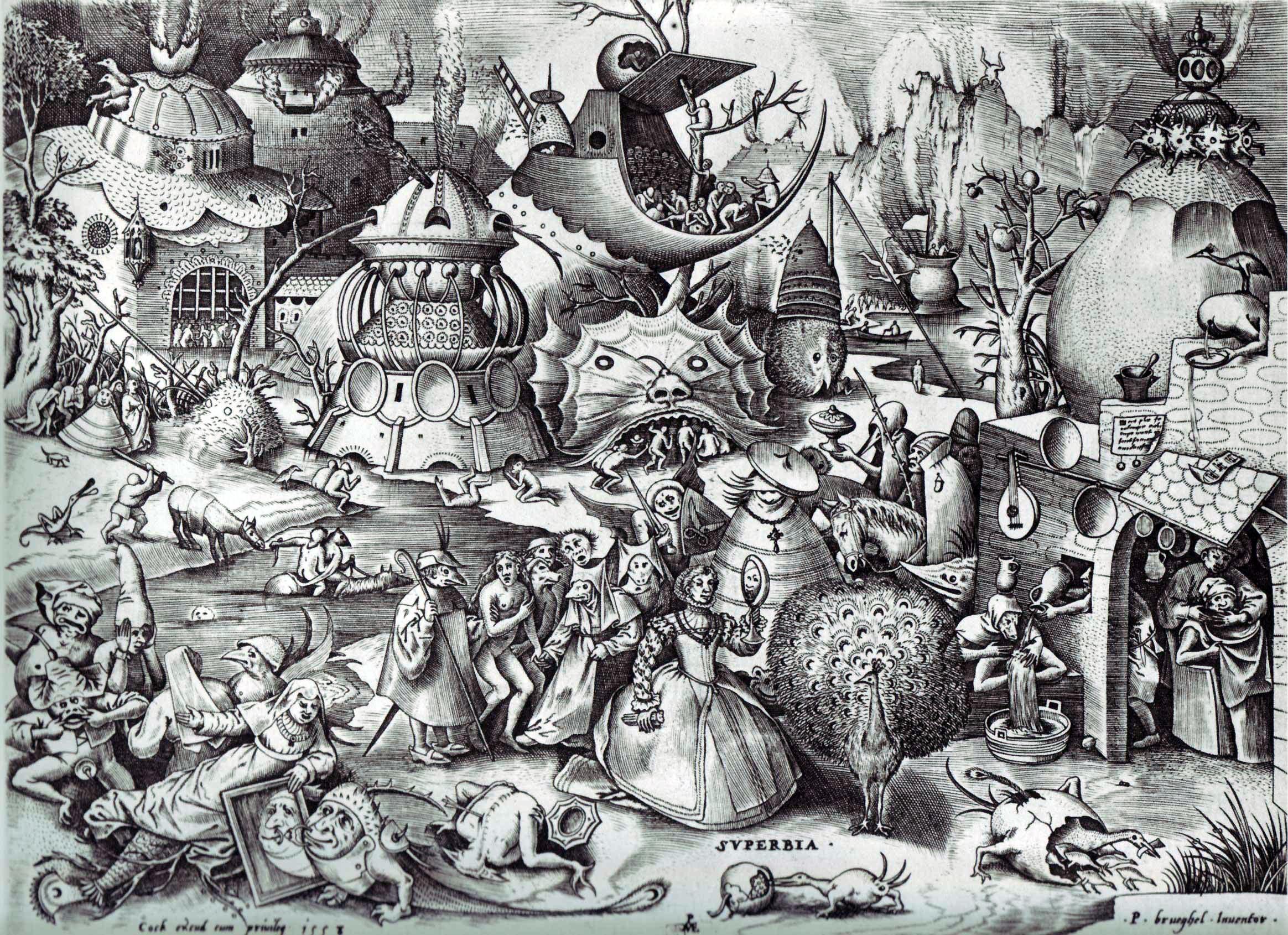
Pieter Bruegel - The Seven Deadly Sins: Pride


So much of it can be chalked up to simple ignorance. But what about the college-educated conservatives? What about the ones that make it their business to understand the world? There are other religions. There are other types of people. There are other ways of viewing the world. Did they never read about studies of human behavior? Anthropology? Philosophy? Economics? Colonialism? Race relations?

Why is their view of why people do what they do so different from mine? Why is mine so much more concerned with systemic injustice? Why is theirs so concerned with deflecting blame? Why is mine reflected in every major faith's emphasis on humility, sacrifice, love and kindness, the least among us - while theirs in the absolute congratulation of the self? I'm a fucking Atheist and I know this!

The politicians represent them. The media feeds on their worst, most craven impulses (within FCC limits - an irony). But they live and fester on their own, seeping into the sunless nooks and crannies of darkened, blinded thought. Unconcerned with ever looking at the world in a truly fresh or objective manner, everything must first be passed through conservative goggles of "the free market & me".

Healthcare must be neither redistributive, nor bad for business or me. The free market couldn't have made it the way it is. And government will only make it worse.

Economic catastrophe couldn't possibly be the fault of a free market. Government couldn't possibly help. In fact, they must have caused it. The solution is a freer market.

The problem with education couldn't be society or a failure of the free market to meet social needs - it must be government and unions (organized labor). Although we can't exactly stop offering public education, right? I mean, they are children after all.

The problem with the criminal justice system can't be solved by supporting people before they go to prison, or helping them learn to be better individuals once they get there. The solutions is simply to lock more people up, for longer, and offer less support! (Oh yeah - and let's blame the cost on prison guard unions).

Who am I kidding. What problem in the world could not be solved by free markets and people "deciding" to do the right thing? If they don't, it's their fault. There are no social forces at work! You have a choice to accept Jesus Christ as your personal savior and if you don't, you'll burn in Hell anyway!

Problem fucking solved.

Tuesday, December 8, 2009

The Question of Free Will and its Bearing Upon Governance


Governments can be, and are, defined in many ways. I think the modern world is pretty well discovering that, while not perfect, a capitalist social democracy is generally best. We enjoy electing our leaders, starting businesses, and the provision of public education. I think it’s safe to say that neither extreme communism nor libertarianism are sensible options.


At its most basic level, government is formed to provide for individual security and freedom. How these come to be defined, and then achieved, present a formidable philosophical and practical challenge. Yet I believe a key insight into where we must begin on this matter, is the question of Contra-Causal Free Will (CCFW). In order to define what government ought to be, you need to determine whether CCFW exists. A large enough subject in its own right (although one I firmly believe has been settled, due in no small part to the discoveries of modern scientific research), for the purposes of this discussion, I will avoid much of the arguments for and against the question of CCFW, and concentrate mainly on the implications of its resolution.


Because I don't believe in CCFW and the processes underlying what makes us who we are, I don't believe it is fair for a child born to a family poor in social capital to have to compete with a child born to a family rich in social capital. Therefore, any government system that does not actively seek to redress this inequity of means not only does not guarantee freedom, but through inaction actively promotes the continuation of a status quo that is anti-freedom.


For instance, in our modern economic system, if one man is able to live richly off the low wages of thousands of others, whose freedom are we talking about? Should his wealth be relative to the stability and basic fairness of the larger society upon which his market is based, or is it simply relative to what he can buy with it?


These are certainly not easy questions. And we see them being labored over intensely in current debates over healthcare - does our modern society owe it to each individual to guarantee a minimum of health services?

Conservatives know exactly where they stand on the issue of free will and why it is so central to their concept of government. They come back to it again and again as a justification for their interest in maintaining the status quo. They see a socially activist government as entirely unethical: not only does it seek to unfairly redistribute income through progressive taxation, but it seeks to fritter it away on services that would be unnecessary if people would only choose correctly (drugs, parenting, education, hard work, crime, etc.).


Liberals are the ones I always find oddly oblivious to the inconsistency in both holding that society has a responsibility to promote fairness, and that free will does indeed exist. I think the reason has more to do with free will having an entrenched philosophical advantage in being the incumbent world view, well, for most of recorded history.


But I think the paramount example of why CCFW matters is in constructing a criminal justice system. Currently, we inflict terrible punishment upon convicted criminals – a prison sentence is certainly cruel, if not unusual. Yet if CCFW does not exist, then what business do we have in exacting revenge upon people who could not have chosen any differently? Going back to my point regarding children: we treat them with forgiveness to the degree we attribute to them a lack of CCFW. The reason we treat them with the full harshness of the justice system when they reach 18 years of age is precisely because we deem them as suddenly possessing full CCFW: they could have made better choices.


Were we to instead deny CCFW, we would then have to treat adult criminals with the same sort of understanding that we do children: that they were not really responsible for their behavior: that society and genetic chance was. While acknowledging any continued threat they may pose society, as well as providing a message of deterrence, we should certainly still hold them accountable and protect society from them. But we ought to treat them with dignity, at least attempt rehabilitation, and certainly not subject them to the sort of violence and abuse rampant in today’s prisons.


On the flip side, neither does rejecting CCFW allow us to treat the millionaire as if he is responsible for his own success, rather than society and genes – at least in so far as he enjoys a level of power and privilege due to simple circumstance. This is why we no longer tolerate kings and aristocracy. What right does the wealthy man have to his wealth when it was obtained through no doing of his own? A civilized society is based in the concept that every man ought to be free to “pursue their own happiness at minimal detriment to everyone else's”. Implicit in this assumption is that we all ought to begin that pursuit at a reasonable level of equality of social capital.


So it would appear to me that not only does the question of free will have great bearing upon our personal values, but it must be dealt with if we are to structure a government that is able to best deliver freedom of opportunity to society. Fittingly, just as whether or not CCFW exists we must act as though it does, we must also structure our society according to whether or not we believe in CCFW. The consequences for either belief or disbelief could not have more dramatically different political implications.