Showing posts with label government. Show all posts

Saturday, June 23, 2012

Questioning the Social Good

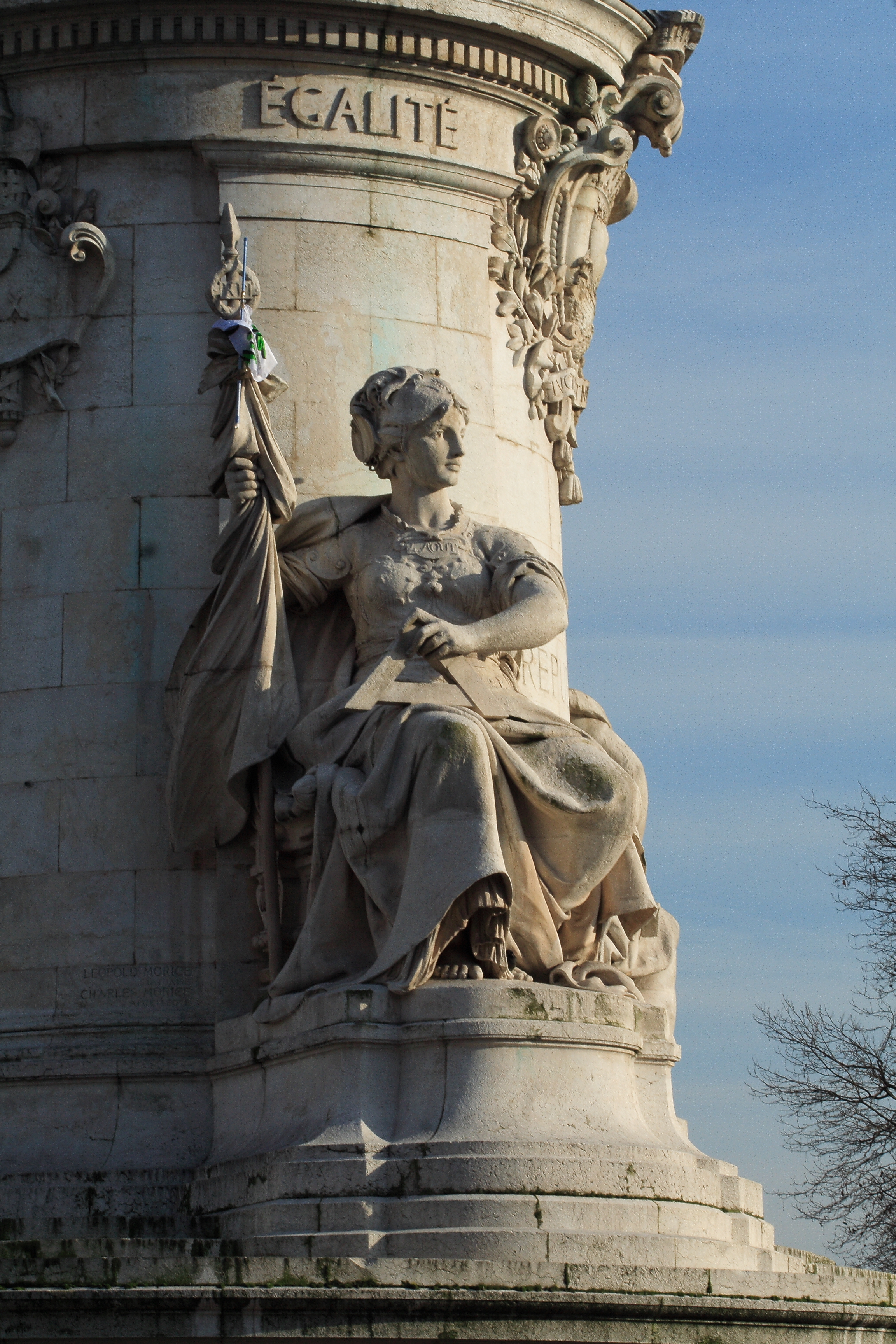
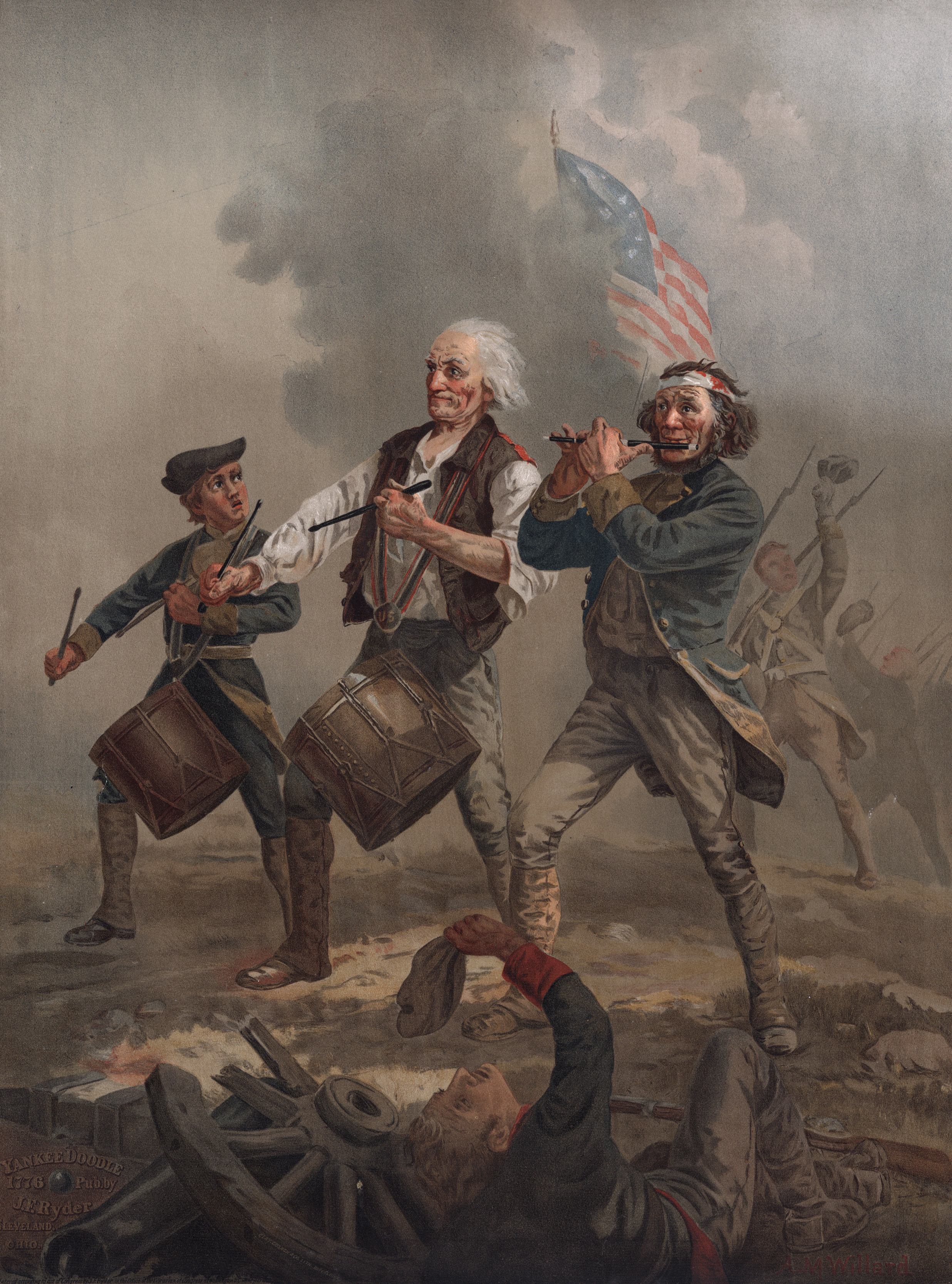
The Spirit of '76, A.M. Willard
While looking back over some of my older posts (I'm considering using my currently unemployed status as an opportunity to publish my writings into something of a book), I came across an entry on the tendency of social spending to go to people not in our personal community, and thus "out of sight, out of mind".  I was reminded of how this is a perennial problem for progressivism, as not only must we make a case for the efficacy of these programs, but so too their moral necessity.  The merits of government action have a moral claim when they are felt to be worthwhile endeavors.  And they are worthwhile if they are providing a valued service.  We can all appreciate the services we experience directly, or can easily imagine to be necessary.  Roads, police, parks, libraries, etc. are all things that we can personally take advantage of.  A national defense, while more abstract, can at least be imagined to be important to the safety of ourselves and loved ones.  Yet what about a moral case for services that we will never imagine needing?

A moral appeal requires showing that the recipients of such social spending, the beneficiaries of our larger social largess, are themselves worthy.  Yet because of economic and social segregation, these are often people who are not a direct part of our communities.  To the progressive mind, ever conscious of inequality and social injustice in society, it is easy to imagine their plight, even if we do not live in their community.  We see a causal connection between a child raised in poverty and his likelihood of lack of success in adulthood, and argue that this is a social problem that requires intervention.

However, the conservative mind is much more likely to believe that it is the responsibility of the poor family to help themselves, and that it is not the moral responsibility of society to help.  Further, doing so would probably make things worse, either by wasting tax dollars better spent on growing the economy, or by creating a moral hazard problem in which the aspirations of the poor are dimmed and a culture of "entitlement" sets in.

Although as a progressive I am already biased against the conservative outlook, in my career working with the poor and needy, I have found little evidence to support conservative claims.  Indeed, have found them not only to be genuinely disadvantaged, but generally in situations in which but for government or private charity, their circumstances would be much more dire.  Neither have I found much evidence that a "culture of entitlement" has arisen because of social largess, primarily any such culture is the product of vastly larger forces at work than any pittance of social services on offer.  An individual with healthy levels of human and societal capital is not going to give up all personal ambition and choose a life of poverty for the chance to acquire free food stamps, child care, or a disability check.  While many individuals exist who no doubt could find more personal success would they just apply themselves, and instead rely heavily on government aid, they represent a very small portion of recipients, and in the absence of aid would still lack the human and societal capital to make much of themselves regardless.  Properly designed social programs are structured in such a way as to promote individual agency, rather than retard it.

But how to make this moral case to those who would not naturally align themselves with the poor and downtrodden, and who will rarely if ever directly experience their struggles?  Conservatism has become (to what extent it has always been, I can only guess) enraptured with the idea of government as a sort of personal market.  Instead of an institution that promotes the welfare and well-being of all, it is thought of as an institution that ought only promote the welfare of oneself.  Thus, the question becomes not "what is society getting out of government", but "what am I getting out of government"?

The model shifts from one of social insurance and shared sacrifice, to a personal, transactional ledger of goods and services rendered.  No better example of this exists in the movement towards vouchers and charter schools.  The question is posed as what is an individual getting for their tax dollars, as opposed to what is society getting?  Public schools have always been socialist in the sense that they are a provision of the government, guaranteed to all children, designed to maximize the social welfare of all.  Private schools, by contrast, operate in private, for the sole benefit of the individual, and without concern for the welfare of anyone else.  This is why we do not fund private schools with public funds - their purpose is expressly at odds with the mission of public governance.  If one spends public monies on private schooling, one might as well return all taxes and allow individuals to purchase parks, libraries, roads, police, etc.

The absurdity of this logic rests in the fact that public spending is fundamentally based on  a principle of social good, and the redistribution of what you might call social risk.  For instance, many people do not have children, yet agree to pay taxes so that other people's children are guaranteed an education, or so would theirs should they find themselves with young of their own - the risk being that any child should lack a proper education.  Likewise we all pay taxes for services that we do not directly consume, such as the paving of a street across town.  Yet we agree to such services in order to avoid the risk that any of us not have a paved road, or that should we drive down that road, it be paved for us as well.

This - the sharing of risk and mutual responsibility for fellow man - is a basic premise not only of democracy but of civilization going back millenium.  Even kings were obligated to provide for their people, lest the people become too dissatisfied and organize a rebellion.  The notion of democracy comes in when the people, not a king, demand to control how this risk is managed. For sure, the American revolution was fought expressly over the idea that taxes were being collected to pay for risks over which the people were given no claim of ownership.

Which is as good a place as any to bring up the Tea Party, a conservative movement founded in part with the Revolutionary notion in mind that taxes ought to be used fairly.  Yet to these conservatives, decked out in Revolutionary garb as they often are, the issue is not that the people are not being given say in how risk is managed (after all, the social spending they decry is passed legally, by elected representatives), but that they are be forced to risks which they do not approve of.  While the progressive sees the an injustice in the disadvantaged not receiving help from a society that has a moral responsibility to help them, to manage their their risk, the conservative Tea Partier sees an injustice in having to be held personally responsible for that social risk.  To him, driven by such long-standing distrust and anger at the government, the idea of social risk itself has increasingly been called into question.  In coming to view the government not as an institution entrusted to provide for the greater good, but rather as an institution unfairly taking from him and giving to others, he has come to question the very notion of social good itself. 


Sunday, February 27, 2011

Demanding Taxes

California, like most states across the country, is facing dramatic cuts in government services.  Polls show that when asked about specific services, people want them.  But when asked about raising taxes, they shrink.

I'm sure much of what is behind the immaturity of Californians, of wanting to have their services without paying for them, is the relentless propaganda that for decades has been declaring government and the taxes we pay for it evil.  When the bill comes due, personal responsibility is no where to be found.  Instead the blame is placed on waste, fraud and abuse, and the terrible, bloodsucking unions.

Meanwhile, at the local community college where my wife works, they are canceling an entire section of remedial English courses, effectively shutting the doors on hundreds of prospective students.  This is just one of the many tragic stories that will be surfacing in coming months.

There is a lie being sold across the country: because the state is broke, we can't afford to pay for things.  The truth is that in our adoption of a right-wing view of limited government, we don't want to pay for things.  The dishonesty here is that one can say, "Look, I'd like to, I really would, I just can't afford it," and hold on to moral dignity of pretending to care.  But in reality one does not actually care. 

Much of the response to the plight of public sector workers, clinging to their bargaining rights and pensions, has been the rather spiteful, "I don't get a pension, so why should they?"  Stephen Colbert, playing his satirical role to the hilt, summed up this notion by asking, if a rising tide lifts all boats, then when the tide goes out, "I want to pull their boat down with me."  This might be more understandable if we were talking about the millionaires and billionaires who have been getting steadily richer throughout this great recession.  But it is not.  They have been having their taxes cut, while the public blames middle class teachers, firefighters, police officers and prison guards.

It is time to stand up for what we want from our government, in clear terms, and demand that those who can afford to pay their share do so.  They cannot claim that we are "stealing" their money.  They cannot claim that taxes will limit growth and prevent jobs from being created.  It is our right to demand taxation, as it is the price required to live and do business in this great country.

Friday, February 25, 2011

Whipping Unions

A common argument you hear in defense of the Republican assault on public sector unions (aided in no small part by the liberal embrace of union-busting teacher reform), is that the public sector shouldn't be allowed to have union representation at all - that they necessarily have a conflict of interest with government. Just because they are a constituency paid by government, they are not guaranteed any other special privileges than private constituencies.  Jonathan Zazloff asks why public unions are considered corrupt, but not limitless spending by private corporations:
Public-sector collective bargaining is unhealthy and distorts democracy because it enables workers to influence the government which negotiates with them; but
Unlimited and secret corporate political campaign contributions are necessary to democracy because they enable corporations to influence the government which regulates them.

It is a slippery slope fallacy to assume that because unions can argue for better pay, and better pay can buy more representation, thereby acquiring better pay, a corrupt feedback loop is created. The obvious problem with this is that there are numerous checks on union power, not the least of which is the fact that government officials are democratically elected. This argument generally rests on the notion that political speech is necessarily corrupt.

Yet, this applies just as well to private political speech. Enter Zasloff’s suggestion that private corporate speech has just been given an enormous boost, generally by the same folks who are now decrying unions.

Another argument on the right – one I heard just today – is that unions were responsible for the destruction of private sector jobs, and now they’re doing the same to the public sector. This is absurd in numerous ways. For starters, even assuming that unions were responsible for job losses due to pay demands, workers would never have been able to compete with third world labor.

Yet what happened to the productivity gains when those jobs were done more cheaply? How has that “trickled down”? And if there had been no unions, and if workers somehow would have been able to compete, where would the productivity gains have gone then?

Yet the public sector can’t outsource its services. So how would unions be able to destroy that sector? Are public workers making too much? I think that’s pretty subjective. I certainly don’t feel like they are getting anything more than they deserve. Are other workers getting what they deserve Probably not. But whose fault is that? By cutting taxes on the rich, are those “productivity gains” going to trickle down too, just like they did in the private sector?

Saturday, February 19, 2011

Distractions

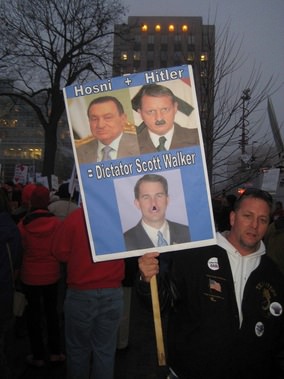
Matt Welch at Reason finds a distasteful sign at the Wisconsin rally and has this to say about public sector unions in general:
I have written in the past about how libertarians are pretty lonely in the political scheme of things in terms of constantly being challenged to defend themselves against the "logical conclusion" of their philosophy. But I think it's time to amend that. We are witnessing the logical conclusion of the Democratic Party's philosophy, and it is this: Your tax dollars exist to make public sector unions happy. When we run out of other people's money to pay for those contracts and promises (most of which are negotiated outside of public view, often between union officials and the politicians that union officials helped elect), then we just need to raise taxes to cover a shortfall that is obviously Wall Street's fault. Anyone who doesn't agree is a bully, and might just bear an uncanny resemblance to Hitler.
This is an object lesson in cherry picking problematic elements of the rhetoric used by those with whom you disagree, in order to create a straw man.

That was a terrible sign.  But is there much evidence of that type of rhetoric elsewhere on the left?  With the Tea Party, as with right wing radio and television in general, there seems to be a definite trend.  What is more, there is a longstanding tradition on the right of a narrative that literally worries that liberalism is inherently fascistic and will lead to tyranny.  That said, it is an important reminder of how muddled thinking cripples debate.  More than anything, what the above sign did was to distract from real engagement.

Welch also makes some more serious points.  There are a couple of assumptions implicit in Welch's commentary.
1 - Because few private pensions exist, public pensions shouldn't either.
2 - Public workers shouldn't be allowed to unionize, because they'll end up capturing politicians and getting paid too much.

1 - Should private pensions not exist?  It would seem that pensions are a form of compensation set up in an environment of job stability.  For a number of reasons, they couldn't be maintained.  But does that necessarily apply in public sector work, which is almost by definition a very stable industry (we'll always need cops, teachers, firefighters, etc.)?

2 - Public workers have the same needs as private workers.  Aside from basic questions of labor rights, unions can be an invaluable way for an organization to get objective input from its "members on the ground" - middle managers are just as interested in preserving a status quo that makes themselves look good at the expense of larger truths.  (Our teachers union is greatly interested in best-practices and is often the only bottom-up link politicians and administrators have with what is really going on in the classroom.  To the extent that they are receiving information they otherwise could not that affects students, it is a structure that ultimately benefits student learning).  Any large organization is fooling themselves if they think that workers won't rationally choose to protect their jobs to avoid rocking the boat.  Often, the channels for constructive criticism simply don't exist.  (The popular television show Undercover Boss illustrated this point again and again).

The argument against political capture is valid as far as it goes.  But if you accept the argument that all workers ought to have organized advocacy, not only to benefit themselves, but to benefit the larger organization, this weighs against it.  And if you look at union-backed public compensation in general, it isn't terrible out-of-control at all.  Obviously there will be debate, but if you think public workers are living high on the hog you're sorely mistaken.  The compensation I see seems perfectly reasonable.

Welch is making a slippery slope argument when he says worries that the democratic position on public unions will lead to a political capture that will spiral out of control.  The problem with slippery slopes is that they aren't logically predictive.  Just because something could, in some perfect scenario, happen, it doesn't mean it will.   This is why we don't have speed limits of 150mph - or 10 mph for that matter.  Other pressures come to bear.  With public sector unions, that pressure has kept compensation pretty reasonable, and is certainly coming to bear now.

Yet what to make of Welch's claim that the current situation is proof that public workers will always require an increase in taxes - if tax rates were sufficient to cover compensation before, why are they inadequate now?  A picture is painted in which closed-door negotiations conspire to grab ever-more of public coffers.  Yet the public consistently supports services they are unwilling to pay for.  This schizophrenia pits public confusion (manipulated in no small part by ideologues and politicians) against sound fiscal policy.  What's more, the electoral reality is that this also reflects a bitter split between competing visions of what public services should exist to being with.

Furthermore, while the recession has hit all states, each fiscal situation is different.  It is simply not the case that state deficits can all be pinned on compensation negotiated by public unions.  Frequently, pension coffers are drawn from to finance other areas government.  To blame pensioners now is not only an unfair breach of contract, but it is a dishonest manipulation of fact.

Saturday, January 1, 2011

Looking for Any Excuse

Brookside Mill workers in 1910, Knoxville, Tennessee, USA
An article in the New York Times describes the growing anger across the country directed at public service workers.  As state budgets face red ink, many are shifting their gaze towards one of the last seemingly stable sectors of the economy.  Unions are seen as shielding their members' exorbitant salaries, pensions and job stability itself.  As the economy continues to stumble, people are asking why they should continue to foot the bill for these seemingly recession-proof workers.  As the article puts it:


A new regime in state politics is venting frustration less at Goldman Sachs executives (Governor Christie vetoed a proposed “millionaire’s tax” this year) than at unions.
This is an interesting point.  There is a clear calculus being made here that unionized public sector workers are somehow less deserving of the need to sacrifice than millionaires.  This, despite the fact that most public workers clock in at the low end of the middle class pay scale.

The philosophical basis for this distinction is rooted in the conservative, meritocratic fallacy that millionaires not only deserve their wealth because of hard work, but are the active engines of economic growth.  Therefore, taxing their income would actually stifle growth.  The essential image of this picturesque fantasy is one of every millionaire out there starting new businesses or investing their money in growth-industries.  Of course, when speaking of tax breaks of $20-30K, none of these individuals is indulging in zero-sum consumption - in which their spending produces no net gain in growth; i.e. jewelry, fine leather goods or vacations in Aspen.  Of course not.

Yet what seems particularly more irksome than the notion that millionaires are magic growth machines, is the idea that lowly non-millionaires are of negligible worth to society.  Now, maybe I'm getting ahead of myself...  maybe these outraged Americans do actually value the public service workers who spend their days working for the very same "government" despised by those outraged, and who perform jobs they would just as soon not have them do at all.

But even supposing these workers are valued, why expend so much energy trying to cut back on their salaries and benefits while sparing the marginal rates of the very wealthy, unless you fundamentally don't believe those jobs are worth doing.  As the article notes, simply acting out of a sense of fairness would seem spiteful.
All of which sounds logical, except that, as Mr. Moriarty also acknowledges, such thinking also “leads to a race to the bottom.” That is, as businesses cut private sector benefits, pressure grows on government to cut pay and benefits for its employees.
An increasingly familiar complaint is that anyone should expect a pension at all.  On a recent episode of 60 minutes, New Jersey Governor Chris Christie flat out asked the question:
I think the general public thinks, 'I can't believe anybody gets a pension anymore. I've got a 401(k). It got killed in the stock market. I don't know what I'm gonna do for my retirement. I can't believe people get a pension anymore.'
Well, we know what Governor Christie thinks.  You know, maybe the minimum wage is a bad idea too.  And maybe costly workplace safety regulations.  Or overtime pay. 

I think we know where this is heading.  We've literally been there before, and conservatives are itching to take us right back.  And a recession is as good an excuse as any.

Wednesday, December 15, 2010

Public Art

The controversy over the Smithsonian's recent censoring of an art exhibit has reopened the old debate over public funding of the arts.  For many, art is simply something the government ought not be in the business of funding at all.

A classic liberal response to this is that, by funding art, government is actually giving artists and the public more freedom. So in a completely private market, you would have a lot of forces in pushing down freedom in many ways through private capture of the process (recording industry, galleries, museums, venues, broadcast, promotion, etc.). Of course, these also create a good deal of freedom, as the market drives a lot of innovation and allocates capital to content creators.

But it can also push out innovation, or limit public access. If art is ultimately a commodity, the content can get pressed into "what sells". And if the means and mode of production is tightly controlled, "what sells" is often going to be dictated, rather than a natural expression of popular demand. (How much are Katy Perry or Nickelback genuine artistic expression, and how much are they contrived and highly-produced pop commodities?)

I'm certainly not arguing that all of this is necessarily bad. But, like most liberal concepts of government, the idea is generally that it can provide something additive. So you can still have the cheesy music and television, but that there is a place for public funding of the arts that provides a small amount of liberation from the shackles of market demands. NPR, public television, art grants are all examples of wonderful content that might not be able to survive - or at least not in as rich a form, were it not for government support.

I've known a number of people who play - I guess you would call it - avant garde music. They sacrificed a great deal for their art, knowing that it would never pay the bills. That's fine. But I'd make a principled argument that they should have been able to find some sort of financial support beyond what they were able to find. I'm not sure what this might have looked like, but in principle I don't think it's a bad idea. Geez, universal health insurance would have been great!

In the end I'd just place art in the same vein as a common good such as libraries or parks, that aren't served well enough by an entirely private marketplace. There ought to be at least some level of assistance. The artists and the public I think deserve it and are better off for it.

Sunday, November 7, 2010

Fearing Government

In a bloggingheads diavlog with Peter Laarman, Susan Thistlethwaite makes a really interesting point on the anti-government mentality: you're alone.


This can't but feed a sense of alienation and well, fear. The modern conservative movement has essentially come to mean the demagoguery of government. From a reasonable skepticism about the role of government in particular areas of life, it has through endless political propaganda and movement politics morphed into an angry attack on the very idea of government itself.

This is incoherent. Most conservatives will themselves admit to supporting all manner of government services, from libraries to schools to parks to social security and medicare. But in seeking to demonstrate that government is not explicitly doing what they want it to do, in the way that they would prefer, the rhetoric of the movement denies the great and undeniable good that old fashioned government does day in and day out.

This occurred to me today as I drove up one of the beautiful streets in my hometown: the degree to which we take for granted the almost seamless perfection with which our state functions. Who cleaned the street? Who decided to put a left-turn lane there? Who made sure those street lights were working properly? Who planted those shrubs? OK, maybe "seamless perfection" is a bit over the top. But all-in-all, we've got it pretty good.

And in a much grander fashion, we see laws being organized, voted on and followed. We see mail being delivered and businesses applying for the proper permits. We see commerce regulated, children taught, the needy fed, the sick and injured given emergency services.

Now, of course we disagree, often profoundly over what should and should not be done. But that is to overlook the fact that we agree on so much! And we benefit in so many ways from a qualified, competent, citizen-directed and responsive government. To the degree that we have any major problems with the government, is is in the quality, not the quantity. Corruption ought to be rooted out, inefficiencies tightened, important needs met.

But there is no need for existential questions about government, which is what the rhetoric against "big government" often implies. We should all be thankful that we live in a country where things work as well as they do. And to the extent that we do not appreciate this, that we have lost faith in a government that is overwhelmingly good, I worry that our cynicism will only make things worse.

Wednesday, May 26, 2010

Hobbes, Locke and Perilous Zeal

Damon Linker has a good post up on the difference between liberal and tea party political philosophy:
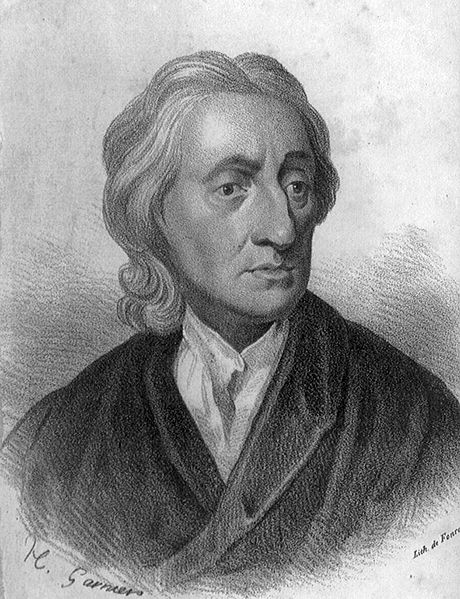
Speaking broadly, modern government moves between two poles, each of which has a seventeenth-century thinker as its champion, and each of which is focused on minimizing a particular form of injustice. On one side is Thomas Hobbes, who defended the creation of an authoritarian government as the only viable means of protecting certain individuals and groups from injustices perpetrated by other individuals and groups. On the other side is John Locke, who advocated a minimal state in order to protect individuals and groups against injustices perpetrated by governments themselves. Taken to an extreme, the Hobbesian pole leads to totalitarianism, while the Lockean pole terminates in the quasi-anarchism of the night watchman state.
A couple of interesting thoughts are expressed in the comments following the piece.  One writes:
There have been Hobbesian states (Hitler Germany, Stalin USSR, Mao China, and of course current North Korea). As far as I know there has never been a real Lockean, libertarian (right wing) or anarchist (left wing) state.
 and another:
The tea partiers have no trust in, and actually fear, government and prefer the Lockean solution whereas the left fears an even worse condition if the powerful have no countervailing force (i.e., government) and prefer the Hobbesian solution

I think combining the two gives a good description of why the tea partiers seem so often crazy and incoherent. The left is no longer supportive of the strong Hobbesian, having foolishly supported communism in the past. The examples have illustrated why such extremity is dangerous, and have thus moved toward a much more moderate free-market/welfare, democratic socialism - witness public schools, medicare, medicaid, regulation.

Yet the tea party (and Republicans in rhetoric) have no strong Lockean example from which to draw pause. Thus their fantasies are endlessly indulged, while arguing anything less is tyranny. What I can't see is how this could be explained by anything other than either sheer ignorance or dishonesty. In the mind of a developing adolescent we forgive this as cognitive immaturity - incoherence is understandable. But for adults to be so delusional seems crazy at best and immoral at worse.

Because in the end, do we really need the Lockean example? Communism was in large part a response to the sort of tyranny that arises from the unfettered capitalism of the late 1800's. The assumed trajectory, having not yet witnessed any real Hobbesian check, was monopoly and social and environmental exploitation and degradation. The notion that a nightwatchman state would ever possibly get better at checking already rampant private abuses was absurd.

I suppose that this current forgetfulness and Lockean pining has only been possible after the incredible success of government in providing for such unprecedented equality. Hence the tea party movement's classic line "Keep government out of my medicare". All of which would tilt towards a paradigm of abject ignorance.  This isn't necessarily a damnation of moral character.  The left has certainly had its share of naive and ignorant enthusiasm over the years, often resulting in horrendous consequences.  What began with a cogent insight into difficult political questions took on a life of its own and the ensuing abstraction became a self-perpetuating monster.

But that zenith occurred nearly 100 years ago.  I'd like to think that society has matured since then.  Yet obviously the human capacity for zeal and Utopian denialism is as strong as ever.  One wonders what structural forces can ever hope to keep these destructive tides at bay.  I suppose it may take another 100 years to find out.  Or maybe we'll just be asking the same question.

Wednesday, March 24, 2010

Denial in California

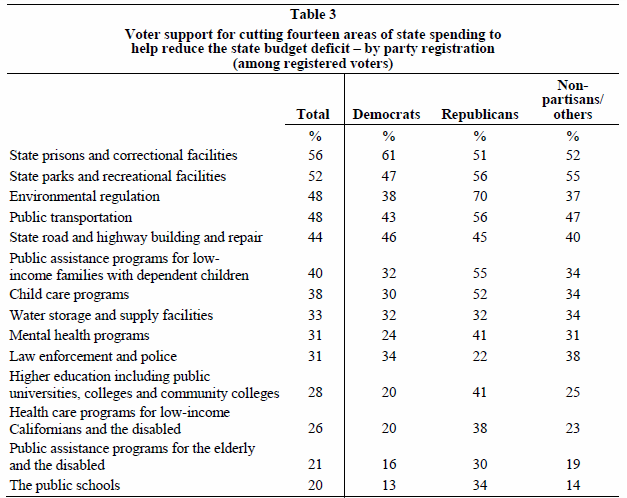
A new Field poll has come out with numbers on what kind of spending cuts Californians would like to see.  It is no surprise really, but a majority of voters favor barely any cuts at all.  Out of 14 categories, the only two to eke out a narrow majority of votes are parks & prisons.

More interestingly however, is how it breaks down along party lines. 

Democrats unsurprisingly only agree to cut one major category
• prisons (by 61%).  
 Also no surprise is the GOP's endorsement of cuts in
• environmental regulation (70%)
• state parks and recreation (56%)
• public transportation (56%)
• public assistance programs for low-income families with dependent children (55%)
• child care programs (52%)
• state prisons and correctional facilities (51%)
Everyone agrees that the last thing to cut is education (20% all voters, 13% Democrats, 34% GOP).

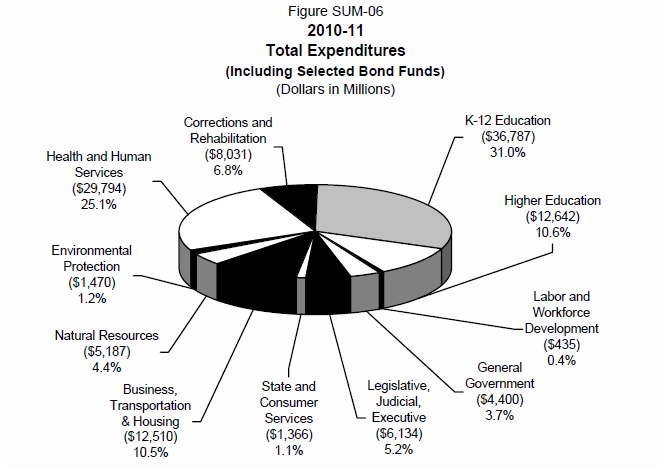
But when you look at the state budget, many of these categories represent a very slight percentage of the budget.

Obviously these sorts of attitudes aren't sustainable, for either party, without an increase in taxes.  For Democrats, who would only like to see cuts in prisons, the only area of savings is going to have to come out of the prison budget, which is only around 7% of total spending.  As it exists today, it is faced with a number of problems, not the least of which is overcrowding. 

For the GOP, much more willing to make cuts, the overwhelmingly desired cut is to environmental regulation, which barely makes up 1% of the budget.  It's about evenly tied on whether to cut prisons, parks, public transportation, and child and family services, which do take up a considerable portion of the budget.

All of which spells out pretty well why we are a state in such dire financial straits.  The public is massively polarized over what types of services the government should be performing.  The Democrats and GOP are locked in a bitter struggle with deep roots in very different views of human nature and social development.

But with climbing deficits, and no other option than emergency program cuts, the state is literally being forced to follow the GOP's world view of what role the government should play in a modern capitalist society - with the possible exception of prisons being forced to release convicts early.  If Democrats want to see their vision of a government more actively involved in ameliorating what they view as a struggle for basic rights and equal opportunities, they must demand that Californians embrace higher levels of taxation.

Tuesday, February 23, 2010

Who Else Will Do It?

My response to the main appeal of libertarianism - that government is just consistently inefficient, if not in a sense corrupt, is the same response that I think most people have: how else would the same job get done?

If the answer is that it could be done by the private market, I have no problem with that, and actually prefer it. But the problem is that so often times it can't be done by the private market. I mean, who else if not the EPA is going to try and protect the environment? To the extent that businesses are able to police themselves out of a moral sense, or even just market pressures to behave cleanly, that's great.

But of course there will always be businesses don't act responsibly, and in fact have a profit incentive not to.

What is more, as the environment is a common, there ought to be democratic input as to what level of damage we allow it to endure. In this way, Libertarianism ends up being opposed to the common freedom. Just as would the idea that there should be no police protecting us at night or firefighters putting out our neighbor's fires.

Frankly, I find libertarian philosophy incoherent: as soon as you concede that government should play some role, then very quickly you are no longer a libertarian but a democratic socialist.  The only question has become not whether government, but how much?  And unfortunately, this is not an argument you generally get on policy from libertarians or conservatives.  Instead, you get all sorts of appeals to broader philosophical principles, which in the end amount to little more than anarchy.

Friday, February 5, 2010

Fox, Hen, Uncle Sam

Some conservative commentators are positing a conspiratorial theory in which the government is unfairly punishing Toyota in order to gain an advantage either indirectly via UAW interests or directly for its majority shareholder stake.  This is largely infantile and intellectually dishonest partisanship.  But it raises the question, does not a government have a conflict of interest in regulating business interests in which it itself has a stake?

This may be a nice pivot in the government/business divide.  The business owner in theory acts out of self-interest.  The government administrator in theory acts out of "common good".  At this point in history, it is obvious now that too much faith in the latter is foolhardy.  The former, owing to basic human nature, is more precise.  Although while business is often well-regulated by either the market or the owner's sense of benevolence, neither are generally up to the task.

The general messiness of all this makes default partisan crankiness on either side all the more disheartening.  Government is in so many ways not only necessary but very well-implemented, if only for the element of honor and sacrifice integral to the particular task at hand - one only needs to think of the cop, the fireman, the teacher, the librarian, the inspector, the researcher, etc.  Yet this is not enough, and corruption must be guarded for structurally.  In the same way the business corruption must be guarded for structurally. 

Ultimately then, government must be relied upon to police both itself as well as business.  The best solution we have to this "fox/henhouse" dilemma is democracy.  And to the extent that democracy fails, so to does government.  Yet how much of our time is spent debating our democratic process?  How well do our citizens know it?

Sunday, January 17, 2010

The Difficulty of Sainthood

I imagine very few of us are really moral, in the sense that we are making rational decisions about our lives based on what is always right.

Peter Singer's thought experiment on sacrifice illustrates this well: we in the first world make daily decisions that favor our own small benefit over less fortunate others who would experience vastly greater benefit, even though were we to face these individuals we would make the sacrifice in an instant. For those unfamiliar with his point, he asks you to imagine yourself witness to an ice-skating child falling through an icy pond, whose rescue would then depend upon you ruining your $100 fur coat.

I think the really moral thing for us all to do is to take vows of poverty and donate all our free time to charity work. The obvious response to this is that our pleasures serve as a reward, thus generating more overall behavioral efficacy. I think this argument is mostly lazy, and serves nicely as a convenient justification for immoral behavior. After all, losing our shoes and jumping into ice water would just as well diminish our reward-stimulus yet the moral imperative is as strong.

So then why are we not all more like Saints? What is it about them that allows them to possess such vigorous discipline and moral courage? And then, maybe, what is it about us that keeps us from acting saintly?

It seems very difficult to answer this question at the individual level. But at the larger, social level I think we can more reliably find structural trends, and possibly apply universal human behavioral patterns. I may not be able to see why right now, up until this point in my life I have rarely acted saintly. But I can find patterns in others with similar life experiences.

I know that the more comfortable and satisfied I am in my life, the more appealing the idea of sacrificing for others becomes. And much of my position in life is owed to the fortunate experiences I have had over the years. I have been able to learn sets of behaviors that generate for me the life results I desire. At the broader social level, similar experiences are predictive of similar capacities for self-efficacy. (Of course, sorting out causal relationships is enormously challenging. And any causal hypothesis, after identifying clean correlations, is dependent upon continued predictive strength.)

Yet getting structural factors involved in group compassion is complex. Determining social outcomes that support individual satisfaction in order to promote efficacy is part of it. There are also the cultural institutions that act as mechanisms for stimulating the compassionate response. Foremost among these would be the media as a way to deliver information. Then there would be the actual delivery of care, facilitated by NGOs and governments.

Depending on political persuasion, one might be more of an advocate for taxation as a way of embedding compassionate sacrifice into a governmental-social framework. This is dependent upon a choice of ultimate efficacy - broken both into belief in governmental efficacy and emphasis on a social contract specifically designating compassion by all member citizens. Others may opt for an emphasis on private delivery of services, either out of mistrust in government's efficacy or a de-emphasis on inserting compassionate sacrifice into any social contract.

In the end, we will all determine what is a comfortable level of sacrifice, even if, except for the saints among us, it is never quite moral enough. That sacrifice might look different for different people. It may take many forms, from the simplest act as smiling at a stranger, or volunteering at a soup kitchen. In our social behavior though, it is through our interactions that we experience compassion - as we communicate, then place ourselves in the minds and hearts of others, and then choose how to act towards them.

Thursday, January 7, 2010

I Don't Understand My Fellow Americans


I don't understand my fellow Americans.

If many of them had their way there would be no justice system. There would be good-doers and evil-doers. Period.

The concept of "rule of law" to them is a joke. Our founding principles of fairness, nuance, tolerance and human dignity, subsequently substantiated by science again and again, are foreign to them.

It's as if there's this large artery of evil, pumping out anger, fear, pridefulness, resentment, and other reptilian emotions responsible for everything wrong with the world. And they just mainline it, along with the the xenophobes, the racists, the majoritarians, the theocrats, the homophobes, etc.

They got theirs. Good and evil. Black and white. Fuck everyone else.

Our prison system is a festering nightmare of cruelty. We can't decide whether to punish or rehabilitate, so we just let people rot - subjected to daily humiliation, brutality and threat of death. Then we wonder why recidivism rates are so high. To many convicts, life inside isn't so different than the outside - with it's "game" mentality, dysfunctionally anti-love and anti-life.

But we didn't really care about them before they went to jail. So why care now? We set them up to fail and then kick them while they're down.

The whole mindset of American conservatism makes me physically ill. The pomposity. The callousness. The knee-jerk assumptions. The cowardice. The narrow-minded ignorance. The hypocritical values. The selfish greed. The impatience. The failure to put themselves in the shoes of others. The uncritical embrace of tradition. The acceptance of inequality. The self-satisfaction.


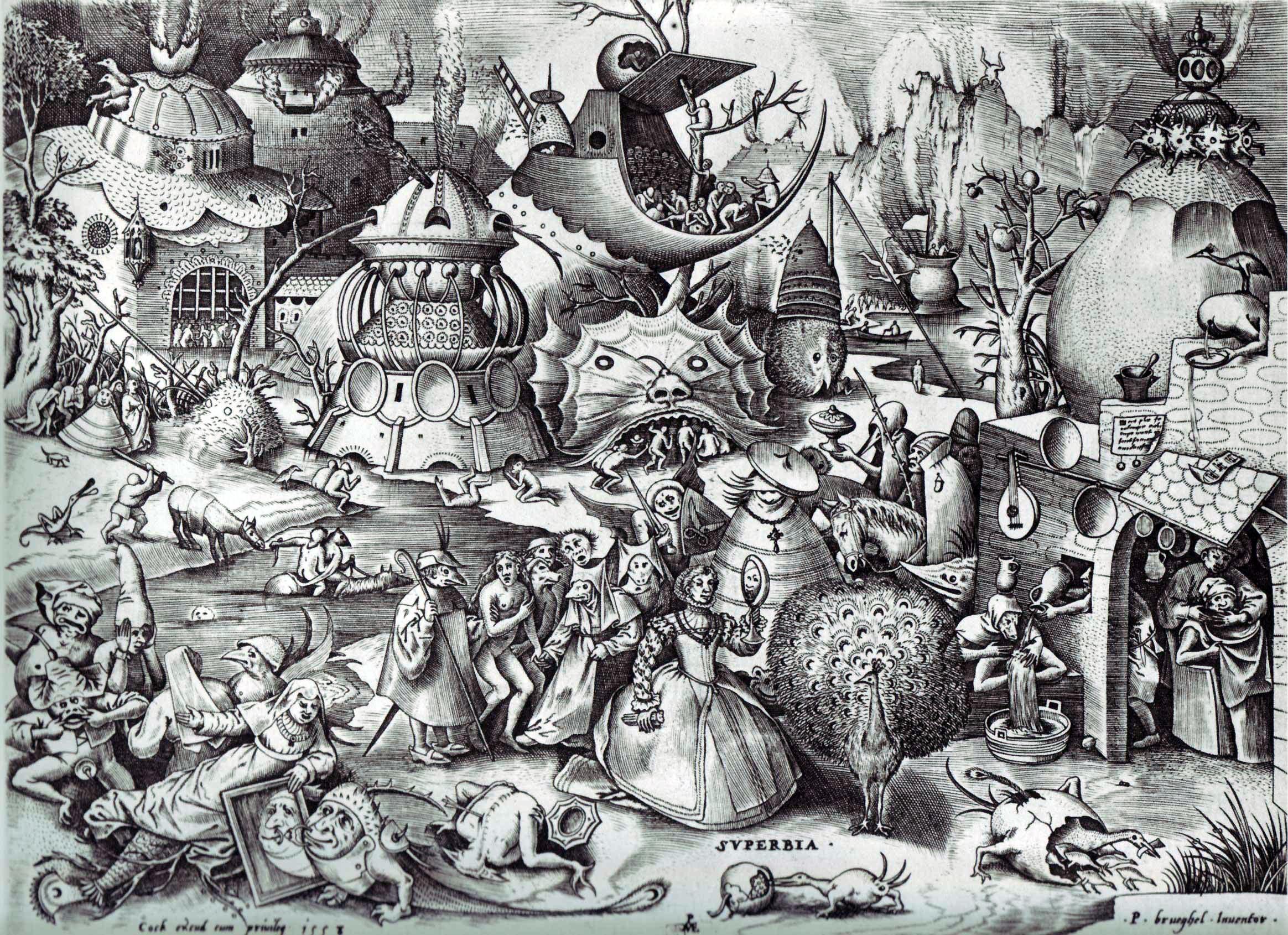
Pieter Bruegel - The Seven Deadly Sins: Pride


So much of it can be chalked up to simple ignorance. But what about the college-educated conservatives? What about the ones that make it their business to understand the world? There are other religions. There are other types of people. There are other ways of viewing the world. Did they never read about studies of human behavior? Anthropology? Philosophy? Economics? Colonialism? Race relations?

Why is their view of why people do what they do so different from mine? Why is mine so much more concerned with systemic injustice? Why is theirs so concerned with deflecting blame? Why is mine reflected in every major faith's emphasis on humility, sacrifice, love and kindness, the least among us - while theirs in the absolute congratulation of the self? I'm a fucking Atheist and I know this!

The politicians represent them. The media feeds on their worst, most craven impulses (within FCC limits - an irony). But they live and fester on their own, seeping into the sunless nooks and crannies of darkened, blinded thought. Unconcerned with ever looking at the world in a truly fresh or objective manner, everything must first be passed through conservative goggles of "the free market & me".

Healthcare must be neither redistributive, nor bad for business or me. The free market couldn't have made it the way it is. And government will only make it worse.

Economic catastrophe couldn't possibly be the fault of a free market. Government couldn't possibly help. In fact, they must have caused it. The solution is a freer market.

The problem with education couldn't be society or a failure of the free market to meet social needs - it must be government and unions (organized labor). Although we can't exactly stop offering public education, right? I mean, they are children after all.

The problem with the criminal justice system can't be solved by supporting people before they go to prison, or helping them learn to be better individuals once they get there. The solutions is simply to lock more people up, for longer, and offer less support! (Oh yeah - and let's blame the cost on prison guard unions).

Who am I kidding. What problem in the world could not be solved by free markets and people "deciding" to do the right thing? If they don't, it's their fault. There are no social forces at work! You have a choice to accept Jesus Christ as your personal savior and if you don't, you'll burn in Hell anyway!

Problem fucking solved.

Sunday, August 9, 2009

Efficacy Software, P. 2: Implementation

(part 1)
Once it is established that human achievement is a result of specific qualities in the individual that are both inherited and learned, which we may call Human Capital (HC), the challenge then becomes how to best develop social policy that facilitates its maximization across society. For if true freedom is the possibility of individual success, and individual success is the product of the sum of one's HC ( plus good fortune, which of course is an uncontrollable variable), then a society that values freedom must guarantee access to HC.

The great challenge then becomes developing a capable system of delivery. Much of this will be done organically, that is via natural human social and economic activity taking place in homes and neighborhoods. But if we are to truly endeavor to offer absolute freedom to very member of society, supplemental systems must be developed out of our common charter, which we of course call the "government".

This system will undoubtedly be multi-faceted, and composed of many different delivery subsystems and modalities. My focus here however, will be the applicability of free, internet-based training software, as it seems to present a viable, cost-effective delivery platform that is accessible, scalable, and sustainable.

To start with, here is no reason it could not be age universal; beginning with preschool, it could well extend to the elderly. Secondly, while a classroom curriculum could be developed, for use both in schools and community centers, logistic & financial challenges make this model less universally accessible. Although for many HC skills, a live and public environment would be ideal. Yet many HC skills could actually be better monitored and delivered via computer interface.

The first challenge is to properly identify the degree to which each element of HC impacts success, and then which offers the greatest possibility of delivery. Some elements will be enormously influential on success but difficult to deliver, while others easy to deliver yet of lesser value towards success. The overall challenge will be to examine the cost/benefit ratio, and determine what is the most effective use of what will always be limited resources. Into this equation must also come equitability considerations.

This chart is from a 2008 Australian study in which Socio-Economic Status correlated strongly with student test scores. On average, a 10 point increase in socioeconomic status scores is associated with a 6 percentage point increase in the pass rate.


It seems appropriate to examine social statistics to see what patterns emerge. It is reasonable to assume that income in general be tied to personal fulfillment, as it is generally the result of HC. However a software interface should be universally applicable to all groups. Certainly its use in the K-12 public education system would be used by students of all income levels, and built-in assessment and differentiation would scale to each student's HC level. However, when offered to the adult population, group targeting addresses both issues of cost and need.

Lower income communities, having less HC to begin with, can be assumed to have more limited access to computers and internet. Just as early telephone access necessitated government intervention, high-speed data lines may be a required component to fully implement a robust HC development campaign. As technology progresses, the provision of free, or low cost wireless notebooks may be a sensible option. To discourage fraud, they might be locked to an individual's government account.

Monday, October 6, 2008

Institutional Chaos

Modern society depends, one could say, on a few powerful institutional entities. Without these, it would surely lose its course and fall prey to any manner of insidious and destructive forces, resulting ultimately in physical and emotional suffering of its people, to say nothing of the failure in living up to the promise of progress, so far defined as general happiness, personal liberties, respect of conscience, etc.

Democratic government is the most significant, but a free press and academia are close seconds and thirds. Imagining the absence of one cannot help but reflect new, poorer light upon the others. And they are interdependent. Arguably, none could really exist without the others, at least to their fullest potential. Without democracy, what good is the expression of journalism, or academic ideas? Without a free press, are democratic principles even possible? And without academia, well, would time not come to a sort of standstill?

But what brings me to this topic a the development in modern conservatism, expressed with vigor by the Republican vice-presidential nominee in the last debate, of a heightened form of ideological fervor that in many ways has essentially obliterated two of those institutions. By defining them in such a way as to make them irrelevant, the end result has been that they have been taken out of the social order.

I have no idea how long this movement has been going on, or how precisely it came to be what it is today. It certainly has roots in many political traditions, some of them more uniquely American than others. Populism is a large part of it: we the people are not our institutions. We create them to serve us, not the other way around. But populism alone is nothing but anarchy, and thus self-defeating as a governmental design.

There seems to be a subtle nihilism at its core - an end-of-days sort of reductionism that, not getting its way, wants to throw everything on the fire and watch it all burn. Sour grapes. In so doing, two of civilization's greatest institutions are spurned.

The first dismissal is the media, often more specifically referred to as the "mainstream media". Derided as hopelessly liberal, biased, partisan, it becomes altogether dismissible. The reporters can no longer be trusted, and so neither can their reporting. Suddenly there is a vacuum. Imagine for a second what life would be like with no journalism. No TV. No radio. No newspapers. No magazines. How would we get our information of the world and current events? Yet, by dismissing all established media as partisan out of hand, this is effectively what one does. In such a cynical situation, there may be hope that a discerning consumer might be able to take their pick from a variety of sources, partisan though each may be in its own right.

But this movement is not skeptical of all media, including that it may agree with - just that of which it does not approve. News is reduced to what comes through one's own approved filter. And what this inevitably means, is that there is news, and then there is news. Certain media outlets, defined by their partisan stances, are to be trusted, while everyone else is not to be. A hallmark of contemporary journalism is the charter claim to attempt objectivity. Yet by defining those one purports to disagree with as wholly biased, and therefore inconsequential, the only alternative is partisan sources. Given that this claim is leveled at almost every major national and international news organization, there isn't much left. One is left receiving only the news which with one preemptively agrees. Inevitably, facts conform to view, instead of view conforming to facts.

The second dismissal is academia, and in many ways is the much scarier position. Journalistic bias is generally not terribly difficult to parse. The assumptions behind its attack may be false, but the requisite facts themselves are usually pretty straight forward. The trust we place in journalists is not so much that we depend on their authority in every issue, but that that do their job well, reporting honestly, accurately and in sufficient detail.

Academia is a much more complex and difficult beast. By its very nature, the contribution it makes to society must be taken on good faith. No ordinary citizen can be expected to be well-versed enough in every area of study to make judgments on the relative merit of each issue. Even the college educated citizen has not been exposed to more than a very brief introduction to most relevant fields. Most research is read by only a very select few. Yet it's effects are obviously enormous. Pertinent information from academic study winds its way throughout the halls of policy-specific think tanks, down into mass media journalism, through the minds of newly graduated job applicants, into courtroom deposition, across government cabinet councils, etc.

And so, faced with its impact on so many issues in so many areas of society, we are forced to choose what makes sense to us and what does not, even while being so little-informed of the context from which each bit of new information arose. What were the parameters of the study involved? What were the prior assumptions involved in examining the issue? What sources were used? We can ask all of these questions. But it would be foolish to pretend that a layman could ever digest the totality of academic output with authority. And so we do not. We trust academia. We may not want to. But what is the alternative?

Looking back over the past 25, 50 or 100 years, the progress of human intellectual development has been staggering. Imagine if 100 years ago, one decided to refuse to accept any new thought coming out of academia for fear of embracing "biased" or distasteful conclusions. Well, we all know what that looked like because there have always been those that have fought every new idea. From evolution to psychoanalysis, racial and gender equality to cigarette smoke, there have always been those uncomfortable with trusting the authority of those more familiar with an issue.

And this is not to say that this forced blind-embrace of academic authority always leads to human progress. Eugenics was maybe the most notorious example of the misappropriation of academic authority. One can only hope for a continued social emphasis on political & social reflection, with an unfailing investment in public education.

But here may lie the greatest irony. Those who would wave away academic thought, especially thought that challenges traditional assumptions, as biased and therefore irrelevant, are themselves contributing to just the sort of environment in which ill-conceived social developments arise. A public who is uncomfortable with the rigors of academic thought, incapable of holding competing positions in their head at once, evaluating issues from many angles, or waiting patiently for more evidence to arise, is exactly the type of public most vulnerable to political & social manipulation.