Showing posts with label tea party. Show all posts

Tuesday, August 14, 2012

Dog Men

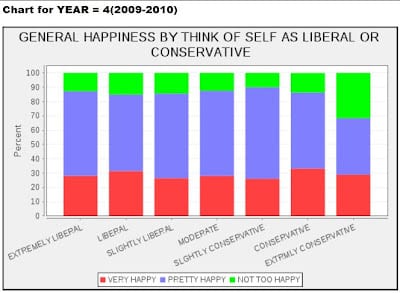
Andrew Gelman points to findings from sociologist Jay Livingston that, contrary to recent news, partisan Tea Partiers aren't actually all that that happy.


When I was younger, I used to listen to a lot of AM radio conservatives for the thrill.  What struck me more than anything, aside form the mendacity and childishness, was the constant sense of outrage and anger at the smallest things.  "Road rage" was all the talk then, but these people seemed in the grips of a sort of "life rage".   Resentments were directed at every little inconvenience in life.  From video store clerks, to bicyclists, to ATM machines, to women with "clipped hair", their ire extended even beyond things that actually affected their life in any way, to the mere presence of people who were different from them.  All of it, however, was an affront.

Much of this was group kvetching, no doubt.  One wonders how many of these people sustain such levels of anger and intolerance on a daily basis.  Yet I've met more than one person who seems perpetually pissed off at a world they feel is constantly slighting them.  True, they are sometimes left wing.  But my lunch rooms over the years have held more than one borderline Republican spouting off about damn  wetbacks or the need to round up gang-bangers and shoot them.

For some, I think, the anger is simply dispositional; they're going to find a way to put their belligerence into political thought.  Yet for others, ideology is a convenient narrative that provides a ready-made answer for life's dilemmas.   This can have quite a balming effect, whether or not it encourages free thought.

The problem with modern partisan conservatism however, is that the narrative is built upon a kind of utopian view of human nature that is largely superstitious and inevitably leads to resentment.  They believe, along with everyone else, that people ought to do "the right thing".  However, instead of seeing human behavior in terms of a dynamic interplay of complex social structures and nuanced choices, they tend to see things in black and white.  Everyone is assumed to have, at every second, a clear choice between doing right and doing wrong.  People are either smart, or they are "idiots".  

The problem with this worldview is that there is no explanation for human behavior.  There is therefore a constant sense of astonishment and lack of understanding.  How could he have done that?  What an idiot!  And because the answers are always clear - whether from the bible, tradition, common sense (their favorite kind of sense), there is no point in trying to explain oneself or God forbid understand someone else. 

Discipline is the order of the day!  Punishment arises directly from this sort of thinking as it treats human behavior as so simple as to need only threat of punishment to function properly.  If the bad choice is associated with discomfort, then the good choice will easily be chosen.  In  a subtle way, their view of humans is as quite primitive, almost dog-like.

As long as everything is going well, I imagine the modern conservative to be quite content.  The problem is that he must live with the rest of us idiots.


An original Pavlov dog, mounted (Pavlov Museum Ryazan, Russia)


Saturday, September 10, 2011

Ponzi Party

Rick Perry calls social security a Ponzi scheme.

Pretty ironic.

Wouldn’t the whole supply-side BS the current Republican crop and Tea Party zealots hold sacrosanct fit the definition of Ponzi scheme perfectly, i.e. work hard and play by the rules and you’ll enjoy a comfortable standard of living, access to health care, well-funded public infrastructure and a secure retirement? We trade our hard work for the promise of these things, even if it isn’t directly reflected in our paycheck, because we are doing work that needs to be done, and we assume that the rest of society will do its part to contribute to the collective good, to the extent that they are able. Yet the wealthy don’t end up paying their fair share because free market apologists pretend that their hard work is somehow more important than than that of the rest of us. They assume that the market is meritocratic. They deny inherent structural inequalities of capitalism and only see governmental responses as the true inequalities. (For example, denying that there is anything wrong with inherited wealth and fighting government attempts to introduce fairness into what is essentially an aristocratic dynamic)

Yet as health care costs rise and access dwindles, infrastructure crumbles, and retirement seems ever more ethereal, they tell us this is the fault of greedy public workers, regulatory protections, and the recipients of the safety net. The idea that a police officer can expect to retire on a modest pension with access to health care, while living in a clean environment with functioning roads, libraries and parks, somehow represents everything that is wrong with society. Who does he think he is, they tell us. Because through their policies of tax cutting and deregulating, they have made his simple world seem somehow luxurious. Only by bringing him down, they tell us, will we too get to enjoy his success. If that doesn’t seem like the greatest Ponzi scheme of all time, than nothing does.

Thursday, November 18, 2010

Either/Or Racism

From a diavlog between Adam Serwer and Michael Moynihan on, among other things, racism and the Tea Party:


This is probably the idea about racism that frustrates me the most: that unless someone is explicitly saying something racist - or even thinking it, that they are not racist or expressing racism. It's the idea that racism is either "on" or "off", and entirely consciously chosen.

We know for a fact that much of racism is actually unconscious. And when you think about it, even people who are avowed racists are obviously expressing a hatred they don't really understand, that is irrational. Much of hatred is carried as cultural memes and attitudes that aren't fully-formed, reasoned opinions. So wouldn't it make sense that even people who don't consider themselves racist might be prone to racial bias?

So you can have all these classic examples of hateful ideation that play on old stereotypes and fears, and they infect even those who may consider themselves perfectly tolerant. What's difficult is tying down exactly what is racism from what isn't, and separating genuine principle from bias.

So you would never want to say what Moynihan proposes many liberals do - that the Tea Party is motivated singularly by race. But if it is possible that people can have their ideas and fears infected by unconscious bias, wouldn't it be possible that at least some of what animates the Tea Party - as a political movement in a general sense - is unconscious racial bigotry? And if this is possible, then how do you decide to what extent this is going on?

This is especially true when so many on the right are avowedly opposed to the idea that they could be harboring unconscious racial bias at all. They generally feel that unless they specifically say "I find minorities inferior", then racism cannot exist. This seems very wrong.

Sunday, September 26, 2010

Moonies over Marin

Apparently the Tea Party organized a rally in Marin County today, featuring guest speakers Ward Connerly and John Yoo, the mastermind of the Bush Administration's "enhanced interrogation" torture policies. 

Any excuse for a little Dead Kennedys:

Tuesday, August 3, 2010

A Better Dialogue on Race

Glenn Loury and John McWhorter are back with their usual arch commentary on race in a recent Bloggingheads.  Both express great boredom with the endless cycles of this hoary American Dialogue.  I grant that it is perpetually juvenile and superficial.  But when John calls the whole enterprise "unnecessary", I entirely disagree.

I would distinguish between what could be learned and the tendency for little to be learned.  I agree that much of it tends to be theater - but that doesn't mean there isn't anything of substance to be learned, or discussed.  The problem is that so much of our political discourse is simply hackish in general.  Partisanship, talking points and scorekeeping take the day.

So when Glenn and John say there is nothing to be learned (again, I prefer "discussed"), I think that's really not true.  For instance let's take the Rand Paul flap.  The libertarian/tea party willingness to even entertain such foolishness speaks volumes about their priorities, and especially their view of race and class in America. 

This is how I see it being important: Paul's anti-civil rights view diminishes the legacy of racism, resulting current social and human capital in minority communities.  He and Tea Party's homogeneity and claims of "government intrusion" largely framed around minority/welfare issues, specifically in regard to social programs.  Granted these are pieces of a puzzle, but I think you can draw a pretty straight line from his statement to his party platform.  Ditto the Macaca (?) comment.  And generally the large number of racist Tea Party crap ever published.

Glenn points to "structural problems" driving minority poverty.  But how can he divorce this from Republican opposition to government intervention?  He can't seriously by the BS notion that these communities will pull themselves up without targeted government help?  And that's exactly what modern conservatism does not want.  They may pretend that they want smart government - but they never show any platform but cuts.  They basically have zero to offer minority communities.  Their one proposal for ending generational poverty through education - vouchers/charters - is aimed solely at parents motivated to escape the ghetto.  This is not a scaleable solution, it is a band-aid for certain parents who already have enough human/social capital to succeed and are stuck sending their kids to school with other ghetto kids.

The dialogue on race needs to be better.  It is definitely stuck in a sort of racist vs. non-racist framework that is absurdly inadequate to what we're dealing with in the 21st century.  Race is no longer just about racism, but about justice.  Most Americans want to be there, but they have no idea how to get there.  There are still many unconscious assumptions and prejudices that will eventually need to be exorcised.  We need to get back to looking at causality and practical steps we can take to move the country forward.

Wednesday, July 21, 2010

The Tea Pretense, P.2: Yes, It Is About Race

     Apparently the Tea Party is going to hold a summit on race July 31st in Philadelphia.
The rally, called Uni-Tea, will feature white and black Tea Party supporters in all-day event that will feature live music, a web cast and plenty of Obama bashing.
The site for the event features 13 speakers, with at least 8 speakers being persons of color.

    I’d like to see the Tea Party spend even a small amount of time addressing steps to end poverty in America and the achievement gap in our schools.

    I may be wrong, but my general impression is that they believe that A) poor people are the only ones to blame for their poverty, and B) the only way to “help” them is to leave them alone and let them solve their own problems, and C) any government help is only making things worse by creating a sense of grievance and dependence. Further, any attempts to point out racism are just a natural outgrowth of the politics of victimization, and the only racism that really exists any more is by angry minorities and the organizations that advocate for them.

    Is that about right? Well, its sickening, and wrong on multiple levels.

A) Poor people are the only ones to blame for their poverty 
    This is true to a degree. But there are structural problems that created it in the first place. Poverty tends to be generational. This means kids are getting poor parenting and education: having more kids: repeat. Geography isolates low property values, creating ghettos of dysfunction and distress. This means neighborhoods of kids with dads in prison, moms on drugs, no supervision, no college education or training, etc. Environmental hazards, such high lead content, have been found to reduce cognitive development in poor children. The educational system is no equipped to make up for what are essentially very low levels of human and social capital.

B) The only way to “help” them is to leave them alone and let them solve their own problems 
    This is clearly not true. From a safety net standpoint, absent health services and food stamps, people will be sick, starve, and die at higher rates. Charity has never been able to handle everything on its own. Talk to the charities out there today and they’ll tell you there is x, y, z they could do with more resources. From a skills standpoint, there is much we can do to increase human and social capital. From nurse home visits for young mothers, to early childhood education and parenting classes, to jobs programs and better city college funding, to health services that allow people to be productive, to nutritional help for kids and parents to learn how to take better care of themselves… none of this is possible without help. It’s mostly a matter of education on how to be successful.

C) Any government help is only making things worse by creating a sense of grievance and dependence.
    This has been a problem in the past – and arguably still is to a degree. But the vast majority of social programs do nothing to create dependence. What they are designed to do is to increase personal agency so that people are able to get their lives on a productive track. No one involved in social programs wants people stuck relying on government help. They are obviously so much more happy and productive when they can do things for themselves. It is no coincidence that the Tea Party is largely made up of people who have little contact or understanding with minority poverty – or any poverty – in the US. Because they are that much less likely to have witnessed first hand how social programs can help change peoples lives. This also explains how people can seem so out of touch and unconcerned with the real-life travails that people in this country are facing, people that the programs they disparage are designed to help.

    The Tea Party is conceptually built around the diminishment of government spending on social programs, specifically for poor minorities they feel are only “leeching” off the rest of America. Race is at the very core of their anger. It may or may not be directly, consciously or unconsciously, motivating them – as in, “I don’t like black people so I don’t support health care subsidies”. But to the extent that they are specifically motivated by a sense of injustice at having to pay for social programs that are disproportionately used by poor minorities, their stance takes a certain racial perspective. And it is one that actively delegitimizes the sense of grievance that minorities feel in seeing their communities continuing to fail disproportionately. It is no wonder then that the movement has been attractive to racists.
    
    One last thing on race: people are not either “racist” or “not racist”. People are mostly operating from unconscious impulses. Our intelligence and wisdom allows us to peek our heads into consciousness and control our lives. The percentage of people who are admitted racists is very small. But even they don’t understand why they don’t like minorities. They just do. It’s mainly unconscious response. Then there is the rest of us who, to varying degrees, are conscious of patterns of thought that are racist and wrong. We learn to control them and adjust our thinking accordingly. We never really escape it, but we can be on guard for it.

    To me, the scariest “racist” is the one who thinks he isn’t racist at all, yet hold all kinds of creepy unconscious biases and allows them to corrupt his thinking without any attempt at self-reflection. Many people are often indeed quite full of racist ideas. And they would recoil from the thought. But because they’re so afraid of being labeled a “racist”, they never have the opportunity to grow. It feels like that’s where we got stuck post-civil rights. There was so much confusion and acrimony, that we never learned how to have an honest and forgiving dialogue about unconscious bias.

Tuesday, July 20, 2010

The Tea Pretense

   I recently came across a comment by someone sympathetic to the Tea Party movement. As outrageous as it sounds, they actually felt that the Tea Party was in many ways an underclass, although not what we normally think of as such, that is in any kind of socio-economic terms.  And that of all people, liberals were the least interested in helping poor Americans.  In a way, the commenter seemed to feel, while not any actual political alignment of interests, a sort of camaraderie with them.
    “You guys just kill me with your bleating about the underclass. You looooove the underclass, but you despise every single person in it. A bunch of rubes, a bunch of cheap votes. I have volunteered (that means working free of charge) hundreds of hours of my time as an EMT in a small jerkwater town plagued by poverty and meth. I’ve seen and smelled squalor you soft-handed pansies can’t imagine. I’ve repeatedly walked among criminals, crazies, and puddles of bodily yuck to help some human reject from society who was sick or hurt. I’ve foregone many a night’s sleep and risked infection with horrible diseases, just because it’s kind of a rush to be a small-time hero. By my hands and the strength of my back, I’ve done more to provide access to healthcare and reduce costs, than all of you put together with your holier-than-thou posturing and whinging.”


    I won’t bother posting my resume.  But I will say this. He's just described the real underclass pretty well. It’s a really sad situation. Yet how many of those poor people go to Tea Party rallies? How many of them are complaining about paying too much taxes, or that their health insurance is being redistributed to the sick? How many of them are concerned about too much government “help”?

    The reality is that these are the people the Tea Party hates! They are the ones that all the government spending is being directed at. They are the supposed constituency “pay-offs” democrats are supposedly after. They are the ones with drug problems, incarceration problems, mental health and behavioral problems, working for low pay and not raising their children well enough. What does the the Tea Party have to offer them?

    Nothing! A big fat, “Get lost you lazy losers!”, “Quit sucking off the government teat!”, and “Get a job!”. These are the people the Tea Party doesn’t want their taxes to go to. These people are who “big government” was designed for. It pays for their rehab, their childcare, their social security, their food stamps, their job training, their mental health services, their children’s free lunches and after school programs, their city colleges, their tax credits. These are the people that the Tea Party says would do better if we just left them alone, and let social Darwinism reign.

   Of course that doesn’t actually happen. People simply can’t take their medication anymore. Old people starve or freeze to death. Kids get raised by unfit adults. Children go hungry or eat candy for lunch at school. People don’t go to college. Kids don’t graduate from high school. Whether you think that these people deserve these services or not, they have effects.

    Because if they do deserve help, then we need to make sure we are providing effective services. I think we’re doing a pretty good job. I can make a strong case for most social service programs not simply creating dependency but in supporting people’s ability to take care of themselves. But what we can’t do is nothing.

    Because for every conservative who is out there selflessly sacrificing his time, there are plenty of communities struggling without adequate resources. Talk to almost any service provider and they will tell you that they can’t do enough because there aren’t enough resources. Take away government help and the delivery of services severely drops or disappears outright.

    But if they don’t deserve it – and this is what I think most Tea Partiers believe, then all this government spending on services does seem an awful waste. I think most would say that these people need to pull themselves up. As Glenn Beck puts it, “They need the freedom to fail.” Well, tell that to a 75 year old grandmother on social security. Tell that to a schizophrenic who isn’t under a bridge tonight because of the clinic down the street. Tell that to the diabetic who lost his job but can now find an insurance carrier who will accept him. Tell that to the child who’s got nothing to eat at snack time because his mom never made him lunch, and then who’s three grade levels behind and need some after-school support. Tell that to the single mom who works 40 hours a week while baby is with her aunt and still finds time to take an affordable night class.

    This may sound harsh, but when an EMT arrives at the scene of a disaster does he ask whether the victims need the “freedom to fail”? Well, poverty and dysfunction are also tragic disasters. It usually starts young and by the time they reach adulthood their course has been set. These people don’t need the freedom to fail, they need the freedom to succeed. And government is usually the only thing in their lives that has the power to help them. And no, they often can’t help themselves! Children can’t help themselves. Diabetics can’t help themselves. Single moms can’t always help themselves.

    So, this is why you won’t find any liberals at Tea Party rallies. Because we believe in helping these people, this underclass. We think its fair that society looks after the least among us. We think its possible to give people a hand up, and not just a “hand out”. If you want to get philosophical about it, we believe there are larger reasons for why this class exists. We believe there are structural inequalities at work. For the same reason we think it is only fair that the upper income white people at Tea Parties should redistribute some of their money so that it goes toward rectifying some of these inequalities. And if they don’t want to, then they should be forced to.

   You can call it fascism if you want, but I think that’s quite a stretch. The question is whether they really earned that income – that they really deserved it – or they just took advantage of a system that was rigged in their favor. Just because the structural inequality is complex that doesn’t mean it doesn’t exist. Say it was something simple, like a monopoly. If one family in a town owned all the resources and profited from everyone’s labor, would it be fair to require them to pay a higher share of taxes to help pay for common services?

    So if it is fair the question is how far should we go. What is a fair rate? What is an effective rate? We had marginal rates of up to 90% in the fifties and people seemed to be doing fine. I think the reason conservatives dislike progressive income taxes isn’t that they think they’re bad for the economy. I think they simply find them unjust. Which is principled. But I hope I’ve at least made a case that they’re wrong.

    In the end the Tea Party loves to play the American underclass. Oh, these poor white Christians! The terrible racist Black Panthers! The terrible Shirley Sherrod oppressing white farmers. Obama’s hatred of whites. His hatred of Christians. It is all just really silly. But as for any real American underclass, they show little sympathy – even downright contempt. Let’s not even get started on illegal immigrants. 

    Now that’s an underclass.
Sunday, May 23, 2010

Rand Paul Is Making Sense

Well, not to me of course.  But what he's done is very important.

He isn't saying anything that isn't entirely consistent with decades of conservative rhetoric.  For years all we have heard is how terrible the federal government is.  Regulations are evil.  Taxes are evil.  Progressive legislation and judicial philosophy is evil.

Now, what conservatism used to mean was that government had a tendency to be wrong.  Government wasn't necessarily wrong in principle.  Sure, the real crazies thought that.  But they were sidelined to the fringes of mainstream conservative thought.  Of course we had to have government.  It did important things.  The rhetoric was OK because it was merely hyperbole; it was useful as a bludgeon against the steady leftist march towards more social protections, environmental regulations and higher taxes.  But the intelligent conservatives knew that it could only ever be talk.  Actually following the rhetoric would be politically and practically insane.

But then something happened and the smart conservatives left the room.  Maybe they were drummed out.  Or maybe times changed.  But suddenly the voices of responsibility and reason were no longer there to keep the boat from capsizing.  Instead of being the hyperbolic froth above the ideology, the rhetoric became the ideology.  The tradition of temperance and moderation had faded away and all that was left was the crazy.

So, after the worst financial crisis since the depression forces the government to take drastic measures, bailing out the financial industry, then the auto industry, then pouring nearly as much into a Keynesian stimulus plan for economic recovery and stability - up pops the tea party, with the force of a thousand blustering AM radio jockeys and the FOX broadcasting corporation supplying a steady infusion of rhetorical red-meat.  Yet it is incoherent and preposterous.  Beyond the anger and recrimination, there is little substantive political philosophy.  Conspiracy theories are flung out left and right, and in the profound ideological vacuum, each seems as acceptable as the next.  The list is breathtakingly long: Birthers, FEMA camps, NAFTA superhighway, Socialism, Death Panels, Federal Reserve, Acorn, Secret Muslim, etc.  Each seems as plausible as the next because the ignorance at the bottom and and crazy at the top is so profound.  Medicare is something to be protected from the government.

And Rand Paul gets elected, claiming and claimed as the Tea party's first big success.

Sure, he wasn't the first nutter.  His father made sure of that.  But when Ron Paul talked about returning to the gold standard, pulling out of the UN or shutting down most Federal Agencies people mainly rolled their eyes.  I mean really, who the heck wants to try and understand fiscal and monetary policy?  But that was before.

Now people are really listening.  They want to find out what they really believe.  And by golly, he's telling them!  It turns out that if government is evil, and taxes are evil, and regulations are evil, then a lot of what we've been doing for the past century is really, well... evil.  It turns out that we can't make people pay taxes for the government to regulate private businesses anymore - whether they put rotten meat in hotdogs, pay their workers $3 an hour, dump sewage into the creek, or deny minorities employment.  I suppose you could add any number of other things to the list - things that we as a nation have fought very contentiously over for decades, but that now seem as American as apple pie.

These are Rand Paul's principles.  They are libertarian principles.  And they are now the principles of the modern conservative movement.

The nice thing about a democracy is that we get to elect our leaders based on what they tell us.  The problem has been that Republicans have been taking advantage of the fact that the public hasn't understood the difference between the rhetoric and the policies their party has supported - if often grudgingly - for the past century.  The trick was simple: just say one thing and do another.  One wonders if they were able to do this because their candidates were either ignorant of simple political philosophy or just dishonest.

Yet somehow this trick just didn't work so well anymore and for whatever reason they elected a man who wasn't afraid to make sense of what they have been saying.  Not only that, but he actually believes it.

So I say, "Good for you Rand Paul!"  An honest Republican for once.  "Don't let those handlers keep you down.  Preach it, brother!"  He's like a big bullshit magnet.  I just hope he can get as many of the other tea partiers to sign on with his brilliant plans so we can watch as many of them as possible get flushed down the drain when the public is finally able to see what enormous a-holes they all are.

Friday, April 16, 2010

The Unconscious Racism of the Tea Party (restated)

Racism, as a cognitive process, is largely unquantifiable and unknown. It certainly isn't rational. And so while it has become entirely taboo in society to openly admit to racist views, the underlying fears, biases, memes, etc. that go into that inchoate  stew we call the unconscious are still floating around. As many liberals will point out, having themselves at some point undergone that definitional ritual of racial guilt and self-reflection, you don't just flip a switch and disapparate 200+ years of racial history - especially when race is still incredibly tied up in socioeconomics. This stuff is complicated and built into our social fabric.

So of course this is a really tricky area. I completely agree that you can separate people who are full-time KKK from those who simply hold up pictures of Obama with a bone through his nose. But what you cannot do is say these people aren't racist. And before we continue, even if such overt displays are actually somewhat rare among the tea partiers, the larger context in which they exist is heavily race-laden; witness Rev. Wright, community organizing, "Hussein", secret Muslim, Kenya, Birtherism, palling with terrorists, "deep hatred of whites", etc. And that's not even getting into the actual racial implications of progressive, redistributive programs and their emphasis on the "needy" - from which it doesn't take David Duke to make a logical connection to minorities, especially blacks.


There is a fundamental driving force behind this movement that is profoundly motivated by a sense of threat to White Christian Patriarchy. The fact that so few of them say it outright isn't because it isn't real, but because they largely aren't even conscious of it themselves. I'm sure that if you asked most of them if they had negative views of minorities they would be appalled. But yet there they are, holding a sign with an overt, inexusable expression of racial hatred. This isn't someone making an honest mistake by comparing Obama to a monkey (we've all seen the George Bush signs doing the same thing). This is over and over, examples of seething racial anxiety. The Republican staffer who ran the picture of the white house lawn covered in watermelons was very apologetic. Oh, she was very sorry if she offended anyone....

If every tea partyist was wearing a Klan robe I'd be extremely worried. But the fact that they aren't doesn't do much to explain the incredible preponderance of racist rhetoric, and I'm not sure I'm much more at ease. And to the extent that so many people are downplaying the idea that there is a larger undercurrent of racial anger (understandable as it is to close partisan ranks), one wonders how much it has do do with our comfort with anti-black hatred. For instance, if the president happened to be Jewish, and a tea partier held a sign that depicted him with horns, would we be as cautiously sanguine?

As if reading the tea leaves weren't enough, there's still a big elephant in the room. And that's that there is a very internally consistent logic between racism and basic conservative philosophy. This doesn't make conservatives racist. But there is a good chance that, by accepting conservatism's premises, in light of contemporary racial socioeconomic inequality, one could see a compelling reason to entertain racist attitudes. In the end it isn't coherent, but neither is conservatism. In fact, the denial of a racial explanation is actually one of the major arguments against conservative thought.

But honestly, most of these people have never come close to doing the heavy lifting that sort of philosophical thought requires. As many will indeed attest, they were never that interested in politics to begin with. But when the economic collapse hit they got sacred. And modern conservative thought was more than willing to soothe their confused souls and lead them right down to Washington. Although who is leading who at this point is hard to tell.

Thursday, April 15, 2010

The Unconscious Racism of the Tea Party

Birtherism is a phenomena that can pretty well be argued as fundamentally racist.  One might say that it is simply a partisan meme that, like any other, exists primarily as a perseveration that has as its only goal to delegitimize the president.  In this way it is no different than claims that Bush was never really elected in the 2000 presidential election, or subsequent claims of voter fraud in 2004.  But whether or not you find those memes legitimate (they at least couldn't be dismissed with something as simple as a birth certificate), they also didn't exist within a larger context of racial and ethnic paranoia.

Maybe it is all just a coincidence, but birtherism is just one of many accusations that Obama's ethnic, racial and political heritage presents a real threat to White American Christianity.  Whether it is his community organizing in the ghetto, his membership in a radical black church, his Kenyan father, his time spent with Muslims in Indonesia, Hussein being his middle name, or his supposed "palling around with terrorists" and institution of a socialist tyranny, the claim is not that he is merely unfit for the presidency, but that he actually represents a radical plot to overthrow the nation's ethnic, religious and racial heritage.  Considering that this is obviously not true, the case that it is motivated from deep-seated unconscious racial bias is quite clear.  The fact that it perseveres despite all possible evidence to the contrary only reinforces it as motivated by irrational hatred.

Brendan Nyhan points to a new CBS/New York Times poll that illustrates its prevalence among American public, and especially the Tea Partyists.


Now, I’ll bet that every one of these people would say they have no racial bias whatsoever. The odd thing about racism is that people expect it to be rational, when it is totally irrational. It exists almost entirely within in the unconscious. Even among admitted racists, the biases driving their feelings aren’t rational, but driven by hidden assumptions and feelings.

So it makes sense that many people would ask themselves a rational question like “Am I racist?” or “Is racism OK?”, and answer “No”. They know it is socially taboo, and makes no rational sense. But because they haven’t done the self-reflective work of analyzing their assumptions (which conservatism actively validates), they aren't aware of the extent to which their views are motivated by racist impulses.

We’ve all seen the racist tea party signs. But I’ll bet that if you asked them if they consider themselves racist, they’ll say of course not. In their own mind, they aren’t. The views they express on their sign, whether using racial stereotypes or treating the president differently because he is black, don’t represent racism to them because that would be inconsistent with their self-identification. Yet they are obviously trafficking in racist rhetoric.

Now, one might argue that they are simply being obnoxious and, knowing full well the racist implications of their statement, choosing to ignore the hatefulness it represents; Sort of hard-core political incorrectness. But isn’t the choice to use such hurtful rhetoric a sort of apology for racism to begin with? If using faux-racist language to make your point is in practical appearance no different than actual racist language, is the difference just a matter of degree?

It is telling, in a country that has been so profoundly shaped by its persecution of African Americans, that self-identified “non-racists” would so willingly embrace the idea of openly displaying hateful rhetoric towards blacks. If our president were Jewish, would people feel it acceptable to borrow anti-semitic imagery from say, Nazi propaganda? Would we see images of a Jewish president with horns?


On second thought, after seeing the tea parties in action, I wouldn’t be so surprised. And when asked, of course they would all say they think Jews are great.

Wednesday, February 24, 2010

The Life of A Sheep

Sara Palin is coming under fire for promoting herself as an advocate for disability rights, as the mother of a son with down-syndrome, yet positioning herself against state assistance for families of the disabled, much less the just plain needy.  This is nothing new to conservatives, who have often had to actually had to place the word "compassionate" in their titular ideology, in case one got the wrong impression from their policy perspective.

Trying to decipher the personality differences of conservatives vs. liberals is fascinating, if frustratingly difficult.  There are obviously differences, not only in one's temperament itself but in its larger political philosophy implications.

The best, most scientific examination of this is in The Authoritarians, by Bob Altemeyer.  He finds a lot of very interesting correlations between authoritarianism and current right-wing politics.  He writes that right-wing authoritarians are capable of holding very high levels of contradictory thought.  They are frequently religious fundamentalists.  If empathy is based in part on actually experiencing life in another's shoes, any movement that actively limits one's ability to understand the lives not exactly like theirs, or thoughts not exactly like theirs (this is sometimes proudly referred to as "common sense"), would have a net decrease in empathy.

I imagine it as a sheep that only sees its little green pasture, and so when forced to peep its head out of the fence, it has no context for anything else in its world.  The analogy here would be the white, Christian, "American", traditional gender, etc., etc. type who doesn't really understand other people or cultures - either because they haven't been exposed to them or have actively ignored them (I think it is usually both). 

Those of us who live outside this narrow cultural perspective, or at least have spent our lives trying not to - both by reflecting on the political & cultural implications of having that group be so dominant and by learning about other ways of life, are almost liberal by definition.  This relativistic conceit drives us to continually explore history, science, politics, religion, the arts, etc. from an objective and values-neutral position. 

And this is exactly the critique that you get from right wing authoritarians: that we are too "soft"; that we need to see the world as it "really is" (in black and white), that we make up our morals as we go along; that we make excuses for everyone (we call them explanations for behavior); that we are elitists who look down on provincialism (it's hard not to, once you have left the "province"); that we don't believe in individual responsibility (the whole point was that we began to deconstruct what "individual" really means).

This week on Frontline they ran a very interesting story on the fundamentalist Taliban and Mujaheddin, told from the inside by a reporter with special access.  What became clear was how just how insular they were.  The most motivated among them were indeed "true believers".  The sort of pinnacle of excellence was a single-minded devotion to an entirely specific way of life.  The concept of learning about new things and reflecting upon why they were who they were was anathema to their project. 

Yet one could easily see how powerful this mindset is to the success of a cause.  Free thinking and questioning of authority would be a grave threat.  This is a common feature of cults.  One of the first things required of a new cult member is limited communication with the outside world.  Right wing authoritarians, defined as they are by strict obedience to tradition and fear of the outside, would fall perfectly into this category of thought.

A word popular on the left right now is Christianist, describing just this sort of fundamentalist Christian thinking.  Sarah Palin, along with most of the current Republican leadership, falls directly into this category.  The Tea Party movement, while not specifically religious at all, is of an ideological kin to Christianism.  There is certainly some friction between the two groups in that a good portion of the Tea Partiers are staunchly secular libertarians who want not of the Christianist preaching.  It will be interesting to see how they come to terms with their common ground of angry white nativism, anti-government and pro-traditionalism.

Tuesday, February 2, 2010

A Real Republican Roadmap to Balancing the Budget

Paul Ryan, Republican congressman from Wisconsin and ranking member of the House Budget Committee, has introduced "A Roadmap for America's Future", his alternative budget proposal.  But unlike most other republican proposals, his actually balances the budget.  It does so mainly via steep cuts in social programs, namely a massive cap on Medicare spending.

The basic idea is to give seniors a voucher, which they can then use to purchase health care on the private market.  The way this cuts costs is that this voucher will be substantially lower than what what Medicare currently covers.  Although the program doesn't go into effect until 2020, the annual cost adjustment is far below expected actual increases in health care costs.  What is more, the age of retirement coverage will have risen, further limiting coverage.  What it all amounts to is massively rationing health care for seniors.

The amazing thing about the plan is its intellectual honesty.  It takes a philosophy of limited government - low taxes, low spending - and actually proposes implementing it.  The problem most Republicans face is that their rhetoric has over-reached their policy recommendations.   During the Bush years, tax cuts were made, yet without the painful cuts in spending that would pay for them. 

Republicans, now in the minority, and facing record deficits, seem to have rediscovered fiscal discipline.  Yet to complain about the deficit without proposing steps to actually balance it, is intellectually dishonest.  The ease with which this incongruent rhetoric is employed likely explains much of their current low approval rating.

Interestingly, the Tea Party movement seems to be tremendously popular.  Its main thesis would be very approving of the Ryan proposal.  Yet much of its rhetoric is even more extreme, if somewhat incoherent.  Aside from the demagoguery of Obama, a main theme seems to be the detestation of any form of socialism in government.  This has been largely directed at government involvement in health care - even if many of the Tea Partiers seem to be very attached to their medicare.  But one wonders how far the logic might really extend.  Public schools?  Libraries?  Ostensibly the objection might solely lie with federal government.  But how would state spending on social services be any different.  The same philosophical deference to individualism and markets would seem to apply.

To the extent that republican policy proposals have not adequately matched their rhetoric, they have been difficult to take seriously.  The Ryan plan is honest, and logically consistent.  That its Medicare provisions would not really begin taking effect for 10 years likely reflects the political impracticality of its acceptance.  But at least it is something with which to reasonably debate.