Showing posts with label economy. Show all posts

Saturday, October 22, 2016

But Isn't Trump a Free-Trader?

Something that's baffled me in this election is how much Trump's campaign seems to be built around the notion that part of "making America Great Again" is bringing back jobs that have been lost overseas due to manufacturing.  Aside from how much this is actually true, isn't a fundamental tenet of conservatism a belief in markets, free trade, and that workers simply need to adapt?
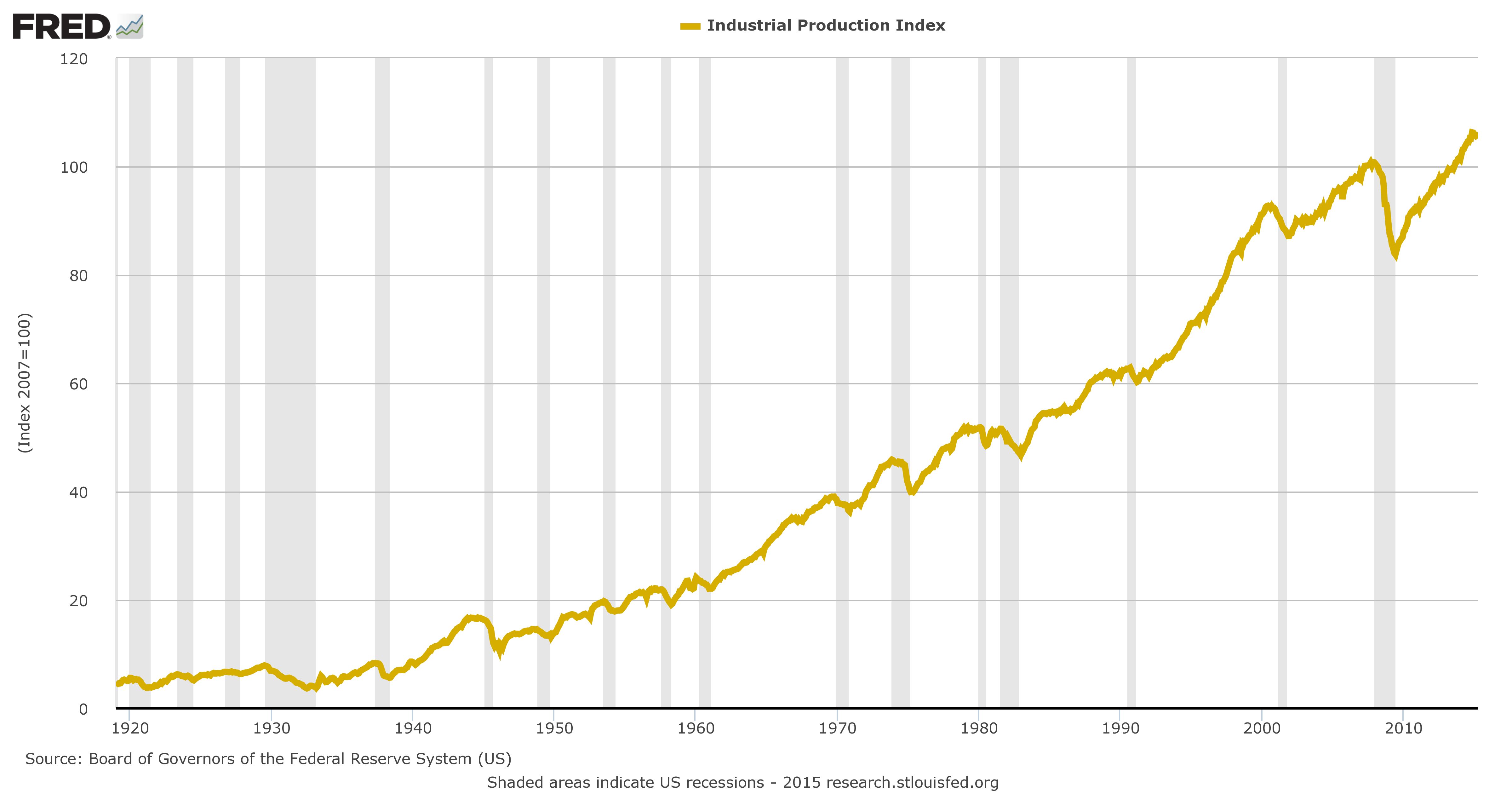
Matt Yglesias argues that this is exactly what workers have been doing, and that manufacturing, per say, hasn't really been in decline at all.  He points out that perception could be misguiding us because we tend to focus on all the consumer goods we say that don't say "made in America" on their tags.
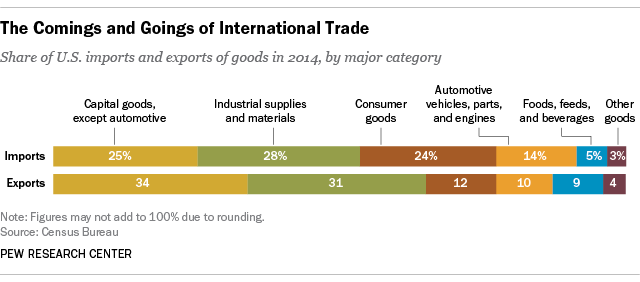
Consumer goods and cars are two big things people buy, and both of them are things the US imports more of than we export. 
Consumer goods and cars are two big things people buy, and both of them are things the US imports more of than we export.
Meanwhile, 65 percent of our exports are either capital goods or industrial supplies — in other words, machines and equipment that companies buy to conduct their businesses. Sometimes that's something like a computer that might also be sold to a consumer. But more typically we are talking about products that aren't sold in stores or marketed to normal people. You've probably never bought a Boeing 737, for example, and almost certainly never will. But airplanes are very expensive. The sale of a single new passenger jet contains as much value of industrial output as a truly tremendous pile of shoes or toys or other consumer goods.
He also provides a couple of interesting charts:

We don't seem to see here the kind of devastating losses we all imagine when we picture rusty, hollowed-out factories.

This one gets at a better picture of what we mean when we say "manufacturing" and talking about imports and exports.
I haven't been paying enough attention - but isn't Trump pretty anti-free trade, and is this just another thing conservatives are holding their noses from? Last I checked, conservatism was all about embracing creative destruction - halcyon me remembers well listening to AM conservative radio in the 90's telling displaced workers to get over it, quit bellyaching and get retrained.
However it seems progressives are the ones who've wanted to embrace a compassionate free-trade in which government tries to facilitate the retraining and support of the displaced. Trump I understand wants to keep the jobs from leaving simply through protectionism and tax breaks. Not sure this is a very accurate vision of how economic paradigm shifts actually occur - see: automation, AI, etc.  

Personally, I'm all for disruption. But I want to make sure people get the support they need in the process.  I'm reminded of the Oregon law that required gas be pumped by employees, not customers.  I found this idiotic, as someone perfectly capable of pumping gas myself.  As much as I sympathized with the poor sap pumping my gas getting employment, the sad reality is that he made a poverty wage doing a job that was unnecessary.  I would much prefer it if he had access to job training that would allow him to find long-term, useful employment.  Barring that, a government works program that provided a non-poverty wage doing something actually useful would be a good start.  Lord knows there was infrastructure in Portland that could have been serviced while I had nothing better to do than sit on my ass in my car for 5 minutes.

Of course, Trump, as a "conservative", wouldn't go for any of this.  It is much easier for him to simply punt to the notion of tax cuts solving everything.  But he appears to be in a bind here: he gets to sell himself as the avatar of the displaced working white man, and all the racial resentment he can squeeze out of that, but without being on the hook for any actual solutions.  

Thursday, October 6, 2011

Hidden Privilege

The Trusty Servant
 From Wikipedia:

“The hircocervus (Latin: hircus, "billy goat" + cervus, "stag") or tragelaph (Greek: τράγος, tragos, "billy goat" + έλαφος, elaphos, "stag"), also known as a goat-stag or horse-stag, was a legendary creature imagined to be half-goat, half-stag. Plato utilized the idea of a fabulous goat-stag to express the philosophical concept of something that is knowable even though it does not really exist.”


This article in the NY Times points out a tragic flaw in our economy.   Farmers trying to find labor can't find Americans to do the work.  Picking crops is exhausting, back-breaking work, and people won't even do it at $11 an hour.  At what price would they do it?  How much would we pay for food?  On a recent Daily Show skit, Jason Jones couldn't even find Mexicans to do it.

The Daily Show With Jon StewartMon - Thurs 11p / 10c
Mexed Out
www.thedailyshow.com
Daily Show Full EpisodesPolitical Humor & Satire BlogThe Daily Show on Facebook

The excellent, heart-wrenching documentary Last Train Home recently aired on PBS followed the story of a Chinese couple's tribulations as they sacrificed everything to move from their rural village to a big city in order to work 7 days a week in a sweatshop.  They had moved fifteen years earlier, when their daughter was barely one year old.  They come home for one week, once a year, along with the rest of the migrant city workers wishing to celebrate Chinese New Year with loved ones.  The stations are packed by the tens of thousands, all scrambling madly, dangerously to escape the thriving smog for the impoverished, bucolic countryside.

They live in bunk beds at what appears to be the factory, or some nearby squalor, and wash from a bucket.  They send everything home, so that their daughter might have a chance to go to college and have a better life.  Yet now a teenager, their daughter barely knows them, and resent their visits.  To rebel, she flees school and finds her own job at a factory in the city.


The product of their labor appears to be designer jeans.  But it could be any product really, that we in America consume so readily and purchase so cheaply from Chinese and other foreign labor markets.

A case might be made that this is improvement for China.  It certainly is for American migrant farm workers, in the sense that they are making ten times what they might have made in Latin America. 

Yet what a convenient scheme for us.  Their servitude is our gain.  Unless of course we see a lack of jobs to replace those we have lost through efficiency.  In theory, the cheaper prices and increased productivity of business investment is channeled back into the economy where it can hire new employees for new types of production.  In theory.  I can't claim to understand economics well enough to make a claim either way.

The American job market doesn't seem to be what it once was.  Today a high school diploma, hands and a strong back won't get you as far as it once did.  You can still do pretty well for yourself by going to college and taking a degree in math or science, to do the labor that American businesses will still pay top dollar for.  But that's a selective portion of American society.  It requires a level of human and social capital that many American families don't possess - that for many was never possessed.  The difference is that in the past, you could stumble out of high school and find a cozy middle class life for yourself.  No longer. 

This seems a question for American civilization: can we as a people raise the bar enough for the average American family that even the lowest rungs - those for whom - for whatever reason - the rigor of high school and college or technical school wasn't enough?  Is this economic and social requirement too much to ask?  We've still certainly the need for low-skill, tedious labor.  Who will perform these jobs? 

You can't outsource crops.  Not at least to the extent that the land itself is a natural resource.  We've done a pretty swell job sneaking in illegal labor for now.  Our obedience to the siren song of low prices and hidden externalities has enabled a robust market for low-wage earners.  People are being taken advantage of, as they must be.  They are working in shitty conditions for compensation we would not stoop to accept.

And yet anti-illegal sentiment seems to be reaching historic proportions.  We have the gall to pretend that these people are somehow leeching off us - expecting health care and public education.  Not In My Backyard (well, unless you're here for the lawn trimmings).

Everyone wants the brainwork.  No one wants to swab the decks.  Unless the price is right.  Which it isn't.  How much would they have to pay before your daughter or son making a career out of picking lettuce, washing dishes or sewing garments seems admirable?

Someone has to do it. 

"A trusty servant's picture would you see,
This figure well survey, who'ever you be.
The porker's snout not nice in diet shows;
The padlock shut, no secret he'll disclose;
Patient, to angry lords the ass gives ear;
Swiftness on errand, the stag's feet declare;
Laden his left hand, apt to labour saith;
The coat his neatness; the open hand his faith;
Girt with his sword, his shield upon his arm,
Himself and master he'll protect from harm."
- Arthur Cleveland Coxe


Sunday, July 17, 2011

Is There A Plan for That?

It's long been understood that the Democrats have a brand problem.  But it seems like before they can go about solving it, they need to answer this deceptively simple question:

What does it mean to represent the working and middle classes today?

I think when there was a larger unionized manufacturing sector the Democrats were an ally for their interests in Washington. But now that that's dwindled so much, Democrats are seen to be picking winners and losers when they advocate for what remains - certain specific sectors like autoworkers, or public sector employes. Now the question is not, "Who will protect our pensions?", but - as Governor Christie dismayingly put it, "Who gets pensions anymore?" What once was an expression of solidarity, albeit self-interested, has now become a liability among the economic nihilists.

And the rightwing noise machine, cheerleaders for the big business race to sell out working class Americans in favor of profits, has been successful in selling the idea that what is good for big business is good for the working class. Pensions hurt the bottom line, which costs jobs - no matter that the savings have simply been funneled upwards and never trickled down.

To hear them tell it, the trickle down has all been taxed away. Yet this is clearly untrue. The working class surely isn't being taxed to death, and upper income rates have stayed low. Yet with all this savings in productivity, why is it that "no one gets pensions anymore?". Maybe much of it is the structural reality of a shift in manufacturing. But while those savings have trickled up, people are now forced to depend on fragile 401ks or social security - the latter there no longer exist tax revenues to pay for (or so we are told).

So the question remains: what is the Democratic response? And why is the Republican response seem to get so much traction?

Maybe the Republican response is simply to leverage people's sense of frustration and nihilism, running a platform of no one cares about you so get yours too. It seems that Republican populist success is largely based in class-resentment of liberals, who appear to be doing well, certainly with their decadent values, while Rome burns.

I'm loathe to tempt Godwin's law, but I'm struck by the dynamic of liberal-as-jew, seen to be in conspiracy with the levers of power (media, academia, government) to bring about the downfall of tradition and economic strength. The idea may be absurd, but it doesn't have to make sense. It just needs to feel like it does. The idea of tax increases seems almost as a back-door way to pad liberal coffers while loading the progressive cultural cannons and aiming them at main street.

So the Democrats can play into this caricature by showing they are on the right side of this image. They can ignore it entirely and push on with their limited agenda of gay rights, regulation and protecting the old and sick.

But the question remains: what are the Democrats offering the working class, aside from appearing culturally insensitive, redistributive to everyone but them, and making their employers seemingly miserable? They can talk until they are blue in the face about "creating jobs", but this just seems like bullshit. At the end of the day, jobs really do "trickle down", even if they're fragile, low-paying, non-union, with poor or non-existent benefits and retirement. Do Democrats have a plan for that?

Sunday, July 11, 2010

A Case for Open Borders

We're stuck in an odd place in America today where immigration is concerned.  On the one hand, nearly everyone agrees that we must have closed borders, with selective admissions.  But the fact is that millions of illegal immigrants are already here, and many more are in the process of coming.  Building a truly secure border would require expensive fencing, cameras and patrol units.  Even then, there would likely be gaps.

So we are faced with tackling the problem via law enforcement.  Employers of illegal immigrants are targeted, and any illegal immigrants found are deported.  Yet this solution is difficult for various reasons.  Employers have many incentives to hire illegal immigrants.  They are plentiful, willing to work for little pay, and as illegal immigrants they are easier to exploit (poor conditions, safety hazards, regulations, etc.).  The immigrants have every incentive to work as they have risked all to be here.  Surviving without work is much more difficult. Dealing with state welfare institutions is either impossible or puts them at risk of deportation, as does any illegal activity.

From a human rights standpoint, every action targeted at illegal immigrants threatens American citizens who might find their rights diminished.  The balance of rights vs. security is an old and complicated one.  We must find a compromise between what rights we are willing to see sacrificed for every new security we agree to.  With the vast majority of illegal immigrants coming from the Mexican border, being a largely Hispanic population, new security measures designed to target illegal immigrants is going to affect Hispanic Americans disproportionately.  We see this in the new Arizona law sb1070 which places Hispanics in Arizona at much greater risk of having their rights violated.

A further complication, and one which may be the most tragic of all, is the issue of birthright citizenship and family dissolution.  Illegal immigrants often either bring their families with them to America, or have children once they are here.  If one parent is arrested and deported, the consequences to the family are severe.  In many cases the children might have been here illegally, possibly for most of their lives, and thus arrest and deportation means incredible burden. If a child has citizenship, the family is then faced with the prospect of how to secure for them the future they were guaranteed by law.

So this is where we are.  All of this is going on now, with no likelihood of change in the near future.  Profound resentment, especially in these economic times, has reached the boiling point.  The governor of Arizona is literally either making up stories herself, or repeating the lies of others:
"Well, we all know that the majority of the people that are coming to Arizona and trespassing are now becoming drug mules.  They're coming across our borders in huge numbers. The drug cartels have taken control of the immigration. … So they are criminals. They're breaking the law when they are trespassing and they're criminals when they pack the marijuana and the drugs on their backs.  I believe today and in the circumstances that we are facing, that the majority of the illegal trespassers that are coming in the state of Arizona are under the direction and control of organized drug cartels, and they are bringing drugs in."
"Law enforcement agencies have found bodies in the desert either buried or just lying out there that have been beheaded."
The range of serious solutions to the situation basically range from complete security at the border no matter the cost and draconian raids and round-ups, to a more liberal policy of "amnesty", in which there is a "path to citizenship" that illegal immigrants can pursue that allows them to continue living and working here.  The latter only differs from an outright open border policy in that immigrants are still deterred from entry at the border and businesses who hire illegal immigrants are penalized.  This policy has been used in the past, however generally on a case-by-case basis.

But I wonder whether we should even have closed borders at all.  My general outlook on life is to not believe in anything without a good reason for doing so.  Because many issues are so complicated, the authority of experts must often be trusted.  Other issues are less empirical, and more matters of philosophical principle.  Other issues are a robust combination of both - the experts disagree, and philosophical principle isn't unimportant.  As illegal immigration seems to fall into this last category, I feel comfortable taking the radical stance that what America needs to be doing is opening our borders to most anyone who desires entry.

According to Wikipedia, the main arguments against borders are as follows:
  1. That open borders are a threat to security and public safety.
  2. That, in prosperous countries, open borders would trigger  massive immigration, straining the domestic economy.That closed borders are necessary to protect the domestic culture(s).
  3. That closed borders help to prevent criminals from smuggling drugs, guns and other illegal items in quantities across the border.
  4. That closed borders make it more difficult to smuggle people across a country's border for the purpose of slavery, prostitution and similar criminal activities.
  5. That open borders are unnecessary in countries with legal avenues for immigration.

The only argument I see holding much validity is number 2.

On numbers 1 and 3, I see no real threat to public safety from open borders.  The vast majority of illegal immigrants are otherwise law-abiding, and criminals have not seemed to have been deterred much so far.  In fact, because increased adds to the price of drugs, closed borders may in fact increase violent crime.  On this front, a prevention program, possibly combined with legalization and taxation, that treats the problem of drug addictions seems a better, cheaper option.

On number 2, I'm not sure how much of a problem slavery and prostitution are.  I see no reason that simple law enforcement shouldn't be given this task.  Any gaps are likely already there, and the expense of a questionably secure border apparatus for solely this purpose seems inappropriate.

Number 5 isn't really an argument.

Now, it does seem reasonable to fear that completely open borders might trigger a mass-migration that the state wouldn't be able to handle.  But there are a number of reasons to doubt this.  First of all, if the labor market isn't able to handle them, the immigrants will quickly realize how limited their prospects are.  The only alternative is then to either make ends meet through illegal means or seek help from the state.  Neither seems a very attractive propositions for prospective immigrants.  The idea of relocating hundreds or even thousands of miles to engage in criminal activity seems an odd life choice.  What's more, illegal activity entails market pressures of its own.  The state is already quite stingy with welfare payments.  There seems no reason why it wouldn't still be able to require proof of citizenship for benefits.

A socio-economic and burden that does seem reasonable is the introduction of competition into the labor market.  Even assuming that minimum wage laws would still be enforced, numerous occupations would suddenly face an influx of foreign workers.  However, language and technical considerations would still give Americans an advantage.  The occupations most at-risk would be those in which these forms of human capital would not be required to the same extent.  This is the current greatest socio-economic impact of illegal immigration.  There is little reason to think that it wouldn't only increase were we to open our borders.

This is where I have the most difficulty finding my own moral perspective.  As a college-graduated, credentialed teacher, my job is in no way threatened by immigration.  I could see future immigrants receiving credentialing and posing a threat, but that prospect doesn't seem to bother me.  I know it may bother some, but I'm not sure whether I feel as though I have some God-given right to teach in America that any other equally-qualified candidate does not, regardless of citizenship.  I'm perfectly willing to accept that because I face no real threat from immigrant labor competition, I am missing some possibly persuasively principled argument.  But for now I can't foresee any.

As regular readers will note, I have a strong disposition towards viewing socio-economic achievement through the lens of social determinism; I believe the murderer is no more responsible for his actions than the millionaire.  Maybe as such, I see no difference between an American citizen and a Mexican citizen.  Why should an American have any more right to the American labor market than a Mexican?  If there is no existential threat to our entire economy (in which case open borders would become moot as we would all be doomed), the difficulties presented are zero sum: any net cost to American workers presents a net gain to foreign workers.

It is at this point that I think the conversation becomes about abstract notions of nationalism, and what it means to be a citizen.  I am entirely utilitarian in that I find the concept of nation-states compelling only in that they make sense in terms of practical governance.  Government needs to represent the people for whom it exists.  In this way the citizen gains access to democratic rights and privileges.  For instance, it would not make sense to allow foreign citizens from around the globe to vote in local elections. 

Foreign citizens need not enjoy every single right and privilege of citizens, but to the extent that it is practical for them to do so, they should be allowed them.  As I have argued thus far, there appears no practical reason why foreign citizens should not be allowed full access to labor markets.  In this way, foreign citizens would not be treated much differently than out-of-state residents.  We see no problem with accepting labor competition from any other state in the union.  Assuming there are no other social or economic costs, labor competition from foreign countries should be viewed no differently.

Alas, I'm afraid that there exists one last refuge in this argument, and it resides within the nationalistic notion of identity.  While many Americans no doubt cling to some form of unconscious bias towards some mysterious cultural quality of "American" that in their mind serves as a line of separation between themselves and non-citizens; that somehow by being an American citizen you are in some way different, and as such entitled to special privileges.  Obviously, any dark hatefulness under-girding this attitude is immoral.  No human life anywhere on the planet should be considered more worthy than any other.  To the extent that nationalism is used as the sole reason for valuing the quality of one life over another, the argument is really based in nothing more than personal greed and selfishness.

As has been pointed out many times before throughout our history, we are a nation of immigrants.  Implicit in this conception is the idea that human liberty transcends all boundaries, especially that of the nation state.  Inclusion in American society should require nothing more than an agreement to honor its rules and principles.  If the only thing that separates an illegal immigrant from a legal one is whether one was given permission from the state to enter, granting that permission to all simply removes that technicality.  As I mentioned previously, there is a necessary balance between security and freedom.  To the extent that the foreign citizen represents no threat to our security, either economic, social or political, they should be allowed all the freedoms citizens enjoy.  And that freedom includes the right to live and work here among us as equals.

Friday, June 11, 2010

Regulation Babies

I've been thinking a lot about how the discussion of the BP disaster has played out.  One thing that seems to be conspicuously absent is the simple notion that there is a very ideological narrative to how this all happened.  Some people are angry at BP.  Others are angry at Obama.  This was clearly an accident, and as such things go it could have happened 10 years ago, or ten years from now.  But given BP's safety record, and the corruption at the Mineral Management Service (MMS), it was clearly an avoidable accident - one we could have easily predicted.

I think the only serious debate to have here is over ideology. All things being equal, as long as you have reasonably competent people in power, it doesn’t matter whether they are republican or democrat.
The differences arise out of ideology. If a leftist representative thinks the only way to do something well is by having the government do it, then they will be less able to take advantage of what the market might bring to the table. If a rightist thinks the only solution is less government, they will be less able to take advantage of what the government has to offer.

Modern leftists are perfectly comfortable with markets functioning freely as long as there is no fundamental need they are not meeting, or if they present a threat to the environment or public. Modern rightists, while comfortable with government to a degree, have moved much further in the direction of no-compromise free marketeering.

This is exemplified by the rhetoric we’re all familiar with: “Government is bad”, “Government can’t do anything right”, “The worst words one can hear are, “I’m from the government, I’m here to help”, etc. You would have to go back more than half a century to find anything similar on the left, i.e. “Business is bad”, “Business is corrupt”, etc. You will find specific reference to corporations, which is comparable. But even then, it isn’t the capitalism per say but the form it takes when incorporated.  Furthermore, most of what the government does is additive, in that were it to cease, no private market would fill the void.

So regarding oil spills, and any other man-made disaster, there is a very clear line you can draw between the degree to which an administration is opposed to regulation of industry and the implementation thereof. So, while a case could be made that Democratic presidents and congress weren’t tough enough on financial or environmental regulation, the fact of the matter is that the left has a built-in concern with making sure that the excesses of business are kept in check. The extent to which they are able to get any regulation at all is often tampered by the extent to which the right is shouting – in this case, “Drill, Baby! Drill!”  The previous administration was packed full of people who had a basic philosophical opposition to the very jobs they were supposed to be doing.  This would be like sending pacifists to fight a war.

When regulation inhibits growth, the left must take ownership of that. Of course, the argument there is that what the right often deems “growth” comes via externalizing costs. In the case of BP, we may have enjoyed a small (tiny?) amount of growth because regulations were being dodged – whether because the MMS was being paid off in whores and coke, or some other reason, and that allowed business to move more quickly than it otherwise could. But even a fool can see that that bargain was one that ultimately didn’t pay out very well.  You can't have it all.  You either have to maybe sacrifice some growth, or you get stuck with billion-dollar catastrophes.  To the extent that we are unable to come to this conclusion, we aren't acting like adults.

Sunday, May 2, 2010

Business Rights

The NY Times is reporting that the Labor Department is planning new rules that require businesses to show evidence that they have specific plans to follow existing labor rules.
The effort, aimed in part at reducing the incidence of employers not paying overtime and improperly classifying workers as independent contractors, will require them to document many of their decisions and share that information with their workers and the government.

This raises an interesting question: What right does the government have to treat businesses any different than individuals?  It seems in a way that by requiring businesses to pre-emptively show how they will abide by the law would be like requiring individuals to show plans that they are not going to break the law.  Kind of like the new Arizona law that requires citizens to show proof of residency when asked.

But there is a profound difference here.  In America - at least so far - businesses do not have the same rights as individuals for a variety of reasons.  For starters, business is an activity, not a person.  The activity involves power relationships between people.  There is also an established profit incentive embedded in the activity that regularly depends upon compliance with the law. 

So the onus is on the business to prove all manner of things, if asked.  Because people are depending on an employer for their livelihood, there is an unequal power relationship.  To the extent that the worker is dependent on the employer, they are subject to the employer's moral integrity.  In a "worker's market", this isn't quite as important.  But in tough economic times, or in certain sectors of the market, workers are more vulnerable.  Also, there is an information gap - because most workers are not overseeing operations, they may not be aware of ways in which they are being taken advantage of (something unions have traditionally played a role in addressing).  Businesses must prove that they are not employing children, or that they are disposing of waste properly, keep their kitchens clean, or that they are paying overtime precisely because these are activities that business has an economic incentive to engage in (at least in the short term).

With individuals, it could be argued that there is also a profit incentive to take advantage of others, and break the law.  But because being an individual is not generally a for-profit exercise, there just isn't the intrinsic motivation to bend the rules.  Sure, we can speed in our cars, or steal from stores, or build additions that are not up to code - but these activities are either have a high cost/benefit ratio, or just very infrequent opportunities. 

Also, as individuals we expect certain personal rights to privacy, so as to avoid mass abuses by the state.  Every individual lives in a private residence, while places of business are relatively few, and generally don't hold the same notion of private space - except maybe the boss's office.  So the idea of inspectors entering a business on a whim is much less worrisome than the idea of inspectors being able to do the same to any individual.