Showing posts with label race. Show all posts

Thursday, February 1, 2018

Mapping Race

It occurred to me that it might be interesting to observe the correlation between voting patterns and ethnic geographic integration.  The results are not going to be completely in-obvious.  As we all know, there is a deep partisan divide between rural and urban regions.  Given that urban areas are more diverse than rural areas, one might expect to see a similar partisan pattern. 

What if there existed a number that identified one's level of proximity to diversity, a diversity number if you will.  You might have various breakdowns:

- proximity to non-whites in a 10 mile radius
 - proximity to non-whites in a 50 mile radius

But you might also add some weights, such that:

- depth of diversity (types of non-whites)

Or you might take class into consideration as well:

- proximity to annual income < $30k per family
- proximity to those with college degree

I browsed google for a bit but didn't come up with anything quickly.

However, I did come across this from 2015 in the NY Times.  A project called "Mapping Segregation", it is a tool that allows you to view geographic maps of the US by ethnic concentration.
Ethnic Groups in Coachella Valley, CA, 2015
It's quite fascinating.  Noting one of the sources, "socialexplorer.com", I'm off to gather more data in hopes of creating some of my intended weights.  Wish me luck.


Friday, December 22, 2017

The Language of Poverty

Coates is again in the news as Cornel West takes him to task for his neoliberalism.  A portion of West's thesis deals with Coates' embrace of Obama, including the imperialism he finds distasteful.  While germane to a definition of neoliberalism, I'm personally more interested in how the two deal with minority poverty.  As a white man, I recognize the privileged view from which I sit.  However, with decades of work among poor and minority communities, and a life-long grappling both (literally and figuratively) with how to help understand and solve the wealth gap, I feel my critical engagement with these issues comes from a place of deep respect.  Further, I continue to feel that true anti-racism requires humanization, not objectification of minority thought.  That said, I welcome critique of my ideas should they veer towards offensive caricature, or any other reflection of my whiteness.  But onwards.
Critiques of West have been that he is too ad hominem - arguing Coates' hasn't "earned" the right to his pessimism.  That can be read as such - shouldn't Coates' arguments be taken on their merit, as opposed to the body that voices them?  But one could read West not as impugning Coates' personally, but rather - again in line with West's thesis - his lack of a developed theory of oppression.  West is a Marxist, and places oppression in the context of an accumulation of wealth and power that is  explicitly capitalist.  Coates spends very little time with this.  Coates' paints vivid and beautiful portraits of what oppression feels like.  And this is to be admired greatly.  And his effect has been great.  But much of this effect, arguably, can be attributable to his resonance with Whites' deep ambivalence between their neoliberal assumptions and their discomfort with their obvious privilege.  Coates paints a vivid portrait for them to hang on their wall, to give passing penance.  But nothing else about the room is required to change.  The walls of the building remain.
My problem with Coates’ neo-liberalism is that it rests snugly in the neo-liberal Whites’ allergy top real economic reform. If it is all about racist white behavior, then you don’t have to deal with the deeper economic assumptions that literally perpetuate minority poverty. Whites are, have been, and likely be racist in all kinds of ways. But imagine if you got them all to stop tomorrow: what would that really change about minority poverty? We have an economic system which requires low-skill labor be paid low wages. This means historically marginalized groups will inevitably be the ones doing that work.
Neo-liberals assume that if you simply make the playing field equal, that society with be equal. But capitalism simply doesn’t work that way: it REQUIRES an underclass. Take Coates’ reparations - I’m all for them, but they don’t demand better pay for low-skill work. In fact, the neo-liberal assumption of a meritocracy in which everyone gets a good education and goes to college, ACTIVELY undervalues and views moral failing in the poor. Yet when the poor make bad choices, don’t raise their kids right, misbehave, etc. - neoliberals have no answer other than to pretend it doesn’t exist and that the problem is not the system but rather white racism. What they cannot or will not grasp is that capitalism depends on a caste system of societal capital, in which financial, emotional, cognitive, neighborhood, property, etc. resources are leveraged by market values. These market values don’t care a whit about the immorality of privilege and historical advantage. It depends upon the individual acting according to self-interest, which will always be stronger than group interest unless larger contingencies are in place. The strongest contingency of all is a system of laws that grant privilege status to property above morality. Thus, high-SES and low-SES is allowed to exist.
Of course race will be a factor in this, but it is only the language that the system uses to describe the violence that the economic system perpetrates. West’s critique of Coates is that he is “all talk” in this sense - that he revels in the language of racism without looking deeper, into its economic  grammar, if you will. 
In my intellectual evolution over the years (documented for better or worse on this blog!), I've come to develop the notion of something I call Societal Capital.  Its an extension of the Marxist notion of the leveraging of capital in a capitalist society, but reaching more broadly to include not only financial but other forms of material wealth that can also be seen as commodities.  Essentially, anything that can be leveraged to help one develop for themselves more freedom is Societal Capital.  Likewise, the lack thereof of this development act to deleverage one's freedom.  For example, when a parent reads to her child and engages her in stimulating conversation, she improves the child's cognitive capacity, which the child will be able to leverage for increased access to freedom in school and peer relationships.  Similarly, the way a parent smiles at her child, hugs her and comforts her builds up a child's emotional strength, which then she will be able to leverage outside the home. 
The notion of Societal Capital is Marxist in that it eschews the static notion of libertarian free will that is presumed by classical liberalism.  Supporters of a "free market" imagine in individuals as free actors; if people are free to make decisions, all things being equal they will thrive according to their merit.  An inherent morality is thus derived in which personal circumstance is largely the product of one's "personal freedoms", without regard to past or future learning histories.  The ultimate product of this view is that people who don't do well in school, seek to better themselves, stay in low-wage jobs, or generally make choices that are less productive, have no one to blame but themselves.  

This presents a problem for neo-liberalism, which fundamentally accepts the notion of merit and personal responsibility.  But hold on a second, you might say - I'm a Democrat and I don't blame the poor!  

Enter Coates and West.  I first began reading Coates many years ago, when he used to blog for the Atlantic.  I was interested in his take on education, especially how it intertwined with race.  But I grew frustrated with his embrace of ed-reform (a movement rooted in neoliberalism's assumptions), and the picture he painted of "poor" schools did not reflect what I knew to be the case - both from research as well as first hand experience in the classroom.  More so, I was annoyed with the what White readers - most of whom likely never spent much time in a ghetto in their lives -  seemed to conveniently elevate him.  Sure, there were racist teachers - I'll never forget one in PA who whispered a complaint to me about the "black ones".  But sadly, the racism in her words was not in the facts of the case, but rather her interpretation of them.  In Reading, PA, schools were filled with poor, misbehaved children.  And there, as is the case everywhere in America, a higher proportion of misbehaved kids were indeed minority, especially black.  But the racism dripping from her white lips was that she put the blame squarely ON THEM.  She did not understand the context of what she was seeing.  She did not see the historical marginalization, the wealth gap, and ultimately that poverty, not race was the determining factor in the behavior that she loathed.  And as a teacher, you can only imagine how infuriating poorly behaved, disrespectful, sassy, unmotivated children can be.  But poor white kids were hardly better (owing to their small privilege of being white and the modicum of Societal Capital that had allowed their family to maintain).  When I finally left the profession, it was because I simply could no longer take the daily confrontation of poor kids with no support in the rest of their lives.  I would end the day with a stack of notes to call home.  When I phoned, their parents had long given up on them, and had no advice for me.  These parents did not have enough support themselves.  And in Yucca Valley, CA, they were primarily white.
For decades now, since explicit racism has been written out of the lawbooks (segregation, miscegenation), and society has generally embraced the notion that all races should be in theory treated fairly, the persistence of the minority poverty gap has presented a problem for mainstream political thought.  The conservative Republican party views the problem as classical liberals might: free will in minority communities necessitates that the problem is individual.  Far right racists say this is biological, less far-right race "realists" say it is cultural.  The problem is not, that is, due to racism or economic structure.

The liberal Democratic party is too politically "liberal" (i.e. moderately progressive), to directly challenge the classical liberal assumptions of capitalism such free markets, property rights and individual freedom of action (free will).  Instead, (especially after the horrific example of communism's form of dismantling these assumptions) it has chosen to delicately tip-toe around these notions, avoiding direct confrontation.  Government is sold as a salve in the rougher edges of capitalism.  Supports such as public education and health care subsidies are promoted as morally necessary when individuals are unable to obtain services such as education and health care on the free market.  But when faced with the persistence of minority poverty, they are ill-equipped to confront the problem directly.  To challenge racism is old-hat.  This requires no actual challenge to any real norms.  Be nice to everyone and treat them with respect.  OK, fine.  We've all agreed that this is what you are supposed to do.  Of course, people are going to be racist in all manner of micro-aggressive, ignorant and mildly ugly ways.  But undoing any of this, no matter how hard we try, is... well, lip-service.  

Generational poverty is a product of capitalism.  If we take race out of the equation altogether, you still get economic segregation and broken communities, for the simple fact that low-wages inflict a violence upon families that is beyond compare.  It creates stresses, hardships, and instabilities that devastate Societal Capital.  It creates ghettos bereft of public capital such as parks, clean streets, role-models, nice stores, good transportation and basic safety.  It saps family capital as marriages are strained and children grow up unsupported.  Emotional and cognitive capital is deserted in early childhood, leading to schools filled with children far behind their higher-wage family peers.  Educational capital is thus hamstrung as the school-to-poverty pipe-line is reinforced.  Hope is depleted, short-term is prioritized, which reinforces behaviors that don't build long-term capital.
But all of this is to become skeptical of capitalism, of merit itself.  It is to become skeptical of  economic and social structures that are foundational to our country.  The moral portrait it begins to paint is one of inequity, specifically that the privileged no more earn their place than do those without privilege.  Inequity is not something you can simply "educate away".  All the schools in the world and lack of racism is not going to fill the vacancies of landscapers, dishwashers, maids, cashiers, line-cooks, waiters and the rest.  
This is what I took West to be saying.  Coates was his target not because he was black, but because he wasn't white.  In the neo-liberal mainstream media world, critiques of capitalism are verboten, but lip service to racism is always fair game.  And better yet, when a black writer like Coates, who so eloquently, poetically describes in rich detail the indignity of White Supremacy - yet without the deeper, revolutionary critique of capitalism, he is lauded.  Much like the erasing of Dr. Martin Luther King's pivot to poverty allows modern Whites a sort of moral cleansing, Coates' wallowing in the pessimism of a neo-liberal framework unsatisfied with its own inability to come to terms with its perpetuating forces too abets a process of toothless political meandering.

And while "woke" twitter throws shade over lattes and worn copies of bell hooks, people are still waking up at the crack of dawn to do dirty work for little pay.


Friday, December 8, 2017

The Neo-Liberal Paradox

Race Counts is a great project.  Its goal is to bring awareness of racial disparities across the state of California.

"Through cutting-edge, rigorous research and analysis, RACE COUNTS will rank all 58 counties by these issue areas and provide a roadmap of how we can unwind generations of racial oppression.My package was marked delivered today, however I was at home all day.  It was marked left beside door, however I have an enclosed courtyard, and there are no packages there."
It was established by The Advancement Project, which calls itself

 "a next generation, multiracial civil rights organization working on systems change. The staff in the California offices in Los Angeles and Sacramento work to expand opportunities in our educational systems, create healthy built environments and communities, develop the connective tissue of an inclusive democracy, and shift public investments towards equity."
The website is smartly laid out,  and provides handy tools to examine data on economic opportunity,
health care access, education, housing, democracy, crime and justice and healthy built environments.  Information is broken down by ethnic group, population and county.

For instance, a chart filtered by poverty shows Fresno as having the highest levels of income disparity and lowest performance (overall prosperity, including income, graduation rates, etc.).  In a population of around 100k, nearly 30% of people live in poverty.  Clicking on the Fresno link takes you to a county overview.  Some key facts:

  • It is 50% hispanic and 30% white.
  • Highest employment levels are among Latinos.
  • Highest graduation rate is Pacific Islander at 97%, lowest is black, at 72%.
  • Whites on average had $30k income left over after housing costs, Latinos had only $23k
  • Other figures broken down by race included included: truancy arrests, curfew arrests, incarceration, food access, proximity to hazard
So, most of it is what you'd expect, with Black and HIspanic minorities generally bringing up the bottom of the disparity gap.  Some surprises, however.  White kids are actually arrested for truancy at rate more than doubling Black and Hispanic kids.  However, while curfew arrest rates are roughly equal for Blacks and Hispanics, rates for Hispanic kids are more than two thirds lower.

All well and good, but two things stood out to me.  First, the rates across ethnicities aren't broken down by SES.  For instance, how would high-SES blacks compare with high-SES whites?  My guess is we'd still see disparities, but they would be vastly smaller.  When you have a good paying job, a stable family, an education, and live in a nice neighborhood, things are kind of going well by definition.  

So this presents a problem.  Emphasizing disparity by race is important in understanding historical context of racism, legacy of Jim Crow, immigration, redlining, etc.  It makes a profound case for the present disparities being unfair and immoral.  It thus demands action as a moral imperative.

However, the danger in racial analysis is that, by emphasizing racial disparity, an easy narrative can form that racism is the problem.  That is, if we simply ended racism, things would all get better and we would have equality.  If teachers treated kids fairly, if employers looked past race, if lenders gave out loans without regard to skin color, these disparities would somehow end.

But this misses a crucial element of how we have chosen to structure our society: the setting of wages in free market capitalism.  You can treat people as fair as you want, but we will still have millions of low-skill occupations that need to be filled.  In a free-market system, these jobs will pay poverty wages.  If you look at pay scales historically for jobs in which repetitive, relatively simple and manually intensive labor is required - picking, scrubbing, folding, stacking, carrying, checking - you will find wages at the very bottom of the pay scale.  The people who will take these jobs will be the most desperate, those with the least available options - the least education, the most difficult childhoods, the most mental and physical health issues, the most unfortunate family crises, etc.  And when you require someone like this to spend 40 hours a week performing difficult, exhausting and depressing labor, and then only pay them a poverty wage, you create a perfect recipe for intergenerational poverty.  

To make matters worse, in a system of free-market housing, they can only afford to live in the cheapest homes.  Voila!  Ghettos are born.  Apartment complexes,  trailer parks, housing developments filled to capacity with poverty and struggle.  

But why stop there?  Tie basic government services to a neighborhood income tax base, and things like roads, postal offices and libraries are barely funded.  

What about the children?  Public schools in these neighborhoods will be filled with children who come from homes with vastly fewer resources.  Lower education, higher stress, more dysfunction, and likely generations of disadvantage.  Even the best teacher will struggle to make up for the cognitive, and emotional needs of their pupils.  Federal programs like Title I try to make up for these disadvantages in small ways, like providing free and reduced lunches, counseling or maybe social workers to try and support the families.  But they are for the most part band-aids that, while crucial and greatly needed, only serve to stem some of the bleeding.  

Schools try to innovate, but results are messy, and what appear to be effective interventions are often fleeting as success often requires a lot of luck and everything to be just right (above average leadership and staff, above average culture, above average... something).  But by definition, above average is not scaleable.  

Charter schools have proven to be a mixed bag - well intentioned, but more often than not merely representing a selection bias, attracting only the most motivated families: by definition the very families in these communities whose children are going to be the most prepared.  One feels for their plight - who doesn't want the best for their child, and every family deserves a good school for their child.  But if the reason your school is not "good" is that it is populated by poor kids, and you live in a poor neighborhood, requesting a selective school is helping certain families but not solving the larger issue.

Which, again, is poverty.  Even in the best scenario - the one you hear again and again from those interested in "education reform", is that all these kids go to college.  Great.  But we still have millions of jobs that pay poverty wages.  This is the great neo-liberal paradox: you spend/organize the perfect government intervention to get everyone an education and great jobs, yet millions of low-skill, low wage jobs remain.  

And OK, education is hard, not everyone is cut out for college. Maybe the answer is trade school.  A plumber, carpenter or electrician can make a solid middle class wage.  But you still haven't dealt with the problem.

What if we really used our imaginations and somehow schools were able to get all kids graduated and into trade schools or college?  So there then becomes this massive glut of highly educated/trained workers who can't find work.  Yet there still exist millions of low-skill, low wage jobs.  Are they going to all demand higher wages because of their fancy degrees and certifications?  The maid, the fieldworker, the cashier is still going to be competing for a job, and will need to work... or starve.  Degrees are poor leverage when everyone has one, jobs are scarce, and there's a line of willing workers lined up behind you.

The sad reality is that unless we find a way to raise pay for the massive numbers of low-skill jobs that our society demands, we are going to have massive numbers of people living in poverty, necessarily in poor neighborhoods, with their kids going to poor schools.

All you have to do is sprinkle a touch of historical racism and marginalization into the mix and racial disparity is guaranteed.

The Race Counts website has a list of current campaigns it is working on, including:

  • Incarceration and racial profiling
  • Investment in poor neighborhoods
  • Affordable housing
  • Better schools
  • Taxing corporations
  • Gentrification


These are all great ideas.  But notice anything missing?  How are any of them going to help raise wages for low-skill occupations?

Your guess is as good as mine.


Friday, October 6, 2017

The Noble Savages Across the Tracks

The Death of General Wolfe,
Benjamin West,1770
The iconoclastic Thomas Chatterton Williams goes after Ta-nehesi coates in today's NY Times.  His main beef is the racial essentialism he feels Coates embraces, and which mirrors that of explicit racists.

This, more than anything, is what is so unsettling about Mr. Coates’s recent writing and the tenor of the leftist “woke” discourse he epitomizes. Though it is not at all morally equivalent, it is nonetheless in sync with the toxic premises of white supremacism. Both sides eagerly reduce people to abstract color categories, all the while feeding off of and legitimizing each other, while those of us searching for gray areas and common ground get devoured twice.

My beef with Coates has always been something else.  He's a great writer.  There is a lyricism in his words, and a brash, unapologetic embrace of colloquial manners, albeit never sacrificed for imprecision.  But his passion and craft are hamstrung by a lack of nuance in the larger project of deconstructing the system he rails against.  

Much of the heft of his words lazily harkens back to civil-rights era tropes that just don't fit the times.  Racism is alive and well today, but it is of a much different sort.  Whereas before, the question of racial equality was actually on the table, and people took explicit positions against it.  This isn't true today.  Right wing leaders publicly praise Martin Luther King.  They talk about "not seeing color", and in a belief that everyone should live together as equals.

So what to make of the present, then, when inequality obviously persists, and white people behave in ways in which they seem to value minorities less?  

For black liberals like Coates, the easy answer is racism.  White people are discriminating against blacks in employment, in school, in policing.  Sure, blacks may be misbehaving more often that whites - but this is because of how racist whites are.

The problem with this critique is that it is superficial and naive.  It skips over the deeper questions about how our social and economic system is organized in ways that limit historically marginalized groups' access to and development of societal capital.  Instead, it chooses to focus in on explicit acts of white racism, as if once white people stopped acting racist, that the problems of the black community would be solved.  If only whites became more "woke" and no longer engaged in microaggressions like assuming light-skinned people are white, or wanting to touch black hair.  Or supposed macroaggressions such as moving into black neighborhoods.  Or moving to neighborhoods where the schools are "good" (read: non-minority).

The focus is always on the personal, the individual - the conscious-raising.  But as much as microaggressions are certainly real, and workplace discrimination, teacher prejudice and police brutality exist, they are not the cause of black disadvantage.  They are ugly, obvious issues.  But they aren't close to the source of the problem.

In white liberals' prostration before Coates, there is something of a Noble Savage act. Our deep guilt and uncomfortableness drive us to embrace a ritualistic display, in which, by allying ourselves with a black authority, we no longer have to be uncomfortable or guilty.
Instead of seeing native peoples as complex - even flawed at times, white anthropology sought to absolve itself from dealing with the foreign other on equal terms. It was an overcorrection, a way to make-believe that cultural understanding could happen in a sort of historical and value-free vacuum.
So too with the black "other". My hunch is that minority critics of the Coates variety find themselves torn between enjoying the attention that their broadsides against "White Supremacy", "Intersectionality" and "Privilege" enjoy among white liberals, and the suspicion that their critiques aren't actually understood all that well - that their harsh speaking of truths is a sort of Kabuki that whites are attending as a form of cheap penance that absolves quickly rather than requiring an advanced interrogation of both sides.
I've always felt that this style of white guilt is dangerous, as a vapid understanding ultimately hurts those who would benefit most from a true discourse. Poor minorities who suffer the actual disadvantage in all this become mere shadow puppets in a theater of faux-deconstruction. All the while, the actual gears of oppression churn on. 

While personal identity politics is interesting, and important, it too often gets in the way of a larger discussion about a system which depends on and reinforces disadvantage.  Solving that problem may in fact raise many more uncomfortable questions about privilege, and how we may need to radically alter some of our social structures going forward so that we can finally end disadvantage once and for all.

Monday, September 25, 2017

It Never Ends

The New York Times has a terrible article today, headlined "When Black Children Are Targeted for Punishment".

God, these articles are so frustrating.  Black students ARE far more likely to misbehave.  But if writers acknowledge this, they feel like they're agreeing with those who would say blacks are inferior.  So, they invent a narrative in which nothing has changed since 1965, and white teachers are to blame.

But these people have either never spent much time in poor minority schools, or they are willfully blind.

Here's a question: when a community inherits hundreds of years of discrimination and abuse, it's culture shunned, and levels of low-education, broken families, crime and neglect are far higher, how well-behaved are its children?

Really, you can leave race out of it (to make things a little more clear).  I've taught kids from low-SES homes who are white, hispanic, asian, black, Native, etc.  They're always the ones who misbehave.  Why, because life has fucked them over.  Their parents - or parent, or grandparent, as often, have a shitty life.  They make crappy pay, live in a crappy neighborhood, with crappy neighbors.  They develop crappy habits.  They are in survival mode, and try to find happiness where they can.  This might mean taking a nap instead of helping their kid with homework.  Or watching TV while letting their kid run around outside with the other little hellions so they can get a moments' peace.  Or handing out a quick smack.  Or forgetting to do the laundry, or pack a lunch.

By refusing to acknowledge the reality of underclass life, with all of its ugly behavioral symptoms and cyclical traps, these would-be do-gooders continue to spin this BS.  But by all means, continue to pay your clerks, cleaners, waiters, washers, diggers, scrapers and pickers a poverty wage, yet wonder why poverty exists.  Then, wonder why we have such high incarceration, violence and ghettos.  Wonder who leaves next to the airports, factories.  Wonder who is going to get high on drugs or corn chips.

I used to blog about this shit, but I gave up because I got sick of living in an intellectual wilderness.  You can either be Charles Murray or Ta-nehisi Coates.  But you can't be both.  The Devil or the Angel.

Is it too difficult to understand?  Does it require too much explanation and prerequisite information?  Do you need a bachelor's of arts to add it all up and grok the thesis?  My guess is no.  My guess is the subject is fraught with danger - for getting on the wrong side of the wrong people.  My guess is that our society reinforces tribalism and punishes free thought. (Even saying the phrase "free thought" irks me because it has become synonymous with literal bigotry - with those who would hide behind it as a hideous shield behind which they lose sight of humanity beyond reach of their cold logic.  In their case, the "freedom" has only landed them in another homogenous group of a-holes).

In the end, I am simply saddened because the real questions aren't being asked.  The real, lived experiences of these kids remains unseen.  Their misbehavior is a cry from the darkness.  The educational system is a relentless beast of order and suppression - for those who cannot navigate it's strict monotony, it acts like a vice.  The harder you squirm, the tighter the grip becomes.  By secondary school, these kids know nothing but to be prey.  The day is spent forever flitting from flimsy branch to branch, one eye on the beast, one eye on more games to play, unconsciously desperate to find some silliness, some cruel joke to distract themselves from the inevitable, crushing reality they one day they too will be laid out, exhausted, children nipping - their little resentful eyes now too growing larger, poor quality, dirty belongings tossed about in some previously dreary rush, bills stacked high, with echoes and visions of self-satisfied mid-managers barking orders and counting beans, being told to smile more.  Being told that, "One more time and you're fired."  Knowing where you live.  Knowing where your parents live.  Knowing where your children live.  Seeing the white people come in, laughing, digesting their fancy sandwiches and laughing easily.

In all of this, horrible, systemic drudgery, this pretty little articles get written.  A self-satisfied separatist religiosity permeates smugly.  Charles Murray's solution to the "achievement gap" is for blacks to start behaving better.  His recommendation is for somewhere, somehow some mysteriously delivered "message" be given to them, such that they'll stop acting like fools.  Murray is a racist idiot.

To authors of pieces like this - which do-gooder white liberal types seem to eat up like some kind of periodic penance, which they find distasteful but hope deep down will absolve them from the privilege they can't help but enjoy, but feel an inexplicable yet persistent shame over - the solution is for whites to just stop being so damn racist.  See, if white teachers would just allow little black and hispanic boys to raise their hands and turn in their homework like the rest of the class, all of our problems will be solved.

Then everyone can grow up and some can nicely go to college, and some can nicely go into the trades, and some can do the scrubbing, and cooking and cleaning and digging and fixing and watering and picking, and then return to their nice, dirty little houses with broken screen doors and cats that we can't afford to spay and so piss everywhere.

And when the school bus comes in the morning, the nice little poor boys and girls will nicely get onto the bus without their lunches (or if their lucky, with a can of soda and a bag of chips because dad stopped at AM/PM last night after the bar and was feeling generous).  And they will ever so nicely wave at each other when they come into class, each knowing how their parents were screaming and throwing things early that morning.  And when asked, they will raise their nice little hands, forgetting all about the fact that their older sister got knocked about and how mom didn't have time to help them with their science project because she was taking care of her granddaughter.  And when on the playground, and another kid tells them they're sister is a slut (because their father isn't in prison), they will politely ask them to stop, and then maybe tell a teacher, because hundreds of years of social and political oppression doesn't have consequences.  And kids from poor, broken, disadvantaged homes are no more likely to misbehave.

Friday, May 5, 2017

A Couple of Bold Ideas for Education Reform

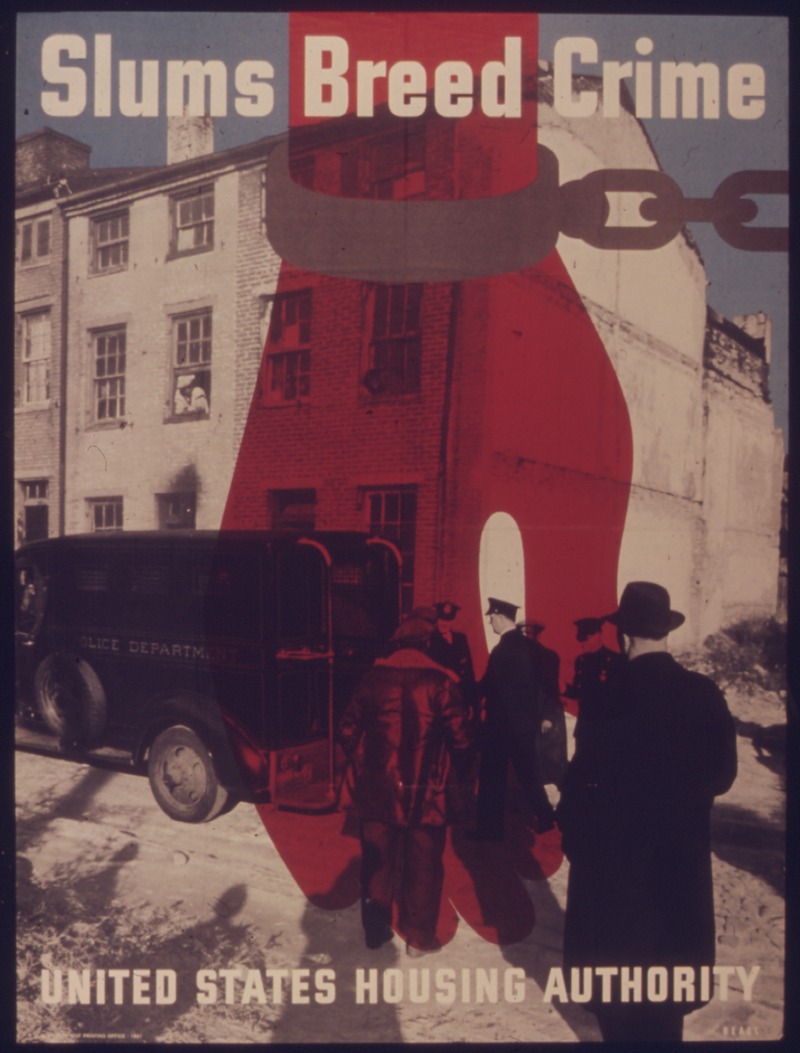
Unite States Housing Authority poster, 1940
Keith Humphreys has an important piece in the WaPo today highlighting the nuance of poor black communities with regard to violence and incarceration.
In his new book, Locking Up Our Own, Yale University Law School Professor James Forman Jr. points out that in national surveys conducted over the past 40 years, African Americans have consistently described the criminal justice system as too lenient. Even in the 2000s, after a large and sustained drop in the crime rate and hundreds of thousands of African Americans being imprisoned, almost two-thirds of African Americans maintained that courts were “not harsh enough” with criminals.....Through a compelling mixture of personal stories and wonky data analysis, Fortner and Forman document how African Americans have grappled with an anguished choice. On the one hand they want to protect themselves from crime, on the other hand they know that the more active and powerful the criminal justice system grows, the more African Americans will be caught up in it, some of whom will be subjected to grossly racist treatment.
As for Forman's policy recommendations - "expanded employment opportunities, improved housing options and better schools" - I'm not sure how far they will get into the problem.  Even if you had all of these things, the black community would still have a lot of difficult contingencies to reckon with.

Education always seems most meaningful to me, as you're getting kids while they're young.  But without a solid home, you're going to be spending a ton of money chasing maladaptive behaviors.  A lot of the so-called innovation we see in creating "good schools" is really about selectivity, as the parents who go the extra mile for their kids are exactly *not* the problem.  Instead, we want to target the overworked, stressed, dead-beat, angry, confused, overwhelmed, etc. parents.  These parents are not in a position to make good choices, they are barely able to keep it together as it is.  They won't be signing up for special charters, enforcing homework, looking out for their children.  And these kids are the ones who are the dirty little secret behind "bad" schools.

Traditional schools continue to fail them, with neither the funding nor comprehensive strategy to deal with them.  Charters just plain avoid them.

But they are the result of a larger economic system which segregates by property value.  Middle class neighborhoods populate schools with children of middle class parents and all the stability that represents.  Poor neighborhoods populate schools with children of poor parents and all the lack of stability that represents.

I have two ideas for intervention.  The first is to simply implement economic integration.  Each school must have a certain percentage from different socio-economic levels.  If you really wanted to get creative, you could create an SES scale that goes beyond mere income, and takes into account things like education, health, family support, issues, etc. (all of the the contingencies that go into supporting the development of a child).  Families would be assigned a score based on filling out a new card each year.  This would require a certain level of busing, which has its downsides.  But it would "spread the hardship" across our neighborhood schools.  There would likely be some downwards pressure from these struggling kids on the rest of the student body.  But there would likewise be upwards pressure from the rest of the students.  However, with this method, you're still not directly addressing the particular need of the student.  With a 30:1 ratio, and few other interventions, stressed out kids in stressed families who don't do their homework or get read to at night will still be highly at-risk.  The other way of going at this would be to incentivize economic desegregation by offering tax rewards to poor families who move out of poor communities and wealthier families who move in.  This brings up a gentrification worries for many, as ethnicity is so tied to income.  Personally, I wonder if actual economic desegregation wouldn't make the notion of gentrification irrelevant though.

A second option would be to forget busing, and focus on interventions at the local level instead.  Poor schools would get 10x the funds, the ability to cut class sizes by a half or even two-thirds.  Instruction and support would be much more differentiated to the needs of the individual student.  Similar to the IEP model for students with physical disabilities, every child would get an academic, "wrap-around" team to monitor performance both at school - and as would be central in this case - home.  On the television show The Wire, a so-called "Hamsterdam" experiment was invented, in which the police created a decriminalization block where drug users could freely use and pushers to sell their wares.  The idea was to end the violence of the trade, and allow the users to come out of the shadows where they would be able to be targeted by social service workers.  While poor, struggling families aren't quite drug addicts, I'm struck by the similarities, as well as our social response to their plight - which is a muddled mix of disdain, pity and victim-blaming.  Rather, these are fellow humans who need all of our help.  The bonus being, of course, eradication of a major source of social ill.


Both of these ideas are radical, but in my view more directly align with our values, and support fundamental notions of fairness in public education.  If we must have economic segregation in our capitalist economic system, then we must also reckon with the fact that we are going to be creating segregated economic ghettos, defined by their lack of resources and societal capital.

Saturday, September 17, 2016

Still Looking for First Base

Glenn Loury and John Mc Whorter for the umpteenth time are bemoaning the state of left-wing thought on race and poverty. These guys have been engaging in this funny little dance routine for years now.

I'd like to hear John or Glenn - or anyone else who shares their perspective - discuss what policy directions we might move in. I tend to agree with them that racism isn't what is driving black poverty (If you're not a seasoned reader of this blog, do me a favor and go back to some of my older posts on racism here, here, or here). But I disagree that it is something "they" need to figure out how to solve by themselves.
But I start from a place of determinism, where culture and institutions are what create all of our behavior. I can't just say someone "ought" to do X or Y, I also have a moral responsibility as a member of society who has been fortunate, to not just sit back and take advantage of that grace while less fortunate others don't have the option. Further, as a participant in an economic, legal, political, social, etc. system, I am perpetuating this system. So, what then to do. We can start with identifying the problem. What are the behaviors that people are engaging in that is leading them away from success? I would start at birth. Three year old children from impoverished families are already falling behind in their cognitive and emotional development. You can track them up through elementary, middle and high school, and plot the cycle of poverty. Then it becomes - if not racism or some nebulous notion of "bad choices" - accounts for the specific behaviors that disadvantaged people are engaging in? What are the institutional relationships? What are the social relationships? What are the economic relationships? There are micro-operations, such as how parents are speaking to their children, to macro-operations, such as how wages are determined for low-skill work. (I think part of the problem is that it is insanely complex stuff, and it is much easier to spend one's intellectual resources engaging in easy answers. This behavior is also reinforced by the sweet nectar of blame - in which we can point fingers and suckle at the teet of self-righteousness. Those silly liberals, those silly conservatives, etc. But the truth is that most people's quiver is sadly empty. And who likes to admit they don't have all the - heck, even some of the answers.) Oh yeah, so finally - after we identify the behavior, then identify the causes. What should the policy solution be? What should we do or not do? What is possible to do? But if we can't even agree at the first or second, we'll certainly never agree on the third level.

Monday, May 28, 2012

Victimhood

Michelle Alexander, author of The New Jim Crow, was on the Colbert Report last week.  In the interview, she claimed that people of color don't use drugs at higher rates than whites.  Colbert then asked her, "why didn't David Simon set The Wire in Greenwich, Connecticut?"  I'm skeptical of her claim.  What kind of drugs are being compared?  Surely more crack is smoked in the ghetto than in Greenwich.  But regardless, an obvious answer to this question is that the Wire is about the drug trade, and whites must get their drugs from somewhere.  I'm also wary of the notion seemingly argued in the book that much of the problems facing the black community have to do with drug laws and biased enforcement.  But having not read the book, I'll refrain from comment.

However, a common response to the notion of dysfunction in the black community, mainly coming from the the right, is the idea that  "they need to fix their own problems".  This rests on the assumption that larger society bears no responsibility - whether structurally or because of explicit bias.  Further, many on the right claim that indeed, it is the claim that minorities are in any way victims that actively perpetuates a sense of victim hood, thus driving behavioral dysfunction.  If one thinks of oneself as a victim, then a nihilism sets in and hopelessness leads to low self-expectations and lowered standards of behavior.  This is quite a theory!  But is it true?

 In my work with at-risk, minority teenagers, there is some degree of resentment and distrust of white people, and it is sometimes vocalized as an "excuse" of sorts to explain their poor behavior. But the larger dynamic of dysfunctional community breakdown and lack of societal capital is far more salient. It isn't as if these kids are sitting around resenting white people and thinking up a narrative of how their problems are all white people's fault.

Actually, in my many conversations with them regarding their poor behavior, they cite the existence of cultural norms in which they feel they must participate in order to survive. They fight because they have to prove they are tough. They misbehave because they don't have a strong family structure at home supporting them. Their role-models are not academically inclined, but toughs who have lots of girls and smoke or sell lots of pot.

Now, they do see themselves as victims. But they are! They are profoundly unlucky, born into such a world. They don't understand who is to blame. They don't understand how the system works, much less how white racism might even be an issue. The most cohesive narrative I've heard has revolved around illuminati conspiracies - their music idols are frequently thought of as having literally made deals with the devil to achieve fame and fortune.

No, their sense of victimization is based on looking around them, at their friends and families. They began down a negative path when they were in elementary school, struggling with schoolwork and dealing with chaos at home. Before they knew it they had developed behaviors and habits that made them rebels. Success meant failing well.

They say that black America must take a hard look at itself. Doesn't it already, on a daily basis? People are doing the best they know how. My students' parents are trying to parent the best they know how. Yet teen parents and dropouts are going to be at a severe disadvantage when raising children, not only because of their lower levels of human capital, but because of social and economic segregation that places them in neighborhoods, peer groups and apartment complexes with low levels of societal capital.

My main issue with what seems to be the thesis of Alexander's book is that it equates the conscious, explicit racism of Jim Crow with a modern system in which racial bias might exist, but is marginal to the larger structural problems afflicting poor and minority communities. I think it is a disservice to individuals to limit the scope of the inequities they face to racial bias, when they are caught up in a far larger and more damaging social and economic system that limits their opportunities from birth.

Saturday, May 12, 2012

Race is About SES

County courthouse lawn, Halifax, NC, 1938
The NY Times reports this morning on the continuing pattern of segregated schools in New York City.  The article goes through the motions, highlights familiar themes: white teachers, black students, race and socioeconomics being inseparable, white parents moving to where schools are more white, black parents feeling misunderstood, black students equating academic success with "acting white", charter schools trying to turn things around by requiring uniforms, plastering the walls with slogans, calling students "scholars", enforcing rigid discipline, and yet generally failing to raise scores and being thought of as "prisons" by students.

I don't deny race is a part of this story.  But it is a by-product of larger themes in our economy and society, specifically the fact that certain racial groups, historically discriminated against and therefore disadvantaged in their ability to build human and societal capital.  This translates into a continued correlation between those groups and lack of economic success.  I don't deny that racial attitudes and cultural norms play some marginally negative role in the continued link between SES and race, but it is far less consequential than SES by itself.

One of the issues raised in articles like this is modern white flight.  White families are staying out of black and Hispanic schools. I think it is important to make a distinction between modern white flight and that of half a century ago, when the civil rights movement ushered in a larger movement of whites out of the cities and into the suburbs.  There were other pressures at work, but as explicit racial attitudes were clearly much different then, it isn't hard to see how race was a major driving factor.  Today, explicit attitudes on race are quite different, and while racism clearly persists, it is much more marginal a feature of the phenomenon of white flight and persistent segregation than simple socioeconomic realities.

So, let's do a thought experiment.  Two neighborhoods exist: one, predominantly African American, one predominantly white.  Yet - and this is of course a rarity - the black neighborhood is largely affluent, its members possessing large amounts of human and societal capital, while the white neighborhood is poor, its members possessing low levels of capital.  For purposes of our experiment, we'll assume that schools in the black neighborhood are high-achieving, while those in the white neighborhood are not (in reality, this would be a very sound prediction according to the data on the link between SES - not race - and school performance).

Which neighborhood school would you like your children to attend?  Of course, ethnicity is a reasonable factor to consider, especially if you are a minority concerned about your child losing his natural heritage.  But the choice is really quite clear.  You want the best education for your child.  You want them surrounded by students from less-stressed, happier homes, fewer discipline problems, better prepared classmates, better organized parents and school culture, etc.  This is all a function of societal capital in which the student population has been developing throughout their childhood.  You want them to attend the majority black school.

Until we address the larger issue of inequity in human and societal capital, racial segregation is going to persist.  As long as our economy is arranged by class, a major requirement of it being a large portion of the workforce performing low-skill labor for low pay, there are going to be economic ghettos, defined as they are by socioeconomic segregation.  And those who will inevitably fill these ranks will be those who have been subject to generational inequities of many types - discrimination, low education, broken families, etc.

Public education is the best resource we have right now for correcting this phenomenon at the margins.  But the perennial question remains - if all have access to an equal education, who will clean the toilets?  There will be a need in the long-term foreseeable future for a great number of low-SES occupations, which will inevitably self-sort into ghettos.  Given the history of African Americans and Latinos in America, especially the influx of immigrant labor from Latin America, these ghettos will no doubt still have an ethnic correlation.  The segregation won't be codified by law, but by our social and economic system.

Sunday, April 29, 2012

Polishing the Bell Curve

Maybe it was the release of Charles Murray's latest book - which is not about race!  Or the recent firing of John Derbyshire.  Or the continued failure of NCLB to show much progress at all.  Or maybe just that we have a black president.  But paleo-conservativism seems to be getting bullish on the political incorrect notions of genetic and racial explanations of social inequality.

As I have written before, there is an enormous degree of correlation between the acceptance of right wing assumptions and the acceptance of genetic explanations for race and socioeconomics.  Because of the unconscious nature of how racism tends to operate, it is therefore appropriate to ask how much right wing assumptions are actually facilitating acceptance of racist frameworks for socioeconomic analysis.

It is easy to see why.  The right wing framing generally sees social class as meritocratic and fair.  Yet the continued disproportionate representation of blacks among the lower-SES strata presents a problem that needs to be explained.   The three general categories of answer are 1) genetic, 2) environmental, and 3) personal choice.  Because of our history of racism, civil society shies away from genetic explanations.  The left wing, comfortable with subverting traditional power structures and state intervention in social environments, tends toward environmental explanations. 

The right, to the degree that it opposes social redistribution or state intervention, is challenged to propose its own solutions.  Generally, it adopts the personal choice model; even though it accepts some of the environmental explanations (who could deny so much research?), as a practical matter - to the degree that we value justice -  it argues for the metaphysical existence of an individual's power to transcend environmental limitations.  This isn't actually supported by social research, but it apparently has great intuitive and rhetorical power.

Another choice, one favored by right-leaning individuals, is to be "politically incorrect", and adopt the genetic explanation.  The IQ-SES framing adopts the genetic explanation, with higher IQs in positions of power, and lower IQs in position of subordinance.  While intuitively "icky", this explanation at least removes the burden of having to explain stubborn patterns of racial and socioeconomic inequality in environmental or personal choice terms.

Of course, as with right wing claims about personal choice and the effects of environment on development, claims about the existence of a genetic meritocracy aren't supported by the research.  Sure, you can always find research that agrees with you.  But like evolution or global warming, the research is poorly designed and rejected by a large consensus of experts in the relevant fields.

Yet given the troubling persistence of unscientific views on the right (far more representative of majority opinion than unscientific views on the left), one wonders whether genetic explanations of socioeconomics and race will begin to become more acceptable in conservative circles, and among the base of the Republican party? 

Wednesday, April 18, 2012

An Ugly Marriage

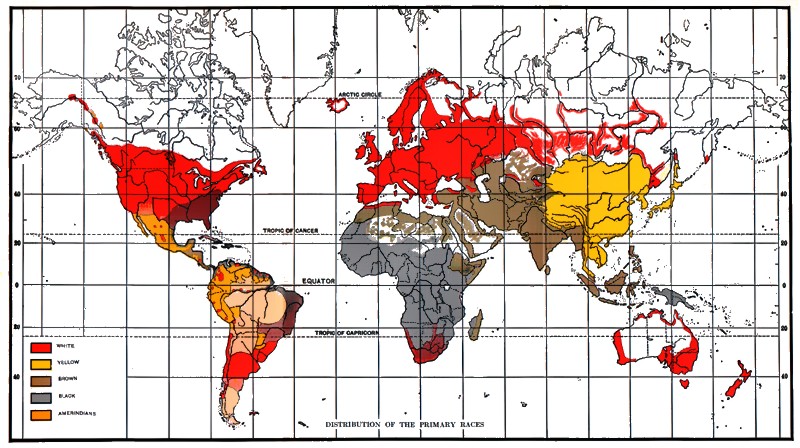
"Race Map" from 1920
I recently came across the book Bad Students, Not Bad Schools by Robert Weissberg.

My interest piqued by the title, I was struck however by this bit from the synopsis on Amazon,
"Weissberg argues that most of America's educational woes would vanish
if indifferent, troublesome students were permitted to leave when they
had absorbed as much as they could learn; they would quickly be replaced
by learning-hungry students, including many new immigrants from other
countries."  
I then noticed that this was followed by a favorable blurb from none other than John Derbyshire, the conservative columnist for the National Review who was recently fired after achieving infamy in a column in which he pretended (?) to give advice to his white child on how to avoid various threats black people might pose - a racist version of "the talk", the much publicized response amid furor over the George Zimmerman profiling case many black parents have felt necessary giving their children.  Here's a little taste:
...Thus, while always attentive to the particular qualities of individuals, on the many occasions where you have nothing to guide you but knowledge of those mean differences, use statistical common sense:

(10a) Avoid concentrations of blacks not all known to you personally.

(10b) Stay out of heavily black neighborhoods.

(10c) If planning a trip to a beach or amusement park at some date, find out whether it is likely to be swamped with blacks on that date (neglect of that one got me the closest I have ever gotten to death by gunshot)....
(11) The mean intelligence of blacks is much lower than for whites. The least intelligent ten percent of whites have IQs below 81; forty percent of blacks have IQs that low. Only one black in six is more intelligent than the average white; five whites out of six are more intelligent than the average black. These differences show in every test of general cognitive ability that anyone, of any race or nationality, has yet been able to devise. They are reflected in countless everyday situations. “Life is an IQ test.”
In my last podcast, I pointed to the fact that racists always seem to be conservative.  I argued that this is likely due at least in part to the substantive claims conservatism makes.  While its logic does not unavoidably lead to racism, its underlying assumptions do much of the logical heavy-lifting.  Taking a spin around the site that hosted Derbyshire's writing, the racism is as close to explicit as it gets.  And the list of contributors is paleo-conservative to the bone.  You can almost hear the brandy glasses clinking in the background as the phrenology calipers are adjusted.

One might dismiss these radical types as not representative of any larger conservative movement.  And to an extent that is no doubt true.  Yet while most prominent conservatives would have a hard time coming right out so bluntly, it isn't hard to see how such thinking represents a mere coherence of the nebulous, uncomfortability conservatism has with race and class in general.  In a tragic way, race acts as a kind of litmus test for the poisoned waters of "meritocracy", the sly fantasy the right-wing embraces as a means of perpetuating traditional power structures.  In a sea of undifferentiated masses, it is easier to pretend that the poor are merely choosing their own sorry destitution.  Yet when poverty remains so wedded to race and ethnicity, it becomes hard not to seek explanations either in social structures or genetics.  As embracing radical change in social hierarchies is anathema to conservatism, radical paleo-conservatives are merely being honest when they voice their preference to adopt genetic explanations.

Milton Friedman, in his 1980 miniseries Free to Choose
I'm fascinated by the politics of education reform, and the lenses that it gets viewed through.  I do agree that the problem is the students, and demographics - you can't argue with facts.  But where I differ is that I see this not as a problem of racial or ethnic inferiority, but as one perpetuated by our economic and social system, where human and societal capital are distributed according to privilege.

I see current reform efforts ultimately as a clever alliance between this kind of paleo-conservative racial & class exclusion and neo-liberal naivete that wants to believe that poor kids' only enemy is bad teaching.  Vouchers have been replaced by charter schools, which promise to give both groups what they think they want.

Unfortunately, the problem - for those of us neither right-wing racialists, nor pie-in-the-sky teacher demagogues - is about equality of opportunity.   If we really want to give kids an equal education, we need to invest in levels of service appropriate to the necessary intervention.  That, we have not yet begun.

Thursday, August 18, 2011

Thinking about "The Help"

The movie The Help is out and stimulating discussions of issues of race and class.  Harold Pollack remembers a painful event from his childhood:

"....our family was close to our neighbors. Their children were cared for by a young black woman whose name I’m embarrassed to say I’ve forgotten. She slept in their basement. My dad did a lot of work around the house, and happened to have some extra moveable partitions. He gave one to her, so that she could have some extra privacy.

That night, the neighbors stormed over. They informed my parents that if they had wanted her to have a partition, they would have bought her one, and that my father had made an inexcusable intrusion into their home. There were some harsh words. Our families maintained polite but frosty relations from that moment forward."
 Things have certainly changed.  But in many ways, they have not.  Millions of people still work for poverty wages.  And taken broadly as a class of worker, there are distinct disadvantages they face that are not entirely dissimilar to what was so starkly a racial matter a few decades ago.  In fact, I wonder as I type this, whether the racial differences are still as stark.  We took a vacation up the California coast this summer and witnessed many fieldworkers who were all Hispanic, as far as I could tell, and likely undocumented.  We're used to the lowest forms of labor - in status, difficulty and pay - being done by minorities.

While we can I think agree that most overt racism has all but disappeared, at least as a primary factor in employment, structural problems remain in which large sectors of society are disenfranchised and almost destined from birth to lives of poverty and desperation.  And to the extent that any of us partake in the economy, certainly when we purchase services that directly require the labor of minimum-wage employees, we are exploiting their lack of empowerment.  The notion that they are all completely free individuals who could easily have decided to go to school and become lawyers or highly skilled workers is a convenient fantasy.

Wednesday, June 15, 2011

Black and Academic

Glenn Loury and John McWhorter are at it again on bloggingheads.tv, this time taking Cornell West to task for simply not being serious enough.


I've had my share of problems with Loury and McWhorter (here, here, and especially here), although I suppose I've come to begrudging appreciation of at least Loury's particular eloquence (I did enjoy him here). The man can wax eloquent on a turd.

Which I guess leads to what is maybe my agreement: these two so often have so much to say, yet end up saying so little. The crutch they - especially McWhorter - have a habit of relying on is an oppositional schtick. They stake out an "unconventional position", yet then spend much time deriding what they have defined as "conventional". Yet much less is spent actually making a case for their unconventional position, allowing much of the argument to be assumed from the fact that it is merely in opposition.

I'm not sure if I heard either of them say this, and it may be a criticism beyond the pale for either of them to level, but I wonder to what extent their critique of West was about a sort of minstrelsy? They are both quite damning of what they refer to as his playing of some old-time civil-rightsy caricature. They both seem offended by this, and wish he wouldn't do it. They seem to think of it as a schtick, a performed routine that he puts on - no doubt to the benefit of a white audience.

Because, what about when he does it before a black audience (as he does)? What role is he playing there? In most academic settings, the form of expression is in sharp contrast to the the subdued, stiff-lipped, "serious", anal-retentive analysis we're accustomed to coming from "experts". And this is for the most part a white thing, right? (As most "experts" tend to be white). Interestingly, his last (first?) appearance on bloggingheads happened to be with a Robert George, southerner very interested in the Christian tradition, which especially in the south has a long history of just the sort of expressionistic style West demonstrates.

But before a black audience, his style is perfectly at home. What Loury and McWhorter seem to criticize as phony or contrived, suddenly becomes an exemplar of the great history of black ethnicity. In criticizing West, they too implicate black culture itself - something these two particular black men are no strangers to. In fact, the very conservative impulse that they have an affinity for has a long history of criticizing black culture, not just for the dysfunction disproportionately prevalent in its community, but for its expression of "otherness", and the way in which it seems to present a perpetual challenge to white European American cultural hegemony. In their quest to transcend race, they become susceptible to the conservative habit of downplaying its significance, having been made uncomfortable with the thornier issues it presents both at the micro and macro levels of social integration and political policy.

If one can say anything about West's core motivation, it is that it is a search for social fairness and human dignity. His academic career has been devoted to this question, specifically race, and how our society has struggled to "do right" by its citizens. I think it is fair to say that no small part of West's public persona has been as a charismatic champion, in the tradition of many great social leaders. No doubt this has meant a sacrifice in his thinking - there is little room for nuance in rallying the masses. In this regard, serious academic thought (not to mention the time required for heavy-duty scholarship), will inevitably suffer.

Yet in his quest to inspire the public, West no doubt has gained a spiritual eloquence. I don't mean this in any religious sense, but in that thought - we are discovering more and more - is not solely the domain of logic and reason. It is at least as motivated by emotion, informing things like empathy, conviction, ego, etc. The great efficacy of a leader is the way in which he or she is able to connect with an audience not only on an intellectual, but this "spiritual" level as well. And of course, doing so requires developing this skill within oneself.

The ultimate question then seems fair: to what extent are Loury and McWhorter offering up a "schtick" of their own? To what extent is any of us offering up a "schtick"? Sure, in the relative comfort of each of our established communities, it may not feel like so much of a schtick, and merely "natural" behavior. But one of the lessons of precisely the movement from which West is coming, not only civil rights but the profound self-reflection and deconstruction that peaked in the 60's, is that there really is no "natural". For what is "natural" about african-americans who took the names of their masters, were forced to live in oppression and cultural violence for centuries? What is "natural" about Barack Obama, who was raised in a relatively white family, yet is seen (and treated) as "black" by the rest of society? Many black radicals, along with many others, took this new relativistic understanding and then sought to upend things by explicitly creating what is "natural" for themselves - whether Kwanzaa, adopting African names or dress.

I think this was actually not so new. Because culture never really was "natural", especially when you live in the hostility of a white supremacist society that denies everything that is truly natural about you, and invents what is not. Despite this, the story of America is in no small part the story of black survival and cultural triumph. What happened in the sixties what largely a conscious discovery of what had already been going on since before the founding.

Loury and McWhorter make a reasonable enough case for the sixties "being over". But I think they strongly overplay their hand. There is a fundamental inertness and stubborn shamefulness to their critique. So what if West is a little over-the-top? The content of what he says, despite their protestations that it is not "deep enough" (ironic, coming from them), is as least as much strengthened as weakened by his emotional delivery. Because when he pulls into that "groove", so to speak, his torso rocking, his hands waving, his words falling into a rhythmic sync, he is tapping into a source of power and strength that finds its roots deep in the human soul, that which will never find expression in even the most complex and well-structured grammatical elocution. Combine this with a first-rate mind, capable of referencing the greatest of human works at the drop of a hat, from philosophy to poetry, to Judeo-Christian texts and historical events, you have a figure that anyone ought to be in awe of.

Thursday, April 28, 2011

Through Birtherism, Darkly

John McWhorter doesn't think that birtherism is really about racism, or about Obama being black, and really a form of political rhetoric.  He compares the flap to the way in which Clinton was attacked in the 90's.  He calls it a "deep-set animus", and that it was simply about politics.

On one superficial level the birther question is perfectly legitimate: is he really a citizen? This is an obvious question, with on obvious answer. Yet the legitimacy rapidly recedes as the question is placed into a context of Obama being black, of his middle name, of his childhood, the non-Christian rumors, the colonialism, etc. All of it overwhelms seriousness - especially as the question had been resolved to a perfectly reasonable standard of evidence long ago.

Yet, all of this "context" goes to the difficulty in identifying prejudice. McWhorter has argued before that it is standard political rhetoric, where the only point is to score points. Yet this is what is so damn tricky about prejudice. You can't put your finger on one specific statement that "proves" its existence. And who among birthers would acknowledge explicitly any racial prejudice?

No one acknowledges racial prejudice these days. And who would expect them to? It is a serious sin. But these tangled patterns, forged over decades and centuries, continue to wind their ways through our unconscious mind. We're left with all of these "tendencies" and suspicions that gnaw at the fringes of discourse - whether on immigration, the "war on terror", Islam, or welfare. And yet we can't talk about them. We can't name them. We don't understand them.

And they are so easy to deny, so deceptively simple and harmless. Each issue by itself can be separated out and a case made that they are perfectly reasonable. Asking whether Obama is an American citizen is reasonable question. But at what point does it become unreasonable? And why? Why exactly? And when a sizable portion of the electorate continues to wonder, what does that say about them? What exactly is going on?

There is nothing exact about it. And in this refuge of uncertainty, of squishiness and vagueness, those who would play upon the oldest, most devilish human tendencies find their safe haven.