Showing posts with label free will. Show all posts

Saturday, July 1, 2017

On Behaving "As If" There Is Free Will


I can't find the quote, but it is as long the lines of "Free will doesn't exist, but we must behave as if it does."

I wonder if this "as if" behavior can be described in a behaviorist account?

In behaviorism, we talk about the concept of stimulus prompts and "rule following". A stimulus prompt is basically a cue for us to engage in certain behavior. Through learning (repeated reinforcement delivered after prompted behavior), the prompt takes on stimulus control: it changes our behavior. Think of a checklist, "wash hands" sign, exit sign, etc. Rule following is much the same, whereas the rule is like a prompt, however the rule doesn't have to have previously been directly reinforced. Rather it can have been inferred, and is generally defined as under stimulus control of previous rule-following behavior. That is, if we have followed similar rules before (and have been reinforced), we will be more likely to follow them in the future.
In this way, thoughts can function as either prompts or rules. In our daily life, we behave according to a mixture of external and internal prompts. Behaviorists call these discriminative stimuli, as they have been followed by either punishment or reinforcement, and are thus defined by our discrimination of them as signals for the availability for reinforcement of punishment ("exit" means leaving behavior will be reinforced; "open" means entering behavior will be reinforced; "poison" means eating behavior will be punished, etc.).
Behaviorists also have a way of describing consciousness (which of course can mean many things) One of the meanings of consciousness though, is the behavior of labeling, via verbal behavior. This is described as operant learning in which certain stimuli take on stimulus control for verbal behavior, either spoken or thought, after having been reinforced in a specific verbal community. For instance, when I see a chair, I can say "chair" or think "chair", because as a child I received reinforcement from the community for emitting that behavior. It could have been direct praise, or conditioned praise in the form of a good grade, or simply the ability to communicate which led to some other kind of reward. We call this "tacting". (We have a different way of describing requests, as their reinforcement is defined as coming directly from the obtaining of the request, i.e. "water" means we directly get that thing. A seemingly minor difference but has important implications for the early acquisition of language). The reverse of this, of course, is listening behavior, in which a stimulus controlling for verbal behavior (tact), is reversed. The chair object controls for the word "chair", but then the word "chair" controls for the object chair.
OK, so I have a hard time describing the behaviorist description of these phenomenon because there are just so many basic concepts that need to be understood to truly appreciate the position! But returning to consciousness, what you might call an active consciousness, in which we are aware that we are conscious, is this process of labeling. When I am thinking about thinking, I am "tacting" my thoughts. Likewise when I am thinking about what someone else has said. However, "tacting" only refers to stimuli that are physically present (chair, desk, apple). We have another level of description for things that are under stimulus control of verbal behavior, but are not in the environment - and may have never been physically contacted. We call this "interverbal" behavior. Most of language involves this type of verbal behavior, as well as abstract thought such as mathematics or literature. This is also the kind of thought we need to engage in for complex thought, such as when planning for future events, or recalling an order of events.
So, what is the implication of this for our thoughts? We can have thoughts that are direct responses to our immediate environment, our distant environment, or responses to words. Our fluency in all of these is determined by a number of factors. First, we have to have been reinforced for the response ("knowing" the verbal behavior), but we also need to have the establishing operation in place. What we mean by this is that there must be a basic desire in place that is being satiated by the behavior. For instance, if you have been reading all of this and trying to understand me (and hats off to you!), you will have to have been motivated to do so. The motivation is maybe generalized social reinforcement, in which you have been previously reinforced for the behavior of engaging in verbal behavior with others. You may also have been previously reinforced for acquiring new ideas and achieving constancy in your thoughts and how they align with the world - truth feels good, right? But maybe I haven't been making sense, and therefore the opposite has occurred, and my words have been extra work for you, in which case you aren't receiving reinforcement from them - they are not rewarding.
The establishing operation - how motivated you are - is not verbal behavior, and largely hidden within the skin. You can learn to tact this behavior, by noticing your heart rate, stiffness, or certain negative thoughts that may arise - "This guy is ridiculous!", and therefore tact your motivation as decreasing for continuing to read my writing. Or, maybe you enjoy arguing and my writing is actually reinforcing, because it is stimulating something else in you - maybe your enjoyment of "tearing down" my argument. In which case, the response I get to this might have been evoked by an establishing operation (EO) for argument, followed by my writing, which was a stimulus (SD) for the availability of reinforcement (R+), which in this case was the satiation of that desire for argument (socially reinforced, of course, by the internet community).
Behaviorists see every behavior (thought or action) as taking place within the 4 term contingency (EO - SD - Bx - R+). Further, this can only be understood as "molar", as opposed to "molecular". That is, as taking place in large chunks, over time. We take place in a continuum of phylogenic (genetic organisms) and ontogenic (life history) interaction.
So, for any given behavior, there is no room for "free will". We are constrained by our past and environment. We will go on behaving no matter what. Even if we were to protest and lay down motionless on the floor, that behavior will have had to have been the function of the four-term contingency.
If we then throw up our hands and say, I must behave "as if" I have free choice, we are basically tacting our behavior, or examining it interverbally, and establishing a rule, or prompt for ourselves. However, as for its effect on our behavior, it will only function as an SD for future behavior's possible reinforcement. That is, the way we behave following having this thought will encounter a consequence in the environment. So it can effect behavior change - you can effect behavior change, but the SD will always be a part of the environment.
In terms of this larger discussion, the way I relate what Garfield is saying about Buddhism and "awareness of the self" and behaviorism, is that the "self" as free actor does not exist, but rather refers to an organism existing within its environment. However the way that we often use the term "self" is as an efficacious agent somehow acting out of time. That incorrect narrative leads both to inaccurate narratives of others, as well as ourselves. How this inaccurate narrative causes problems is interesting, but that it is an incorrect narrative, as a behaviorist, I would say is established science.

Monday, August 22, 2016

Don't Tell Us Any More About Dualism

Hand prints in Pettakere cave, Sulawesi,
Indonesia, est. 35,000 and 40,000 years old
Apparently Tom Wolfe is not a big fan of Noam Chomsky either (see my previous post).  In his August 2016 essay in Harper's Magazine titled The Origins of Speech, Wolfe sets out to take Chomsky down a notch or twelve.   While I've personally always admired Chomksy's vocation as thorn in the side of Western imperialism and neo-liberal capitalist dogma, he's far too often a polemicist of the cheapest order.  Instead of keeping an eye peeled for nuance, irony and self-skepticism, his fervor seems to compel him to lazily troll the waters of simplistic, conspiratorial global plotting, in which there are rarely simply no good answers, but always rather the good guys and the bad guys, and his own uncanny ability to always spot who is who.

Wolfe too bristles at Chomsky's ad hominem attacks - "The epithets ("fraud", "liar", "charlatan") were Chomsky's way of sentencing opponents to Oblivion".  But while he spends a good deal of time examining Chomky's anarchist roots and rise to fame in the anti-war movement through harsh criticisms of the Vietnam war, the real focus of the piece is Chomsky's invention, in the late 1950's, of something called Universal Grammar.  UG is a theory of language in which humans, thought to essentially possess a "language organ" somewhere deep in the brain, that
"could use the "deep structure", "universal grammar" and "language acquisition device" that [the child] was born with to express what he had to say, no matter whether it came out of his mouth in English, Urdu or Nagamese."
Regular readers of this blog will note that I am a Board Certified Behavior Analyst.  In my practice I work with children with developmental disabilities (primarily autism), who suffer severe language deficits.  As such, I am trained in the science of behavior, the philosophy of which is called Radical Behaviorism.  From Wikipedia:
Radical behaviorism differs from other forms of behaviorism* in that it treats everything we do as behavior, including private events such as thinking and feeling. Unlike John B. Watson's behaviorism, private events are not dismissed as "epiphenomena," but are seen as subject to the same principles of learning and modification as have been discovered to exist for overt behavior. Although private events are not publicly observable behaviors, radical behaviorism accepts that we are each observers of our own private behavior.
(*these other forms are largely no longer practiced, radical behaviorism today being the predominant philosophy at the root of applied behavior analysis, experimental analysis of behavior, organizational behavioral management and relational frame theory)

As a behavior analyst, I am not an expert in language per say.  I'm certainly not trained in linguistics, nor speech pathology.  That said, as much as language is behavior, I understand how it works quite well.  Behaviorism as a field draws much of its foundation from the work of B.F. Skinner.  More than anyone else, he developed and expanded upon the notions of reinforcement and punishment, antecedents and consequences, discriminative stimuli, motivating operations and schedules of reinforcement to establish a robust theory of language.  In 1957, he too published a landmark book, Verbal Behavior.  Again, from Wikipedia:
For Skinner, the proper object of study is behavior itself, analyzed without reference to hypothetical (mental) structures, but rather with reference to the functional relationships of the behavior in the environment in which it occurs. 
Within Behaviorism, Chomsky is famous for his harsh criticism of Verbal Behavior, in which he generally misunderstands its fundamental concepts and levels baseless attacks.  Outside Behaviorism, however, Chomsky is famous for utterly refuting Skinner, igniting the "Cognitive Revolution", and generally assigning Behaviorism to the dustbin of history.  Behaviorists are endlessly baffled by a dismissal of Verbal Behavior that continues to this day, as psychology, education and language students are routinely taught Skinner only in passing, and with nowhere near the depth required to truly understand his work.

I must pause.  I realize that sounds like a suspicious plea.  Oh, if only they understood our work, they would agree with it.  The implication is, well, kind of Chomskian in its dismissal of disagreement: your objections are not valid because you haven't taken the time to understand the subject.  Maybe you have become too accustomed to the decadence of your bourgeois hegemony, non, comrade?

To start with, behaviorism is actually quite hard.  For starters, it is deterministic, and thus in opposition to traditionally dominant notions of free will and agency that are the very pillars of entire religious and political dogmas.  It is also highly technical and reliant on an elaborate network of scientific principles that much each be understood in their own right before the larger whole is assembled into a coherent theory.  And finally, it is often quite unintuitive.  Aside from its refutation of free will (an assertion many will reject outright based on what will be described as self-evidence), it's principles describe interactions between events that take place across a timeline that isn't easily grasped at first.  In this way it is like the theory of evolution, which requires a pulling-together of a number of various concepts (mutation, natural selection, change over time), and that can't be pointed to easily as a process unfolding right before our eyes.

In another piece I've been working on, I plan to go into more detail as to what I think Chomsky's motivations, or possibly as important, the larger public embrace of his supposed refutation of behaviorism's explanation of language.  I hope to have that up soon.  But as one might imagine, Verbal Behavior and Chomsky's notion of a Universal Grammar were bound to conflict.  Now, contrary to common understanding, behaviorism does not believe in the tabula rasa view of humans, in which we are entirely a product of our environment.  Rather, behaviorism understands that every organism has certain genetic proclivities for certain stimuli - these drive our basic wants and needs (food, sex, shelter, touch, etc.).  And within our species there are no doubt a range of individual differences in proclivity - some people will be more sensitive to certain stimuli more than others.

However, this is only the beginning.  We are learning creatures, and possess a basic tendency to behave in certain ways more or less, depending on physiological desires and the ways in which the environment does or does not stimulate them.  In this way, we are no different than most (if not all) other mammals.  If a baby chick makes a certain sound near her mother, and is rewarded by more attention, she will be more likely to make that sound again when her mother is near.  If a dolphin eats a certain type of fish and is disgusted by the taste, it will be less likely to eat that fish again.  If a bear hears the sound of a car and follows it to a campground filled with tasty potato chips, it will be more likely to follow that sound again (however, if following the sound is followed by no chips - or worse, a gunshot - it will be less likely).

When we drive past a sign in a store window announcing "75% OFF ALL ITEMS"*, we will be more likely to go into the store.  Of course, as humans, our behaviors will be somewhat more complex.  We will be likely, in fact, to begin a behavioral chain that we have learned (that has been REINFORCED, or has been previously followed by benefits): for starters, the words of the sign have previously been reinforced ("75% off"  = wow!, VERY available; all items").  Seeing that the store is one in which many items you enjoy are found within, you become extra excited.  You then engage in the behavior of thinking about what you might want there.  When you realize you could really use an antique Buddha lamp you've been eyeing in the window (a behavior previously reinforced by a college course you took in which you discovered the Buddha and how he reminded you (conditioning) of Santa Claus, whose appearance was consistently followed by presents), you are even more likely to pull over.  You now engage in a series of responses - checking your mirror, turning on the signal, turning the wheel - all of which you have learned have the desired effect of safely navigating the car where you want it to go (previously engaging in that behavior has had precisely the same result).

(*In fact, just reading "75% off" likely evoked in you a bit of conditioned warm feelings as you have likely been conditioned by our society to respond to large discounts).

Have you ever walked into a room and realized you forgot why you went there in the first place?  Have you ever been reading a book and realized that you hadn't even noticed the last couple of paragraphs you were reading because your mind was elsewhere?  These seem strange because they are unexpected moments in which "mindless" behavior is obvious.  But in reality, how much of our daily behavior is indeed "mindless" anyway?  In behaviorism, this "mindlessness" is easily explained in behavioral terms, as a part of our normal conditioning.  In fact, even our awareness of our actions is the product of conditioning; the language we use to describe it is Verbal Behavior.  The "radical" in Radical Behaviorism emphasizes this completeness: it deals not only with observable behavior, but with the verbal behavior that takes places within our own minds as well.

So what to make of Chomsky's Universal grammar?  It isn't necessarily inconsistent with behaviorism.  One could imagine the human brain possessing some structure that finds certain patterns of stimulus more reinforcing.  We do seem to see this in universal preferences for certain symmetrical facial features, or compositional patterns in art.  However, the real issue is more philosophical, and has to do with emphasis.  Is language something that is created by a physiological structure in the brain - a sort of computational device, or is it something that emerges over time, out of repeated interactions between the brain and the environment?

Chomsky preferred the former.  While he couldn't point to any such structure yet discovered, he assumed it was only a matter of time before it would be.  Mainly, he argued, the fact that humans were capable of generating utterly new thoughts and ideas refuted the notion that we were bound by our experiential interactions with the world.  He pointed out that small children were able quickly to imagine and speak of things which they had no direct knowledge.  He noted as well that all human languages had certain patterns in common.  This was clear evidence that there was something universal about language, something that had evolved in our species.

Wolfe describes how influential Chomsky's position became.  Despite a lingering lack of evidence for any organic grammar structure, his theory was massively popular, and helped propel linguistics as a field into increasing popularity.
"Thanks to Chomsky's success, linguistics rose from being merely a satellite orbiting around language studies and became the main event on the cutting edge... the number of full, formed departments of linguistics soared."
 The so-called "cognitive revolution" ushered in an era in which the context of the speaker (history, stimuli, motivations, etc.) was less important than the structures presumed to exist within the brain.  Although, still without much evidence of what or where those structures were in the brain, researchers had to be content with inventing metaphors for these supposed mental processes.  Chomsky's emphasis on physical structure inspired elaborate conceptualizations that were themselves rooted in 3D dimensional intuitions: sorting, shifting, stacking, storing, building, etc.  With the rise of the computer, which was indeed a physical system in which code could be written and organized that did all these things, a perfect analogy was there for the taking.  What was the mind, it could intuitively be imagined, but a computer of flesh and blood?

But we had made this mistake before.  Rene Descartes, writing in 1647, reasoned that the mind could not be part of the body because it was ethereal and indivisible, as the body was corporeal and thus divisible.

[T]here is a great difference between the mind and the body, inasmuch as the body is by its very nature always divisible, while the mind is utterly indivisible. For when I consider the mind, or myself in so far as I am merely a thinking thing, I am unable to distinguish any parts within myself; I understand myself to be something quite single and complete….By contrast, there is no corporeal or extended thing that I can think of which in my thought I cannot easily divide into parts; and this very fact makes me understand that it is divisible. This one argument would be enough to show me that the mind is completely different from the body…. 
The notion of the "mind" being an entity separate from causality, and therefore from the body, is known as Cartesian Dualism, and is a fallacy.   As Daniel Dennet writes in Consciousness Explained:
Cartesian materialism is the view that there is a crucial finish line or boundary somewhere in the brain, marking a place where the order of arrival equals the order of "presentation" in experience because what happens there is what you are conscious of. [...] Many theorists would insist that they have explicitly rejected such an obviously bad idea. But [...] the persuasive imagery of the Cartesian Theater keeps coming back to haunt us—laypeople and scientists alike—even after its ghostly dualism has been denounced and exorcised.

Somehow, however, the dualist trappings of cognitivism persisted.   While behaviorism explicitly opposes it as mentalistic,  and by definition non-deterministic and unscientific, the idea "that the mind and mental states exist as causally efficacious inner states of persons"  has been a major assumption of many cognitive theories for the last half-century.  

Wolfe fast-forwards us to 2005.  A paper by Linguist Daniel L. Everett, titled Cultural Constraints on Grammar and Cognition, described a tiny Amazonian tribe, the Pirahã , who Everett had spent a great deal of time with as a Christian missionary, and whose language broke all the Chomskian rules of Universal Grammar.  Indeed, it was observed that it was the culture of the Pirahã themselves that defined their language.
"...Their unique ways of living shaped the language - not any "language organ", not any "universal grammar" or "deep structure" or "language acquisition device" that Chomsky said all languages had in common.
This was a people who lived radically different lives than most everyone else on the planet.  Intensely isolated, they lived in a world most of us wouldn't recognize.  Because of their cultural patterns, they simply had no use for concepts and ideas most of us might take for granted.  They used almost no tools, they kept few material goods, neither read nor wrote, and had no mathematical concepts beyond "a lot" and "a little".  When Everett showed them black and white images, they struggled to make sense of them, so unaccustomed as they were to pattern recognition.  Furthermore, they had no words for yesterday, or tomorrow, but rather referred to them as "other days".  With little conception of the past, Everett's attempts at converting them to the Christian faith were hopeless.  In a hilarious (and honestly, quite triumphant, personally)  passage of the article, Wolfe writes of what happened when Everett tried to teach them about Jesus:
"How tall is he?" the Pirahã would ask.
"Well, I really don't know, but -"
"Does he have hair like you?" meaning red hair.
"I don't know what his hair was like, but -"
The Pirahã lost interest in Jesus immediately.... After about a week.... one of the Pirahã, [named] Kohoi, said to Everett politely but firmly, "We like you Dan, but don't tell us any more about Jesus."
 
To a behaviorist, this makes perfect sense.  Culture evolves, and with it language.  Why would a language develop if it wasn't being reinforced?  To the Pirahã , who had no use for concepts of tomorrow or yesterday, no such language was needed.  The universal structures Chomsky proposed to have evolved in all humans were curiously absent in in the Pirahã.  Everett argued that this was, as the New Scientist described his claim, "the final nail in the coffin for Chomsky's hugely influential theory of universal grammar... [that] most linguists still hold to its central idea."

In my work, I regularly encounter children who completely lack any language, or as we say - a verbal behavior repertoire.  There can be many reasons for this, but often, the most salient reason is lack of learning opportunities.  What this generally means is that, either because of their genetic make-up or specific environmental history, they require more exposure to certain stimuli before relationships develop.  We apply the principles developed by Skinner in Verbal Behavior, in which different contingencies of reinforcement are targeted for different language skills.  We teach echoic (vocal) imitation to begin to develop in the learner the ability to produce certain sounds.  We find motivating items and make their availability contingent on emitting certain requesting ("manding") behavior, usually either by handing a correct image of the item, or signing or making a correct vocalization.  We teach receptive language skills by saying the name of an item or activity and reinforcing when the child indicates the correct response.  We teach labeling by asking what an item is and reinforcing the correct response.  We teach what Skinner called "intraverbal" behavior, in which a response is controlled only by other verbal behavior, i.e. not simply what is in the room (e.g. What do you wear on your head?  Hat).  We teach matching and categorizing items into groups by what features they share, what they do, or logical classification.

All of these skills are slowly built up in a child until the skills, as a whole, represent a language repertoire. The child is now talking.  The child is now thinking.  Now, by definition, these children have a disability.  They were not raised in an environment completely lacking in language.  For whatever reason, they were not able to "pick up" language as easily as their typical peers.  There are many reasons for this, and much is still not yet understood.  However, a common feature of the autism diagnosis is that what is sensorially pleasing to a typical child might not be so to a child with autism.  For instance, eye contact, a critical component of social connection, is often lacking in autistic children.

And yet it is critical for learning.  When a baby makes eye contact with you and you smile back, indicating joy, the baby experiences social reinforcement.  This will go on to become one of the most powerful mechanisms in the child's life as it grows and begins interacting with the world.  Some of the first behaviors of an infant are shaped by differential social reinforcement.  That is, when a  baby says "mago mago", we likely show little excitement, and there is little reward for the child.  It will be no more likely to occur again.  However, if the child says "mama mama", and our eyes light up and our cheeks rise and the corners of our mouth widen, that behavior has just been rewarded, and will be more likely to occur again.   The baby wants that response, and so will say mama over and over.  Soon, it realizes that when it says "mama", we stop what we are doing and pay it attention.  That little word is like a giant invisible rope that it can now use to turn us around.  Yet, if the child is uninterested in your facial expressions, it will miss the difference in response you show.  It won't be able to learn to say words that can use to control its environment.

This process of conditioning extends its reach into every aspect of our lives.  More words mean more leverage in the world.  They mean more access to new items and activities.  They mean more thoughts and ideas.  Children without language live in very simple worlds, with only the simplest access to rudimentary, basic sensory activities.  But as language develops, so to does their world:  a toy car is no longer a thing with wheels that spin, it is a people mover that drives on a road and crashes into things!  Little people panic and move out of the way.  Categories of community helpers need to come and help put out the fire.  Friendships are forged in trust over the terrible disaster.  Social relationships are explored and complex emotions are developed.

Nature versus nurture has always been a puzzle.  As soon as babies are born - even within the womb, really, they begin to experience environmental stimuli and the process of conditioning.  What would it be like if a child was raised without humans around?  We've never been able to do such an experiment, for obvious ethical reasons.  However, in these children, who lack a typical means of conditioning, you in some ways have a control group for what it would look like.  It is as if they weren't exposed to the normal contingencies that day to day social life exposes typical children to.  Like the Pirahã people, they are cut off from that process of socialization, even if unlike the Pirahã, the barrier is not geographic, but physiological.

Apparently Chomsky wasn't moved in the slightest by Everett's revelations.  Wolfe writes that Chomsky told him Everett's opinion "amounts to absolutely nothing, which is why linguists pay no attention to it."  A reaction strikingly similar to the one he gave Skinner in 1957.  At least then he wrote a scathing review.  The original idea, which assumed some mysterious physiological organ capable of generating new thought independent of one's environmental context, which threw out the notion of language as a behavior conditioned for like any other, which revolutionized the fields of psychology, linguistics and education among others, was finally refuted by a small tribe in Brazil.  Meanwhile Behaviorism, the field which Skinner was instrumental in developing, and for whose work he received the Humanist of the Year Award in 1972, which spawned multiple journals and is today the pre-eminent treatment for Autism and has helped millions of individuals begin to speak, still struggles to find mainstream acceptance.

Wolfe closes by noting that despite Chomsky's theory failing to ever find any hard evidence, he
"had made the most ambitious attempt since Aristotle's in 350B.C. to explain what language exactly is.  And no one else in human history had come even close.  It was dazzling in its own flailing way..."

Actually, nothing could be further from the truth.  Behaviorists have not only a much better explanation, but we put it into practice on a daily basis.  While it may be a rather complex, a bit unintuitive, and downright subversive to many traditional ways of thinking, its results are indeed quite dazzling.   To those of us in the field, we can hardly keep from imagining how transformative a larger, more widespread adoption of our techniques and principles might be in other areas of human development, such as education, or criminal justice.  And something tells me, the foundation of our science is a lot more solid than might be overturned by researching an obscure population in a remote part of the world.  As I used to tell my students when I taught high school biology, all it would take to overturn evolutionary theory would be to find fossilized remains of a human in a strata of rock from the age of the dinosaurs, so too might we find an ancient culture whose language was not explainable by conditioning or reinforcement.  But I won't hold my breath.


Sunday, November 4, 2012

Pinning Down Will

A big problem in discussions of free will is language.  One of the sticking points is often the way we talk about the meaning of will, or volition.  The common intuition that we all have free will is based on the observation that most choices we make are in the context of there being many possible options.  I could have eggs for breakfast, but I could also choose to do an endless number of other things.  I have the freedom to decide which.

In explaining how a computer works, it would make sense to say the computer "chooses" from a set of variables, according to a predetermined set of parameters. When IBM's Watson computer famously competed and won against Jeopardy's best contestants, his responses were accompanied by the relative probabilities his system gave alternate responses.  Did Watson have the "freedom" to make other responses?  No, he did not.  He chose the response that made the most "sense" to him, based on predetermined parameters.

I think it is important to describe will as the act of merely choosing between competing options. In doing so, we make the notion of freedom irrelevant, instead describing the fact that choices are dependent upon predetermined parameters, ultimately arising from impulses outside of, and prior to, our conscious awareness. Just as no one would describe Watson's decisions as anything like "free", no one should describe our choices as such either. The only difference is that our impulses are infinitely more complex and (presently) unknowable.  


Yet to the degree that those impulses are knowable, they are deterministic.  That is, when analyzing why we make any particular choice, wherever we look we see a will that is dependent on predetermined parameters.


Saturday, October 27, 2012

Future Dishwashers of America

I teach the messed up kids.  OK, not all of them are messed up.  But a much higher portion of them are in my classes, as I teach subjects that, although core curriculum, are generally not college-track.  These are the kids that don't do their work, talk too much, have little interest in school as a priority.  Instead of taking notes, they like to break pencils and make jokes with their friends.  Anything they can do to disrupt the lesson and distract the teacher means less time spent focusing on school work.  These are students for whom passing the class with a bare-minimum D is all that matters.

Some of them are angry and mean.  But most are nice enough.  They just hate school.  Some of them truly struggle with reading and writing, and repeated failure has made them frustrated and bitter.  But most simply lack the "grit" to succeed; they cannot stay focused and often give up on completing even the simplest of tasks.

While they comprise maybe half the students in each of the subjects I teach, the other half of the students are generally hard working and genuinely interested in getting a good grade, respecting the class rules, the teacher, and their fellow students.  Many of them struggle as well with reading and writing, but unlike the failing students, they have the grit and determination that the others lack.

I am deeply convinced that the polarization in America today among liberal and conservative outlooks can be boiled down to how we view the nature of human choice, and the process of human development.

A local business woman in my neighborhood like to place bold right-wing slogans in large print in the windows of her dress shop.  Her most recent was "The government didn't build my business, I DID!", an obvious reference to the Republican campaign attack on Obama's speech in which he argued that government and social infrastructure is integral to a successful economy.  An obvious rejoinder to her slogan would be to point out that her business relied on everything from the clean streets and stoplights outside her doors, to public school and post office up the street, to the parks and libraries across town, to the well-regulated, quality neighborhood buildings, clean water, police patrolled safe streets, firefighters putting out fires, interstate highways bringing her goods, etc.

But at a deeper level, her impulse is representative of conservatism's emphasis on individual responsibility, and the corollary claim that people get what they deserve because of the choices they make.  She worked hard to build her business, and shouldn't have to pay for government expenditures on those who maybe made poor choices.  She was never (in her mind, infrastructure aside) looking for a "handout".

I recently had a conversation with a fellow teacher, an older Republican guy, who himself has taught these very same "gritless" students, who make poor choices on a daily basis, have misplaced priorities, and will statistically go on to live lives of poverty and likely dysfunction.  Many will drop out, many will resort to substance abuse, many will end up in prison.  Most will simply live out their lives in poor desperation, creating broken homes and generally living with high levels of stress and exhaustion.  "I tell my students," he said to me, "don't hate wealthy people.  They worked hard.  You can be wealthy too.  Just do your work.  Go to college."  It's a good message, but its optimism somewhat deceptively hides an ugly truth.

To conservatism, people have no one to blame but themselves.  They could have studied harder.  They could have put their own pain aside.  They could have reached down deeper, focused harder, sacrificed more, and put in the work to become successful.  History, they'll remind us, is filled with examples of people who have come from little, faced enormous odds, and found a way to overcome.

Yet these are exceptions.  I see it daily with my students.  Many of them have terrible stories, and yet they manage to buckle down and keep pushing to success.  But the vast majority of those who truly face disadvantages - broken homes, negligent parents, wayward peers, etc. - do not find success.  For them, the best they can do, amid the multitude of teenage distractions, is keep their head above water, struggling to complete just enough assignments to pass their classes by a hair.

So what is it about the exceptions, those who diligently do their work and seem to have a vision for themselves of a better life, that is different?  With 130 students, it is impossible to know all of their stories.  But there are many clues.  They tend to have more supportive parents.  They are more mature.  They tend to have a quietness about them that speaks to lower levels of stress coursing through their brains.  They are often preternaturally more introverted, more academically oriented, seeing a definition of self in terms of intellectual, rather than social pursuits.  They have a better sense of self-esteem, not feeling the need to measure themselves up against others through constant attention seeking.

In poor, disadvantaged, broken communities, seeking external validation means adopting what are often destructive and unhealthy norms.  Internal validation, unlike external validation which is subjective, and a constantly moving target, is more objective.  It gives one reliable, immediate feedback against intrinsically rewarding goals that are self-reinforcing.  Making art, reading books, playing sports, getting good grades involve the building of skills that are not only easily identifiable but progressive and generally highly valued by wider society outside of the local, dysfunctional community - especially that of superficial and status-driven teenagehood.  And in a poor neighborhood, where so many peers are going to have lower capital and developing dysfunctional coping mechanisms, external validation is a constant driver of community destruction.

It is hard to disentangle the genetic and environmental factors in either students who manage to "rise above", or those who do not.  But it is undeniable that it is developmental forces that have created them.  They cannot be said to be "making their own choices" in a sense in which their actions can be separated from their background, life-experiences and temperament.  Whether at 16, 12, 7 or 5, each student has a specific developmental history that is entirely dependent on his own genetic and environmental story.

When zooming out to a larger, macro social level, the pattern is all the more distinct.  Socio-economics is completely determinative of a student population's exhibition of successful or unsuccessful characteristics.  At schools in which parents are better educated, have better jobs, and whose families are more intact, the student populations will always be much more mature, have more self-control and emotional management, have better world knowledge, better cognitive skills, better academic performance.

Can these students be said to "choose" their developmental abilities?  Can they in elementary school?  Middle school?  High school?  They can't choose their genes or their environment.  They cannot be said to have chosen their development of emotional and cognitive skills.

So how can they be said to "choose" their ability to act beyond their developmental capacity?  How can they be said to possess the ability to have more self-control than they do?  How can they be said to have the ability to choose to have more intrinsic than extrinsic motivation?  How can they be said to have the ability to be more loving and compassionate than they know how to be?

There is a classic Mad TV skit in which Bob Newhart plays a therapist whose basic technique is to simply tell his patients, "Stop it!  Stop doing it!"
While there is some truth to the notion that such simple advice can be effective in certain situations, the basic premise, that all manner of psychodynamic and developmental patterns of conscious behavior can be reduced to such a simplistic either or choice, is absurd.  Over 100 years of psychological research, as well as the burgeoning field of neuroscience provides ample evidence that such a view is laughably naive.  Equally, social science research into the enormous variety of factors that contribute to the ways we end up living our lives paints the same picture at a social level.  If it were so simple, nearly all social problems would be neatly resolved, billions of dollars and countless hours of productivity would be spared.  Nothing less than world peace would be accomplished by the simple admonishment, "Stop it."

Who could believe such a silly notion.  Well, conservatives, for one.  Again and again, this basic premise underlies many forms of conservative rhetoric.  I built it.  I pulled myself up by my own bootstraps.  I played by the rules.  I worked hard.  I never asked for a handout.  I abstained from sex.  I never did drugs (or if I did, I quit on my own).  I studied hard in school.  I never needed anyone's help.  I found God.  It isn't easy, but one faces a choice between doing the right thing and doing the wrong thing.  You have no one to blame but yourself.

All of this sounds good.  And these are mostly good words to live by.  But, even though they feel true, they aren't.  The choices we make seem simple at the time, but our ability to make them is dependent both on a lifetime of development as well as the specific situation we find ourselves in at any given time.  Even though feel as though, at any given point in time, we are completely free - seemingly omnipotent - agents of every choice we make, we are just the opposite.  We are merely the conduits, second by fleeting second, of all that has gone before, into all that will come to be.

This is a profound perspective.  The absence of free will, classically defined, strikes many as utterly contrary to common sense.  But, just as it was once common sense to believe the Sun circled the earth once a day, once the evidence is gathered, and the theory becomes better supported by fact, it is increasingly understood with a "new common sense".

There are a number of claims made in opposition to the notion that we do not have free will, but they are rather easily dispatched.  The first claim is often that this leads to fatalism; if we are mere conduits of time and biology, then what is our purpose?  Well, what purpose is there anyway?  Any evidence of purpose with free will is the same without.  This is because although we may be conduits, our brains have evolved a consciousness that is dependent on a model of ourselves as agents, functioning within a limited range of knowledge of choice at any given moment.  There is a vast, incomprehensible reservoir of stimulus operating on every conscious thought that arises within us.  We will only ever be capable of understanding a small fraction of it, and most of us will spend the majority of our days not giving it a second thought.  In fact, one of the strengths of consciousness is the ability not to get caught up in self-reflection and over-analysis of one every thought.  Many mental illnesses, such as depression or anxiety , are actually marked by a tendency to over-think one's problems, real or imagined.  People with a capacity for minimal self-reflection can often be much more successful, focusing only on the positive aspects of life, as opposed to both the positive as well as the negative.  In general, while we do not have free will, we cannot but act as though we do have it.  We are thus subject to the same pleasures and pains that would drive our behavior and give us purpose regardless.

A second common claim against the idea that we don't have free will is that personal responsibility would disappear, and we would thus have no mechanism for justice or social order; people would be free to do what they wish, with no accountability, being as they could no longer be considered free actors.  The first part of this claim is certainly true; personal responsibility, in the sense that one could have done differently, does disappear.  But the latter does not follow, that social order would break down.  The concepts of deterrence and reward would still apply, as would the utilitarian notion of protecting society from the dangerous among us.  Interestingly, the concept of deterrence and reward are actually behavioral concepts that rely on an certain absence of free will; if one truly has free will, at least the psychological effects deterrence and reward would not exist.  Obviously, they do.  We do not have to believe that one could have done otherwise to allow the intelligent and hard-working to be rewarded for their productivity.  But we would acknowledge that their ability to work hard and apply their highly developed cognition and self-control was not consciously made, but rather the product of genetic and social forces that created in them the capacity for behavior that society holds in high regard.  Likewise, we do not have to believe one could have done otherwise to punish criminal behavior, or provide more limited pay to those who have only developed limited cognitive capacity, or the capacity for much self-control.  But we would acknowledge in them as well the centrality of genetic and social forces, and thus ensure that their lives are as meaningful and dignified as possible.

I can't simply tell my students to "Stop it!"  Although I certainly do, on a daily, hourly basis.  But I am merely one behavioral mechanism in their river of development.  With the current level of resources at the disposal of government, acting as an agent for larger social policy, one teacher can only do so much.  When my students leave my classroom, when they leave my school, they will return to the environment that created them.

In a recent conversation with a couple of well-intentioned, yet struggling students, I was described home lives that were developmentally crushing.  One child described being yanked about by a father high on methamphetamines.  His later conflict with a step-father drove him to rebellion in middle school.  To this day he struggles to find his priorities.  All day long, his teachers have told him to "Stop it!"  But after talking with me, the next day something in him beamed with intrinsic desire to be successful.  He needed me to listen to him.  It was by no means everything he needs, but it was a start.  Another student told me everyone in his family has been to prison (likely for drugs).  He does no work in school, and spoke of being depressed.  But he has never wanted to do drugs himself, seeing how it affected his family.  After we spoke, he too expressed an interest in finally doing enough work to at least pass the class.  He told me he felt like none of his other teachers listened to him.  They were probably too busy telling him to Stop it!  In a classroom of 30 students, there isn't much time for anything else.

If a student doesn't work hard in school, his prospects for success in life are severely dimmed.  Society is rife with inequality.  Those from disadvantaged backgrounds are much more likely to remain disadvantaged.  Those from privileged backgrounds are much more likely to remain privileged. 

In a recent column, Steven Pinker described how conservative thinkers such as Thomas Sowell and David Pinker characterize the right-wing view of humanity as having
a Tragic Vision of human nature, in which people are permanently limited in morality, knowledge and reason. Human beings are perennially tempted by aggression, which can be prevented only by the deterrence of a strong military, of citizens resolved to defend themselves and of the prospect of harsh criminal punishment. No central planner is wise or knowledgeable enough to manage an entire economy, which is better left to the invisible hand of the market, in which intelligence is distributed across a network of hundreds of millions of individuals implicitly transmitting information about scarcity and abundance through the prices they negotiate. Humanity is always in danger of backsliding into barbarism, so we should respect customs in sexuality, religion and public propriety, even if no one can articulate their rationale, because they are time-tested workarounds for our innate shortcomings.
This Tragic Vision might also be summed up as the Stop it! vision; the choice between hard-work and sloth, barbarism and civilization, sin and sainthood, comes down to a simple choice.  The simplicity of the choice implies an ease which needs to complex social science or psychology to understand: that who make the wrong one have made a choice and thus must face the consequences.  In this vision, inequality is not structural, but rather personal.  Thus, it dismisses any sense of collective culpability, either in contributing to the original inequality, or the failure to adequately correct for it.

The Tragic Vision is built upon intuitions, and denies mountains of scientific evidence that paint a far more complex and nuanced picture of social structure and human development.  It appeals to a certain kind of common sense about the degree of power one has over his own life.  It appeals to basic human emotions about wrong-doing and causality, where the person-hood of others is understood to be the rough equivalent of ourselves, and imagined to be operating within a similar context of agency; if I were you, I would Stop it!  So why can't you?  It appeals to a sense that humans all have roughly the same capacity for action, regardless of genes or environment.  It denies the complexity of human behavior, and the facts we know about development.  It supports the status quo, where millions of Americans who grew up poor are imprisoned, addicted to drugs, or raising children by themselves, their children statistically destined to repeat the story of their parents.  It supports the status quo, where the millions of wealthy and middle class Americans grew up in educated, intact families from nice neighborhoods, with health insurance and safe childhoods filled with enrichment and positive stimulation.  It supports the notion of "I got mine, and I don't have to care about you", by pretending that "you can to" because developmental capacity doesn't matter.

This is the essential underlying belief of the Republican party, who in the current election are enjoying the support of 50% of American voters.  This is what half of the country believes.  According to them, the rich deserve to be rich because they knew how to Stop it!, and the low-skilled, low-income workers deserve to be poor as long as they continue to refuse to Stop it!  As long as this particular brand of common sense, this intuition unrestrained by fact, this unscientific fantasy, is alive and well in America, there will be no hope for my struggling students, who clearly don't possess the capacity to do better in school, despite what some of their teachers, voters and politicians continue to assume about them.  And that is a truly tragic vision.


Tuesday, July 17, 2012

Towards An Optimistic Determinism

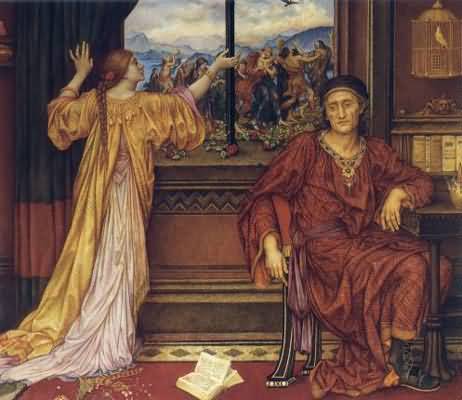
The Gilded Cage, Morgan (1919)
In debates over free will, the determinist position, even when accepted, is often met with a sense of begrudging despair, as if, upon seeing the wizard behind the curtain of reality, life suddenly loses much of its luster and charm.

(For those unfamiliar with the debate: libertarian free will posits we are the original cause of our choices', and thus ultimately responsible; compatibilists and determinists acknowledge that we make choices, and feel as though we are free in doing so, we cannot actually "choose to choose" our choices, thus our will not originating within our consciousness.)

In a recent review of Sam Harris', Free Will, the reviewer - having largely ceded the determinist case - expresses an all-too common sentiment.
Couldn’t it be that we need the experience of what Wegner and others call “perceived control,” at least as a model of voluntary behavior, to get on with our lives and to have our achievements recognized and to be instructed by our failures? (Doesn’t Harris enjoy his success? I bet he does.) Finally, what happens to traditional qualities of character like courage, villainy, leadership? Poof! However correct Harris’s position may be — and I believe that his basic thesis must indeed be correct — it seems to me a sadder truth than he wants to realize.

So, why all the pessimism?

Rather than seeing determinism as a cold, subtractive, fatalism, I would argue the opposite – that current society is generally opposed to a determinist model, with some terrible policy implications. For starters, our criminal justice system is highly retributionist, terrorizing hundreds of thousands (with not only moral but practical implications – the almost complete lack of rehabilitative thinking). Understanding people as fully-caused would promote not only compassion, but an embrace of the science behind rehabilitation measures.

Income inequality is another. Too many currently feel that people are responsible, original causes of their successes or failures, leading to an acceptance of dire poverty and decadent wealth. Accepting determinism means acknowledging that biological and social privilege, combined with extant social structures are the original causes. This makes a moral case against inequality, as opposed to the notion of free will that apologizes for it.
At the very least, the notion of contra-causal free will overstates the case for reward and punishment. For while determinists much acknowledge the positive import of behavioral triggers like deterrence and success, they are in the end not only limited in their ability to drive behavior – only one factor among many others – but to the extent that they contribute to inequality, are immoral.

Finally, in terms of personal interactions and conscious development of self, determinism provides an enormous amount of grace and forgiveness. The more we are able to see one another as caused, the more we are able to accept each other as we are, not who we pretend to be, over-imagining agency where it does not exist. Often, the mere remembering of determinism is enough to occasion a soothing sigh and reminder to be compassionate and empathetic.

In the end, it seems much more liberating, if we must live caged, to do so fully aware of our humble position, rather than pretending to enjoy freedoms that do not exist.

Monday, July 16, 2012

God = Ego = Death, p.2

James Wimberly responds to my analogy of the ego as a dog in a rooftop crate on a car.
“Only along for the ride?” My image for this hypothesis is looking out of the rear window of the bus. The main objection to it is Darwinism. The brain we have is enormously expensive metabolically – and creates SFIK the most dangerous childbirth in nature. It would be contrary to everything we know about evolution to think that such consequential and high-priced developments as the self-aware, reflective brain come about for no adaptive reason.

I see the point, and I'm not saying it isn't enormously useful.  The angst alone has resulted in plenty of remarkable achievements.  But as a part of a feedback loop, it's hard to think of anything as a driver - even self-awareness.  With  a lower animal, the stimulus is unreflective and external, and easy to think of as automatic.  With humans, it's partly reflective, the stimulus being regurgitated through higher-order thinking processes such as compare/contrast, ordering, mathematics, prediction, etc.  We facilitate in our young the development of highly complex identities that integrate all of these skills into an amazingly efficient and sophisticated platform for stimuli interaction.  (You should see the way I interact with my children!  I kid.  I realize this all sounds absurdly cold.  But it's only a framework for understanding.) 

And yet, sophisticated as it is, there seems no reason to think of it as other than a feedback loop, operating according to laws of cause and effect, constrained by time itself, flowing from past to future.  We learn from our past and the future is changed.  Our agency in all of this seems entirely dependent upon past events, how our biological systems have integrated external stimuli.  The idea of the ego as crate, as I have described it, is an attempt to get at this transcendent notion of the self not as superfluous, or useless - indeed it is the greatest thing ever created in the universe.  But rather that it seems, as a thing *of* the universe, a mistake to assume that it is somehow a thing apart. 

I'm reminded of the notion that, as creatures of a particular time, space and scale, we are biased to view the universe from a very particular perspective.  We see a limited spectrum of light.  We feel a particular gravity.  We have a particular relationship with atomic particles.  Yet, there exists a great range of electromagnetic waves we can't see directly.  If we were 100th of our size, our weight would feel very different.  If we could experience atoms at the atomic level, we would see a particles made up mostly of space.  Our "common sense" experience would be completely different.  An everyday example of this is how we still talk about the sun rising and falling, because it makes more *sense* to think of it that way.  Relative only to us, it actually is rising and falling.

In this way, it seems we are trapped in a common sense view of consciousness in which we are the final agents of our agency.  Yet clearly, we are highly developed beings that have spent years achieving this particular state of agency.  And still, there are God knows how many forces (emergent or otherwise) at work on our every thought, pulling strings from deep within our psyche, like the dark matter of space, creating the context within which our thoughts enter our awareness.  So how is it that our agency is not simply a manifestation of everything that has thus far come? 

But now that we are here, in this final platform configuration, one might ask, are we not free then to go forward, to use all of this sophisticated mental equipment to do our bidding?  My response would be: but from where does that "bidding" come?  Again, we face the dark matter problem.  Any bidding we would seem to choose has to arise from somewhere.  And unlike galaxies that appear to have nothing around them, yet seem to exist in some miraculously ordered context, our bidding - our desire to choose - is surrounded not by nothing, but rather embedded deeply within an organic mechanism highly ordered and designed by the complex history of the individual, highly traceable and quantifiable - even to some extent predictable.

But not enough, right?  This is the rub.  The resolution on consciousness fantastically dim.  In theory, by knowing every possible angle and trajectory of every particle one could determine the exact thoughts that might arise.  But then you get into quantum problems and problems in constructing a model of emergence itself and it all seems so.. well, hopeless.  But in the aggregate, people are incredibly predictable.  Psychology, sociology and economics for instance tell us an enormous amount about human behavior.  Animal behavior is even easier, right?  When specific molecules attach to certain smell receptors, huge arrays of neuronal networks become very predictable.  Just because we can't yet make the physical models for this process, can't we pretty safely assume there is a purely physical mechanism at work.

And much of this can be applied to humans.  Place a bacon molecule in my nose and I will salivate.  So far so mechanistic.  Ditto for pornographic imagery.  Violence.  Food, sex, fear - all pretty simple, so to speak. 

And then comes reflection.  Consciousness.  Higher-order thinking, memory, emotional regulation.  While we can measure some of this stuff, the paths become infinitely more complex.  Add to this the very real sense we have that we design our own thoughts.  However, just because the sun comes up, it does not follow that the sun spins around the Earth.  When I eat someone's sandwich from the lounge refrigerator and they get mad at me, I feel guilty.  I feel like "I" did something wrong.  "I" made a mistake.  "I" am useful to myself as a thing, a thing to mold and correct, to improve upon going forward in the world.  But whether a dog in a crate, or a spinning gyroscope, am "I" more than a device useful to the platform that is me, yet still utterly dependent on contextual forces that imprint memories?  Neuroscience describes the way in which myelin sheaths around neurons serve to reinforce pathways of thought.  Apparently they are underdeveloped when we are young, so as to facilitate creative thinking and the laying down of new avenues of thought.  Yet as we age patterns become ingrained, and the sheaths thicken.  Arterials become freeways.  Rudimentary, but another piece of evidence towards a mechanistic understanding of conscious thought.

Sunday, July 15, 2012

God = Ego = Death

James Wimberly questions the physical nature of consciousness.
Materialists say that it’s the matter that’s conscious, stupid, and laugh at the myth of “ghosts in the machine”. However that commits them to a strange view of matter. The physical properties of all instances of an elementary particle are identical. But some, a tiny proportion, support consciousness, by mechanisms not yet elucidated but, it is assumed, following the standard models of natural law. So all elementary particles (or possibly all particles of a particular common type; it may be the electrons or the protons) are consciousness-capable. If not, the materialist answer to the “what substance?” question is handwaving.

I always return to Richard Hofstadter, who in his book, I Am A Strange Loop, came up with some fascinating metaphors for consciousness, based both on what we know as well as what we might infer (and a good deal of pure speculation).

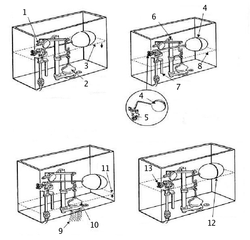
But he had a system he called the Hunecker scale, which measured consciousness, based on the principle that consciousness is ultimately about a series of feedback loops. One on the scale would be the simple mechanism of a toilet ballast which, sensitive to the amount of water filling up in the tank, receives feedback and stops the water flow. At the other end of the scale would be a sort of omnipotence, in which all future possible events are known. Humans would land somewhere in between, with lower forms of life occupying places further down the scale.

One of the things I like about this is that it seems to illustrate just this sort of gap between the material activity of the physical world and the elusiveness of consciousness. (Hofstadter spends considerable time in the book exploring different ways thinking about this problem.) I’ve always been struck by how ridiculously mechanistic people tend to be. Maybe it was the acid I took in my youth, but I’ve always felt we tend to anthropomorphize people too much.

So animal-like, we are mostly the only self-aware creatures on the planet. But this fact of supposed self-awareness seems only marginal to the larger complexity of our brain, the rest of which we have in common with most mammals, etc. I say “supposed” because in reality we aren’t very self-aware at all. Mostly we are incredibly un-self-aware, most of the time. And yet this tantalizing illusion that we are little Gods walking around thinking ourselves original, responsible and all the rest, this or that behavior somehow designed by us, that we are somehow in control of our lives, is such an – ironically – ego-feeding enterprise that we just can’t seem to quit it.

Yet as best as I can tell, this little ego-box in which we fly, strapped to fate no less than Mitt Romney’s crated Irish setter, is only along for the ride, pretending to run the show instead of merely enjoying it. Animals without much self-awareness surely experience all the same qualias. Yet what kind of consciousness do we assume in them? And as we travel down the brain-chain, what do we see but decreasing neural complexity? Hunecker after hunecker, myriad network dynamics shrink until we reach creatures that could hardly be described as thinking at all. Rather, they are mechanisms.

Apparently the enlightenment didn’t kill God, but merely made him human. An ironic reversal indeed. He ought to be finished off entirely.

Thursday, June 28, 2012

Free Will as Hubris

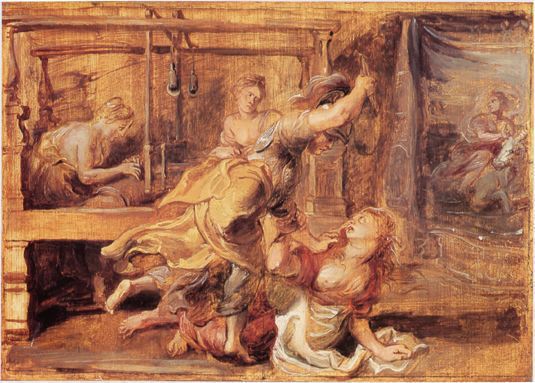
Rubens' Arachne (1656), having angered Minerva
One of the trickiest things about the concept of free will/human agency is that if I am not my own original cause, why am I doing what I'm doing? For instance, how do I decide to act with integrity, etc.?  If I am not making my own decisions, then who is? 

Maybe what is "tricky" is the (wrong) habit of mind of thinking of ourselves not as social actors, but as individuals. Because once you say "I am acting as part of the social/biological (S/B) whole", then every action becomes more understandable. Because we are so woefully ignorant of the extent to which we are S/B caused, it is a priori easier to think of ourselves as individuals.

I've always wondered whether there isn't a lot of ancient - that which has been passed down in religious and cultural tradition for millenia - knowledge intuiting the idea that there is no individual, that there is only the social us. The idea might be that man's greatest delusion is when he stops thinking of himself as owing all that he is to his family, his neighbors, his community, his biological tendencies - to be silly, to be jealous, to be envious, etc.

I was just reading the Greek myth of Arachne to my daughters. In it, Arachne challenges Minerva, a God of crafting, to a weaving duel, despite the fact that as God of crafting, Minerva would have been responsible for all of Arachne's knowledge. When Arachne wins, Minerva is so angered that she turns Arachne into a spider.

If it is a fact that one's talent must come from S/B - in the myth's case, a particular God - then the claim that one's talent comes from oneself is the height of arrogance and lack of humility. "God", in this case, can be seen as a stand-in for the natural, objective world. To deny "God", would be tantamount to denying reality, saying 2+2=5.

To the ancients, without the conceptual framework for scientific naturalism, God could be seen as a stand-in for universal truths of reality.  I'm out of my depth, but could the myth of Adam & Eve be seen as a caution against expressing a similar arrogance, in that the forbidden fruit, the "knowledge" they ate was the idea that they were self-originating, as opposed ot S/B, and that this was ultimately an affront to reality?

I realize I'm stretching a bit, and maybe reading a bit much into it.  But this idea of the self/individual vs. the group seems a concept enormously central to humanity's understanding of itself, consciousness's understanding of its own limitations and spatial relationship with realty.

Saturday, June 9, 2012

Poverty of Culture

It is controversial today to speak of a "culture of poverty".  This stems out of a polarization around two notions, that the poor are victims of society and that the poor are victims of themselves.  But these two framings are incomplete.  I would argue that the poor are both victims of society and victims of themselves.

According to Wikipedia, the idea of a culture of poverty came out of the work of anthropologist Oscar Lewis in his 1959 ethnographic study Five Families: Mexican Case Studies in the Culture of Poverty.
The people in the culture of poverty have a strong feeling of marginality, of helplessness, of dependency, of not belonging. They are like aliens in their own country, convinced that the existing institutions do not serve their interests and needs. Along with this feeling of powerlessness is a widespread feeling of inferiority, of personal unworthiness. This is true of the slum dwellers of Mexico City, who do not constitute a distinct ethnic or racial group and do not suffer from racial discrimination. In the United States the culture of poverty that exists in the Negroes has the additional disadvantage of racial discrimination. People with a culture of poverty have very little sense of history. They are a marginal people who know only their own troubles, their own local conditions, their own neighborhood, their own way of life. Usually, they have neither the knowledge, the vision nor the ideology to see the similarities between their problems and those of others like themselves elsewhere in the world. In other words, they are not class conscious, although they are very sensitive indeed to status distinctions. When the poor become class conscious or members of trade union organizations, or when they adopt an internationalist outlook on the world they are, in my view, no longer part of the culture of poverty although they may still be desperately poor. 
In decades since, this view has been criticized mainly for relying on the simplistic notion of the poor as a monolithic cultural group, and seemingly perpetuating the notion that the poor are to blame for their own lack of success.  Much of Lewis' thesis seems to argue that it is the attitudes of the poor that keep them from finding success.  This sort of dispositional narrative leaves out other causal factors, letting larger social forces off the hook.

However, it appears to me that Lewis actually got it half right, and that he didn't go far enough.  One of my main complaints on this blog is that in discussing poverty and disadvantage, we too often leave out the fundamental components of human development, and that these arise not organically, freely from human agency, but rather from social forces outside one's control.  There are dispositional, attitudinal problems among many of the poor.  But these are the result of other causal factors which work dynamically to create a system of oppression.  For instance, take the example of Rent-a-Center, the predatory lender of home furnishings.  There is no reason anyone ought to ever engage their services.  There is nothing that they have that is necessary enough to warrant such outrageous and usury prices.  Yet they predominate in low-income communities.  The poor thus are more dispositionally inclined to engage in dysfunctional behavior, to the extent that going to Rent-A-Center is dysfunctional.  Any number of other indicators of dysfunctional behavior can be found in much higher rate sin poor communities, which ultimately stem not from lack of resources but from an unhealthy disposition.

Yet this is not the end of our inquiry.  Many on the left bristle at even engaging in this sort of dispositional critique, specifically because the inquiry has historically ended here.  Right-wing notions of ethnic superiority, social Darwinism, class hegemony, and white supremacist apologetics have historically ended here.  The claim is that because it is well within the power of one to change one's attitude and disposition, the poor's failure to do so makes them morally responsible for their own lack of success.  The corollary to this claim is that the affluent have chosen their attitude and disposition, thus are morally responsible for their own success, and thus have every right to be rewarded for it.

Current right wing economic and social policy claims are rooted in this narrative.  Talk of affluent "job creators" and claims that low tax rates create growth by promoting the attainment of success through the reward of low tax rates assumes that disposition is the main driver of prosperity; if one has the right attitude, one will be successful.  Likewise, "rewarding" the poor with safety net programs is thought to create in them a dispositional aversion to hard work and positive thinking.

While disposition is important, it is only one factor of success.  But more importantly, it is not a first cause.  Human development is vastly more complex.  Human beings are unique in the animal world in how long we take to reach maturity.  Our societies have spent millennium evolving extensive social and institutional frameworks designed implicitly to develop in humans advanced productive capacities.  Modern humans are educated, moral, enlightened, critical thinkers capable of amazing contributions to our fellow man.  We are dynamic, ever-learning and evolving culturally and raising our children to do the same.

When we speak of "disposition" or "attitude", we are reducing vast quantities of human development into an absurdly simplistic shorthand for human agency.  The 22 year old human adult will have lived for 192,720 hours, 128,480 of them awake - a staggering 7,708,800 minutes of conscious thought.  That is the sum total of his interaction with the world - his conversations with parents and peers, his observations of the world around him, his cognitive calculations, his emotional internalizations, his lessons learned, his daydreams, his creative endeavors, his fears, his loves, his dreams.

All of this we call human capital.  He has built this human capital out of what I call societal capital - all that has existed in his world during those nearly eight millions of conscious life that has made him who he is, and has made him who he perceives to make of himself.  The concept of a self-made man relies on a notion of human agency that denies the very truth that permeates everything we know about the physical universe, that everything is preceded by something else, that is caused by prior events.  The notion of time itself is predicated upon this fact.  And yet we need not refer to physics for what ought to be common sense to anyone who has ever learned something knew, or learned how to think about something in a new way.  Every parents understands this basic reality, as we have watched out children growing and transforming before our eyes into complex individuals capable of - hopefully - behaving, thinking and feeling in appropriately advanced ways.  Our children are anything but self-made!  And when they reach adulthood, capable of making sufficiently decisions in a sufficiently independent manner, we are known to have raised them well.

Yet have we done this ourselves?  Are we self-made parents?  Of course not.  We were made - by our parents first, and then in concert with life experience and larger society.  We have internalized the culture that we ourselves have been raised in, and then transmitted it to our children.  The cycle thus repeats.

So when we see poor communities displaying what can be called dysfunctional or sub-optimal dispositions, who is to blame?  We all are.  There is no separation between them and us.  We, all of us, are inextricably caught up in one long chain of causality extant since the beginning of time itself.  Individuals can no more be held responsible for poor dispositions than for successful ones.  All that matters is the way we structure society so that to limit as much as we can sub-standard dispositions and elevate positive dispositions.

The question thus becomes how best to do this.  It surely isn't an easy question.  But it begins with the acknowledgement that we are all doing the best we know how to do, and that the issue is one of development, not simple choice.  The poor are not more likely to frequent Rent-A-Center because they choose to when they could have just as easily, like us, chosen not to.  Their choice was determined, as was ours.  The problem is not that their culture must be changed, but that they have not been fortunate in having received sufficient societal capital to build in themselves to develop adequate human capital, or what we might generally refer to as "culture".  They have not had the education, the access to family resources, the access to more affluent peer groups, etc. to develop what ultimately appears on the surface as "disposition".  Through larger structural forces such as economic and social segregation, they have been disadvantaged.  By finding ways to intervene and remedy these things, we will finally begin to tackle the problem in a real way, without having to either "blame" any one or pretend that poor behaviors don't exist.


Saturday, March 10, 2012

Beyond Fatalism

Allegoria Della Vita Umana, Guido Cagnacci (1601 - 1663)
Getting hung up on fatalism seems one of the biggest problems people have in accepting the determinist view (that there is no free will; the choices we make have been fully caused); even if they see it as rational, they worry the implication will be so dire that to accept it would be embracing something immoral.

This is incredibly flawed logic, of course, in that it puts the cart before the horse, and accepts the idea that you don't have to accept reality if you don't like it - as if your views had any bearing on the laws of the physical universe!

But it is also flawed in that it assumes that determinism implies fatalism. For me, rather it implies compassion, empathy, understanding of the ego, and the path to making better decisions. It implies humility and the recognition that we are all doing the best we can. It implies that our positive and negative actions are merely consequences of larger dynamics, and thus allows us to better understand how to ultimately shape those larger dynamics and increase human happiness.

I was reminded of this after the recent school shooting. At the end of the story, the newscaster noting the grief being experienced throughout the small town community, his final words were that the "community was left grappling with one question: why?" It occurred to me that this question is at the root of so much human despair and anguish. When something painful is not understood, it is in our nature to agonize all the more over it. Feelings of fear mix with anger and frustration into a toxic concoction. These emotions cloud our judgement, and often lead to an impulse of retribution, likely itself an attempt to banish the uncomfortable emotions.

Yet as I heard the newscaster's question, and sympathized with the sentiment, I was experiencing none of the angst to which he referred: there would clearly be a reason why, there always is. The boy was disturbed. Whether it was from a personal history as the victim of abuse, or his suffering from mental illness, or dysfunctional cultural influences, or, more commonly, a mixture of all three, he was clearly created by his genes and their interaction with the environment.

Any of us who has ever thought, "well, I would never do something like that", intuitively grasps this notion, that the self is relative: the reasons you would never do such a thing yourself are precisely the things that were absent from the shooter's self.

Parents also intuitively grasp this notion whenever they take the time to provide guidance to their children: they recognize that their child's behavioral development is a physical process dependent on positive multi-sensory stimulation: touching, hearing and seeing the world in ways that stimulate the positive brain growth responsible for improved cognition, emotional regulation, etc. These things don't happen by accident - everything in our cultural and religious heritage since the dawn of history has evidenced that, as advanced primates, humans are practically defined by our ability to learn, and teach, so as to pass on specific behaviors and development that we desire in successive generations.

So, while the question"why" is interesting from a scientific perspective, as there is clearly an infinite number of things to learn about the process of consciousness and individual choice, the larger, existential, question has clearly been answered. We know in a general sense why "bad" people do bad things, as well as why good people do "good" things: because they have been made that way.


This may all lead to a refutation of the second claim in the worry about fatalism: that acceptance of determinism will lead not only to despair and meaninglessness, but to a morality devoid of personal responsibility.

Even if one believes (knows?) that life unfolds according to physical processes beyond our ultimate control, one's practical experience is remarkably unchanged.  One still has needs and desires.  Surely the fact that I do not choose to become hungry, or that my taste buds have been designed to respond to make certain foods pleasurable, doesn't mean that I cannot enjoy a delicious meal.  Or, that my pain receptors have been designed to give me discomfort when they are stimulated by injury?  I cannot escape this fact of human life.


But what of the choices I make?  Here lies what may be the nub of the issue.  Every conscious choice I make is essentially a selection among a variety of options, each given variations of "weight" towards my ultimate goal of making the "best" choice.  This is at one level a physical, mathematical process, in that there exist multiple variables that are adjusted and defined according to discrete relationships, so as to give each meaning in context of the others.  Our brains have been designed to "learn" to make these choices as unconsciously as possible, firmly laying down complex routines and sub-routines, so as to maximize efficiency and free up mental resources for expanded conscious capacity.  For instance, when first learning to ride a bike, 100% of conscious attention is required to manage the feedback of innumerable stimuli.  Yet once bike riding is "learned", the routines have been laid down to the degree that it is now possible to ponder direction, carry on conversations, or ruminate over other, more transcendent concerns.  What began as a complicated series of conscious decisions (keep pedaling, lean left, lean right, watch out for the tree!), has become entirely unconscious.


Yet many decisions in life are unique, and require more sophisticated analysis.  Surely picking a president, or deciding to get up on time to go to work, or to quell one's anger so as not to go on a killing spree, or to accept Jesus Christ as your personal Lord and savior, require more conscious choice.


Or do they?  Individual decision-making is difficult to track, especially on complex, dynamic issues such as religion, politics, or motivation, where a seemingly infinite set of variables come to bear.  But when people are looked at as a group, in categories defined by set variables such as family history, education, wealth, culture, mental health, etc., patterns begin to emerge.  It becomes increasingly possible to predict the likelihood that any given individual in a group will make particular decisions.


What this implies is that people, no matter how conscious they might regard themselves to be when they get out of bed in the morning, or step into the polling booth in the afternoon, are in fact much more determined than they might themselves recognize.  Knowingly or not, they are on courses of patterned behavior that their brains have been evolved over hundreds of thousands of years to establish systematically.  


Can we break free from these determined patterns?  This is actually the question the fatalist gets at:  If one were to, after accepting that he is fully caused and thus not ultimately responsible for any of his behavior, commit murder in cold blood and feel no guilt or shame?  

He certainly could, but only if he were able to completely extricate himself not only from everything he has ever learned from society regarding the immorality of murder, but also from the biological structures in his brain responsible for the human emotions of empathy, compassion and love for others.  He would have to be the proverbial "superman".  

Not only would this be a highly unlikely development in any average man, it would have to be entirely deterministic.  That is, he must recognize that whatever behavior he undertakes to choose, it will have arisen from his own special circumstance as a "self" that had been created under the precise conditions so as to allow him to carry out such a morally radical action, one in direct opposition to biological and social norms that society has not inherited arbitrarily, but largely having been designed with regard to maximal individual interest.  

The decision to flaunt this design would be tantamount to denying one's biological imperative to eat, or even move.  If there is truly no point to anything, as we are all determined, then why should we do anything at all?


I tried this once, when I came to a similar conclusion at the age of 18.  I remember sitting on a chair in my bedroom, realizing that I could find no clear, rational purpose to life, other than to fulfill preordained social and biological (at a certain point these blur together) impulses.  I had no real option other than to adopt a catatonic posture towards waking reality, and simply let nature take its course.  I moved to the floor, laying down onto my back.  I had to breath - that was largely a autonomic response anyway.  I didn't need need to pee just then, which in retrospect was probably a bonus, as I would have had to wrestle with the thought of allowing my bladder to release its contents of its own volition.  


So, there I was.  Waiting.  For what, to die?  I imagined my then girlfriend arriving home and finding me there, inevitably arguing with me to get the hell up off the floor (maybe by then lying in my own excrement).  It began to dawn on me that what I was undertaking required enormous willpower.  By choosing to make no choices, I was stuck in a paradox.  Any behavior would be chosen behavior.  This was simply a physical reality of being human.  And any choice I made was going to be dependent on prior choices, or naturally occurring stimuli.  If I were to truly stay in this catatonic state, and I suppose eventually be taken away on a stretcher, I would have to have process enormous amounts of prior learning and have managed to re-route those innumerable sub-routines.  To do so - and here is the bottom of it all - would have all been entirely determined anyway; reaching this point would have required a specific set of environmental and biological processes to occur that would have caused me to make whatever choices I was pretending not to make.  Maybe it was because I read Camus.  Maybe because I rebelled against my parents' religion.  Maybe I was simply depressed. 


In the end, I could not escape choice.  I would have to then take responsibility for the choices that I did make, even if they were ultimately chosen for me.  I thought first of my girlfriend, and my loving feelings for her. I thought of the sunshine.  I thought of bagels and cream cheese, and riding my skateboard.  I thought of making others happy, of doing good deeds, and of all there still was to learn in the world.  These were all things that gave me pleasure.  They were, of course, all products of my life up until that point.  They were the final result, the now, of the particular way in which all the elements that originally spun together, accreted into the planet Earth, assembled into lifeforms, evolved into humans, and over thousands of years gave rise to little old "me".


As I rose up of the floor, I felt a sort of ecstacy.  I had found an answer to the question "why".  It may not have had much explanatory power - that would come as I continued to live my life, learning and digesting the world before me.  But it was an existential answer.  It integrated my self with the natural world around me.  It established, through reason, a purpose for my existence.  Above all it elevated humility, a word rooted in the basic understanding that we are all only human.  Not only need we not be anything more, but we simply cannot be any more.  As Descartes famously wrote, "I think, therefore I am".  No matter that my thoughts came from some determined place in the past; I am my thoughts.  I am not omnipotent, and I must be satisfied with that limitation.    I must be satisfied with these physical limitations, even as I seek to expand my consciousness - that which is defined by the relationship between the self and it's own immediate history.  

Just as a serpent cannot eat its own tail, the self cannot think itself away.  It is trapped in its own causality.  All we can ever do is try to understand as best we can that which we have come from, that which makes us, as it will lead to the kind of fulfillment we cannot help but desire.  What this fulfillment is, or even how to attain it, is nothing less than the human project.  We are involved in it whether we like it or not.  It is indeed fate, but it is a fate much more profound and dynamic than we can hope to understand.  All we can do is go along for the ride, our contribution, in no matter what capacity, preordained.  


And there is beauty.  


Of course.