Showing posts with label determinism. Show all posts

Saturday, July 1, 2017

On Behaving "As If" There Is Free Will


I can't find the quote, but it is as long the lines of "Free will doesn't exist, but we must behave as if it does."

I wonder if this "as if" behavior can be described in a behaviorist account?

In behaviorism, we talk about the concept of stimulus prompts and "rule following". A stimulus prompt is basically a cue for us to engage in certain behavior. Through learning (repeated reinforcement delivered after prompted behavior), the prompt takes on stimulus control: it changes our behavior. Think of a checklist, "wash hands" sign, exit sign, etc. Rule following is much the same, whereas the rule is like a prompt, however the rule doesn't have to have previously been directly reinforced. Rather it can have been inferred, and is generally defined as under stimulus control of previous rule-following behavior. That is, if we have followed similar rules before (and have been reinforced), we will be more likely to follow them in the future.
In this way, thoughts can function as either prompts or rules. In our daily life, we behave according to a mixture of external and internal prompts. Behaviorists call these discriminative stimuli, as they have been followed by either punishment or reinforcement, and are thus defined by our discrimination of them as signals for the availability for reinforcement of punishment ("exit" means leaving behavior will be reinforced; "open" means entering behavior will be reinforced; "poison" means eating behavior will be punished, etc.).
Behaviorists also have a way of describing consciousness (which of course can mean many things) One of the meanings of consciousness though, is the behavior of labeling, via verbal behavior. This is described as operant learning in which certain stimuli take on stimulus control for verbal behavior, either spoken or thought, after having been reinforced in a specific verbal community. For instance, when I see a chair, I can say "chair" or think "chair", because as a child I received reinforcement from the community for emitting that behavior. It could have been direct praise, or conditioned praise in the form of a good grade, or simply the ability to communicate which led to some other kind of reward. We call this "tacting". (We have a different way of describing requests, as their reinforcement is defined as coming directly from the obtaining of the request, i.e. "water" means we directly get that thing. A seemingly minor difference but has important implications for the early acquisition of language). The reverse of this, of course, is listening behavior, in which a stimulus controlling for verbal behavior (tact), is reversed. The chair object controls for the word "chair", but then the word "chair" controls for the object chair.
OK, so I have a hard time describing the behaviorist description of these phenomenon because there are just so many basic concepts that need to be understood to truly appreciate the position! But returning to consciousness, what you might call an active consciousness, in which we are aware that we are conscious, is this process of labeling. When I am thinking about thinking, I am "tacting" my thoughts. Likewise when I am thinking about what someone else has said. However, "tacting" only refers to stimuli that are physically present (chair, desk, apple). We have another level of description for things that are under stimulus control of verbal behavior, but are not in the environment - and may have never been physically contacted. We call this "interverbal" behavior. Most of language involves this type of verbal behavior, as well as abstract thought such as mathematics or literature. This is also the kind of thought we need to engage in for complex thought, such as when planning for future events, or recalling an order of events.
So, what is the implication of this for our thoughts? We can have thoughts that are direct responses to our immediate environment, our distant environment, or responses to words. Our fluency in all of these is determined by a number of factors. First, we have to have been reinforced for the response ("knowing" the verbal behavior), but we also need to have the establishing operation in place. What we mean by this is that there must be a basic desire in place that is being satiated by the behavior. For instance, if you have been reading all of this and trying to understand me (and hats off to you!), you will have to have been motivated to do so. The motivation is maybe generalized social reinforcement, in which you have been previously reinforced for the behavior of engaging in verbal behavior with others. You may also have been previously reinforced for acquiring new ideas and achieving constancy in your thoughts and how they align with the world - truth feels good, right? But maybe I haven't been making sense, and therefore the opposite has occurred, and my words have been extra work for you, in which case you aren't receiving reinforcement from them - they are not rewarding.
The establishing operation - how motivated you are - is not verbal behavior, and largely hidden within the skin. You can learn to tact this behavior, by noticing your heart rate, stiffness, or certain negative thoughts that may arise - "This guy is ridiculous!", and therefore tact your motivation as decreasing for continuing to read my writing. Or, maybe you enjoy arguing and my writing is actually reinforcing, because it is stimulating something else in you - maybe your enjoyment of "tearing down" my argument. In which case, the response I get to this might have been evoked by an establishing operation (EO) for argument, followed by my writing, which was a stimulus (SD) for the availability of reinforcement (R+), which in this case was the satiation of that desire for argument (socially reinforced, of course, by the internet community).
Behaviorists see every behavior (thought or action) as taking place within the 4 term contingency (EO - SD - Bx - R+). Further, this can only be understood as "molar", as opposed to "molecular". That is, as taking place in large chunks, over time. We take place in a continuum of phylogenic (genetic organisms) and ontogenic (life history) interaction.
So, for any given behavior, there is no room for "free will". We are constrained by our past and environment. We will go on behaving no matter what. Even if we were to protest and lay down motionless on the floor, that behavior will have had to have been the function of the four-term contingency.
If we then throw up our hands and say, I must behave "as if" I have free choice, we are basically tacting our behavior, or examining it interverbally, and establishing a rule, or prompt for ourselves. However, as for its effect on our behavior, it will only function as an SD for future behavior's possible reinforcement. That is, the way we behave following having this thought will encounter a consequence in the environment. So it can effect behavior change - you can effect behavior change, but the SD will always be a part of the environment.
In terms of this larger discussion, the way I relate what Garfield is saying about Buddhism and "awareness of the self" and behaviorism, is that the "self" as free actor does not exist, but rather refers to an organism existing within its environment. However the way that we often use the term "self" is as an efficacious agent somehow acting out of time. That incorrect narrative leads both to inaccurate narratives of others, as well as ourselves. How this inaccurate narrative causes problems is interesting, but that it is an incorrect narrative, as a behaviorist, I would say is established science.

Sunday, November 25, 2012

Stuck in Society With You

Libertarian Mathew Kahn argues that climate change is real, however in our attempts to adapt to it, we ought not incentivize irrational choices, such as building levees so that people can continue to live in low-lying areas.

Humans are incredibly irrational decision makers.  Assuming they are not underlies our greatest tendencies to apologize for inequality and injustice.  We tell ourselves, "It is their own fault.  They could have done differently.  They made a rational choice."  Yet again and again, we see that people do not.  Any businessman who has ever depended on advertising knows this well.  Any politician who has calculated his message knows this.  Any one who has struggled with diet, a budget, or quitting smoking knows this.

The problem is that it is near impossible to understand the irrational drivers of our own behavior.  With great work, we can find ways to counteract this irrationality, but it is largely in the darkness that we work.  God knows what it is that is driving you to take that bite of the fattening donut?  Your bad childhood?  The time you spent reading Zorba the Greek?  An impulsive temperament?  All the brain research and psychology that exists can only give us the faintest hints.  The fact is that the causal mechanisms at work in any given second, when each of our billions of neurons involved in the choice is firing off with its 7000 connections, making up the entirety of consciousness and unconsciousness, is unfathomable.

We learn to counteract the irrationality, in order to supposedly act more rationally.  Yet are we really acting more rationally, or have we simply been able to design habits for ourselves that have out-maneuvered the negative impulses?  "Rationality" is merely shorthand for *choosing the correct option*. 

In a fundamental way, society can be thought of as a vast, evolving system of habit formation.  At the individual level, we feel very rational and "in control".  But at the macro level, patterns emerge that tell a very different story.  Instead of individual, rational actors we see the products of systems such as family, peer relations, education, government, and social norms that conspire to design not only an individual's ability to make correct choices, but - more foundational still - an individual's ability to design for himself the ability to make correct choices.  Thus, the choice as whether to eat the donut or not is dependent not only on an individual's choice, but the individual's prior ability to have designed for himself the ability to make that choice.  For instance, after week three of having successfully fought the 8am donut cravings, the choice to not eat the donut will be far easier than it was on day one.  (I'm not actually hip to diet design, but you get my point: successful routines for habit formation are successful because they are routines, not individual, isolated choices).

So, does this mean that no one ever ought be held accountable?  Should we all get to make base, easy, immediately gratifying decisions with no concern for external effects, with the excuse that we had no control?  This is generally the first response many have to the argument I have presented.  Yet this is a case in which patient, nuanced thinking is called for!  If you will recall, I spoke of the element of social design in individual decision-making.  Just as we would set for ourselves a course of habit formation that we hope will bring about correct decisions, so too we set for society a course of policy that we hope will bring about correct social behavior.  So too we design our formal and informal social institutions.  The idea is to look ahead and put in place systems that we hope will flourish.  This utilitarianism makes the question of blame somewhat irrelevant.  Policies ought be designed that foster, through the mechanics of incentives, social good. 

If the question was mere utility, it could be answered by either side of the aisle.  It could mean lowering taxes on the "job-creators", harsh sentencing for criminals, or letting residents in low-lying areas suffer rising tides without assistance - the right-wing model.  Or it could mean a more left wing emphasis on the benefits of redistribution, leniency, or shared burdens.  To the extent that these are subjective, evidence based controversies, the chips will fall where they will.

But what is removed from the equation is the moral posturing that has traditionally been wrapped up in left vs. right politics: no one is to blame.  So, even if we will all benefit from "job-creators" getting tax breaks, they are not inherently morally superior by their good works.  They have merely been the recipients of social circumstance that have allowed them - being in the right place at the right time - to do good things.  We can argue until the cows come home about the extent to which their work is actually good, and how much money is the right incentive for them to continue whatever it is they are doing.  But in the end, they are products of *us*, as the saying might go, "we built them".

And so too did we build those who, at the other end of the spectrum, we now see are playing out what society has designed for them in the form of irrational, self-indulgent or poorly-planned behavior.  We can also argue about the extent to which these people's behavior is all that bad, or whether by circumstance it appears so (the "negligent mother" may indeed be working two jobs and thus have no ability to look after her delinquent son).  But regardless, again, "we built them".  So when designing policies that, in the interest of deterrence, or disincentivization, will create hardship on individuals caught in such a tangled web of causality, we must admit that, as they are not the originators of their actions, rather society is to blame, their hardship is a form of Earthly purgatory. 

It may allow us to sleep easier at night believing that the many who suffer do so at their own choice.  But it is a convenient fiction. 

I confess much of this argument is aimed squarely at the right, who though at times concede some degree of social determinism, generally downplay it, if not deny it completely.  After all, who then, if not government is going to help enfranchise those whom society has failed to give an equal design?  The utilitarian case for less government action is rather weak.  And, more noticeably, a great portion of right-wing framing is not utilitarian at all, but rather a direct appeal to an assumed agency ("I built it"), or merely a sense of unfairness at the notion of social design - redistribution is unfair because well, "I built it".  The truth is that, were government indeed pared down to only its most basic elements, poverty and class-mobility would not suddenly cease, or even diminish.  The supposed moral hazard in provision of social services, or even such things as student loan forgiveness - as former candidate Romney complained about -  is a convenient excuse for a callousness that comes from not seeing individuals as determined by social design, whose ability to make rational choices is constrained by a prior ability to develop in themselves this ability, and so on, outwards into the fabric of socialization.

So I'm all for utilitarian incentives.  But when their effect is serious hardship in the lives of real people, we must ask ourselves if there was not another, better way to have both incentivized good choices, without having allowed such trauma to have occurred.

Sunday, November 4, 2012

Pinning Down Will

A big problem in discussions of free will is language.  One of the sticking points is often the way we talk about the meaning of will, or volition.  The common intuition that we all have free will is based on the observation that most choices we make are in the context of there being many possible options.  I could have eggs for breakfast, but I could also choose to do an endless number of other things.  I have the freedom to decide which.

In explaining how a computer works, it would make sense to say the computer "chooses" from a set of variables, according to a predetermined set of parameters. When IBM's Watson computer famously competed and won against Jeopardy's best contestants, his responses were accompanied by the relative probabilities his system gave alternate responses.  Did Watson have the "freedom" to make other responses?  No, he did not.  He chose the response that made the most "sense" to him, based on predetermined parameters.

I think it is important to describe will as the act of merely choosing between competing options. In doing so, we make the notion of freedom irrelevant, instead describing the fact that choices are dependent upon predetermined parameters, ultimately arising from impulses outside of, and prior to, our conscious awareness. Just as no one would describe Watson's decisions as anything like "free", no one should describe our choices as such either. The only difference is that our impulses are infinitely more complex and (presently) unknowable.  


Yet to the degree that those impulses are knowable, they are deterministic.  That is, when analyzing why we make any particular choice, wherever we look we see a will that is dependent on predetermined parameters.


Friday, August 17, 2012

Moral Responsibilty vs. Moral Accountability

Stephen Horst gives a summary of his new book, Freedom and the Laws of Nature, which seems an exceedingly long wind up to a rather silly argument.  Claiming to pick no bone with determinist account of the universe, or human agency specifically, he instead merely wants to argue for the possibility of contra-causal, or libertarian free will.  In the main he seems to be claiming that an empirical view of a materialist universe is always limited to the laws we are aware of, and thus with a subject as difficult as the human mind, there indeed might be some as yet hidden explanation for free will.  Unless I mistake his case, it seems a bit like the "God of the gaps" argument, which, unable to show evidence for God whatsoever, endlessly seeks to allow for him wherever He might be imagined to be? Yet even worse, the "gaps" Horst finds are nothing less than the possible existence of laws yet undiscovered that would make free will possible. Could I say that the invisible unicorn beside me (which I just *know* is there) could well exist according to some yet unknown law - maybe of, say, unicornity?

But while I find that thesis boring, I found what he mentioned in passing, the discussion of free will with relation to moral responsibility, an important issue to parse. 
Since the time of Laplace, the idea that a law-governed universe must also be a deterministic universe has become a fairly common assumption; and as a result, free will and all that depends upon it have often fallen into doubt and disrepute. And chief among the things that seem to depend upon free will is the possibility of moral responsibility. It seems misguided, perhaps even nonsensical, to praise or blame people for doing things they could not help doing. And some have argued, in a similar vein, that one cannot have a duty to do something unless one is actually capable of doing it: in the words of Laplace's German contemporary, the philosopher Immanuel Kant, "'ought' implies 'can'". If this is correct - if ethical notions like duty and responsibility make sense only if there is free will - then determinism would imply that all such ethical talk is literally nonsense.

Destruction of moral responsibility is often the primary issue defenders of libertarian free will have with determinism; they fear that without it, society would crumble. If one is not accountable for their actions – either to be praised or blamed, then what basis do we have for a cooperative society of laws?  However, moral responsibility is different than moral accountability.  While it may be true that no one is truly responsible for their actions, we can certainly make sure that they are accountable to the extent that we determine is fair.
The idea of people acting with no sense of moral responsibility is an understandable fear.  But its answer I think is found in the resolution of an even deeper problem: if I am fully caused, and neither to be praised or blamed, what is the purpose of my existence; what sense is there in doing anything, either good or evil?

The bad news is that there is no ultimate sense in doing either.  The good news is that one has no choice.  Any choice one makes will have been caused.  So for those who think that the end of personal responsibility means the granting of freedom to do whatever one wishes, the reasons for doing so remain the same.  Refusing to go to work still means one will get fired and end up penniless.  Stealing from a neighbor will still cause them to suffer.  Climbing Mt. Everest will still fill one with the sense of awe and sense of accomplishment.  Being kind and loving to one’s family will fill them with joy.
So while none of these acts may have special cosmic significance, we can take comfort in the fact that we are in the end, simple human creatures, evolved to take certain pleasures in our worldly endeavors.  We might curse the limitation of our corporeal forms, but somewhat paradoxically, that curse itself is merely a product of circumstance; it too is fully caused.

But let us take a deeper look at causation, specifically that of morality.  The fear of the destruction of moral responsibility is a social claim.  That is, it has to do with the interaction of individuals within society.  The moral responsibility of a man on a desert island is irrelevant.  It is only when he comes into contact with others that moral claims begin.  His responsibilities lie in the dynamics of his relationship to others.  He has feelings towards them, and they him, regarding the effects of their respective actions.    
Moral responsibility is compatible with determinism if we think of it in this macro, societal sense, and place it within a utilitarian framework.  That is, we can say no one is himself responsible, but rather the norms and values society has designed for them to live by, which have emerged from the wisdom of history, define his responsibility. 

Through the centuries and millennia, humans have evolved complex cultural and philosophical norms so as to structure our societies with no greater aim than to maximize individual and group harmony.  Of course there have been great failures, and nothing like complete success has ever been achieved.  Each of us play our small part, and – like Adam Smith’s invisible hand – the group project steadily emerges.  All of it terrifically complex in largely incomprehensible, one man can neither understand all of it not affect all of it.  In this way, it is like the individual: terrifically complex, he neither understands himself entirely, nor affects the entirety of his own choices.  And just as society cannot be said to have free will, that is to say it is determined by and emerges from its antecedent participants (philosophers, politicians, journalists, public, etc.), so too is the individual determined by and emergent from his antecedent causes (thoughts, feelings, impulses, etc.).

And just as a society cannot choose to be anything other than what it is at any given moment, neither can man. If a fascist dictator comes to power, it will be because of specific historical and cultural circumstance.  Sure, an alternative course would have been preferable, but alas, it was not to be.  Thankfully, our human capacity of reflection provides some ability to learn from our mistakes.  This cognitive power is the mechanism by which humanity slowly provides itself an opportunity for moral responsibility, or, what might be better described as moral accountability.  Interaction on a global scale, over decades and centuries, we have the opportunity to right historical wrongs, thus holding ourselves accountable for what we hope will be a system of laws and political structures more conducive to what we perceive as having been lacking in the past.

So too, if no individual is truly morally responsible for his acts, himself a conglomeration of antecedent impulses, he will be held accountable for his actions to the extent that they interact with his fellow man.  Because of power dynamics, he may be more or less accountable (the dictator, for instance, or powerful boss, might have few around to hold him to sufficient account for what they feel he has done).  And here, social institutions provide the direct framework within which power dynamics are established.  Aside from whatever the individual’s personal sense of moral responsibility to his fellow man might be, his fellow man will have an opportunity to hold him accountable according to the structures that have been established in the society within which they interact.

When wildfires rage, they often do great damage to homes.  Of course, we do not for a second think that a lick of flame is morally responsible.  Yet neither do we allow the fires to rage unchecked.  We put them out as best we can.  We also take preventative measures, so as to reduce the possibility that wildfires will rage to begin with.  We do the same with our children.  Whether we see in them moral responsibility or not, we teach them to be caring, thoughtful and kind, hopefully so that they will grow up to be positive, productive members of society.  When they err, we hold them accountable, regardless of how they felt about their actions.  Some of us might feel the need to sate an appetite for revenge, and include that satiation in their desire for accountability.  But in the end, all that matters is that they be held accountable.  We want their actions to have consequences, regardless of what may or may not be in their heads, unless it might have bearing on the degree to which we feel they might act in the future, at which point its bearing only enters with regard to a more clear picture of accountability.

Friday, June 15, 2012

Economic Freedom vs. Self-Determination

Proponents of classical liberal free-markets base their vision broadly on the concept of economic freedom.  From Wikipedia:
The free market viewpoint defines economic liberty as the freedom to produce, trade and consume any goods and services acquired without the use of force, fraud or theft. This is embodied in the rule of law, property rights and freedom of contract, and characterized by external and internal openness of the markets, the protection of property rights and freedom of economic initiative.
This view is seen as incompatible with the modern welfare state, which requires levels of progressive taxation that are argued to be at odds with the rule of law (unequal treatment before the law), property rights (government "takings"), and freedom of contract (worker rights, regulations, minimum wage, etc.). 

Yet an underlying assumption of this view is that within this system of economic "liberty" men are free from privilege.  It takes a sort of tabula rasa view of social and economic interaction in which, free from all government constraint but the enforcement of private contract, men interact on a level playing field.  Yet this is clearly not so.  Let us imagine a story of how democratic capitalism has historically played out. 

Ninety percent of the land of a small village is owned by an elite aristocracy who raise their children in private schools and colleges, and control the employment of the villagers.  The villagers are free to borrow money from a bank operated by the aristocracy, and free to run their own businesses.  A few of the villagers have been able to be quite successful this way, even able to send their children to the private schools of the aristocracy.  However, the private schools, important as they are in the development of human capital, largely function to perpetuate the exclusivity and privilege of the aristocratic grip on positions of economic and political power in the village.

Is this a picture of economic liberty, or a picture of injustice and inequality, in which one's birth determines one's lot in life?  Sure, it is possible for a child to be born to a poor villager, and yet rise up to find success and entry into the aristocracy.  But this is by far the exception, not the norm.  And because of the structure of compensation and economic freedom in the village, positions of employment are defined by stark skill and wage differences.  Geographic areas of the village have developed, distinctly segregated by the occupation and education level of the residents.  There is clearly an inequality of agency to the degree that those well born have much more of it.

Proponents of economic freedom will notice that there is a marked inequity of human agency in this village; it does indeed matter to whom one is born.  And yet, they will argue, the system is quite productive.  The wages of even the lowliest worker allow them to afford basic food and shelter and, in principle, to take advantage of opportunities for advancement.  Over the years their living conditions have improved, their amenities having become more affordable and plentiful.


Yet what about individual freedom to choose one's life path?  The traditional critique of class is that, to the degree that it is defined by an inequality of agency, it is immoral.  We implicitly recognize the right to self-determination as a fundamental, inalienable right.  Even if we are better off materially than generations previous might have been, without equality of self-determination, we cannot be said to be sufficiently free.  One is reminded of the benevolent monarch, who promises his people peace and prosperity - as long as they accept his benevolent rule.

Even though some, by hook or crook, manage to find self-determination, they are the exception.  A defining feature of this system is that self-determination arises out of what one is born into, in other words one's societal capital.  This privilege allows one better access to a stable home, a quality education, and all that which better facilitates their arrival into the aristocracy, petty or otherwise.  One's development as a man is determined in no small way by their place of birth in the class system, and it arrives unto him as a piece with consciousness itself.  It colors his expectation of what life owes him, of what he understands of the world, and how to best advantage himself and his family.

So, athwart economic freedom, I propose what you might call developmental freedom.  To the extent that economic freedom displaces developmental freedom, it need be hindered.  This hindrance is not arbitrary, but rather explicitly designed to promote developmental freedom, the freedom of self-determination.

Many will say that developmental freedom is something that cannot be imposed from outside, but that must arise naturally within oneself.  Yet from what we know about human development, it is highly determined by societal interaction.  If every man's development and self-determination were to arise naturally, it would not be constrained by class, and you would see equal levels of development across economic strata. 

But this isn't the case.  Different classes of people, when defined by income, education level and family background, have very different outlooks on life.  They have different cognitive styles, different interests, different areas of knowledge, and - most importantly - different parenting styles.  Among the very poorest, there are incredibly high levels of dysfunction.  Nearly half the American prison population are high school dropouts, and majorities were raised in homes with multiple risk-factors.  Levels of self-determination are highly correlated with socio-economic class.

If we truly value self-determination as an inalieable right of man, then we must seek to maximize it whenever possible.  To the extent that economic freedom limits self-determination, then we must seek to constrain it.


Saturday, July 30, 2011

On Nihilism

Las Meninas, Velasquez
When discussing the question of determinism and its effect on how we live our lives, the question of nihilism ultimately arises.  A form of this question goes as follows,
"If we believe we are determined, why should we follow any moral action, or any course of action at all?"

I would say this isn't an ought question. We simply can't behave otherwise. Our brains are not powerful enough to unravel every last influence on our actions. Sure, we do this to a degree, and it can be quite helpful. But it's ultimately a kind of rabbit hole. Douglas Hofstadter likens consciousness to an infinite loop, such as a picture in a picture in a picture, etc. He describes consciousness as a process of feedback loops of increasing complexity.

My favorite example he uses is what he calls a "Hunecker" scale ("Huneckers" being something like souls), in which zero is an object with no feedback awareness (a rock, a stick), and 100 is an object with total feedback awareness (God, a super-alien). He then describes the feedback mechanism in a toilet ballast as being a one on the Huneckers scale. A tree might be a 42, a human a 61. (His book I Am A Strange Loop goes into a dizzying array of suggested allegories for the mechanism of consciousness.)

This makes a lot of sense to me. After all, as soon as we take notice of our thoughts, they become things already thought. We simply cannot determine what we are thinking in the moment. We can notice memories, which in turn determines future thoughts. But at a basic level we are in an endless state of reaction.

Which makes a lot of sense, right? Especially considering that when we are not conscious, we are certainly in a state of complete reaction.... my daughter (4) just showed me her painted fingernails. They were pretty badly smudged, and I suggested we find some nail polish remover to clean them up. Where did this thought come from? How much was I aware of all the ways I could have reacted? No, I simply went with what "came to mind".

And even in our most contemplative moments, aren't we simply searching for what "comes to mind"? We won't possible know where the thought originated, or, from what it has been built - they were likely billions of pieces to it - a conversation with a classmate back in college, the way a dog barked at me when I was a child, a book I read a couple of months ago, the way my wife smiled at me this morning, a commercial I watched last night, etc., etc.

Only an entity with a Hunecker score of 100 would know every input, much less then process that information and adjust to it in a way that aligns with an entirely different set of connections. What is basically happening is an infinitely (at least as far as we are aware) large set of reactive stimuli from within and without the world, and then the conscious experience of "noticing" what we can of those stimuli, as well as then noticing what we can of the infinitely large set of connections we make internally.

Consciousness has been likened to the tip of an iceberg, the depths of which are far more vast, yet largely out of reach. Maybe a better metaphor would be a fast moving river current, only a small area of the surface we can at any given moment see and feel.

So it is simply impossible to know how we are determined. We can guess, and know some of it, but most will always be far beyond our grasp. And yet we are creatures built to act. As an existential youth, having thrown away all previous conceptions of God or the universe I could, I despaired that there was no point to existence - the classic existential conundrum.

I still remember where I was when I took this recognition to its logical conclusion. I was living with a girlfriend at the time, and I sat down on the chair in her bedroom, realizing that if there was no reason for anything, there could be no reason for me to act. I then realized that I should not even be using my muscles to sit. I rolled down onto the floor and lay still, listening to the sound of my own breathing.

This was it. My body was breathing - to stop it would be to make a decision, and what point was there in that? I would lay there and starve. Catatonic. That seemed the only reasonable solution.

Of course, my girlfriend, who was out at the time, would return home, beg me to get up. And why would I?

Which is when it hit me: because of her. I loved her. And what was that love? I didn't know. There was so much I didn't know. How was I to lay down on the ground, only 18 years old, and give up on something so mysterious as life and consciousness? And there was so much going on in the larger world. I was relatively lucky to have a floor below me, a roof above me, in one of the most wealthy countries on Earth.

Maybe there wasn't an ultimate reason for anything. But in a weird way, that gave me a reason; what I didn't know - my lack of consciousness - gave me a reason. In the end, making a decision to do nothing was just as much a decision as a decision to do something, regardless of whether a reason existed.

My task was then to create meaning. Which I like to think I have been doing ever since. I have to. I can't not create meaning. To decide not to is itself only another form of creating meaning. (I'm reminded of religious fundamentalists who feel that the only way to not be led astray by selfish reason is to strictly adhere to original texts. Of course, these have generally been complied by less than perfect sources, and are themselves subject to interpretation, i.e. are they really saying what they appear to be saying?)

So an acceptance of determinism is an update to the process of meaning making. Rather than making meaning myself, I now see myself as little more than a conduit for society at large. This doesn't excuse me or anyone else, it merely explains us. We simply do the best we can and hope for the best.

To those who would say this allows one to excuse oneself from responsibility, I would reply that any moral code is only as good as the individuals who adhere to it. Just because I believe my code was determined, I am not given an excuse to break it. The fact that I know it, and accept it, does not allow me to dismiss it. For instance, a pianist who learns the notes to a new piece of music understands that he only knows them because he had learned them, also knows that if he plays them wrong - breaks their musical "code" - he will no longer be playing the same song. Knowing the laws of gravity does not allow me to break them.

There is a cause and there is an action. I accept that stealing is wrong because it will harm another. I also accept that I know stealing is wrong because I have thought about it, and understood the argument, the pieces involved in its logic. If I steal, whether or not I believe I have been determined to find it wrong, the results will still be the same - someone will be hurt. And I will be to blame, in the sense that I will have broken a moral code.

Wednesday, March 16, 2011

The Stochastic Mind

I just came across a concept which may have some meaning in questions of free will and determinism. It is the idea of a stochastic process. From wikipedia:

In probability theory, a stochastic process, or sometimes random process, is the counterpart to a deterministic process (or deterministic system). Instead of dealing with only one possible reality of how the process might evolve under time (as is the case, for example, for solutions of an ordinary differential equation), in a stochastic or random process there is some indeterminacy in its future evolution described by probability distributions. This means that even if the initial condition (or starting point) is known, there are many possibilities the process might go to, but some paths may be more probable and others less so.

.... Manufacturing processes are assumed to be stochastic processes. This assumption is largely valid for either continuous or batch manufacturing processes. Testing and monitoring of the process is recorded using a process control chart which plots a given process control parameter over time. Typically a dozen or many more parameters will be tracked simultaneously. Statistical models are used to define limit lines which define when corrective actions must be taken to bring the process back to its intended operational window.


I think this may get at some of the issues that bedevil the debate. I think I'd understand consciousness to be a stochastic process. There are physical elements moving around, which in sum equal thought. But because we don't have good enough data on every particle, or even a precise understanding of how groups of particles actually represent thought, we can't comfortably call anything explicitly deterministic.

Yet, as with manufacturing processes, we do have a sense of probability parameters. We do know that if we tweak one or another parameter, the outcomes will change. I think it is this vagueness which fools people into believing that the brain is not ultimately determined. Yet there is a difference between a determined system and determinism. The batch of cookies is not a determined system - in the sense that each cookie will turn out slightly different. But the physical properties underlying how cookies bake is entirely deterministic.

Monday, March 7, 2011

Morality and Determinism

One argument for contra-causal free will, and thus against determinism, is that if we can't make choices, then we can't make moral choices, and the whole concept of justice breaks down.

I think we should start any discussion of free will with an agreement upon terms..

Let me say that "making choices" can mean different things:
A)I think about different options, and choose one
B)I was not determined/caused to choose a particular option over another

I think some will agree with both, while I will agree with the former but deny the latter. I'll add that I think we can be completely oblivious to the extent to which we are being caused to act; we simply see our options and then pick the one that seems best. Neither can we know what it would have been like to either not have some piece of knowledge, or to have some extra piece of knowledge. (I find it fascinating that this presents a profound cognitive deficiency in our ability to imagine the thought processes or "mentality" of others. At best, we can use our knowledge of others to predict what they might be thinking. But we cannot actually experience their deficit or gain.)

Let me also say that "determined" can mean different things:
A) A choice was made in response to a specific genetic or environmental condition
B) Unconscious processes in the brain have responded to a genetic (internal) or environmental (external) condition, or have been created within a feedback loop of the two, and by their interaction are now making a choice that the mind is at most partially conscious of.

Some may agree with the former, but not the latter, while I agree with both.

Anyway, so I think we are perfectly capable of making moral decisions. I just find this in the same category as to where we'd like to go for lunch, or TV program to watch, in the sense that we are presented with a cognitive challenge, and compulsions to one or another choice. The extent of these compulsions is anyone's guess. Much of it will be skill-based, in the sense that specific, coherent models are being applied. For instance, when deciding when to cross the street, knowledge of traffic patterns would be handy. This would be a very discreet memory. But skills could also be more broadly thought of as encompassing such things as impulse control, so that the desire to get across the street takes a backseat to traffic memories.

Ultimately, one's skill set could really encompass the entire gamut of human capital one possesses: that which allows one agency to interact in the environment. This would be everything from walking to talking, to holding one's bladder, to synthesizing and making hierarchies of informational importance, to applying previously learned skills to new concepts, to formulating workable hypotheses and testing them, to reading, writing, recalling, etc.

I think when you draw this dynamic and fluid development process out over lifespans, over cultures and genders, you get humanity in all its complexity. Yet it deceptively provides cover for what is at root an entirely deterministic process.

I continue to be fascinated by the many liberals I meet who seem appalled at the notion that free will does not exist.  They'll rightly point to attacks from the right that decry liberalism as rooted in a cold, authoritarian fascism in which people are automatons better served by government mandate.  I might go so far as to say that most liberals believe in free will... consciously!  But I think the liberal impulse towards rehabilitation, towards relativism, towards compassion and selflessness is unconsciously rooted in an intuition of determinism. I think the slander is indeed accurate, but not just of deterministic liberals like me, but of liberalism (well, and of reality, but I won't push it!).

Liberals want to rehabilitate because they recognize that people who have done wrong were made that way - either by genes or society. They embrace a relativism (not in the "moral relativist" sense, which I've yet to meet anyone who identifies with), but in the sense of culture, morality, ethics, etc. being rooted in human desires, as created (determined) by humans, and not handed down by God - or, at least in the sense that even if there exist such absolutes, we as humans are fallible (determined) and must be open to new thoughts, new ideas and new ways of looking at the world. Liberals are compassionate because they, by way of their determinist intuition, are more willing to do the sort of emotional and cognitive geometry required to to try and understand what might be going on "in the mind of their enemy", and because of this are able to find more forgiveness, which in turn allows them to more better empathize.

I think here we can raise the subject of the "femininity of liberalism", in that as a philosophy it in many ways mimics the nurturing response of mothers toward their children. This would be set against the "masculinity of conservatism", in that it is built around the opposite, "tough love" response, where instead of rehabilitation, relativism and compassion, there is retribution, dogmatism, and emotional distance.

Continuing this exploration a bit further, I think it important to add that both tendencies have their strengths and weaknesses. Babies do need to be punished, rules need to be laid down, and distance can be important. I think anyone familiar with traditional family dynamics will agree that these two poles are important counter-weights to a child's development. I think it fair to say that this is true at the social level. To the degree that the reality of determinism leads one to overly rationalize and make excuses for others, it is more difficult to be "tough" and strict - against our nurturing natures.

It is surely more a complicated form, but the general rules of behavioralism apply to the idea that while we can learn to choose, we are determined. (Here I think an acute critique of my Skinnerian tendencies would be in order. But I won't do my interlocutor's work for them! j/k - I shrug it off as a category error, although there are are some root similarities). Just that, as with a child, learning mechanism are learning mechanisms, whether coming from Jesus, Mom, or the ballot box.

And so, how is there no ethics, morality or justice? I think the implications for justice are quite fascinating. Actually, if determinism is correct, than our current course is entirely immoral and unjust! I work with young men everyday who will no doubt wind up in prison. And don't tell me they have a choice! Why is it that certain environmental conditions just happen to create criminals? Of course they don't just happen to. There is a very clear chain of causality. Or, more of a mobius strip. Teen males get teen girls pregnant, the kids get raised screwed up, then make more babies, repeat.

Of course there is hope - we know how to give them choice! We pay people like me to work with them in small groups and help get them back on track, help the mommies graduate, etc. Then they can "choose" to succeed! (And go to college and become teachers so that they can help more young kids who will end up on internet forums like this one debate who caused it all). Of course, when you give people choice, you imply that they didn't already have it. And you imply that those that do, were given it. So it came from somewhere. It certainly didn't come from them. 

Saturday, March 5, 2011

The Science of Determinism

The concept of Contra Causal Free Will asserts that one's ability to choose from a variety of options is not determined.  This debate has classically existed only within the realm of philosophy, and without the benefit of scientific understandings.  But, especially in recent years, the case for determinism has been increasingly sealed by scientific evidence.

Let me give you some examples of the science I am talking about. First, there is our knowledge of the brain and which areas are responsible for thought processes. Damage to these areas can effect one's ability to respond to the environment. The amygdala, for example, is well known to play a critical role in memory and emotion. If it is not fully developed, or not functioning well, an individual's ability to make moral choices is impaired, as emotions such as fear or anger can cloud out rational thought. Thus, the degree to which one possesses will is dependent upon, (or determined by), the physical state of one's brain. Not only in my work with children, but my work with adults with traumatic brain injuries has demonstrated that there is a clear relationship between one's brain function and their ability to choose.

Now, and this seems to be the crux of your critique, it is difficult to point to a single behavior and say exactly what was happening in the brain at that time, that one's decision was determined. But if we think of free will as the driver of a car, able to drive in any direction at any given time, one's mental capacity is akin to barriers that force the driver into certain routes. Therefore agency is not really free at all, and governed by ability.

The next example I'll point to is social learning. By the age of 5, children have been found to have widely varying skill sets, according to the parenting they have received. Cognitive and emotional skills, as well as world knowledge and vocabulary are determined by input from parents. (I can link to the studies, but it is well-documented.  See Hart & Risley). As children progress through school, by the time they reach adulthood, their ability to think and reason, as well as process emotions, has been similarly affected by their environment. I see this in my students on a daily basis, as most have not learned the proper skills that would allow them to make anything like free choices. Returning to the driving analogy, their routes have been strictly limited. They are simply not conscious of the choices available to them.

Now, none of this is to say that one's will cannot be increased, so to speak. Through learning, whether emotional, cognitive or factual knowledge, self-reflection or instruction, consciousness can be expanded. Yet whether this learning comes from external or internal motivation, it still must be set in motion, and thus it is caused. To return to the brain, there are a variety of stressors that can make the engagement of this process very difficult, as negative emotions are powerful dissuaders from positive action. Levels of cortisol, a stress response, have been linked to sleeplessness, for example, which places measurable barriers on emotional regulation and rational thought.

Wednesday, October 13, 2010

Another Post on Determinism and Political Science

Van Gogh's Deathbed View
In my opinion the free will vs. determinist view of consciousness is the sharpest dividing line between liberals and conservatives.

Now, I have yet to see any evidence of how such a thing as free will might look. In our scientific understanding of the world, there are fundamental forces and laws under which everything must abide. We see time as essentially a process of cause and effect. So why would the human mind be any different?

Thus, you have a theory that says every human action must have an antecedent; there must have been some impulse behind every new thought and action. So while one may choose from available choices, there are factors that act upon one's ability to know and choose from those options. So yes, a guy knows full well that stealing is wrong, and in theory could have chosen otherwise. But could he? What were his motivations? The area of his brain that was conscious of what he was doing somehow made - as brains always do - a rational choice, in the sense that it analyzed the set of options and took the one that made the most sense.

We all do this daily, right? Aside from those of us who are perfect, we are always fighting with our better angels to do the "right" thing. But our brain is operating on a pretty simple algorithm: make the choice that we want the most. So most of the time, to the degree that we have been acculturated properly to the social norms & common good, that desire for integrity will win over any selfish feelings, and what we "want" most of all will be what is "right". Most major social institutions have this inculcation of integrity as one of the top 2 reasons to exist. The family, the school, religion, government, etc. all are heavily oriented toward the maintenance of agreed upon values of human behavior.

But we often falter. When we do so, it is because our brain has made the selfish choice to not put the health of ourselves or society before some immediate personal gain. But this is entirely rational in the sense that the basic algorithm still holds: one will do what one wants the most. Unfortunately what one wants is not always what one ought to do. We are unknowingly being pulled toward one or another action either subconsciously, or simply through ignorance.

John Dewey talked about this a century ago in Democracy and Education:
"We rarely recognize the extent in which our conscious estimates of what is worth while and what is not, are due to standards of which we are not conscious at all. But in general it may be said that the things which we take for granted without inquiry or reflection are just the things which determine our conscious thinking and decide our conclusions. And these habitudes which he below the level of reflection are just those which have been formed in the constant give and take of relationship with others."

In this sense, the behavior is certainly a character flaw. But it is one that can be understood in a deterministic way. It doesn't make it right, or acceptable. It just is. We will likely never be able to entirely map the human mind, and likely never be able to cite the specific cause of complex human behaviors that involve inordinate amounts of biological processing. But every new step we take in neuroscience is validating the basic theory of mind that we do have: that our thoughts originate from brain tissue and are essentially the process of taking input, running it through an existing biological mechanism, calculating something we call "thought", and then acting on it.

If all of this is true, then we have two options in response to negative behavior: ignore it and hope it resolves itself on its own, or respond in such as way as to influence the individual and produce the best outcome we can.

Now, regarding social policy, as far as I know the conservative option is kind of both: ignore the behavior (unless it requires policing/locking people up), and hope that either people figure things out on their own or are somehow shamed into changing their behavior.

This seems to have been a complete failure on both counts. The behavior isn't changing. Some conservatives claim that this is only because of liberal welfare spending. But that's hard to buy. Very little "welfare" actually exists any more, and what there is is hardly dependence-inducing. Or, at least to the extent that it is, it in no way compares with the general deprivations of being so poor in the first place. No, the reasons for continued poverty are well known - family breakdown, institutional rebellion, violence, drugs, lack of human and social capital, generational neglect, etc. Compared to this, government dependence is hardly an issue.

Shaming doesn't seem to be helping either. Ask anyone who is poor and they'll tell you that it isn't fun. A good argument could actually be made that public shame is actually a contributor to many negative behaviors, in the sense that certain rebellious, spiteful attitudes toward traditional social norms often develop no matter how self-destructive they may be. A good example of this would be street gangs, and general hooliganism.(God, I feel really old saying that!). Remember, as a community, these are often people who spent the formative years of their live being told again and again that they were failures. They came to self-identify as such. And once one has lost all sense of dignity, why would public shame be a useful behavioral modification technique?

So, instead we've got devastating social and economic costs. Simply locking more and more people is obviously not a serious solution. Sitting around waiting for people to start acting better isn't working. Shaming certainly isn't working. That about exhausts the conservative repertoire.

Over on the left, we have a ton of ideas. Sure, they cost money. Why wouldn't they? But if they are effective, then the only question seems to be one of personal sacrifice. Actually, there is plenty of evidence for many targeted programs that end up saving a lot of tax dollars in the long run by increased productivity and reduced crime, etc. But regardless, if the issue is how best to get people to change, then you're either on board or you're not. And waiting around isn't working.

Friday, September 24, 2010

Moral Foundations and Emotional Geometry

Ravi Iyer has some graphs that show some pretty interesting delineations between liberalism and conservatism.  They're based on the five pillars of Jon Haidt's "Moral Foundations Theory" :
 1) Harm/care, related to our long evolution as mammals with attachment systems and an ability to feel (and dislike) the pain of others. This foundation underlies virtues of kindness, gentleness, and nurturance.

2) Fairness/reciprocity, related to the evolutionary process of reciprocal altruism. This foundation generates ideas of justice, rights, and autonomy.

3) Ingroup/loyalty, related to our long history as tribal creatures able to form shifting coalitions. This foundation underlies virtues of patriotism and self-sacrifice for the group. It is active anytime people feel that it's "one for all, and all for one."

4) Authority/respect, shaped by our long primate history of hierarchical social interactions. This foundation underlies virtues of leadership and followership, including deference to legitimate authority and respect for traditions.

5) Purity/sanctity, shaped by the psychology of disgust and contamination. This foundation underlies religious notions of striving to live in an elevated, less carnal, more noble way. It underlies the widespread idea that the body is a temple which can be desecrated by immoral activities and contaminants (an idea not unique to religious
traditions).
Ravi's been collaborating on the web site YourMorals.org, where they've been collecting data on liberal and conservative self-reporting in regard to the pillars of each domain.  He writes,
The central finding of Moral Foundations theory to date is the split between what liberals and conservatives report caring about.


A comment on his post asks whether it isn't too early to claim any innate, or evolutionary evidence for such a construct.  I think that's a very fair point.  The pillars seem very universal, but so are a lot of human behaviors that would seem better explained as a function of simply being really smart people with culture. I can't remember the proper term but it's essentially the unintended consequence of another adaptation.

Something I find crucial to the liberal/conservative vision is determinism/free will. This is a complex subject, as it is philosophical, political, scientific, as well as intuitive.

We all obviously intuit that we have free will. Yet the argument against it says this is merely a mistake. Which then raises the question of how much our intuitions are culturally based. Or maybe simply too intellectually taxing. It is obviously advantageous to live our lives as if we were not determined, or at least not live in a perpetual state of laborious self-analysis of our every decision's causal impulse. (Although being more reflective can be ultimately quite beneficial both to ourselves and society).

But it is political in the sense that there are many political concepts wrapped up not only in the question itself but in the resulting implications. It is scientific in that we are getting better and better at being able to test consciousness and narrow down precisely the the physical structures involved in thought.

In a sense the question of determinism ties directly into a all of the pillars mentioned. Harm, loyalty, authority, fairness and purity are all directly affected by one's feelings on determinism. Or if not ones own actions, at least how one views the actions of others is affected. If the essential question is: from where comes the experience of the mind?, then each pillar takes on new meaning.

Tuesday, September 21, 2010

A Hidden Philosophy

I came across a conservative argument against progressive taxation recently.  It began:
“To be clear, I do not believe the market rewards virtue of achievement. I believe it rewards choice.... I am all for helping people that make a series of choices toward one path, and something unexpected arises that changes their course. But I don’t feel the need to help people that chose to value different things”.
What to make of such a statement? If we all make our own choices (and are accountable as such), then how can we be helped to make choices? Am I missing something?

Sometimes I feel like I’m the only one in the world interested in how the determinism/free will debate drives liberal/conservative politics.  Nothing is more central to the liberal/conservative divide.  Yet it receives almost zero discussion. 

Now mind you, I know plenty of liberals who consider themselves to believe in free will. But then you start talking about reality and it is soon clear they do not. I suppose maybe the real problem is that the subject is difficult to parse and meanings become confused.

But his point is clear, as is any conservative you’ll ever meet. In fact, the degree to which they are conservative is basically expressed in the degree to which they believe that we are rational actors, aside from biological/environmental causality.

Basically, he believes that the rich have chosen to be rich, just as the poor have chosen to be poor. The devil is in that terrible word “choice”. Because yes, most people are aware of their actions to a degree, and the rich and poor have done things differently – but in only a strict sense of the word is this a “choice”. Rich kids don’t generally stay rich out of choice. Neither do poor kids stay poor.

They have had it all handed to them by the world. They are not little Gods.

Liberals grasp this. Conservatives do not. I think in both regards it is an intuitive understanding; the details get tricky pretty fast. But liberal phrases like “it takes a village” say it all.  The folk wisdom has been around for millennium, yet the science overwhelmingly backs it up.  We are far from having a perfect model of the mind, but the extent to which is essentially a deterministic organ has been proven again and again.

I know the partisan divide has become rigid in this country.  Little dialogue seems to be taking place.  Each side sees the other as unfathomable, if not immoral or even mentally ill.  But worse convictions have been held.  I wonder if the great lever we have right now, one standing in the way of revolutionary political change, is sitting right beneath our noses.

Sunday, August 15, 2010

Making Galt

Over at Crooked Timber John Quiggin's post Not Going Galt has generated a considerable degree of debate.  The thrust of the piece is this: The hero of Ayn Rand's objectivist/libertarian opus Atlas Shrugged eventually decided that he was going to leave behind all the "moochers" in society, who clung to him (and men like him like parasites), and establish a sort of libertarian paradise in the wilderness he would call Galt's Gulch.  The reason that no state like this actually exists on the planet is that it is Utopian.  Structurally, its economic model is incoherent.
   "While our hero would never become disabled or unemployed, it’s bound to happen to some people. That means either budgeting for organised charity or putting up with lots of beggars. Randians might appreciate this daily testimony to their own superiority, but I suspect others would prefer that these losers move elsewhere.
   All things considered, it seems pretty clear that Libertopia would yield its residents a greatly reduced standard of living, compared to what they could get from a government. Of course, the ideal would be a nearby government jurisdiction that would provide the large-scale industry needed for a ready source of consumer goods, a home for contracted-in service providers, support for losers and so on, but would not be able to tax the Libertopians."

I would go further.  While from a strictly economic standpoint, I agree that it would be a farce.  But it would also be silly because of the faulty assumptions it makes about human nature.  Not necessarily because some humans are incapable of living in such a fashion, but that the nature of human development itself could not function in anything like an equal or free manner because such a system of government could not provide a sustainable level of social cooperation required to facilitate even current levels of civilization.  Society must be capable of providing its citizens with not only the opportunity to attain some level of social equity, but the means with which to take advantage of it.  The choice can be there, but the will must also be there to take advantage of it.  And because will is not free, society must establish certain structures that facilitate its use.

I always think this is the central issue between the right and left on economics, that is, the idea of what choice is and its relation to human social behavior. It's basically the free will debate, upon which rests all of our assumptions about the way society ought to be structured. 

So take the idea of choice and advertising.  It is not a gun to someone’s head, forcing you to make the decision to buy a certain product. But it isn’t nothing either. The fact that it works is evidenced by the billions spent on it every year. It functions in very coercive ways, in the sense that it operates in areas of the unconscious that, by definition, people can’t be said to be consenting. There are any number of examples, but as someone with bad neck pain, I always think of the example of acetaminophen: Tylenol costs 2x as much than the generic, which is exactly the same stuff, yet enjoys no million dollar advertising campaign. That’s coercion.

Now, coercion is a pretty negative word, yet I think that it is often quite benign. Just because advertising is coercive, it isn’t necessarily bad. Maybe it’s a net gain for the economy. Maybe people actually feel happier buying Tylenol. That’s a fascinating rabbit hole to go down, but I’ll just say right now that there is an empirical process happening, for good or bad.

Back to “free will”, choice, coercion, etc. There is very good research on human agency, or the ability for people to facilitate their own choices in life. If we were to create a life from scratch, there are optimal and sub-optimal structures we would want that individual to develop within. And our assessment of each is mostly based on how much agency it provides the individual. So things like parenting, culture, nutrition, education, peers, etc. would all be organized around providing the individual maximum efficacy. Another word for this is “freedom”. We want the structures to provide him the maximum development of his ability to facilitate his own freedom.

What liberals (and modern research) says is that citizens have great variation in this self-efficacy because of structures in which they have developed. Thus, in order to maximize freedom, we ought to structure society so that each citizen is guaranteed a minimal amount of freedom, or agency. So for example, an individual who inherits millions, comes from a stable home in a nice neighborhood, goes to school with similar children, learns the important cultural norms, etc. will be – in general – more more free, that is, have much more self-efficacy and agency. This is incredibly predictive. If you look at the numbers the pattern is born out in any number ways.

The counter example is the individual who grows up in poverty, from a broken family in a dysfunctional neighborhood, who goes to school with similar children, who does not learn the norms, etc. will be – in general – less free. He will have much more limited self-efficacy and agency. Again – totally born out in the data.

The standard argument against all of this is essentially absurd: people have free will and make their own choices. Hah! This hypothesis would thus predict that individuals in different circumstances would, on average – being essentially the same biologically (I won’t go into the logic that here begins to feed into racism on the right) – generally end up with similar levels of self-efficacy. Basically, we should see as many millionaire white children in prison as poor blacks. Its preposterous really, but this seems to have never quite been worked out by conservatives/libertarians in general. Like I said previously, this is not rational, evidence-based thinking.

So, in terms of coercion, or the ability of an individual to be free from it, in the sense that he possesses a high degree of consciousness about himself and the world, as Bob Marley put it “emancipated from mental slavery”, individuals all possess it in varying degrees. And it is entirely dependent upon biological and social structure. We all make choices, but upon what do we base those choices? And upon what is that basis itself based? This deterministic conclusion is indeed quite frightening to many. But it isn’t any less true. The facts are facts, no matter how much we wish they might be otherwise.
The real question is what to do about it.

Thursday, July 22, 2010

Grappling with Determinism

In a piece in the NY Times today, Galen Strawson takes on the question of Free Will and moral responsibility.  I'm in basic agreement with his fundamentally deterministic take. 
(1) You do what you do — in the circumstances in which you find yourself—because of the way you then are.
(2) So if you’re going to be ultimately responsible for what you do, you’re going to have to be ultimately responsible for the way you are — at least in certain mental respects.
(3) But you can’t be ultimately responsible for the way you are in any respect at all.
(4) So you can’t be ultimately responsible for what you do.
The thrust of this argument comes in the empirical observation that everything we do has to have had either some biological or environmental origination, or simple chance.  Every choice we make is based on a prior choice, based on a prior choice, etc. - all confined within an interaction between our brain tissue and our environment.

I think the trouble we have with this is that we feel as though we have free will, or a choice in our own agency that is free from our past.  When we look at a set of options, we see nothing pushing us towards one or another and assume that we are originating a choice.  But the reality is that the great majority of our mental processes are unconscious.  We simply have no way of seeing every tiny droplet of unconscious impulse that churns within our psyche. 

I'm reminded of the idea that everyone believes himself to be "above average".  Similarly, few of us believe we are horrible people - destined to do bad things; or great people - destined to do great things.  Somewhat ironically, those most likely to think in these terms are the mentally ill.  Yet most great and terrible things are not done by the mentally ill at all.  They are done by people who were likely just living their lives and well, one thing lead to another.  If we think back on the best or worst things we have done, they were largely unplanned. 

From the heroic acts of kindness to the selfish acts of impulsive cruelty, most were likely done with little to no thought at all.  When we wonder whether we have free will, we tend to ask ourselves whether or not we could do some or another task.  Like, say, scratching our elbow.  The obvious answer is, "Why yes, I am in complete control!"  But rarely in life are we in such a zen-like state of perfect consciousness.  In fact, such an existence would be overwhelmingly exhausting.  Thank God for autonomous behavior  (I get much of my best thinking done while doing something else!).

The biggest trouble people have in accepting determinism is the idea that they might no longer in control of their lives, or that personal responsibility is impossible.  The simplest answer is: you never were, so what is different now?  We still have all the dreams and desires and flaws that we have always had. 

But doesn't life then become pointless, says the nihilist?  Well, it depends on what you thought the point was to begin with.  If you thought you were playing this really interesting game in which you were the supreme controller of your own universe, like a little God, maybe this is a bit of a let down.  But relax, aren't glad that you weren't really in control anyway?  Personally, I feel it's a considerable burden lifted.  But just in case you're feeling a tad claustrophobic, try this experiment: do something without causing it. 

OK, that's a little determinism joke.  You can't.  Whatever you do, or do not do, will have been determined already.  So even if you say, "FUCK THIS SHIT!" and run screaming naked out into the street you will only be someone who has decided to run screaming naked out into the street.  I guess it is kind of like the ultimate claustrophobic nightmare.  But hey, might as well get used to it, right?

This is getting long, so I don't have time to go into what determinism means for morality, or society at large.  Which is unfortunate, because I think that's when things get really interesting.  Another day!

Saturday, June 12, 2010

Student Capital and Constitutional Equity

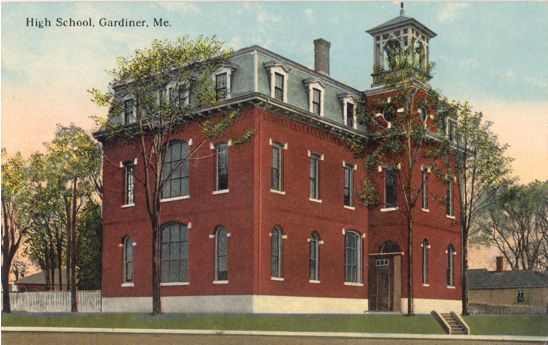
Deborah Meier at Bridging Differences comments on the significance of modern education architecture versus the old, beautiful buildings that were once the norm for educational institutions.
we went from grand to pedestrian, from castle to factory. Looking at high schools, it's even more startling. The old buildings were statements about the power and glory of education. Of course, they weren't for everybody—especially the high schools. The trouble is that once we claimed them for "everyone," we forgot to build them to be inspiring.
She goes on to relate this decline in design to a more general trend in which the promise of educational equality is payed lip-service to, meanwhile still avoiding the hard task of actually doing something about it in a meaningful way.  She refers to Harvard's Paul E. Peterson as saying in essence:
...all our favorite silver bullets have failed to change scoring patterns over the past half-century: the end of legal segregation, extra federal dollars for students in poverty, high-stakes tests, schools of choice—via charters or vouchers, teachers with more degrees, teachers' unions, improved wages for teachers, and even smaller schools.

Wait a second here, Deborah - I have a silver bullet to add to the list!

OK, maybe it's not a single bullet - more like a full clip.  The standard model currently is guaranteeing each kid a classroom of 29 other kids and a teacher.  Within that model, miracles are supposed to occur that will completely reverse social stratification and generational poverty in one fell swoop.  I call it the "Rambo Teacher" model.  Federal funds are then sprinkled over the top like pixie dust - whoopie, reduced lunches and an extra hour of tutoring a week to the rescue!

Of course, as we know - there are huge differences in levels of human/social capital between students.  So instead of focusing resources on finding better teachers, or marginal programmatic improvements, how about creating a baseline for "Student Capital": what total resources the student brings to the table.

Any number of factors could go into this framework - parent education, family income, number of parents at home, language & cognitive skills, emotional/behavioral evaluation.  What the heck - test the parents too!  It may require an entire level of administration to assess children at a certain age, and maybe every two years thereafter.  But this data would then be used to allocate an appropriate level of resources and targeted intervention, if necessary.

The idea needs a lot of work, but I think if we are to take seriously the idea that no child be left behind, that each  child has a constitutional right to an equal education, this would be an excellent way of leveraging the public education system.  Currently, all students get a very similar level of funding.  In this system, that paradigm is reversed and some students will get dramatically less services, while others dramatically more.  The whole thing is essentially means tested.  In a very real sense, the concept is very similar to that of special education.  But instead of only acknowledging that a child with a learning disability or physical handicap has a special need, that designation is broadened to include a whole host of statistically significant risk factors for educational failure.

I think we've been going about this in a totally wrong way.  We've looked past family capital for too long - even while research has told us for decades that parenting is just as important if not more so than schooling.  Yet while we cannot (should not!), replace parenting, we can take ownership of that deficiency and take real steps to ameliorate its effects both through working with parents and providing extra resources to the child through schooling, home visits, or some other combination of programmatic engagement.  We don't need new schools, or new teachers, or new curriculum.  We need a new way of looking at how education is distributed.  It is simply unfair that some children grow up in households that leave them woefully unprepared, while others are pushing them to the very top.  This is not a recipe for social justice.

Friday, June 4, 2010

Virtual Charters and the Kids Down the Road

The New York Times has a piece up documenting the continued growth of online charter schools - by definition paid for at taxpayer expense, and at the same level of individual student funding as brick-and-mortar schools.  This means that a virtual charter can expect to receive anywhere from $5-7k per student, or whatever the going rate is in that district.

From the article:
  • There are no libraries, cafeterias, playgrounds, coaches, janitors, nurses, buses or bus drivers.
  • Twenty percent of California’s 872 charter schools now conduct some or all of their classes online.
Regular readers of this blog will know that I taught for 3 years at a California charter school based around a similar model.  While a small number of its students, such as those I taught, were served in more traditional school houses, most of the nearly 3000 students were home-schooled.  These students received up to $800 for curriculum and supplies, and access to an "education specialist", a fully-compensated credentialed teacher who met with the family weekly or bi-weekly to oversee progress, and who usually had around 30 students on their roster.  So basically, the school paid a teacher around $60k, and took in 210k - all without the normal expenses associated with running a school building.

The homeschool parents were by and large thrilled with the service.  Mostly mid to upper-SES, they had the typical human and social capital to provide a quality education to their child.  What this typically meant was that the household had two parents, and enough income to support one parent (usually the mother) staying home to teach the children.  They had access to online resources that served as lesson guides, and the ability to meet their child's academic needs.  I don't have access to such specific demographic data, but my guess would be that most had a college education.

While there were a handful of schools in which students came in for instruction in a classroom setting - "acedemies" they were called, they represented only a small number of enrolled students.  Of the academies, only a few served primarily low-SES familes.  In fact, ours happened to be one of maybe two, located as we were in a small, poor town 2 hours from the corporate offices.  Our school had begun as a small K-12 staging area for the largely upper-SES, white, religious families in the community who sought homeschooling as a way to avoid the neighborhood schools, which were mostly poor and Hispanic.  Yet as a charter school, any local children were allowed to attend, and the original population was slowly replaced with one that reflected more clearly the demographic make-up of the surrounding area.

Currently, 35% of the school's students are eligible for free & reduced lunches, a standard means-tested measure of poverty in any given school.  At our academy, this would likely been at least 80% of the population.  Unfortunately, a range of administrative failures resulted in a profound denial of resources to these students.  Had they attended the local public school, they would have had access to a variety of services.  Yet the academy was seen by many parents as preferable; many considered it somewhat exclusive - almost "private schoolish".  This was certainly how the school wanted to present itself.  As most of the parents were unfamiliar with what a good school environment really looked like, few among them having gone to college or experienced much academic success in life, they were ignorant of what their children were missing out on.

Sadly, the main component of a "good school" is often simply students from higher-SES parents.  So such a large percentage of poor families in one school inevitably requires a whole range of special resources to compensate: better teachers, better administration, smaller classes, as well as a variety of extra services like meal programs, special education, etc.  In many ways our school did as well as any school could have hoped.  Our teachers and staff were dedicated and caring, we had high standards, and did our best to work with meager resources.  But we were in no position to offer what these students really needed.

Despite our students' eligibility for federal Title I resources - extra funding for poor students, we struggled to provide a bare minimum:
  • We had no meal program (no breakfast or lunch).  Students often came to school hungry, without food, or with nothing but a soda and a bag of chips.
  • We had no library, or librarian.
  • We had no PE, Music, or Art teachers.  Foreign Languages were taught via software.
  • There was no budget for field trips.  No school bus.
  • We had one special education teacher, working on a pull-out basis.  No special day class.
  • We had a skeleton crew for yard duty.  Teachers had no preparation periods.
In my time there, enrollment was in rapid decline.  Apparently many parents were realizing that their students were being under-served.  In my final year, the elementary grades had been divided into combination classes, where one teacher would be responsible for teaching two different grades.  I was stuck teaching Kindergarten and First.  With a low-SES population, this meant taking kids who were woefully unprepared and struggling to get them all to where they needed to be - x2.  In order to give direct instruction to each grade level, I was forced to rotate the students in groups of 4, 4 times a day.  This meant 16 separate activities in math and reading.  All without a prep.

I ended up being sent to teach high school science mid year, as the students there had already received a semester's instruction from a substitute.  There were only 3 high school teachers (English, Math, History) as it was.  The school hadn't been able to afford to pay for an assistant director - so she'd have to teach elementary.  As a young man, they thought I could do better with the rowdy highschoolers.  I began teaching Chemistry, Biology and Earth Science in February.  Fortunately I actually enjoyed it.  I went on that summer to get a credential in Geosciences.  That fall I taught Chemistry, Biology, Earth Science, Career Exploration, Visual Arts and Journalism.  But as more students left or dropped out, by November they couldn't afford me and I was laid off.  The science courses were split between the English, Math and History teachers.

Of course, there was no union.  Teachers were often fired the last week of school, and always for seemingly arbitrary reasons.  The principal wasn't really a principal - she was 2 hours away.  He was a site administrator.  This meant that the little input he had in site decisions (he didn't have a budget), always had to be passed through corporate offices.  Suffice it to say what teacher input there might have been was strangled.  We eventually gave up on leadership committees.  We were either too busy, felt our input was unwanted, or simply too scared to question the school's increasingly poor service of its students.

The school's principal had previously come under fire for financial corruption and misuse of funds.  The result was a split from a former organization and her establishing the present charter through the county district.  Her husband is the chief financial officer.  This may explain why the school was so comfortable with what may have been its most fraudulent activity.

When I was hired to teach Kindergarten, I learned that I was technically to be called an "Education Specialist", just like the homeschool advisers.  This was because, technically, the academies were simply meeting places for homeschool students, although the students all attended full-time.  This odd arrangement had a very lucrative benefit for the school: as long as the student could be accounted for having done a lesson at home, they could miss a day and still be claimed as having attended.  Teachers were required to fill out a sheet of paper every month on which they would check if a student had completed an educational activity for each eligible day of attendance.  In theory, the parent would arrange in advance for an absence, and the teacher would arrange for an activity to take place.  Of course, an activity might take no more than an hour, and in no way could be considered equal to a full day's attendance on-site.

What was more often the case however, was that the student would simply not show up to school, with no contact from the parent.  The teacher would mark the absence.  Yet teachers were routinely pressured to go back and have students do a "make-up" assignment so that a full attendance day could be claimed.  The justification for this was, wink-wink, more money from the state = more money for the school to provide better services.  Classes routinely had 100% attendance rates.  Yet, if any money was indeed "trickling down" to the site, we certainly saw no evidence of it.

As far as I know, the site is still surviving.  Although it remains to be seen how much longer they can continue attracting students.  The larger school, meanwhile, is flourishing.  As the story in the Times suggests, many parents have discovered quite a large loophole in the public school system that allows for what amounts to a de facto voucher for private education.  Our academy was seen as a sort of pro bono charity case, in which poor students who otherwise would not have had access to the homeschool model, and ultimately for whom public education was originally designed, were being thrown a bone.  But I doubt very many virtual and homeschool charters are even bothering with a pretense of generosity.

Philosophically, the problem with the voucher model - full funding for individual student expenses - is antithetical to the public school model, which is ultimately founded on the principal that society is responsible for providing a basic education to every child.  Public resources aren't divvied up according to head-counts.  Like an insurance model, they provide a baseline coverage and then allocate resources accordingly.  We don't demand "our fair share" of auto insurance when we don't have accidents.  We don't demand our fair share of health insurance when we don't get sick.  This is the general model for public services in general.  We don't demand our fair share of parks, roads, libraries, police or emergency services when we don't use them.  We believe that society at large should come together and share our collective wealth in order to provide what we believe are basic human rights.

When a high-SES student receives a maximum share of public education funds, they are taking money away from other children who do not possess the same level of human and social capital.  Those students are then further marginalized into schools whose demographic  make-up is increasingly similar to theirs, placing an ever higher burden on institutions that are designed to turn no child away, to "leave no child behind".  As it stands, one of the greatest barriers to reducing the socio-economic achievement gap is our unwillingness to adopt fundamentally means-tested education services.  My daughter, bless her heart, has two college educated parents who themselves came from parents of reasonable means.  When she enters Kindergarten next year, in a neighborhood composed largely of other higher-SES families that feeds an extremely high-achieving elementary school, she will be reading, writing and doing math at a roughly mid-1st grade level, not to mention having a generally well-enriched vocabulary and cognitive capabilities.  She will receive a very similar level of state resources very similar to the children from the poor communities a few miles down the road.

It isn't hard to see what this means for her future, as well as that of the kids in poor communities.  It isn't fair.  It isn't moral.  It isn't just.  It isn't what America stands for.  As long as we continue to think in such selfish and uncompassionate terms, we will continue to fail our future generations.