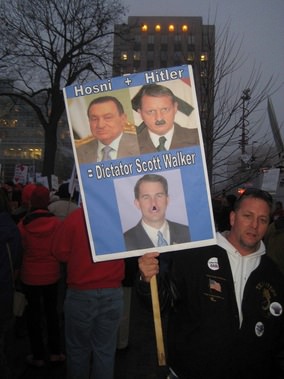
Sunday, February 27, 2011

Demanding Taxes

California, like most states across the country, is facing dramatic cuts in government services.  Polls show that when asked about specific services, people want them.  But when asked about raising taxes, they shrink.

I'm sure much of what is behind the immaturity of Californians, of wanting to have their services without paying for them, is the relentless propaganda that for decades has been declaring government and the taxes we pay for it evil.  When the bill comes due, personal responsibility is no where to be found.  Instead the blame is placed on waste, fraud and abuse, and the terrible, bloodsucking unions.

Meanwhile, at the local community college where my wife works, they are canceling an entire section of remedial English courses, effectively shutting the doors on hundreds of prospective students.  This is just one of the many tragic stories that will be surfacing in coming months.

There is a lie being sold across the country: because the state is broke, we can't afford to pay for things.  The truth is that in our adoption of a right-wing view of limited government, we don't want to pay for things.  The dishonesty here is that one can say, "Look, I'd like to, I really would, I just can't afford it," and hold on to moral dignity of pretending to care.  But in reality one does not actually care. 

Much of the response to the plight of public sector workers, clinging to their bargaining rights and pensions, has been the rather spiteful, "I don't get a pension, so why should they?"  Stephen Colbert, playing his satirical role to the hilt, summed up this notion by asking, if a rising tide lifts all boats, then when the tide goes out, "I want to pull their boat down with me."  This might be more understandable if we were talking about the millionaires and billionaires who have been getting steadily richer throughout this great recession.  But it is not.  They have been having their taxes cut, while the public blames middle class teachers, firefighters, police officers and prison guards.

It is time to stand up for what we want from our government, in clear terms, and demand that those who can afford to pay their share do so.  They cannot claim that we are "stealing" their money.  They cannot claim that taxes will limit growth and prevent jobs from being created.  It is our right to demand taxation, as it is the price required to live and do business in this great country.

Friday, February 25, 2011

Whipping Unions

A common argument you hear in defense of the Republican assault on public sector unions (aided in no small part by the liberal embrace of union-busting teacher reform), is that the public sector shouldn't be allowed to have union representation at all - that they necessarily have a conflict of interest with government. Just because they are a constituency paid by government, they are not guaranteed any other special privileges than private constituencies.  Jonathan Zazloff asks why public unions are considered corrupt, but not limitless spending by private corporations:
Public-sector collective bargaining is unhealthy and distorts democracy because it enables workers to influence the government which negotiates with them; but
Unlimited and secret corporate political campaign contributions are necessary to democracy because they enable corporations to influence the government which regulates them.

It is a slippery slope fallacy to assume that because unions can argue for better pay, and better pay can buy more representation, thereby acquiring better pay, a corrupt feedback loop is created. The obvious problem with this is that there are numerous checks on union power, not the least of which is the fact that government officials are democratically elected. This argument generally rests on the notion that political speech is necessarily corrupt.

Yet, this applies just as well to private political speech. Enter Zasloff’s suggestion that private corporate speech has just been given an enormous boost, generally by the same folks who are now decrying unions.

Another argument on the right – one I heard just today – is that unions were responsible for the destruction of private sector jobs, and now they’re doing the same to the public sector. This is absurd in numerous ways. For starters, even assuming that unions were responsible for job losses due to pay demands, workers would never have been able to compete with third world labor.

Yet what happened to the productivity gains when those jobs were done more cheaply? How has that “trickled down”? And if there had been no unions, and if workers somehow would have been able to compete, where would the productivity gains have gone then?

Yet the public sector can’t outsource its services. So how would unions be able to destroy that sector? Are public workers making too much? I think that’s pretty subjective. I certainly don’t feel like they are getting anything more than they deserve. Are other workers getting what they deserve Probably not. But whose fault is that? By cutting taxes on the rich, are those “productivity gains” going to trickle down too, just like they did in the private sector?

Tuesday, February 22, 2011

Ice Floes, Pt. II

In general, calls for harsh retaliation is a very gut-level response common to conservatives.  A classic example is the father who would exact brutal revenge on anyone who threatened his family.  I think it's fair to say it drives the death penalty, hawkish foreign relations, "tough on crime", etc.

Each of these positions can be rationalized, or argued for with logic and reason.  But I wonder whether all that is somewhat after the fact?  Because the truth is that there is this deep reaction, for which there may, or may not be a well-developed rational framework.

And lest anyone think I'm only pointing at the right here, I think there is a sort of anti-response on the left.  That is, the tendency to under-react, or at least to not respond with the same desire for revenge or finality.  This tendency in liberals is all to clear to the right, who routinely point to it as a deep character flaw.  Liberals are "soft" on crime.  Liberals want a "nanny" state.  They are "bleeding hearts".

Yet, the most difficult piece of this is determining to what extent the feeling/reaction follows philosophy/worldview, or visa versa.  By the time one is old enough to be taking positions on the world, one has likely grown up in either a liberal or conservative environment.  Personally, I am largely sympathetic with my parent's liberalism, even if I've moderated my own somewhat.  And so I have a difficult time understanding what it might have been like to change my politics, as many have.  The sheer number of people who hew to their parents' views would seem to argue for philosophy shaping feeling/reaction.  I would assume natural variance in temperament would predict a much more diverse set of outcomes.

Another piece can be inserted here, something maybe described as the "personality style" of a family.  This would be a sort of familial temperament, or tone, that averages from the dynamic range between primary authority figures.  To a degree, peers and extended authority figures would have an effect, but my guess is less than that found in one's home environment.  This influence would most likely be expressed in the common self-describing statement, "...the way I was raised".  This familial tone would affect the essential temperament of an individual, with respect to his reaction to basic moral questions concerning justice, work ethic, empathy, sharing, in/out group, social status, authority and the like.

Unfortunately, even here we are forced to return to the effect of broader worldview on each of these family and network pressures.  The moving pieces thus rotate between self, family, and worldview.  The latter two seem to be the most static, considering predictable regional and ethnic patterns.  However, the first - one's temperament - varies relatively greatly.  Interestingly, temperament would seem to be highly selected for in forming familial partnerships, as well as inner networks of friendships - all having a great deal of effect on the developing child. 

So with ethnicity and worldview falling into general patterns, at least regionally, you would then have clustering by temperament, as networks associate and disassociate according to basic moral responses. 

And so here we are.  I have a much different response to whether terrorists do, well, basically anything.  And my response is very different.  As a liberal I very much take the "hand-holding" or "bleeding heart" position.  I have plenty of philosophical reasons to back up why I should feel why I do (and why you should too!).  But I wonder just how much of how I got to where I am at emotionally and intellectually, is due to the soundness of my ideas, and how much is due to the particular milieu from whence I come. 

Oh yeah - I love tofu and once hugged a tree (no lie!).

Monday, February 21, 2011

Me, Myself and I

Thinking about abortion....

Heard about this on Radiolab yesterday... very interesting.


Basically, twin zygotes are created, but somehow fuse back together, forming into one (like Voltron!), which then has two sets of DNA, with one or the other assuming command duty depending on cell type.  So the liver might have one, blood having the other, etc.

So, if we aborted one zygote before the merge, would that be "taking a life"?

Sunday, February 20, 2011

Too Elite, or Not Too Elite?, Pt.II

There’s got to be something deeper going on psychologically with anti-elitism and art. There’s something of a fundamentalist mentality to it, in the sense that art is associated with liberalism, which is associated with modernity and threat to traditional values. It is interesting that you brought up historical exclusion. Exclusion has been so much a part of the American mythos – even as we have excluded our own people. To be American is both to be excluded and yet exceptional.

It has been said that there is no dirtier word in America than class. We don’t want to admit to it, yet is stings us. And what is “elitism” but the use of a sort of “class card”. It is real, but at the same time a sort of forgery, and one that can’t be mentioned by name. The working class has been excluded from arugulla, museums, literary criticism, gender politics, etc. But those things aren’t necessarily exclusive – or they don’t have to be.

Yet they happen to be things, ideas that are nurtured and germinate in academia, the ivory tower that is indeed exclusive. The fact that universities are bastions of liberalism is neither an accident nor a fact lost on the many who feel left behind culturally and economically. So in a way, liberalism has been foisted on its own petard – it has allowed itself to be associated with economic privilege, even if that is not generally the case, and liberals are not necessarily more affluent.

Too Elite, or Not Too Elite?

With the latest budget squabbles, we've been hearing a bit about government arts funding.  And again, we hear complaints of arts funding as somehow elitist - presumably because of art's history as a fancy of the upper classes.  I think that's less true than it has been at many times in the past.  More on that in a bit.  But first, let's take on the allegation of "elitism" being deployed with such fervor by the contemporary right.

Let me start with socioeconomics.  I've been lower-middle class all my life, as measured by income.  But both my parents were college educated, and I grew up in a very "rich" cultural environment (arts, philosophy, history, world religions, politics, etc. all discussed regularly).  That puts me in an upper class percentile.  My wife and I now both have graduate degrees, and our daughters are being raised in a similarly culturally rich environment.  Yet we have generally lower-middle class incomes. 

So when my daughter goes to school, she'll no doubt encounter other children whose parents were not college educated, and do not have highly intellectual discussions at home, yet are upper-middle class income-wise.  Thus they are in a lower cultural percentile, yet higher income percentile.  They'll tell her that abstract art is stupid, "as any kid could do that".  They'll tell her that her challenging of dominant social norms is "weird".  She'll tell them their unquestioning embrace of popular art is predictable.  She'll accuse them of being provincial.

Of course, they can all be quite civil about it.  While the town can certainly be snobbish, the gown - at least in my experience - can be just as cruel, expressing an "elitism" of their own.  Just go to any gay ghetto and ask how many people had fled the persecution of small-town norms.  I'm always struck by the tone-deafness of those who would accuse liberals, or the educated, of snobbery, while failing to see how oppressive conservatives, or the uneducated can be.

While the arts have sometimes been used as a cudgel with which to clobber the townies, they have also been used as a sort of cultural escape-hatch, through which those who don't fit in, or just see things a tad differently, might find transcendence.  Furthermore, art appreciation has looked quite differently through the ages.  I'm no art historian, but it seems to me that "the arts" today is wide-ranging and diverse.  There is an irony in those who would disdain the arts as elitist, in many ways actually making the arts more elitist, by dismantling the very supports that have allowed the arts to thrive in ways that a purely privatized field would not have. 

I'm very uncomfortable with the increasingly tired conservative anti-elitist rhetoric.  Especially when coming from millionaires.  Just because George W. Bush, a trust fund baby, legacy education at Yale, talks with a twang, rides horses and likes Toby Keith, he's somehow not an elitist, while the vegan kid behind the coffee counter who goes to a state college, listens to indie rock, and likely has socialist sympathies is an elitist.

Are we not just really talking about the power of knowledge?  I mean, this isn't really about liberal elitists "looking down" on the townies.  It is about the dismissal of their special knowledge, in the sense that they know something about comparative religion, world music, the history of cinema, philosophical discourse, and the subtleties of cuisine. 

And yet, is it even about their knowledge of these things?  Most so-called "elitists" I know are actually quite uniformed in many areas.  Imagine!  So are we then really talking about the knowledge itself - the mere idea that someone, somewhere, thinks your mustache is stupid?  That you can't enjoy a good cheap beer anymore without the idea that there was a "fancy" one on the shelf above it?  Or that you went to see Transformers instead of some foreign documentary about foreign films?  Isn't this why Professor Glenn Beck gave a rave review of Spiderman?

Honestly, it feels like "The Republican War on Science" should more accurately be described as "The Republican war on Knowledge".  You there, with your fancy glasses! 

How much of this sort of cultural self-pity is being hyped up for political if not financial gain?  Everyday.  Millions of listeners tune in to Rush Limbaugh and others who tell them that the "elites" are looking down their noses at them.  Yet are they?  Or is this trumped up paranoia, digging in to people's deep-seated fears about themselves, much in the way hypnotists plant false memories?  The classic demogogic  ploy.

Because yeah - you don't have the most fashionable clothes.  You didn't go to university.  You enjoy cheesy television.  You really like Applebees.  You feel comfortable with traditional cultural roles. You don't "get" modern art.

But so what?  Your clothes are really boring and you didn't put much thought into their meaning.  People are going to sing the praises of university because it is a temple of the human mind.  People are going to rag on television because it is overly commercial and filled with cynicism and cliché.  Traditional cultural roles are often really terrible and we all need to think critically, taking nothing for granted.  Modern art is, well, it's complicated, and it's OK to admit you don't understand it. 

These are objective realities.  It is just as true that "elites" are just as lacking in numerous areas of their lives.  Yet those areas tend to not have the same sort of "status" associations (although ask a redneck if knowing how to change a tire is as important as the difference between modernism and post-modernism and he'll laugh in your face).

In the end, the two forms of knowledge have different uses.  As we move further into an information based world, abstract thought will likely become more important than mechanical thought.  And what is ultimately important is not whether one has a mustache or eats arugulla, but how much human, social and political capital one possesses.  It is in all of our interests to set aside petty bickering and focus on the project of equality and empowerment of humanity as a whole.
Saturday, February 19, 2011

Distractions

Matt Welch at Reason finds a distasteful sign at the Wisconsin rally and has this to say about public sector unions in general:
I have written in the past about how libertarians are pretty lonely in the political scheme of things in terms of constantly being challenged to defend themselves against the "logical conclusion" of their philosophy. But I think it's time to amend that. We are witnessing the logical conclusion of the Democratic Party's philosophy, and it is this: Your tax dollars exist to make public sector unions happy. When we run out of other people's money to pay for those contracts and promises (most of which are negotiated outside of public view, often between union officials and the politicians that union officials helped elect), then we just need to raise taxes to cover a shortfall that is obviously Wall Street's fault. Anyone who doesn't agree is a bully, and might just bear an uncanny resemblance to Hitler.
This is an object lesson in cherry picking problematic elements of the rhetoric used by those with whom you disagree, in order to create a straw man.

That was a terrible sign.  But is there much evidence of that type of rhetoric elsewhere on the left?  With the Tea Party, as with right wing radio and television in general, there seems to be a definite trend.  What is more, there is a longstanding tradition on the right of a narrative that literally worries that liberalism is inherently fascistic and will lead to tyranny.  That said, it is an important reminder of how muddled thinking cripples debate.  More than anything, what the above sign did was to distract from real engagement.

Welch also makes some more serious points.  There are a couple of assumptions implicit in Welch's commentary.
1 - Because few private pensions exist, public pensions shouldn't either.
2 - Public workers shouldn't be allowed to unionize, because they'll end up capturing politicians and getting paid too much.

1 - Should private pensions not exist?  It would seem that pensions are a form of compensation set up in an environment of job stability.  For a number of reasons, they couldn't be maintained.  But does that necessarily apply in public sector work, which is almost by definition a very stable industry (we'll always need cops, teachers, firefighters, etc.)?

2 - Public workers have the same needs as private workers.  Aside from basic questions of labor rights, unions can be an invaluable way for an organization to get objective input from its "members on the ground" - middle managers are just as interested in preserving a status quo that makes themselves look good at the expense of larger truths.  (Our teachers union is greatly interested in best-practices and is often the only bottom-up link politicians and administrators have with what is really going on in the classroom.  To the extent that they are receiving information they otherwise could not that affects students, it is a structure that ultimately benefits student learning).  Any large organization is fooling themselves if they think that workers won't rationally choose to protect their jobs to avoid rocking the boat.  Often, the channels for constructive criticism simply don't exist.  (The popular television show Undercover Boss illustrated this point again and again).

The argument against political capture is valid as far as it goes.  But if you accept the argument that all workers ought to have organized advocacy, not only to benefit themselves, but to benefit the larger organization, this weighs against it.  And if you look at union-backed public compensation in general, it isn't terrible out-of-control at all.  Obviously there will be debate, but if you think public workers are living high on the hog you're sorely mistaken.  The compensation I see seems perfectly reasonable.

Welch is making a slippery slope argument when he says worries that the democratic position on public unions will lead to a political capture that will spiral out of control.  The problem with slippery slopes is that they aren't logically predictive.  Just because something could, in some perfect scenario, happen, it doesn't mean it will.   This is why we don't have speed limits of 150mph - or 10 mph for that matter.  Other pressures come to bear.  With public sector unions, that pressure has kept compensation pretty reasonable, and is certainly coming to bear now.

Yet what to make of Welch's claim that the current situation is proof that public workers will always require an increase in taxes - if tax rates were sufficient to cover compensation before, why are they inadequate now?  A picture is painted in which closed-door negotiations conspire to grab ever-more of public coffers.  Yet the public consistently supports services they are unwilling to pay for.  This schizophrenia pits public confusion (manipulated in no small part by ideologues and politicians) against sound fiscal policy.  What's more, the electoral reality is that this also reflects a bitter split between competing visions of what public services should exist to being with.

Furthermore, while the recession has hit all states, each fiscal situation is different.  It is simply not the case that state deficits can all be pinned on compensation negotiated by public unions.  Frequently, pension coffers are drawn from to finance other areas government.  To blame pensioners now is not only an unfair breach of contract, but it is a dishonest manipulation of fact.