Thursday, October 4, 2012
Quick Debate Thoughts...


Saturday, September 17, 2011
The Solyndra Mistake

But as others have pointed out, the failure of one investment does not argue against government investment more broadly, as many are claiming. It could have just as easily been the case that Solyndra would have been a good investment, both in terms of creating jobs but also in easing the transition away from our dependence on dangerous fossil fuels.
All this worry about the idea of state funding certain industries is missing a key point: these industries are vital to the national interest. The most obvious example of this is military contracting. No one ever argues that military industries shouldn't be supported by the state. The same logic applies to things like environmental, health or infrastructure industry. There are many areas of life in which there exists no natural market.
The upset over the auto and bank bailouts was based in the incorrect assumption that it was another example of the government interfering the markets, or even a government "takeover". Yet these were highly unusual cases in which the market had broken down, and the government had a national interest to uphold. In neither case was the government interested in entering these markets more than temporarily - a fact proved shortly thereafter. You can argue the counter-factual that it was bad policy, creating moral hazard and we would have been better off. But as it stands the interventions stabilized both areas in which we intervened. Will automakers and bankers be more reckless, assuming that they might get bailed out in the future? I see no evidence of this. Automakers have gotten severe concessions from unions, and banks have tightened lending considerably.
The real question is not whether the government should be intervening in markets. It always has and always will, as there are national interests that require investment, yet because individual companies face great risk and little reward, there is little incentive to pursue projects of great national importance. Solyndra may have been a mistake, but it was part of an enormously important larger national project.
Saturday, August 27, 2011
The Limits of Rhetoric
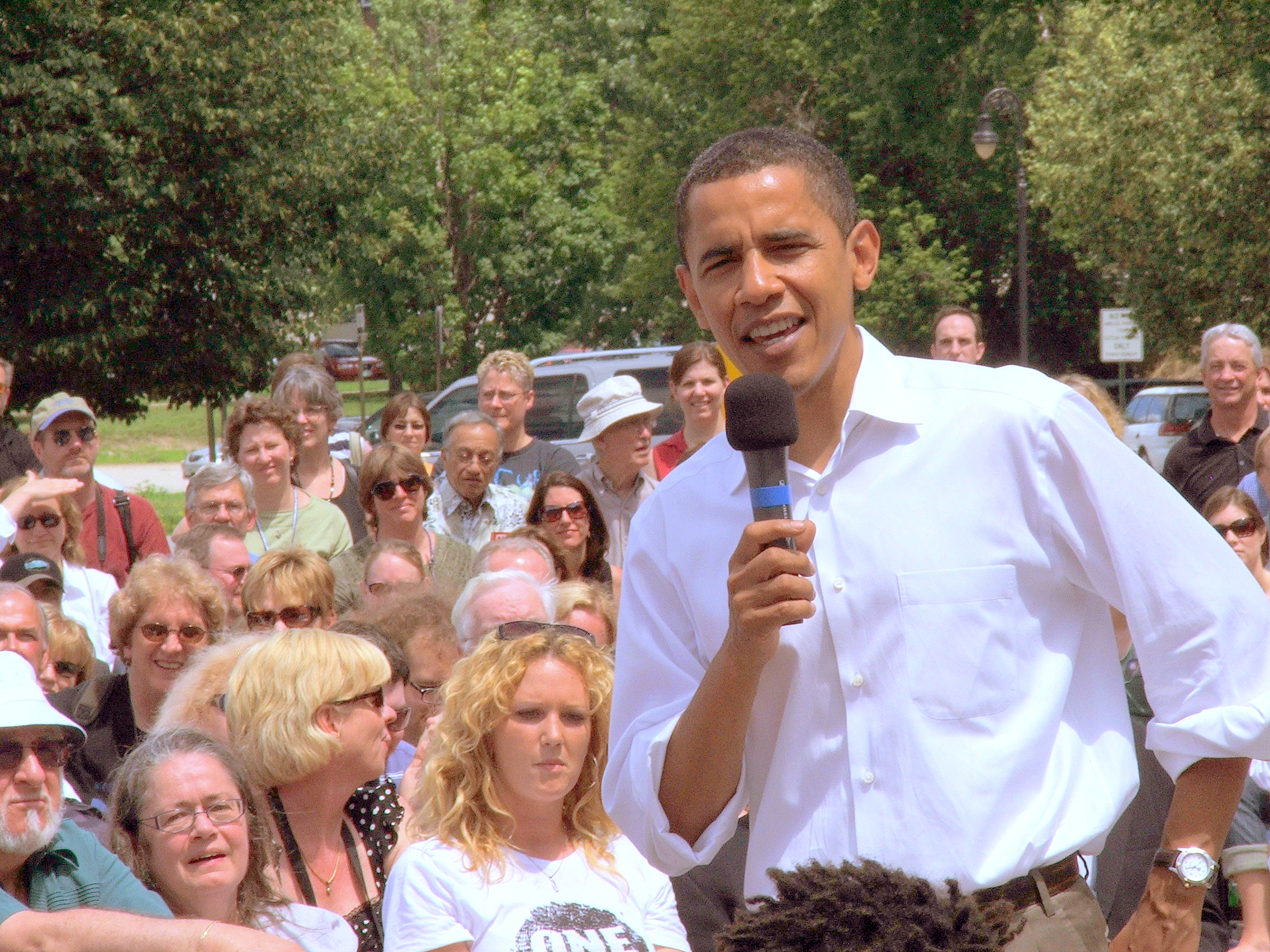
Westen's op-ed rests upon a model of American politics in which the president in the not only the most important figure, but his most powerful weapon is rhetoric. The argument appears calculated to infuriate anybody with a passing familiarity with the basics of political science. In Westen's telling, every known impediment to legislative progress -- special interest lobbying, the filibuster, macroeconomic conditions, not to mention certain settled beliefs of public opinion -- are but tiny stick huts trembling in the face of the atomic bomb of the presidential speech. The impediment to an era of total an uncompromising liberal success is Obama's failure to properly deploy this awesome weapon.What’s odd to me about this phenomenon Chait identifies (I think correctly) of the left’s infatuation with rhetoric, is that it doesn’t seem to really exist on the right. Sure, they speak in powerful language, but I think that power resides as much as anything in pure ideological simplicity and intransigence. It would be the equivalent of Obama saying he doesn’t want any spending cuts, only tax increases, period.
Yet this is why we call the right crazy. Aside from substantive incoherence, they are simply taking positions that literally threaten the economy on a massive scale. This isn’t a function of Republican rhetoric, but the composition of the Republican electorate and the conservative movement in general.
So, to try and match this phenomenon on the left, to try and drum up something similar within the voting left merely through rhetoric – through one man! – seems quite silly. At best it is cynical political posturing. Maybe it would be a good thing to be able to muster such a united front on the left. But doing so would likely come at great cost. Political unity and passion is one thing, but we don’t want the left to go go crazy. We don’t want ideology to trump reality and evidence. We don’t want an authoritarian mind-set that bristles at nuance, that is unable to reach across the aisle, that is only interested in demagoguery and simplistic fear-mongering.
I don’t presume to have any answer to how to best respond to what seems such a frustratingly successful parade of right-wing dullardry. But I’ll gladly take the liberal-friendly principles of free thought and measured truth-seeking over authoritarianism’s blockheaded success.
Thursday, April 28, 2011
Through Birtherism, Darkly

On one superficial level the birther question is perfectly legitimate: is he really a citizen? This is an obvious question, with on obvious answer. Yet the legitimacy rapidly recedes as the question is placed into a context of Obama being black, of his middle name, of his childhood, the non-Christian rumors, the colonialism, etc. All of it overwhelms seriousness - especially as the question had been resolved to a perfectly reasonable standard of evidence long ago.
Yet, all of this "context" goes to the difficulty in identifying prejudice. McWhorter has argued before that it is standard political rhetoric, where the only point is to score points. Yet this is what is so damn tricky about prejudice. You can't put your finger on one specific statement that "proves" its existence. And who among birthers would acknowledge explicitly any racial prejudice?
No one acknowledges racial prejudice these days. And who would expect them to? It is a serious sin. But these tangled patterns, forged over decades and centuries, continue to wind their ways through our unconscious mind. We're left with all of these "tendencies" and suspicions that gnaw at the fringes of discourse - whether on immigration, the "war on terror", Islam, or welfare. And yet we can't talk about them. We can't name them. We don't understand them.
And they are so easy to deny, so deceptively simple and harmless. Each issue by itself can be separated out and a case made that they are perfectly reasonable. Asking whether Obama is an American citizen is reasonable question. But at what point does it become unreasonable? And why? Why exactly? And when a sizable portion of the electorate continues to wonder, what does that say about them? What exactly is going on?
There is nothing exact about it. And in this refuge of uncertainty, of squishiness and vagueness, those who would play upon the oldest, most devilish human tendencies find their safe haven.
Thursday, July 29, 2010
Obama Still Doesn't Get It

From the Times:
"[Obama] said the “Race to the Top” program, which provides additional federal funds to local schools that meet administration standards — and a companion effort to overhaul the nation’s 5,000 worst schools — were ultimately aimed at giving good teachers higher salaries, more support, from supplies to smaller classes, and more training to provide them with career opportunities and financial rewards. About $4 billion is being invested in each initiative.My problem with Race to the top and Obama's other initiatives has nothing to to with a comfort with the status quo. I'm incredibly saddened by the continued failure of our public education system to close the achievement gap. But the reforms he champions are deeply misguided.
... All I’m asking in return, as a president and as a parent, is a measure of accountability. Surely we can agree that even as we applaud teachers for their hard work, we need to make sure they’re delivering results in the classroom. If they’re not, let’s work with them to help them be more effective. And if that fails, let’s find the right teacher for that classroom.”
His operating assumption is that poor teaching is the problem. But this is simply not true. Students come to school with varying levels of human and social capital. Depending on socio-economics, one school might literally be twice as hard to teach at as another. That is to say, the teacher of one classroom of students might have to work twice as hard to bring those students to proficiency as they would at another. Of course, this is simply impossible for most teachers. We hear stories of truly amazing teachers who occasionally manage to produce these kind of results. But these are the Michael Jordans or Red Barons of their field. The fact is that it is unreasonable for us to expect teachers in overwhelmingly more difficult situations to perform at such a high level.
On top of this, determining teacher performance is, and always has been, tremendously difficult. Students are not widgets, classrooms are not production lines or monthly sales tallies. Schools are complex systems of human transformation. This isn't to say that there aren't bad teachers, or that it is impossible to evaluate them, but that it is complicated. Teaching is a profession that is as much an art as science. Poor schools tend to be the first place rookie teachers start and - as they are the most difficult environments - the easiest places to fail, thus either forcing many teachers to leave the profession altogether or to transfer out asap.
Now, what should we be doing *instead* of Race to the Top? If students have a constitutional right to an equal education, this should include a rectifying of any lack of human and social capital they might have had the misfortune of having received. Starting as early as birth, society should make it a priority to see to it that every child encounters the best possible environment we can help them receive. This might include home visits by a qualified specialist to monitor nutritional needs as well as intellectual and emotional support. It may involve parenting classes or child-care support. It might involve the establishment of more and better community centers in which both parents and children can enrich their lives, thereby increasing their human capital.
Upon entrance into school, the classroom should be tailored to each student's level of human capital. For some students, one teacher and 25 peers might be just fine (in higher SES neighborhoods, many children enter school with 3x the vocabulary and basic reading skills). But other students, with lower human capital, may require remediation and/or intervention. They may need an extra teacher's aid, a smaller class of 10-15 students, possible counseling sessions, extra language, support, etc.
The crucial step in real, meaningful reform to public education will be in recognizing that all students have not had the same life experiences, and that our schools should be organized accordingly. In this way, we will be truly meeting the needs of each student, and finally breaking the wretched cycle of poverty and dysfunction in America.
Monday, February 8, 2010
Merit Pay is Nothing New

In order to do merit pay, you need to have data on teacher effectiveness. But therein lies the problem: teacher-effectiveness models must be treated with extreme caution. In order to be fair, they must be accurate. And how you get accurate data is a problem that has always plagued the concept. Salary rates are currently not based on effectiveness for precisely this reason.
I was recently flipping through a handbook published in the early sixties for beginning teachers. It was an odd book really, covering everything from pedagogy to budget considerations. The references to segregation were pretty fascinating. But in a section on salary it outlined today’s debate perfectly – stating that the difficulty in pay-for-performance comes in developing an accurate model for what that effectiveness really looks like.
Merit pay be eventually be done right. Although if it isn’t I won’t be too concerned – teachers don’t do it for the money. But the idea that it is going to be an effective element of reform is naive.
That we’ve been having this debate for half a century tells you A)the concept is nothing new and B) it’s a complex issue with no clear solutions.
Sunday, December 27, 2009
Civics 101

Victor Davis Hanson doesn't like Liberalism:
Apparently he doesn't comprehend liberalism.It works like this: The ghetto resident, the denizen of the barrio, the abandoned and divorced waitress with three young children, can all chart their poverty and unhappiness not to accident, fate, bad luck, bad decisions, poor judgment, illegality or drug use, or simple tragedy, but rather exclusively to a system that is rigged to ensure oppression on the basis of race, class, and gender—often insidious and unfathomable except to the sensitive and gifted academic or community organizer.
So Obama combines the age-old belief that the state is there to level the playing field (rather than protect the rights of the individual and secure the safety of the people from foreign threats), with the postmodern notion that government must recompensate those by fiat on the basis on their race or class or gender. Remember all that, and everything from the Professor Gates incident, to the dutiful attendance at the foot of Rev. Wright to Van Jones become logical rather than aberrant. Michelle Obama could make $300,000 and she will always be more a victim than the Appalachian coal miner who earns $30,000, by virtue of her race and gender.
Quick civics lesson:
White supremacists legally oppress minorities up through the 60's. Laws passed, culture slowly changes. "Legacy of oppression" still exists: high levels of minority poverty & dysfunction relative to whites. Liberals react against history of oppression and continue culture war: political correctness. After a few decades racism becomes socially unacceptable: miscegenation no longer considered terrible; conservatives "no longer see race".
Yet inequalities still exist: minorities fall behind in almost every indicator of demographic success. Paleo-liberals continue to argue its all because of active racism. Neo-liberals point to cultural and institutional factors that perpetuate poverty. Social research supports this thesis: general "risk-factors" are hypothesized to predict social outcomes; education, wealth, race are linked to success.
Conservatives deny that any of this is a factor. They "have a buddy" who grew up poor and is now wealthy; his daddy beat him but he didn't whine about it! They see liberals talking about inequality and dismiss it as a fantasy: everyone can succeed. They see liberal notions of equality as relics of a bygone era which doesn't exist anymore: Michelle Obama is doing great, Appalachian whites are suffering; race doesn't matter.
Yet this hypothesis would predict that all races would have equal rates of success. As would all incomes, educations, family backgrounds, etc: if "a buddy of mine" can truly be extrapolated to larger society. But they do not. The results contradict the hypothesis.
The liberal hypothesis predicts that success will be correlated with wealth, race, education, etc. It is. Year after year. This is a scientific fact. Race is just one factor of many; A bright black girl with a good family who goes to Harvard will almost always do better than a poor white man whose dad is drunk and drops out of school.
These are facts. They prove liberalism. Why conservatives continue to exist in their present form can only be explained by psychology. There is only so much you can do with people who continue to believe that 2 + 2 = 5.
Saturday, November 14, 2009
Have Obama Liberals Embraced Realpolitik?

It seems to me there is still a rather large difference between the Kissinger/Kirkpatrick model and the sort that some liberals embrace. With the former, you would favor propping up this or that regime for reasons of both economic and political principle - namely to defend against foreseen anti-imperialism or communism.
Support for vicious, undemocratic brutality was justified by the greater threat of where these leftist movements were imagined to lead. Yet there was always a good deal of sympathy for the plutocratic regimes. Not only were they acting as proxies for western interests that stood to lose substantial investments, but their very existence was in large part a natural extension of the capitalist narrative: that in markets there are winners and losers, and pity he who ends up on the losing side.
Yet with modern liberal realism, concerned as it is inherently in the progressive concept of social justice, it seems you have less an apology for the propping of regimes’ right to exist, and more a pragmatic, short-term avoidance of instability so as to increase not only future democracy and economic prosperity but social equality. When undemocratic Afghanistan is given aid to go after the Taliban or Al Queda, no apologies are made for the paradigm – within the logic of liberalism it is certainly illegitimate.
What’s more, it is hard to compare the brutality of the Taliban & Al Queda with the Sandinistas or most other communist revolutionaries (although you could draw reasonable comparisons between the Taliban and Latin American Death Squads). Going further, Hamid Karzai – or even Gen. Musharaff are hardly Samoza or Pinochet.