In case anyone might be wondering what strange fuel was in fact burning within the engines of intransigence and dysfunction in the California assembly, Brad De Long points us to Victor Davis Hanson's recipe for a West Coast Conservatopia:
All of which raises the question: how would we return to sanity in California, a state as naturally beautiful and endowed and developed by our ancestors as it has been sucked dry by our parasitic generation? The medicine would be harder than the malady, and I just cannot see it happening, as much as I love the state, admire many of its citizens, and see glimmers of hope in the most unlikely places every day.
After all, in no particular order, we would have to close the borders; adopt English immersion in our schools; give up on the salad bowl and return to the melting pot; assimilate, intermarry, and integrate legal immigrants; curb entitlements and use the money to fix infrastructure like roads, bridges, airports, trains, etc.; build 4-5 new damns to store water in wet years; update the canal system; return to old policies barring public employee unions; redo pension contracts; cut about 50,000 from the public employee roles; lower income taxes from 10% to 5% to attract businesses back; cut sales taxes to 7%; curb regulations to allow firms to stay; override court orders now curbing cost-saving options in our prisons by systematic legislation; start creating material wealth from our forests; tap more oil, timber, natural gas, and minerals that we have in abundance; deliver water to the farmland we have; build 3-4 nuclear power plants on the coast; adopt a traditional curriculum in our schools; insist on merit pay for teachers; abolish tenure; encourage not oppose more charter schools, vouchers, and home schooling; give tax breaks to private trade and business schools; reinstitute admission requirements and selectivity at the state university system; take unregistered cars off the road; make UC professors teach a class or two more each year; abolish all racial quotas and preferences in reality rather than in name; build a new all weather east-west state freeway over the Sierra; and on and on.
In other words, we would have to seance someone born around 1900 and just ask them to float back for a day, walk around, and give us some advice.
I will say this for the man: at least he has the balls to openly advocate what most conservatives can merely allude to. Of course, it's one think for a Standford professor to propose such things. It's quite another for anyone concerned with getting more than 10-20% of the public to go along with most of it.
But packaged in vaguely populist and naive rhetoric, the message is much more digestible. This is what real conservatism looks like - in all its ugly ethnocentric nativism, environmental callousness, authoritarianism and disregard for the disadvantaged. There is certainly logic and principle beneath. But in an odd way, at this sort of mid-rhetorical level - where policy is clearly stated, yet the underlying philosophy hasn't yet been broken open to reveal its incoherence, the modern conservative mind is at its most raw and frighteningly radical.
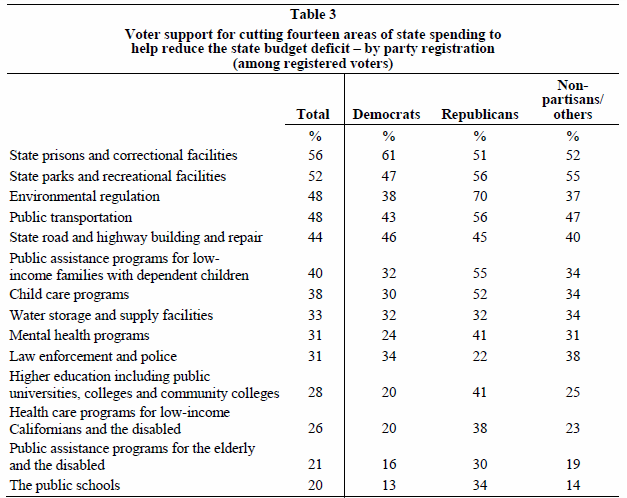
A new Field poll has come out with numbers on what kind of spending cuts Californians would like to see. It is no surprise really, but a majority of voters favor barely any cuts at all. Out of 14 categories, the only two to eke out a narrow majority of votes are parks & prisons.
More interestingly however, is how it breaks down along party lines.
Democrats unsurprisingly only agree to cut one major category
• prisons (by 61%).
Also no surprise is the GOP's endorsement of cuts in
• environmental regulation (70%)
• state parks and recreation (56%)
• public transportation (56%)
• public assistance programs for low-income families with dependent children (55%)
• child care programs (52%)
• state prisons and correctional facilities (51%)
Everyone agrees that the last thing to cut is education (20% all voters, 13% Democrats, 34% GOP).
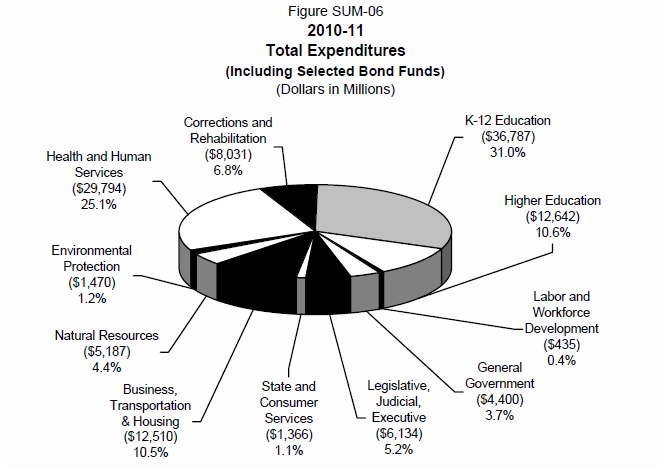
But when you look at the state budget, many of these categories represent a very slight percentage of the budget.
Obviously these sorts of attitudes aren't sustainable, for either party, without an increase in taxes. For Democrats, who would only like to see cuts in prisons, the only area of savings is going to have to come out of the prison budget, which is only around 7% of total spending. As it exists today, it is faced with a number of problems, not the least of which is overcrowding.
For the GOP, much more willing to make cuts, the overwhelmingly desired cut is to environmental regulation, which barely makes up 1% of the budget. It's about evenly tied on whether to cut prisons, parks, public transportation, and child and family services, which do take up a considerable portion of the budget.
All of which spells out pretty well why we are a state in such dire financial straits. The public is massively polarized over what types of services the government should be performing. The Democrats and GOP are locked in a bitter struggle with deep roots in very different views of human nature and social development.
But with climbing deficits, and no other option than emergency program cuts, the state is literally being forced to follow the GOP's world view of what role the government should play in a modern capitalist society - with the possible exception of prisons being forced to release convicts early. If Democrats want to see their vision of a government more actively involved in ameliorating what they view as a struggle for basic rights and equal opportunities, they must demand that Californians embrace higher levels of taxation.
The California fiscal crisis is reminding me of the truly least among us - the mentally ill. I worked for years serving this population, first delivering meals for people with AIDS (a large portion of which were “triple diagnosed” – AIDS, drug addiction & insanity) in San Francisco, then basically handing out meds in a temp home for the insane in Portland. There is a case to be made for ending the abusive nature of institutionalization and patients’ rights, but from what I’ve seen the pendulum is has done a 180.
So now instead of inhumane institutionalization, we have inhumane de-institutionalization. I can’t tell you how many people I saw who were in no shape to manage their lives, let alone their meds. The Tenderloin of SF consists of block after block of slum single-occupancy rooms filled with this population. Nurse Ratchet is now an immigrant Bangladeshi family behind a padlocked office and everything else a patchwork of non-profits struggling to provide services.
I’m sure this situation is repeated again and again in cities across the nation. And I fear in CA its gonna get real bad real soon. The Moral Midgets are finally coming to preside over a great failing state, and the shit rolling downhill will wipe many over the cliff. Starve the Beast is literally being translated into “starve the beasts”. And yet they have the nerve to paint horns on Obama.
In many cases, the best these folk can hope for is permanent incarceration. Suffering the slings and arrows of prison may in some ways be safer than the anarchy of a 6th floor ghetto hotel, or the cold terror lurking within the bushes beside some freeway overpass. And for many more, this will be the inevitable result when society fails to offer even the most basic supports. If one is lucky, an opening may appear on a waiting list for one of the few quality. comprehensive service centers that exist in some communities. But even many of these are likely to soon disappear.
I'll leave you with the trailer for Frontline's April 2009 piece The Released, which I highly recommend.
In his blog today Ross Douthat bemoans the current state of American government spending and warns of its impending slide into... California. This is an increasingly popular reference and one I'm not sure I'd disagree with. He points to 2 essays by William Voegeli which specify what, in tarnation, is wrong with California.
What is surprising is the growing evidence that the low-benefit, low-tax alternative succeeds not only on its own terms but also according to the criteria used by defenders of high benefits and high taxes. Whatever theoretical claims are made for imposing high taxes to provide generous government benefits, the practical reality is that these public goods are, increasingly, neither public nor good: their beneficiaries are mostly the service providers themselves, and their quality is poor. For evidence, look to the two largest states in the nation, which are fine representatives of the liberal and conservative alternatives.
So basically, paying less for less ultimately gets you more than paying more for more. He goes on to lay out what he considers is wrong with California.
I must say I find his writing style graceful, yet his arguments unpersuasive.
His main point is that California pays too much and receives to little; its services are inefficient and ineffective. Yet while he does a good job cherry-picking some obviously distasteful-seeming expenditures, he then admits that they represent a small portion of the budget. Instead, he says, their continued defense simply illustrates California politicians' intransigence.
The real problem is the costly pension system, which apparently is too luxurious. Really? Even if this were the case, it hardly seems as though it can receive the blame for California's services being inefficient and ineffective. Unfortunately Voegeli spends almost zero time delving into just how and why these services are so poor. One could almost say that, if pensions were to blame, the only correlation might be to the funds they siphon away. Yet this doesn't make the case for inefficiency and ineffectiveness, but rather underfunding - a position of which I'm sure Voegeli would not approve.
Californians have been described as having “political schizophrenia” – they want to spend without paying the taxes to support it. Then they complain about their elected representatives…
Lately I’ve been thinking about the “starve the beast” concept in reverse. Proposition 13, which made it incredibly difficult to raise taxes, is now forcing the state to cut spending on services across the board. This is the idea behind starving the beast. And now class sizes are through the roof, clinics are closing, tuition is hiking, etc., etc. As people start to see the effects of low levels of spending, will they finally turn around and “put their money where their values are”?
I believe that people want these services. But they have bought into the conservative myth that cutting taxes will solve all of our problems – force government to be more efficient, stimulate the economy, create jobs and ultimately increase government tax revenue. Republicans repeat this over and over – their solution to everything is to cut taxes. And when government goes broke it isn’t because of low taxes, it is because of inefficiencies, unions, or illegal immigrants – that’s a really popular one. The strangest part of this to me is how little taxes end up being for so many of us. Supporting a wife and 2 kids on an income of $45K last year, with no property I paid $147. On a $250,000 home I would have paid a state average of $1500. That’s an average monthly payment of $137, or 3% of yearly income. And that’s for the privilege of living in the beautiful state of California.
Of course many simply don’t want to pay for health care, education, etc. – and although their political views are at least more consistent, they don’t represent anything like a, well, moral majority.
The worst analogy is the macro = micro. You know, the one where government budgets are equated with family budgets. “When our family can’t pay the bills, we have to cut spending”. Of course, no one would ever say, “when our family can’t pay the bills, we stop working and reduce our income”. But this is level at which many people approach economics.
I think in the end it is a fundamental ignorance of the citizenry – not of what they actually believe, but in their understanding of what policies will get them there.
So we all know the "starve the beast" concept: cut taxes in order to force cuts in spending. In California, we're facing a $21 billion deficit. Without the prospect of sizable tax increases in the near future, and even with some sort of federal "bailout", we're going to have to make some severe cuts. The beast is certainly starved, and we face an impending reckoning. Will the grim reality of going without finally force us to acknowledge the reality of what a low-tax, low-service government looks like? And when we do, what will we choose?
Californians, with a deeply conflicted electorate, have had their cake and eaten it too. We've spent a lot of money on health & human services, education and prisons. And we've done it without raising taxes proportionally. And now, because 38% of tax revenue comes from personal income taxes, the economic crisis has blown a whole in that revenue stream. The legislature is sharply divided, and without the 2/3 majority needed to sufficiently fund our present levels of spending, the effects of spending cuts will be seen shortly. Class sizes will increase dramatically, as we lay off teachers. Neighborhoods will be less safe as we lay off police and firemen. Prisons will be forced to cut back, despite an enormous level of incarceration (ironically much of which stems from a political philosophy largely shared by those who wanted lower taxes in the first place).
I'll try and lay out the arguments for low-tax, small government:
1) Personal responsibility
Regardless of whether it is good for the economy, people must be held accountable to their own situation. If they make good choices, they will be successful. No matter what life hands you, you can always trace a line to prosperity. Government help must be reserved for only the most extreme, and unlucky of situations. Man makes up his own mind, and our social framework rewards or punishes him accordingly. Even in instances where one really is a victim of circumstance, government will only get in the way. Following the principle of "creative destruction", economic catastrophe will force otherwise complacent people to find innovative solutions: necessity is the mother of invention.
2) Inefficiency
Government is always inefficient. The private sector will always do a better job because its inherent competitivity will reward efficiency and punish inefficiency. Government is basically a monopoly, and therefore not only is its inefficiency unchallenged, but it acts as an unfairly advantaged competitor to more capable businesses that lack an unlimited supply of tax revenue, which in turn effectively rewards its continued incompetence.
3) Growth-limiting
Not only does government compete unfairly and thereby stifle business growth despite inefficiency, its mere presence in the market supplants industry, and when it regulates, it further inhibits growth. If left to its own devices, the market would find a way to provide for any real need. Many services could be provided adequately by the private sector, yet are effectively forfeited to a deep-pocketed government. Adding insult to injury, a paranoid devotion to environmental protection and growth management always hamstrings business. Excepting the most severe abuses, industry is generally quite capable of policing themselves, and what they do not do themselves, the public will do for them in the marketplace by selecting goods and services they find ethical.
What is interesting about these arguments is that they contain a dynamic tension: there is always a blurry line between limited and total absence of government. The easiest course to take would be anarchist libertarianism, where any and all government intervention - including, one assumes, military spending - would be gone. How then to write and enforce laws would be an interesting challenge. This tack would be the logic counterpart to communism, with the entire market controlled and run by the government. Neither of these two options is given serious thought, for obvious reasons.
What we are left with is a "tendency" on the right towards low-tax, limited-government, and on the left towards high-tax, larger government - pretty well covering every conceivable position between anarchy and communism. This has the politically messy effect of putting every conceivable government program upon the operating table. While there may be some areas of government that all but the most radical agree must exist at some level, where that level lies causes endless debate. Historically we have seen widely ranging policies on spending and taxation. From less than 5% of GDP in 1900, to around 30% currently, taxation and spending has also varied dramatically in source and substance, respectively. After the Great Depression, new government programs were created, leading to an increase in taxation which reached its peak of progressivism with a top marginal rate above 90% in the nineteen-forties.
Certainly there are many substantial government programs over whose very existence reasonable people disagree. Liberals, by and large, would be hard-pressed to find any government agency they would actually like to see removed completely. This is likely due to their very nature having established a majority of existing programs to begin with. Many conservative interests, on the other hand, might be served by a government agency, but are not because of conservatism's natural inclination against government intervention. The plentitude of government programs however should not be confused with overall size of government. Ten government agencies created to oversee, say, mental health services, might require $250 million a year, while one defense agency might require $10 billion. The obvious difference between the two, besides cost, is relative merit in the eyes of the beholder, whether left or right.
In Part 2, I’ll try to show what a low-tax, limited-government looks like, or would look like, in reality. I’ll then attempt to propose arguments for what a high-tax, large-government looks like, or would look like.