Saturday, October 22, 2016

But Isn't Trump a Free-Trader?

Something that's baffled me in this election is how much Trump's campaign seems to be built around the notion that part of "making America Great Again" is bringing back jobs that have been lost overseas due to manufacturing.  Aside from how much this is actually true, isn't a fundamental tenet of conservatism a belief in markets, free trade, and that workers simply need to adapt?
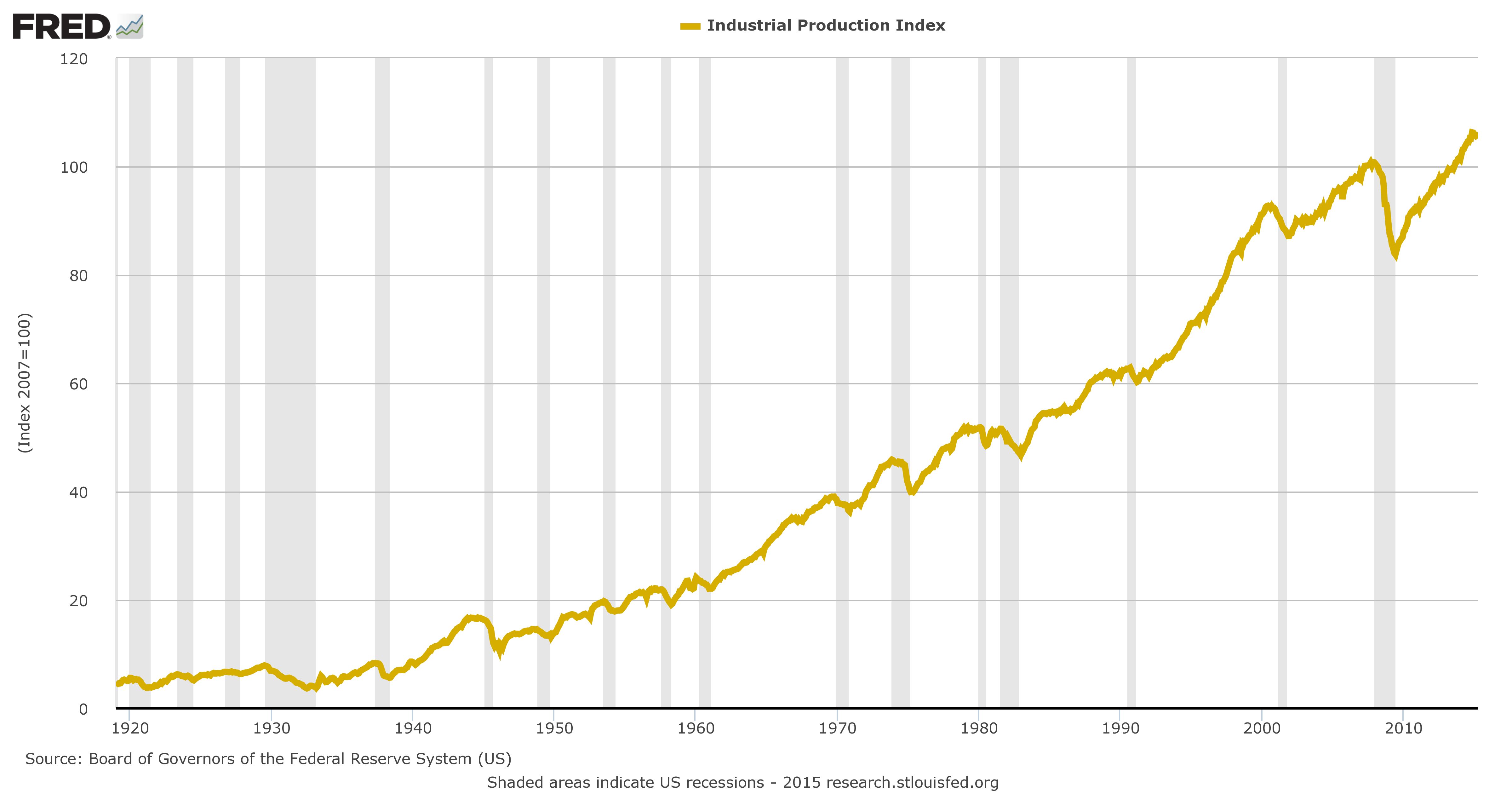
Matt Yglesias argues that this is exactly what workers have been doing, and that manufacturing, per say, hasn't really been in decline at all.  He points out that perception could be misguiding us because we tend to focus on all the consumer goods we say that don't say "made in America" on their tags.
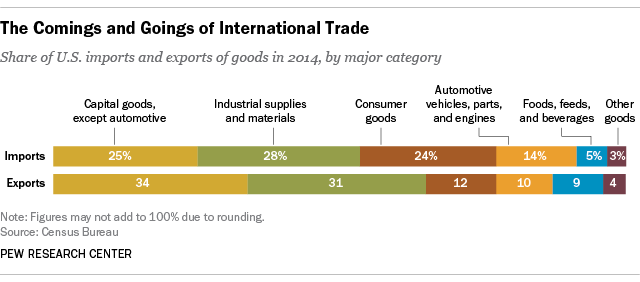
Consumer goods and cars are two big things people buy, and both of them are things the US imports more of than we export. 
Consumer goods and cars are two big things people buy, and both of them are things the US imports more of than we export.
Meanwhile, 65 percent of our exports are either capital goods or industrial supplies — in other words, machines and equipment that companies buy to conduct their businesses. Sometimes that's something like a computer that might also be sold to a consumer. But more typically we are talking about products that aren't sold in stores or marketed to normal people. You've probably never bought a Boeing 737, for example, and almost certainly never will. But airplanes are very expensive. The sale of a single new passenger jet contains as much value of industrial output as a truly tremendous pile of shoes or toys or other consumer goods.
He also provides a couple of interesting charts:

We don't seem to see here the kind of devastating losses we all imagine when we picture rusty, hollowed-out factories.

This one gets at a better picture of what we mean when we say "manufacturing" and talking about imports and exports.
I haven't been paying enough attention - but isn't Trump pretty anti-free trade, and is this just another thing conservatives are holding their noses from? Last I checked, conservatism was all about embracing creative destruction - halcyon me remembers well listening to AM conservative radio in the 90's telling displaced workers to get over it, quit bellyaching and get retrained.
However it seems progressives are the ones who've wanted to embrace a compassionate free-trade in which government tries to facilitate the retraining and support of the displaced. Trump I understand wants to keep the jobs from leaving simply through protectionism and tax breaks. Not sure this is a very accurate vision of how economic paradigm shifts actually occur - see: automation, AI, etc.  

Personally, I'm all for disruption. But I want to make sure people get the support they need in the process.  I'm reminded of the Oregon law that required gas be pumped by employees, not customers.  I found this idiotic, as someone perfectly capable of pumping gas myself.  As much as I sympathized with the poor sap pumping my gas getting employment, the sad reality is that he made a poverty wage doing a job that was unnecessary.  I would much prefer it if he had access to job training that would allow him to find long-term, useful employment.  Barring that, a government works program that provided a non-poverty wage doing something actually useful would be a good start.  Lord knows there was infrastructure in Portland that could have been serviced while I had nothing better to do than sit on my ass in my car for 5 minutes.

Of course, Trump, as a "conservative", wouldn't go for any of this.  It is much easier for him to simply punt to the notion of tax cuts solving everything.  But he appears to be in a bind here: he gets to sell himself as the avatar of the displaced working white man, and all the racial resentment he can squeeze out of that, but without being on the hook for any actual solutions.  

Sunday, October 16, 2016

Peering Into Our Machines

Would it be an overstatement to say that cellular biology is the most amazing thing in the universe?  It is the basis of all life.  Zoomed in.  Right down to the atomic level, where the elements are combining and recombining, swapping electrons, trading polarities.

I was fortunate to have been able to teach basic science at the high school level without any real university study.  I was able to brush up enough to pass the basic exams for credentialing.  I sometimes felt bit fraudulent - I really didn't have the proper training.  But they needed science teachers, and I was able to pass the basic requirements.

Science is like a giant puzzle - the chemistry, the physics, the biomes, the geology - it all fits together.  And you can always go deeper.  Centuries ago, a single individual could reasonably learn all there was to know about the natural world.  Yet today, our scientific knowledge has become so deep and specialized that no one could possibly hope to know everything even in one's own sub-sub discipline.

Even if I had majored in biology I don't think I would have gotten into anything very meaty until grad school.  Even then, I would only be scratching the surface of the cell.

Today I happened upon a field I honestly wasn't quite aware exited: biophysics.  As it's name implies, it is a field that seeks to bridge biology and physics, using our knowledge of both to better understand the fundamental processes and mechanics at work.

Something had always puzzled me about cellular mechanics is how in the heck we have actually made the discoveries that we have.   How did we learn the shape, structure, and operation of organelles like mitochondria, chloroplasts, or ribosomes?  How the heck were we able to determine how Rna transcription was taking place outside the nucleus?

I used to show my students the famous digitally animated animated short film "The Inner Life of the Cell", a collaboration between Xvivo studio and Harvard.  Created in 2006, it takes the viewer on an amazing tour of some of the basic operations of animal and plant cells.  The animators worked with scientists at Harvard's Molecular and Cellular Biology to create the most scientifically accurate representations possible - with the obvious concessions for things like clarity and illumination.  But allows one to visualize what it must be like to see all this stuff in action.

However, without a deeper understanding of the work involved, one's jaw is left on the floor, pondering how it is they could possibly know this stuff.  How is it that they discovered what kinesin proteins likely look like as they make their way down a microtubule, a giant vesicle in tow?

I know that these structures are incredibly tiny, and you simply can't see them at work.  Watson and Crick's discovery of the double helix only came after an analysis of Rosalin Franklin's resolution of DNA molecules through Xray crystallography.  Thats a far cry from what you can see being put forth in the film.

But like I said, I'm no expert.  I assume theres some kind of dyeing and chemical inference going on, all via very complex and painstaking analysis of extremely isolated samples.  But how exactly.  Would I never learn without attending a graduate seminar at university?

Thank to google, I came closer in my understanding tonight.  I found this article, part of a lecture on Molecular Machinery on the Institute of Physics website.  It's all rather complex and a bit much to try to go into here.  I encourage readers to check it out for themselves.  But I did enjoy mention of a particle of gold being used to demonstrate the process by which molecules can be transported throughout the cell.  One of the most astonishing portions of the Inner Life film is indeed that little protein that seems uncannily to be "walking" along a microtubule.  Well, this seems a good descrition of how they can show that process:
 The 40 nm gold bead scatters light very efficiently and the position of its centroid in a dark-field image can be fitted with nanometre resolution, even with frame rates close to 10 kHz. This small label exerts much less drag than the fluorescently labelled actin filaments (microns long) that were first used to prove that F1-ATPase is a rotary machine (see ‘Biological Energy’ Lecture 2). Combined with the fast video rates, this permits measurements with submillisecond time resolution that reveal substeps in the rotation of the stalk (rotor).

An illustration is helpfully provided.  As you can see, the gold bead is held in place, attached right to that little protein!  Marvelous!


So, it had been a while since I checked in to see what the Xvivo animation studio has been up to.  The Inner Cell was produced nearly ten years ago.  Both molecular biology and computer graphic design have surely improved greatly since then.  Boy, have they.   Their newer work is absolutely stunning.  I found this video of their work.
I'm especially impressed with the attempt to portray the stochaistic, or randomness with which the molecules bounce around against each other, jostling and jigging until their polarities match up and their function can begin.  I look forward to viewing more of their videos.  The future is just incredible.

Saturday, October 15, 2016

Conservatism's Odious Upper Lip

Japanese Farting Contest (c. 1700)
Fascinating article in Cracked, of all places.
The theme expresses itself in several ways -- primitive vs. advanced, tough vs. delicate, masculine vs. feminine, poor vs. rich, pure vs. decadent, traditional vs. weird. All of it is code for rural vs. urban. That tense divide between the two doesn't exist because of these movies, obviously. These movies used it as shorthand because the divide already existed.We country folk are programmed to hate the prissy elites. That brings us to Trump.
I'm not quite sure how to process it. My main pushback is that rural Trump supporters have been sold and bought into a narrative that pits them against cosmopolitan liberals, when the conflict largely isn't so meaningful: Mexican immigrants slaughtering meat and picking crops in your town, gay marriage, Muslims, atheism doesn't have to be a bad thing, unless you buy into an ideology in which it is. So, to what extent are rural anxieties born out of actual experiences, and to what extent are they the product of the embrace of an ideology designed to inflame these anxieties? Trump sells solutions tailor-made to fix fabricated issues. My guess is that most of the issues Trump supporters complain about have little to no actual impact on their day-to-day lives, and yet somehow believe they do. White, Christian heterosexual men are not under actual assault - merely maybe some of their assumptions about how they could treat others. Neither is Christmas. But there is a "sense" in which they are. What if they simply treated others - women, gays, immigrants, Muslims, with respect? Problem solved. Ironically, one of the issues du jour - "safe spaces", trigger warnings, PC - could as easily apply to these old chauvinist attitudes. When conservatives tell fainting lefties to "get over it", one might as easily return the phrase.

The salient point in the Cracked piece is how much rural America feels condescended to by the cosmopolitan.... I'm tempted to add "elite". But that is an adjective loaded with baggage from the resentment narrative. Are they actually "elite"?

Websters defines elite in a few ways:

  1. the best
  2. the socially superior part of society
  3. a group of persons who by virtue of position or education exercise much power or influence

This is obviously somewhat arbitrary - who decides what or who is superior?  There are indeed more elite members of society: journalists, academics, public speakers, media writers/creators, politicians. Historically this has been the city/townie schism.  

Rural resentment seems primarily motivated by civil rights resentments: religion, immigration, traditional sexual and gender roles.  Yet what is cast as a function of the elite telling urban liberals what to think, is as easily a function of the reverse.  One of the most striking elements of the gay rights triumph of the last decades has been how gays being "out" has simply shown the rest of us how normal and non-threatening in fact they are.  Larger cultural change in this way came not from the top-down but bottom up experiences in household across the nation.  The normalization of non-traditional sex roles and minority status is hardly different.  Institutional, constitutional reforms were vital -but one could argue they followed popular support as much as set popular opinion.

The use of the term "elite" signifies a power relationship in which the "non-elite" is being oppressed or disadvantaged.  As such, it is a morally righteous political attack.  It is certainly the case that there exists an urbane cultural and political elite who hold ideas that are threatening to the rural narrative of oppression.  However, it is not the elite who is doing the oppressing, but rather that larger cultural shifts that have occurred - with help from elite power,  but at least as much as the hearts and minds of individuals.  

When a rural white Christian male complains that people are speaking Spanish at the grocery store, that they can't mention Jesus in his son's homeroom, that his teacher is gay, that city-council members are openly atheist and women's basketball is being played at the boys and girls club, he is not being oppressed by elites.  He is being "oppressed" by the experiences of cosmopolitan gentry who have lived and worked with Mexicans, gays and atheists, and determined that they are deserving of respect and an equal place at the table.  

I place oppression in quotes because it isn't really oppression, is it.  Someone speaking spanish in line in front of you is not oppression.  However, if you have bought into a story that this is a bad thing,  then I could see how uncomfortable you might feel.  Yet the discomfort is of your own making.  If I decided that perfume and cologne smelled like farts, I suppose the environment might begin to feel quite toxic - oppressively so.  My that would be my problem.  

There's an old saying that expresses this quite nicely.  And it comes in language the emotionally and philosophically underdeveloped Trump supporter might understand:

He who smelt it, dealt it.  


Monday, October 10, 2016

The Dilema for Conservatives

Antoon Claeissens - The Judgement of Solomon (c.1536)

The election is so weird. I try to put myself in the shoes of reasonable conservatives. What if the Democrats had someone who was so ridiculous, but for all the character flaws (ego, racism, misogyny, ignorance, sadism) at least had a somewhat progressive agenda, while the opposition was going to cut taxes on the rich, appoint conservative justices, eviscerate regulations, etc.? Who would I choose?

It's so hard to separate the personal from the policy in Trump, as often his policy (mass deportation of illegal immigrants, intensifying torture, Muslim ban) directly evidences his character. What would a democratic party that elected such an asshole even look like?

This article runs commentary on the transcript of the debate. When you see his words in print, they come across as even more inane than when delivered from his beefy face, which we've all grown somewhat used to.

I suppose if ever there would be a time to "send a message" to my party, this would be it. But of course, the problem isn't "the party", it is the great masses of Republicans who want this sort of man to represent them.

I'm not sure how many people read this blog, but it would be interesting if any were conservatives who are sympathetic to the dilemma I've described. How would one go about separating out the agreeable policy in a candidate from the disagreeable policy - especially when it is backed up by an obviously vile character?

Saturday, October 8, 2016

Placing Privilege on Extinction

Hieronymus Bosch- The Seven Deadly Sins and the Four Last Things
- Anger (c.1450)
I recently argued that social and economic anxiety didn't explain as much of the current right-wing hatred of minorities and liberalism as the prevailing narrative would suggest. While sympathetic to real social changes providing fertile ground for hate to grow, I argued that extremism can become its own justifying, propellant force.
Victims of cults or domestic abuse may be more susceptible to begin with, but the intrinsic structure of thought becomes reinforcing.  Cult leaders and abusive spouses masterfully manipulate their victims, spinning reality so that 2 + 2 = 5.
However, Zach Beauchamp elaborates on the prevailing narrative of far-right populism being rooted in economic and social realities. In a piece in Vox, he describes a sort of controlled historical experiment that demonstrated his argument.

At the beginning of World War II, the small Baltic country of Lithuania saw two major shocks. First, in 1940, it was invaded and conquered by the Soviet Union. Just the next year, in June 1941, it was invaded and conquered by the Nazis.  In the city of Kaunas, the Nazi invasion triggered a spontaneous wave of attacks against Jewish residents, who had gained an unusual amount of power under the Soviets. The perpetrators weren’t the Nazis, who hadn’t had time to set up yet. It was the people of Kaunas themselves.  Prior to the Nazi invasion, Kaunas had a reputation for tolerance; one Jewish resident called it a "paradise." Yet afterward, the "tolerant" citizens of Kaunas tortured, humiliated, and slaughtered their Jewish neighbors. Roughly 3,800 Jews were murdered in just four days.
Just 65 miles away, in the capital of Vilnius, things were different. The city had seen pogroms in the past, so you would have expected something like the horrors of Kaunas. Yet the citizens of Vilnius mostly left the Jews alone. Why?
Indeed. Beauchamp points to an MIT researcher, Roger Petersen, who argued that this was explained not by an appeal to physical threat, nor "ancient hatreds", but rather by a sense of resentment of power dynamics.

In order to fully understand why ethnic violence happens, he argued, we need to appreciate the role of resentment: the feeling of injustice on the part of a privileged portion of society when it sees power slipping into the hands of a group that hadn't previously held it."  Apparently WW2 Lithuanians massacred Jews who had risen to power as communists under Soviet rule.  But are gays, Muslims, Hispanics and Blacks rising to power in the US?  Apart from exceptions it seems not to be the case.  I rather think the resentment is targeted at Liberals who would pave the way towards such thinking. 
This helped explain the puzzle of Kaunas and Vilnius. In Kaunas, the Soviet invasion in 1940 had politically empowered local Jews, who had occupied leadership positions in the Communist Party prior to the invasion and ended up with plum Soviet jobs as a result. This sparked intense feelings of resentment on the part of Kaunas residents, resulting in the vicious pogrom. In Vilnius, by contrast, non-Jewish ethnic Poles held most leadership positions. The Soviet invasion didn’t empower Jews on a large scale, and thus failed to create any resentment toward them.

Beauchamp goes on to argue that this sort of deep resentment is what is motivating current far-right populism.

I have no quarry with this assessment - as far as it goes.  There is certainly resentment at work.  But I question what kind of resentment it is, and whether it is based on any real changes in power dynamics.  

For instance, in Kaunas, plum jobs and actual power were being given to a distrusted, outsider minority.  But that is not happening in the United States.  Sure, a Black man is president, but he is far from representative.  Neither are women, or gays, or Mexican immigrants.  Washing dishes and mowing laws, or picking carrots are hardly "plum jobs" of power and authority.  

And yet these groups are resented.  But rather than actual power, what seems to be resented is the mere concept of power.  Immigrants are resented for "taking our jobs", yet this is largely low-skill labor, and must be weighed against the economic stimulus plenty of economists will argue immigration also provides.  Rather, much more of the resentment is based not in any physical threat, but abstract notions of "cultural invasion", in which Spanish translations are made available, Spanish is spoken in public, or simple Hispanic expressions of culture are cause for offense.  The resentment is the idea of Hispanic culture simply co-existing with Anglo culture.

This same resentment is expressed towards gay, black, feminist, atheist (humanist) or gender transgressive culture.  The resentment is less about physical threat to power and authority, as it had been perceived from Jews in Kaunas, and more about the mere idea of these groups being accepted, respected and having an equal right, or claim on cultural and institutional legitimacy.   The idea of homosexuality being viewed as legitimate is resented.  The idea of black language being used is resented.  The idea of women taking on male roles is resented.  

While the sentiment of resentment against all these groups may not be located in any real threat to power, it is located in political and cultural space.  The civil rights movement has been about toppling the notion that white, patriarchal, heterosexual Christian culture ought to be the default American perspective. A central moral claim of the movement is that as these other perspectives are just as valid, it is thus "politically correct" to take them into consideration when engaging in cultural behaviors and practices.  That is, there is a moral responsibility to do so.  Because the default has been to ignore or deny their validity, and to assume a traditional non-inclusive perspective, an active process of self-criticism must be constantly made in one's personal behavior to correct for this bias.

It is this criticism, this open dialogue of openness to the possibility that one's privilege is unwittingly supplanting or exploiting the lack of privilege of another, this expectation of self-criticism, that ultimately is resented most.  It is a form of moral embarrassment, in which one's concept of self as legitimate and righteous clashes against the accusation by others that one is acting arrogant , chauvinistic, or disrespectful of the feelings of others.  So many today swear up and down all day that they are not racist or sexist or homophobic.  And they honestly believe it.  But through their actions, they express implicit biases.  They make assumptions, create associations and hold values that demonstrate otherwise.   

Political correct criticism is the act of pointing this out, of making the case that one is engaging in behavior that is not aligned with commonly shared values of tolerance, patience, compassion and understanding.  The critique is an attempt to shorten the distance between the speaker and the subject offense, for sake of moral clarity.  For instance, a funny joke might be told that involves the death of a parent.  If one is entirely removed from this perspective, they might find it easy to laugh at the dark humor.  However, if the joke is told to someone whose parent has just died, the joke might not be so amusing.  The pointing out of this is an attempt to illustrate the conflict between shared values (the love of a parent) and behavior (making fun of a parent's death).  Now, these sort of social errors have always been common, and obvious.  We point them out to each other frequently.  When the mistake is unintentional, the gaffe can be chalked up to a brief lapse in judgment.

However, with larger social errors, the offense reflects not merely a momentary slip, but rather evidence that a person shows much greater, persistent ignorance of a historical phenomenon, and is willing to participate in its perpetuation.  This is not always an easy call, and many people are too quick to make such sweeping moral judgments when the behavior is not reflective of ignorance, but rather could be done with contextual knowledge, or in another such way as to demonstrate not ignorance but something else entirely.  I was recently personally involved in an exchange in which my constructive criticism of an article on white privilege (I argued that it was not going far enough into the mechanisms at work), was criticized by a person friend, and person of color for having the temerity to make the criticism to begin with, as a white male.  My sense of identity and values were definitely being placed on extinction.  I thought about the comments at length, and still believe they were unfair and inappropriate.  I felt neither the content of my critique, nor the format in which I made it were legitimately being impacted by my identity as a white male.   What my friend was essentially asking was for me to "check my privilege". Yet is any criticism by a white male (no matter how mild), an unacceptable form of privilege?  

Many people themselves who have been historically mistreated or otherwise marginalized will be the first to make "politically incorrect" statements in jest, during moments of levity.  "Gallows humor" describes the phenomenon of those on the front lines of truly terrible events finding humor as much to rekindle dimming spirits as anything else.  The question, "Too soon?" illustrates the grayish quality of the line between appropriately and inappropriately behaving in such a way as to not give proper seriousness to what was at one point a painful, traumatic event.  This type of judgment is also often doing extra work, so as to bluntly wield an easy moral bludgeon over those with whom one might wish to score cheap political points.  This gives the moral importance of true political correctness - of recognizing real power relationships in effect and actuated in social behavior - a bad reputation and is counterproductive to real social change.

Yet though this type of poor judgment can be indulged in too easily, proper, "correct" socio-political criticism is always necessary.  Power differentials between man are central to our species' continue struggles for equality and freedom.

Political Correctness and the Behavioral Concept of a Stimulus Prompt
In behavioral science terms, this would be known as a stimulus prompt.  Just as a visual prompt serves to correct negative behaviors by signalling the appropriate behavior in public areas, this prompt serves as a conditioned stimulus to correct behaviors in private.  So, for instance, the "wash hands" sign in public restrooms is a conditioned stimulus that prompts us to remember to use proper hygiene after using the bathroom.  We have many "little voices" in our head that have also become conditioned through reinforcement to prompt us to engage in appropriate verbal behavior.  Even though I may find someone's style of dress unattractive, I do not say so out loud because I have been conditioned that this behavior is impolite.  Obviously, social behaviors are highly arbitrary and subjective to different cultures.  However, they have their own logic based on what has been reinforced as acceptable.  If I tell someone they look ugly, this verbal behavior will be punished by our culture.  Likewise a nearly infinite number of responses has been reinforced and punished, establishing in me a repertoire of social behaviors.

The line between what is and is not conscious in this process has to do with my behavior of reflection, or "thinking" about certain stimuli and responses.  Children are taught "strategies" to solve problems.  This amounts to a set of verbal instructions that, through reinforcement, will then be evoked in them when certain stimuli are present.  For instance, when the figures 3+ 3 = are written on the board, the behavior of looking and counting fingers is reinforced so that in the presence of similar number patterns, they can use this type of motor prompt behavior to help derive the solution to addition problems.  As their adding repertoire becomes stronger, this prompt can fade from a motor behavior to a silent "private event" verbal behavior, taking the form of imagining one's fingers.  Eventually, the prompt fades completely as it is no longer necessary and reinforcement for the correct answer is encountered without having ever using the prompt, and it disappears from use (or technically, goes "extinct").

Stimulus Prompts
Of course, many types of prompts are useful in our daily lives.  Many of them are outside of us, and physical, such as written language, signage, taps on the shoulder, railings, lines, etc.  We have just as many within our own skin and metaphysical: counting and echoically repeating phrases to memory are both very common.  Sometimes these private events become public, as when we can be heard muttering a prompt to ourselves, "where did I put that envelope" is a type of prompt we have learned to repeat to help in locating items such as envelopes or car keys.  They have been reinforced in the past when such an utterance has "triggered", or become the stimulus that evokes the behavior of remembering items we were motivated to find.  There is generally no need to be conscious that we are using these prompts.  We have more important things to concern ourselves with.  But sometimes our prompts can be faulty.  We frequently discover that our "thinking" on a particular subject had been flawed.  Recently, I began keeping a particular bowl in a different cabinet.  For weeks, whenever I was motivated to find that bowl, I looked in the location that I had previously found it in, and had been a stimulus that had reinforced my looking in that particular location.  Over multiple opportunities, when I looked in the old location, and was met with an empty cabinet, my behavior was not reinforced, but rather placed on extinction.  However, this became a prompt to look in the new location, and the behavior of looking there was reinforced when I found the bowl.  I now do nothing else.

When your uncle makes a racist joke and no one laughs, he is not getting the reinforcement he once had when he first heard the joke, among his racist friends who first told it to him.  Furthermore, he may be actively punished for telling the joke by frowns or specific verbal behavior such as rebukes.  A common "side-effect" of punishment is what we would consider negative behavior: anger/ resentment/ retaliation.  This "negative" behavior can actually be quite effective for the behaver.  If your uncle gets what he wants by angry outbursts, they will be reinforced, and he will continue engaging in them in the future.  On a societal level, this process of avoiding being "put on extinction", and having one's behavior reinforced, is what drives people to spend time with like-minded others, forming cultural groups.  Political correctness is rooted in the understanding that a class of people's civil rights have historically been privileged, and in order to guarantee an equality of civil rights to all, that previous verbal behavior need be changed.  However, even as many laws have been changed, and institutional practices have been altered, privilege still exists.  In social exchanges, verbal prompts have been established to place certain behaviors on extinction and to reinforce others.  

Privilege as Stimuli
Many members of the privileged group however, resent and are angry about the concept of political correctness.  This is a natural result of being placed on extinction.  They had previously been reinforced for reacting to stimuli from a privileged perspective, and now that reinforcement is being withheld.  This can present a tricky dilemma for social interactions.  In the example of the joke about a dead parent, the context is crucial.  It would be disrespectful to make light of someone's recent trauma, yet maybe after many years or if no one is present who has experienced the trauma, it might be perfectly fine.  The stimulus relations in these two cases are different.  Similarly, the stimulus relations for someone with a history as a member of a privileged class are going to be different than a member of that class.  Political correctness might be thought of as this individual example of an awkward reckoning of stimulus relations being played out on a societal scale.  

However, this says nothing about whether the feelings are legitimate; anger is of course often quite justified.  When one's privilege is challenged, anger and resentment are natural responses.  The question is whether the challenge was justified.  If one makes a racist joke and is offending another, who is experiencing a sort of dehumanization, or exclusion, one is at some level violating their civil rights - their right to be treated fairly and respectfully.  This might be contrasted with a joke told "in good fun" in which both parties are willing and understanding of each other's shared humanity, friendship, good-will, etc.  No civil rights in any sense are being violated.  

But in this case, if the critique is correct, if civil rights are being violated, if people are being ignored, excluded, exploited or otherwise marginalized, especially as part of a larger history of societal exclusion in which the privileged party has been reinforced for behaving in ways which contribute to this process, then the anger is not justified.  The behavior (or "response") had been socially inappropriate.  That is, it conflicted with our larger values.  It had been reinforced by a cultural space in which it was OK to assume that white, patriarchal, Christian cultural norms were supposed to be the default, and other perspectives were inferior.  Yet if we respect the rights of women, of people to be who they were born to be, of people to retain their cultural heritage in a diverse society, then this behavior ought not be reinforced, but placed on extinction.  

Throwing Tantrums
A tantrum is a common set of behaviors often involving anger/ resentment/ retaliation and seen when one has been placed on extinction, having had their previous reinforcements removed.   If you add up all of the ways in which privilege has been reinforced in a certain class of individuals, there is a considerable amount of behavior that political correctness is essentially attempting to place on extinction.  People who have lived their lives in an environment in which privileged behavior for years has been reinforced by popular culture, churches, mass marketing advertising campaigns and partisan media outlets, will no doubt experience a great deal of discomfort might this reinforcement be revoked.

Like the Vilniusians, the nationalist far-right are brimming with resentment.  However, unlike the Vilnusians, the targets of far-right resentment - the gays, immigrants, feminists and the like - have not taken away their positions of real power and authority.  Rather, all that has been asked of them, the privileged,  is that they allow that they no longer be considered the "default" setting in American social, cultural, and institutional life.  They have been asked to make room and share with others.  This has always been difficult for Americans, and is part of the core of the civil rights narrative: learning to share and express humility.  From slavery, to native peoples, to segregation, to feminism, to the disabled, to gay and transgender rights, the aim is simply to acknowledge that everyone has a right to sit at the table and be respected.

The effect of this questioning the default narrative - the electing of a Black president, the presence of illegal immigrant workers, gay marriage, minorities on television, installation of wheelchair ramps outside businesses - has not had a negative impact on real white, patriarchal Christian freedom and dignity.  It has merely rolled-back some of the unequal, out-sized privilege it had enjoyed.

What it has done, however, is to place countless stimulus prompts in places in which previously there were none.  Whether as physical prompts - seeing minority presence in the media and in places of authority, or as verbal prompts - hearing voices speaking out in critique of privileged narratives, new, appropriate behaviors will hopefully continue to replace the previously maladaptive behavior which runs counter to our core values.

In behavior science, there is a phenomenon known as the "extinction burst".  This describes what frequently happens when a previously reinforced behavior gets placed on extinction.  Kicking a soda machine when it fails to give you your soda when you press the button.  Yelling at your car when it runs out of gas.  A child screaming when it doesn't get to watch its favorite show on TV.  All are examples of an extinction burst.  It is tempting to view this far-right nationalist behavior as part of an extinction burst at the societal level.  The term "burst" refers both to a sudden uptick in severity/frequency of the behavior, as well as a sudden decline when plotted on a graph.  After the extinction burst, if reinforcement is continued to be withheld, the behavior will eventually decrease and ultimately stop completely.  However, if behaviors are reinforced, even intermittently, they will continue.

The question for us is one all behavior analysts must first address: what is the function of the behavior, i.e. what is reinforcing it, causing it to continue?  In the absence of an actual threat to the behavior of the privileged, what is reinforcing it?  Right-wing media narratives, especially when taking place in a proverbial echo-chamber, reinforce listening behavior and the adherence to rules regarding assumptions about the marginalized, as well as those who might defend them.  Indeed, if there were any group the far-right nationalists might be thought to despise more than the non-white, it would be the left-wing progressives with whom they are in metaphysical conflict.  Much of the verbal narrative of the right is spent organizing rules about the left in order to inoculate themselves from criticism that might come from those quarters, and interfere with their intra-group reinforcement.



Friday, October 7, 2016

Poverties

Is this lede tactic getting tired:

"I really like X, but......."

Hey - It's the way my brain operates.  OK.  I'll try something different....

Talking about socio-economics is tricky.  Because the subject usually comes up as a result of some other context, we tend to use off-hand catch-alls like "disadvantaged", or "poor".  But these are incredibly blunt tools, and can easily be misinterpreted.

Take for example, "he grew up poor, but found a way to reach his goals."  The word "poor" is doing a ton of work here.  Depending on the case, it could mean a lot of things apart from mere financial poverty.  It could also mean an unsafe neighborhood, a single-parent home, a low-scoring school, a polluted neighborhood, parents who didn't read to him, parents who were abusive, family members on drugs, negative peer influences, etc.  All of these are environmental risk-factors that are associated with poverty.  When we say "grew up poor", any or none of them could be included.  Maybe his parents were loving, nurturing, well-educated, and lived in a relatively safe neighborhood, and sent him to a school with other high-achieving children.  Or maybe not.

Yet how often do we hear poverty spoken of in purely financial terms?  The difference between someone in the former situation and someone in the latter is vastly different.  You put a hundred kids in the first, and a hundred kids in the second, and guess how they'll turn out on average.

The reality of socio-economics is that there are a whole bunch of factors involved, some more harmful or beneficial than others, and depending on how they interact.  Often times, a child will grow up with a host of serious socio-economic risk-factors, yet will turn out quite well due to some key privileges he enjoyed: having a grandmother who was able to support him, having a teacher he connected to, living on a certain street instead of the one a block over.

The contingencies are myriad.

And so I saw this on facebook today.  It was a post by Lin Manuel-Miranda:


Apparently one of his first jobs was McDonalds.  Now, to be charitable, he did work there, and it's a completely low-rung job, and now he has an award-winning musical.  But lest anyone forget for a damned second, there is working at McDonalds, and there is working at McDonalds.  Most McDonalds employees have little education, and grew up poor.  Most will stay uneducated, and stay in poverty.


This verb finds itself at the intersection between the two types of poverty mentioned early.  One type of poverty is like lying at the bottom of a cold dark ocean.  The other is sitting in a dingy just off shore, ones tiny hands on the oars.

From Wikipedia:

His father is a former political advisor who advised New York City mayor Ed Koch, and his mother is a clinical psychologist.  His father is a former political advisor who advised New York City mayor Ed Koch, and his mother is a clinical psychologist….After graduating from Hunter College Elementary School and Hunter College High School, Miranda went on to attend Wesleyan University.


Tuesday, October 4, 2016

Teachers in the Hood

Peter Moskos, who writes the blog "Cop In the Hood", is a former Baltimore police office who teaches in the department of law, political science and criminal justice at CUNY, has an excellent piece in which he argues that we should be more worried about the crime rate.  He goes into some political details, points out why some on the left and right might be trying to spin it.  But what really impressed me was how he brought his own experiences to bear on the subject.

Among academics, it's quite uncool to blame criminals for crime or give police credit for crime prevention. But then how many statisticians who use the UCR Homicide Supplement can point to a specific row and say, "Yeah, I handled that one.".... How many Harvard PhD students have the intimate experience of sorted through a victims' clothes? Clothes that are literally dripping with blood and yet still reeking of body odor. You're trying to go through everything, looking for pockets, for any sign of identification of the life that used to be. And then there are the death notifications.
The piece is dripping with the kind of heartfelt, front-line experience that is crucial to our understanding of the intersection between poverty/race/violence/etc. and our public debate.  I was a teacher for years at poor schools, and this was exactly how I felt when I heard the education "conversation".  It was always missing the kind of nuanced picture of what life is actually like for the families and teachers who actually worked together day in and day out.

I ended up leaving, and am now a behavioral analyst working with many of the same populations (yet with a vastly more effective set of interventions, but that's another story).  I left teaching disillusioned and frustrated.  In the liberal studies courses I had taken I had been led to believe that a good, loving, non-prejudiced teacher with high expectations was all that was needed to turn these kid's lives around - Stand and Deliver was so inspiring!  The only real problem was racism and teachers who didn't care!  Yet the reality is so much more complex.  The disadvantage in the lives of vast numbers of kids leave them with severe cognitive and emotional - not to mention academic -  deficits that grade-level placement in standard coursework becomes increasingly absurd.  And in a classroom of 30 kids, the majority of whom have little regard for a grade, refuse to do homework, and calls home are received by parents who have zero control over their children, the situation is a recipe for failure for all but the most miraculous of teachers.  These students have already been removed from the upper-level courses (those, by the way, that Escalante taught), and generally get warehoused in the lower-levels.

When a kid curses at the teacher, hits or pushes another student, throws things at them, or consistently disrupts class, there must be consequences, and repeated consequences must increase in severity.  These students, by definition, are the most disadvantaged students: this behavior is a result of their environments.  And they are far more likely to be poor and minority.  Yet what you hear in the public conversation is that either the teachers are biased and picking on  minorities (the left), or that minorities have gotten themselves into this bad situation and need to get themselves out without intervention (the right).

There is an element of truth to both of these perspectives.  In all honestly, towards the end I did find myself almost expecting minority students to be more likely to cause trouble - I did my best to check this regularly, many teachers would not.  But both perspectives miss the larger social picture, which isn't about blame, but about what are the actual causes of the problems, and at least point us to what interventions might be appropriate.

I won't pretend that simply being there on the front lines: that working and talking to the families and kids on a daily basis is somehow enough for one to understand the problem.  It probably is as likely to lead you draw incorrect conclusions.  But it is however, essential to the discourse.  When we talk about schools, teachers and kids, we need to have an intimate understanding of what these relationships look like.  They will both disabuse us of faulty assumptions, as well as grant us special insights into the particular difficulties these complex social relationships present.

So my point is not that the problem is hopeless.  I have plenty of ideas about what we can do.  But rather, that the "conversation" we have is abstracted, removed from the front lines, and burdened by theoretical and ideological baggage that is insulated from reality.

This post illustrates this phenomenon beautifully.  Not in education, but in policing, where a larger "conversation" is also occurring, yet which too often feels like it is only coming from a ridiculous pro-police versus anti-police perspective, where there are only good guys versus bad-guys.  The reality is that there are only people doing what they know how to do.  There are innocent minorities being unfairly treated, as well as those who are acting poorly and need to be dealt with in an aggressive manner.  There are police who are being prudent, there are police who are being hot-headed and callous.  There is also a larger system in which babies are born into extreme disadvantage, and will grow up to act terribly.  We as  a society need to find a way to deal with them respectfully but firmly, all the while searching for ways to improve our system so that more babies aren't disadvantaged, and so fewer police will be required to navigate such dysfunctional communities.

Ultimately, what saddens me most is also what comes across in Moskos' piece: when we fail to properly identify the problem, we are failing the actual victims.  In his case, the victims of crime, or in my case, the students themselves.  But the victims are also all of those affected by dysfunctional behavior - from those whose lives they burden, to the perpetrators themselves who could have been more.