Thursday, September 20, 2012

Fear-Based Instruction

As I drove to work yesterday morning, NPR graced my ears with a story about improving education through - what else? - improving teacher quality.  This time it was a "fascinating" study by Chicago economists who found that something called "loss aversion" was highly effective in improving student test scores.  Basically, the idea was to offer teachers $4000 in cash up front, if they promised to return the money if their student's scores didn't improve significantly.  Compared to the control group, the author of the study said scores improved dramatically.
"What we found is strong evidence in favor of loss aversion," he said. "Teachers who were paid in advance and [were] asked to give the money back if their students did not perform — their [students'] test scores were actually out of the roof: two to three times higher than the gains of the teachers in the traditional bonus group."
Yowza.  According to this fascinating piece by Cass Sunstein, my bias against teacher reform has me pulling only the things I want to hear, or the fact that fit with my pre-conceptions out of the story. Thus, I do indeed find the story appalling, and am thus frantically searching my brain for how this story might turn out to be false.  Because, after all, it seems to show that teachers are actually dramatically underperforming, and apparently simply out of lack of motivation.

OK, so wait a minute.  Teaching is one of the hardest jobs out there.  You have to be incredibly motivated to put up with it to begin with.  I have 120 students, half of whom are so-called "reluctant learners", which means if I don't literally walk around and constantly remind them to take their notes, they won't, and thereby failing my class.

And the study apparently found that promises of performance rewards had little effect on test scores, i.e. teaching.  But gains two to three times higher?  Without seeing the actual study (I have to get to work!), I'll allow myself to remain agnostic.

But regardless, what really got me in the piece was the concept of "loss aversion", which is a fancy way of describing something all teachers have come to understand about what teacher reform is all about: fear.  This study is essentially saying that when teachers fear losing compensation, they teach better, leading to better scores for their kids.  More fear = better results. 

Really?  Given the insanity of modern day teaching, how incredibly inequitable it is as a profession, in terms of the job at "good" schools being exponentially easier than that at "poor" schools, and the amount of pressure teachers are under at any given second of the day, a study points to the efficacy of more fear?

And let's be clear about what the mechanism of fear really means.  A teacher consciously, or unconsciously, when teaching, hears a little voice in her head that says, you're going to lose money if you don't get this right.  It's not an externally transmitted physical pain, like an electric shock, but it is pain nonetheless.  And it is a pain that lingers, a kind of emotional anguish.  "Am I doing a good enough job?  Was that lesson good enough?  Oh, I hope they pay attention."  And considering the myriad factors in a child's education that are completely beyond a teacher's control - did the child get yelled at this morning and is now in a foul mood, is the child nervous about neighborhood bullies, does he or she have a mental block or emotional issues? - the fear ends up bleeding into a generalized anxiety that keeps many a teacher up at night.

Wait a second.  That kind of fear is already there, with or without the reward.  Teachers fear that their students aren't going to be successful on a daily basis.  At least I do.  In fact, for my mental sanity, the less I worry about my students, the better I am able to be objective and focus on what really matters - planning good lessons, being prepared and organized, getting good sleep. 

So, I'm supposed to buy the notion that aside from all my sacrifices I make on a daily basis to meet the needs as best as I can with my 120 students, each of them with different specific needs, that the introduction of even more fear is supposedly going to make me a better teacher.

Hmmm.


Monday, September 17, 2012

More Excuses...

This weekend on Up with Chris Hayes, guest host Sam Seder made some brilliant points, along with his panel, addressing some of the "reform" points being made by the neo-liberal on the panel.  ("Neo-liberal" is a term I sometimes use on this blog, and what I basically mean by it is that it pretends that through specific, technocratic adjustments, we can transcend larger structural problems with capitalism that conspire to create fundamental problems of poverty and inequality in the first place.  For example, not every child is going to go to college because our economy relies upon a vast underclass making poverty wages).

This morning the NY Times (ever the neo-liberal paper of record)  this morning argues that reform of teacher evaluations is fundamental to helping poor kids, and assumes unions as the culprit in ultimately perpetuating failing schools.
That teachers’ unions in much of the country now agree that student achievement should count in evaluations at all reflects a major change from the past, when it was often argued that teaching was an “art” that could not be rigorously evaluated or, even more outrageously, that teachers should not be held accountable for student progress.
The problem is actually getting good data on student achievement. State tests give you terrible data for a variety of reasons, ultimately telling you very mixed stories about the actual effect of the teaching in the class. A quality administrator, given a proper amount of time, could look at what students are actually doing in the classroom and tell rather quickly how effective a teacher is. That so many teachers are given high rating by administrators says more about administration policy than teaching (except that so many teachers out there are doing a brilliant job in the face of terrible odds).

In the end, the push for data is driven by the notion that poor kids are being taught well enough by teachers. Yet this is often like squeezing blood from stone: parent background, etc. account overwhelmingly for student achievement, with good teaching making up a small portion of the margin.

Dealing with issues outside the classroom, by rearranging the classroom model itself - smaller classes, more aids, more counselors, etc. - are completely missing from the "reform" agenda, which primarily emphasizes accountability, testing, charters, union-busting and ending tenure.

But again, we aren't even begining to have that conversation.  When it is brought up, teachers are accused of making excuses.  Yet if teachers - the ones on the front lines every single day - feel this is the real need, what students need to be successful, who is really making excuses?


Monday, September 3, 2012

False Enlightenment

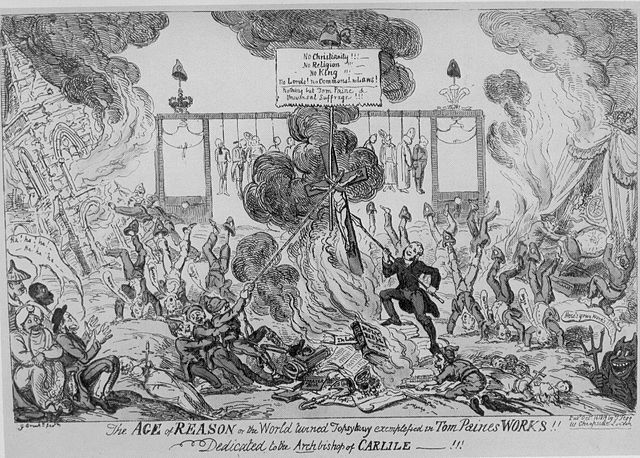
The Age of Reason, Cruikshank (1819)
Jonathan Zasloff reminds us that the GOP wants to return to a time much further back in history than the halcyon days of black and white television and Leave It To Beaver.  He has in mind the days of Social Darwinism and, even further, pre-Enlightenment.
....what the Republicans want on economics is the century before last, the 19th, when Social Darwinism flourished.  And what they want on social issues is the 17th, when theocracy was the order of the day.

I'm not so sure.  Is not enlightenment widely seen as the ultimate manifestation of the concept of free will and the self-made man, through reason arriving as the sole controller of his own fate?  Within an environment of limited government that confines itself to the rule of law and leaves markets alone, the classical liberal interpretation sees the enlightened man as achieving his greatest potential. 

I've heard more than one conservative praise the notion of Social Darwinism.  I highly doubt these folks had spent much time considering the term.  But the instinct to embrace a concept is telling.  Some may quietly embrace a cryptic racialism, or a sense that successful people have better genes.  But embrace of meritocracy is also widely valued.  And it trades in similar assumptions.  The more generous conservative avoids biological explanations.  He instead embraces an immaterial, unexplainable - almost magical - notion of "initiative", that arises not from prior structural development (either genetic or social), but rather believing such a thing to be entirely the product of the universal capacity for enlightened man to create his own destiny, available to him at any second were he only to "choose" it.

The fact is that there is zero evidence for any such capacity in man; all evidence points to initiative being the sole product of structural development, and thus forces apart from one's control.  However, due to this fact being both uncomfortable and seemingly counter-intuitive, we tend to cling to the notion of ourselves as free agents.  Nowhere more so than in the current republican slogan, "We Built It".  While purposely taken out of context, as a response to a Democratic president's emphasis on structural development as opposed to personal initiative, the slogan powerfully illustrates underlying intuitions about popular conception of agency, and the ramifications for social and economic justice. 

While most Democrats likely also embrace the myth of personal initiative, they intuitively understand how important a role larger determinative factors are in its development.  In many ways, the Republican and Democratic parties represent the interests of the haves vs. the interests of the have-nots, respectively.  Whether by race, gender, ethnicity, family education, wealth, or sexual identity, one party emphasizes the import of structural egalitarianism.  The other denies that structure (genes or socialization) have much to do with one's agency; failure and success are the result of a personal initiative located apart from any constraints.  To the extent that the Republican party views initiative as constrained by social institutions, the constraint is merely due to there being a sub-optimal choice on offer that crowds out that which is correct.  At no point, however, is the correct choice not on offer.  In the end, the individual could *always* have avoided the sub-optimal choice.  Again, this assumption rests on the notion of an immaterial, unexplainable source of agency for which there is zero evidence, as opposed to the endless supply of evidence for agency as solely determined by structural sources.

Sunday, August 19, 2012

Questions for Frank Bruni

Frank Bruni dips his little toe into the debate of education reform today, spurred to write after previewing the new film, Won't Back Down, starring Maggie Gyllenhaal as a parent struggling to reform her child's poorly performing public school.  Bruni compares her to Erin Brokovich, with the role of evil, polluting corporation being played assumedly by evil, child-oppressing unions.  To my knowledge, the screenplay was not written by the late Ayn Rand.  Actually, according to Tim Walker at the NEA,
“Won’t Back Down” is funded in large part by Walden Media, the same company that bankrolled  “Waiting for Superman.” Walden Media is owned by Philip Anschutz, a right-wing billionaire who has a long history of supporting right-wing politicians and causes."
Bruni's meandering, naive attempt at objectivity references AFT leader Randi Weingarten and anti-Reform crusader Diane Ravitch.  However it is clear that he is in over his head, and ends by embracing his intuitions about Reform:
"....superior teaching, the need to foster more of it and the importance of school accountability. Who could quibble with any of that?"
Who indeed?  Except that this feeble straw man avoids all the difficult issues involved, and panders to meaningless hubris.

It’s always hard to know where to begin when responding to people who clearly don't grasp the fundamental issues in a debate.  The layers of flawed assumptions just seem to pile up, one on top of another. Much of Bruni's thinking is tautological, finding facts to fit his preconceptions.  So maybe the best place to start is simply to ask a series of questions designed to challenge his assumptions.

I've spent plenty of time on this blog going into great detail on all of this.  So I won't bother repeating myself (although that rarely seems to stop me).  But here are a few:

  • Why are poor parents at poor schools?
  • What makes a school poor?
  • Is it fair for poor parents to go to a school that is poor?
  • Is it fair for poor parents to live in poor neighborhoods?
  • Is it fair for poor parents to be poor?
  • Is it fair for us to consume goods and services that pay poverty wages?
  • Are accountability and better teaching going to solve these issues?
Everyone interested in the debate over education reform should think long and hard about each of these.  Hopefully, then they might have something worthwhile to say.

Friday, August 17, 2012

Moral Responsibilty vs. Moral Accountability

Stephen Horst gives a summary of his new book, Freedom and the Laws of Nature, which seems an exceedingly long wind up to a rather silly argument.  Claiming to pick no bone with determinist account of the universe, or human agency specifically, he instead merely wants to argue for the possibility of contra-causal, or libertarian free will.  In the main he seems to be claiming that an empirical view of a materialist universe is always limited to the laws we are aware of, and thus with a subject as difficult as the human mind, there indeed might be some as yet hidden explanation for free will.  Unless I mistake his case, it seems a bit like the "God of the gaps" argument, which, unable to show evidence for God whatsoever, endlessly seeks to allow for him wherever He might be imagined to be? Yet even worse, the "gaps" Horst finds are nothing less than the possible existence of laws yet undiscovered that would make free will possible. Could I say that the invisible unicorn beside me (which I just *know* is there) could well exist according to some yet unknown law - maybe of, say, unicornity?

But while I find that thesis boring, I found what he mentioned in passing, the discussion of free will with relation to moral responsibility, an important issue to parse. 
Since the time of Laplace, the idea that a law-governed universe must also be a deterministic universe has become a fairly common assumption; and as a result, free will and all that depends upon it have often fallen into doubt and disrepute. And chief among the things that seem to depend upon free will is the possibility of moral responsibility. It seems misguided, perhaps even nonsensical, to praise or blame people for doing things they could not help doing. And some have argued, in a similar vein, that one cannot have a duty to do something unless one is actually capable of doing it: in the words of Laplace's German contemporary, the philosopher Immanuel Kant, "'ought' implies 'can'". If this is correct - if ethical notions like duty and responsibility make sense only if there is free will - then determinism would imply that all such ethical talk is literally nonsense.

Destruction of moral responsibility is often the primary issue defenders of libertarian free will have with determinism; they fear that without it, society would crumble. If one is not accountable for their actions – either to be praised or blamed, then what basis do we have for a cooperative society of laws?  However, moral responsibility is different than moral accountability.  While it may be true that no one is truly responsible for their actions, we can certainly make sure that they are accountable to the extent that we determine is fair.
The idea of people acting with no sense of moral responsibility is an understandable fear.  But its answer I think is found in the resolution of an even deeper problem: if I am fully caused, and neither to be praised or blamed, what is the purpose of my existence; what sense is there in doing anything, either good or evil?

The bad news is that there is no ultimate sense in doing either.  The good news is that one has no choice.  Any choice one makes will have been caused.  So for those who think that the end of personal responsibility means the granting of freedom to do whatever one wishes, the reasons for doing so remain the same.  Refusing to go to work still means one will get fired and end up penniless.  Stealing from a neighbor will still cause them to suffer.  Climbing Mt. Everest will still fill one with the sense of awe and sense of accomplishment.  Being kind and loving to one’s family will fill them with joy.
So while none of these acts may have special cosmic significance, we can take comfort in the fact that we are in the end, simple human creatures, evolved to take certain pleasures in our worldly endeavors.  We might curse the limitation of our corporeal forms, but somewhat paradoxically, that curse itself is merely a product of circumstance; it too is fully caused.

But let us take a deeper look at causation, specifically that of morality.  The fear of the destruction of moral responsibility is a social claim.  That is, it has to do with the interaction of individuals within society.  The moral responsibility of a man on a desert island is irrelevant.  It is only when he comes into contact with others that moral claims begin.  His responsibilities lie in the dynamics of his relationship to others.  He has feelings towards them, and they him, regarding the effects of their respective actions.    
Moral responsibility is compatible with determinism if we think of it in this macro, societal sense, and place it within a utilitarian framework.  That is, we can say no one is himself responsible, but rather the norms and values society has designed for them to live by, which have emerged from the wisdom of history, define his responsibility. 

Through the centuries and millennia, humans have evolved complex cultural and philosophical norms so as to structure our societies with no greater aim than to maximize individual and group harmony.  Of course there have been great failures, and nothing like complete success has ever been achieved.  Each of us play our small part, and – like Adam Smith’s invisible hand – the group project steadily emerges.  All of it terrifically complex in largely incomprehensible, one man can neither understand all of it not affect all of it.  In this way, it is like the individual: terrifically complex, he neither understands himself entirely, nor affects the entirety of his own choices.  And just as society cannot be said to have free will, that is to say it is determined by and emerges from its antecedent participants (philosophers, politicians, journalists, public, etc.), so too is the individual determined by and emergent from his antecedent causes (thoughts, feelings, impulses, etc.).

And just as a society cannot choose to be anything other than what it is at any given moment, neither can man. If a fascist dictator comes to power, it will be because of specific historical and cultural circumstance.  Sure, an alternative course would have been preferable, but alas, it was not to be.  Thankfully, our human capacity of reflection provides some ability to learn from our mistakes.  This cognitive power is the mechanism by which humanity slowly provides itself an opportunity for moral responsibility, or, what might be better described as moral accountability.  Interaction on a global scale, over decades and centuries, we have the opportunity to right historical wrongs, thus holding ourselves accountable for what we hope will be a system of laws and political structures more conducive to what we perceive as having been lacking in the past.

So too, if no individual is truly morally responsible for his acts, himself a conglomeration of antecedent impulses, he will be held accountable for his actions to the extent that they interact with his fellow man.  Because of power dynamics, he may be more or less accountable (the dictator, for instance, or powerful boss, might have few around to hold him to sufficient account for what they feel he has done).  And here, social institutions provide the direct framework within which power dynamics are established.  Aside from whatever the individual’s personal sense of moral responsibility to his fellow man might be, his fellow man will have an opportunity to hold him accountable according to the structures that have been established in the society within which they interact.

When wildfires rage, they often do great damage to homes.  Of course, we do not for a second think that a lick of flame is morally responsible.  Yet neither do we allow the fires to rage unchecked.  We put them out as best we can.  We also take preventative measures, so as to reduce the possibility that wildfires will rage to begin with.  We do the same with our children.  Whether we see in them moral responsibility or not, we teach them to be caring, thoughtful and kind, hopefully so that they will grow up to be positive, productive members of society.  When they err, we hold them accountable, regardless of how they felt about their actions.  Some of us might feel the need to sate an appetite for revenge, and include that satiation in their desire for accountability.  But in the end, all that matters is that they be held accountable.  We want their actions to have consequences, regardless of what may or may not be in their heads, unless it might have bearing on the degree to which we feel they might act in the future, at which point its bearing only enters with regard to a more clear picture of accountability.

Tuesday, August 14, 2012

Dog Men

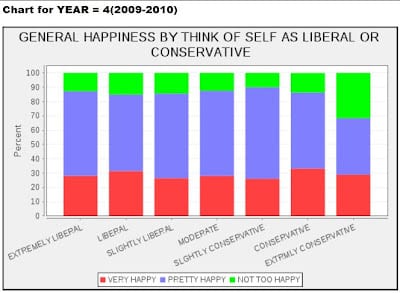
Andrew Gelman points to findings from sociologist Jay Livingston that, contrary to recent news, partisan Tea Partiers aren't actually all that that happy.


When I was younger, I used to listen to a lot of AM radio conservatives for the thrill.  What struck me more than anything, aside form the mendacity and childishness, was the constant sense of outrage and anger at the smallest things.  "Road rage" was all the talk then, but these people seemed in the grips of a sort of "life rage".   Resentments were directed at every little inconvenience in life.  From video store clerks, to bicyclists, to ATM machines, to women with "clipped hair", their ire extended even beyond things that actually affected their life in any way, to the mere presence of people who were different from them.  All of it, however, was an affront.

Much of this was group kvetching, no doubt.  One wonders how many of these people sustain such levels of anger and intolerance on a daily basis.  Yet I've met more than one person who seems perpetually pissed off at a world they feel is constantly slighting them.  True, they are sometimes left wing.  But my lunch rooms over the years have held more than one borderline Republican spouting off about damn  wetbacks or the need to round up gang-bangers and shoot them.

For some, I think, the anger is simply dispositional; they're going to find a way to put their belligerence into political thought.  Yet for others, ideology is a convenient narrative that provides a ready-made answer for life's dilemmas.   This can have quite a balming effect, whether or not it encourages free thought.

The problem with modern partisan conservatism however, is that the narrative is built upon a kind of utopian view of human nature that is largely superstitious and inevitably leads to resentment.  They believe, along with everyone else, that people ought to do "the right thing".  However, instead of seeing human behavior in terms of a dynamic interplay of complex social structures and nuanced choices, they tend to see things in black and white.  Everyone is assumed to have, at every second, a clear choice between doing right and doing wrong.  People are either smart, or they are "idiots".  

The problem with this worldview is that there is no explanation for human behavior.  There is therefore a constant sense of astonishment and lack of understanding.  How could he have done that?  What an idiot!  And because the answers are always clear - whether from the bible, tradition, common sense (their favorite kind of sense), there is no point in trying to explain oneself or God forbid understand someone else. 

Discipline is the order of the day!  Punishment arises directly from this sort of thinking as it treats human behavior as so simple as to need only threat of punishment to function properly.  If the bad choice is associated with discomfort, then the good choice will easily be chosen.  In  a subtle way, their view of humans is as quite primitive, almost dog-like.

As long as everything is going well, I imagine the modern conservative to be quite content.  The problem is that he must live with the rest of us idiots.


An original Pavlov dog, mounted (Pavlov Museum Ryazan, Russia)


Sunday, August 12, 2012

Review of the Film "Home", A Documenting of Societal Failure and Unaccountability

"I can't save them from everything, but I try to do what I can."
SPOILER ALERT: This entry is about the film Home and contains many spoilers.

Yesterday I watched the documentary, Home, about the struggles a single mother faces in buying a new home and leaving the projects.  From IMDb:
'Home' follows Sheree Farmer, a single mother of six, as she tries to buy her first home, and get her kids out of the drug-infested, crime-ridden, and gang-controlled neighborhood in which they live. 
What is most fascinating about the story is how vividly it illustrates the depth of tragedy faced by so many living at the margins of our society.  Sheree Farmer is handed what appears to be a too-good-to-be-true gift from a community non-profit: the promise to subsidize a brand new house valued at $225k, offering a mortgage to her for only $125k - essentially a gift of $100k.  All she has to do is get her credit in order in a few weeks time.  Unfortunately, this proves too much for Sheree to manage.  Stressed beyond measure, she eventually gives up and stops returning the community non-profit liason's phone calls.

Sheree works for the VA, shuttling seniors to and from medical appointments, while taking care of six children at their home in the projects of Newark New Jersey.  Her first two credit issues are easily resolved.  She can afford payment on an outstanding medical bill.  A $1500 cell phone bill is forgiven, after she claims it had been stolen.  (Had it really?  We can only hope, for the sake of Sheree's moral integrity.  At another point in the film, her ex-husband denies her accusations that he physically abused her.  She also claims he became addicted to crack, and took to selling family groceries, including frozen steaks out of the ice box.  Was he such a monster, and she so blameless?  Under great psychological stress, could she sometimes "embroider" the truth a touch?)

But two other issues are more troubling.  Sheree recounts that, after her eldest daughter refuses to perform her chores, Sheree gets her belt and attempts to beat her with it.  The daughter grabs a mop to defend herself.  In the ensuing scuffle, Sheree begins to beat her daughter with her fists, and then calls the police, telling them her daughter is "out of control".  But they take Sheree to jail, charging her with assault.  After two days in jail, the court sends her daughter to live with her father, and forbids Sheree contact.

The final credit problem regards an old issue with her ex-husband, who, after Sheree bailed him out of jail, never turned up at court.  Sheree apparently didn't get notices from the bail bondsman (again, did she really?), who then incurred legal expenses as well as a fee for tracking down her husband, adding further charges to her bill.  This infuriates Sheree, who feels she is being punished for the bad deeds of her lousy ex-husband.  One can see the defiance seething beneath her skin, even after the bondsman offers to reduce her bill.  The community liason, just wanting to see Sheree to move on with her life and into a wonderful new home, pleads with her to simply pay the bail bondsman, even offering to loan her the money interest free.

In the meantime, Sheree is overwhelmed by family life.  A younger daughter has been fighting with a boy down the street.  She wants to go and talk with the boy's parents but her daughter claims not to know his address.  While driving the van at work (being filmed nonetheless), she tries to manage the care of her children over the phone.  One has taken sick and must be taken to the doctor.  Meanwhile, her ex-husband has suddenly decided to claim two of their children as dependents on his tax returns - obviously costing her thousands in tax credits.  Although he pays a couple hundred a month in child support, Sheree points out that her children are all truly dependent on her on a daily basis.

We don't know a whole lot about Sheree's life history.  She hasn't had much more than a high school education.  She's African-American and lives in Newark, NJ, a depressed city with high unemployment, crime, poverty, and low education.  She repeatedly expresses a sense of hopelessness, frustration, anger and defeat.  At one point she tells the camera "I just can't do it anymore, I just can't."   One thing you don't see is Sheree breaking down in tears.  One might imagine this is a luxury she simply can't allow herself. 

In the end, it is indeed too much.  She worries about the prospect of moving from what she knows.  Hanging on by a thread, how can one blame her?  An imagine comes to mind of a cat in a tree, cowering from the hand stretched out to rescue her.  Taking everything she has just to keep from falling, the idea of taking a leap into the unknown requires an extra level of strength.

The major fault lines in American politics are divided along the notion of opportunity.  One side sees it as something that might well exist, but that innumerable obstacles stand in the way of people realizing it.  These may be physical limitations - things like money for car insurance.  Or they might be knowledge-based - like not knowing the right forms to fill out or the availability of neighborhood resources (if they even exist).  But they are just as often psychological - things like trust, confidence, or self-control.  These psychological limitations do not appear out of nowhere.  They might arise from real skills never learned (the love of a family, a behavioral mentor), or simply continued, day-to-day knife-like pressures that fray at one's integrity and emotional health.

The other side of the political divide diminishes these limitations as mere inconveniences - at best tests which one must overcome.  They emphasize the abstract existence of opportunity, and assume that if it is not being realized, then it is the fault of the individual for not trying hard enough.  Attempts to offer help individuals who've been dealt a difficult hand are trivialized as "handouts", insults to the ability of an individual to take credit for his own accomplishments.

The two largest problems with this view is that it is, at its core, immaterial and without grounding in the natural universe, and that it is incoherent.  First, by assuming that every individual is free to realize available opportunity, it denies that an individual's agency is something that must be developed from a functioning social system.  But then, it claims that any effort to help an individual who has not had access to functioning social structures is itself a negative social structure, in that it ultimately limits individual agency by creating in them a sense of "entitlement" that fosters reliance on charity, as opposed to personal responsibility.

These two stances are incongruent.  Individual agency is either free from the causality of social structures or it is not.  If it is free from them, then charity could not limit agency.  If charity has an effect on human agency, as a negative social structure, agency is therefore dependent upon social structures.

My suspicion is that those who would stand by this incongruent politics would want to have it both ways, arguing that agency is only partly affected by social structures.  Yet this then begs the question of where a line is to be drawn between the determining effects on agency and that which emerges free from constraint.  Unfortunately when you look at the data on the development of human agency, it is consistently dependent on prior causes, namely social structures that facilitate its construction (the only way to truly take social structures out of the equation, thus isolating what might be left, is to observe a child raised without social interaction, an obviously terrible idea.)

One might say then, that a basic minimum of social structures are required for the emergence of this "free" agency.  Again, how might one untangle what is free from what has been learned?  And when we look at the data, every variable points to a cause.  I call these factors societal capital, in order to give this process of human development a theoretical framework.  Evidence supporting it is profound, while refuting it would be rather simple.  Just as the theory of evolution could easily be refuted by the discovery of relatively new fossils embedded deeply within a much older strata of rock (for instance, a cat skull found in 1 billion year old layer of sediment), my theory of societal capital could easily be refuted by a pattern of human behavior that does not conform to any known cause, seemingly existing outside the reaches of social structure causality.  Outliers are indeed sometimes found, but aside from themselves not being representative of anything like a pattern, there are indeed after further examination usually specific causal factors at work.

Sheree farmer is not anything like an outlier.  Her lot in life could have been easily predicted by social research.  This is not to say that nothing could have been different for her.  Rather, it is to say that things could have been different had social structures been in place for her.  The tragedy is that, despite the enormous hard work, compassion and dedication of the community non-profit, it was still not enough to overcome the extent to which the Newark community has been ravaged by societal capital depletion.  The larger tragedy is that in the upcoming presidential election, we have such a close race race between the conservative position, which would either deny much of what ails Newark and citizens like Sheree, as well as assume that the solution requires reducing even further our attempts to give them a helping hand, and the progressive position, which holds that the problem is access to societal capital, and seeks to hold larger society accountable for this terrible tragedy.