Friday, August 10, 2012

How Can Smart People Be So Wrong?

The Flying, Anchise Picci (1982)
This morning I was thinking about cases where otherwise smart people believe crazy things.  I wonder if the common variable isn't the degree to which they have a strong ideological "feeling" about something.  We've seen cases where enormously smart/educated people seem immune to facts - anthropogenic climate change deniers, vaccine skeptics, creationists.  In some sense, one wonders if their intelligence doesn't allow them to create ever more elaborate rationalizations.

I'm not sure what that "feeling" really is.  It's obviously an unconscious bias; it's as if their reasoning is a rope you follow along until you come to a dark cave, beyond which there is nothing but darkness.  This is the point at which conscious reason disappears.

Yet we can find interesting patterns when we zoom out and examine the larger context of their ideology.  There are correlations between the likelihood of specific beliefs and larger attitudes.  Religious fundamentalists might be the easiest to understand, because they have a scriptural interpretation that they insist is the final authority.  It becomes more difficult when dealing with something like homeopathy, or 9/11 "truthers" where there is no specific scripture they are required to obey. 

But maybe these two aren't so dissimilar.  What if we assumed that scriptural fundamentalism wasn't really about the text, but rather about a socially normative relationship between one and their community - friends, family, congregants, pastor, etc.?  We could assume the same about the homeopathist.  They too are following certain communal norms.  A striking commonality among these groups is how frequently they live in an insular world, in which they are rarely challenged.  And when they are, it is likely by someone who is an "outsider" to their special community.  Immediately, they are a "traitor to the cause".

So, I think we're getting to tribal and identity politics, which largely exist at the unconscious level. 

Maybe something interesting to think about is the individual who is allergic to these sort of ideological "feelings", those who seem to be reasonable and level-headed, better able to think objectively.  They too might live within insular communities, yet somehow don't feel the same strong sense of allegiance that promotes unconscious tribal bias.  How is it that they have been able to establish within themselves a sense of comfort with breaking tribal norms?  Do they have some special self-esteem?  Do they not feel the same fears?

In thinking about myself, I am objectively a pretty reasonable person - at least in terms of your standard political bogeymen.  I have a lot of nuanced views, and understand both sides pretty well.  But it is enormously difficult to self-analyze this stuff.  Reaching into one's unconscious is hard - where to even begin?  I'm sure I've got plenty of tribal bias.  And how much is any of it affecting my cognition at any given moment?

Monday, August 6, 2012

Parenting as Nihilism

The Thorny Path, Thomas Couture (1873)
This morning I stumbled across a real piece of work at the Awl by Amy Sohn, author of Run Catch Kiss, described thusly by Amazon:
"....a novel that will appeal to a very specific audience--fans of Amy Sohn; young college graduates who'd like to imagine it's really this easy to achieve notoriety in a city like New York; and readers who enjoy lots of name-dropping, club-hopping, and frank descriptions of sex and other bodily functions. Sohn includes several of Ariel's columns ("Stench of a Woman," for example, or "Smutlife") as well as the letters she gets in response. In between, Ariel and her cronies and assorted one-night stands hang out in places with names like BarF and BarBarella, and drop pop references to Gen-X movies and music. Sohn delivers it all up with moxie, making up for the novel's literary weaknesses by sheer full-frontal outrageousness."
Her new novel, Motherland, continues the rally.  Those reaching for the vomit bag will relate to Jen Doll's take-down at the Atlantic, responding to Sohn's labeling of her and her friends as "Regressives".
"Only last week, let's say, I went out and drank so much wine that the next day I might have regretted certain behaviors, or even forgotten them completely, only to regret them anew when I was reminded of them by others. Does that mean I am trapped in my teen years, or maybe my booze-guzzling twenties? Does it mean I have...regressed? 
What if, when I reach the age of nearly 40 and have children, if this happens to happen, I decide to go out on the town regularly, sowing my still-wild oats, with a bunch of other moms in a clique we give the name "Hookers, Sluts and Drug Addicts"? Does that mean I'm spiraling out of Benjamin-Button control...or just kind of an immature self-absorbed jerk who, maybe, has always been that way?"
I couldn't agree more.  Indeed, her cohort reminds Sohn herself of craven teenagers.
"My generation of moms isn’t getting shocking HPV news (we’re so old we’ve cleared it), or having anal sex with near-strangers, or smoking crack in Bushwick. But we’re masturbating excessively, cheating on good people, doing coke in newly price-inflated townhouses, and sexting compulsively—though rarely with our partners. Our children now school-aged, our marriages entering their second decade, we are avoiding the big questions—Should I quit my job? Have another child? Divorce?—by behaving like a bunch of crazy twentysomething hipsters. Call us the Regressives."
Being a good person is hard.  Being kind, self-less, caring, etc. requires reflection, listening, and sacrifice.  Assuming any of what Sohn describes is true (and anyone who has watched more than a few hours of reality TV will know that such depravedly inclined individuals indeed exist - what seems new is that you wouldn't expect to find them among the liberal arts crowd at Brooklyn co-ops), listening to tales of these relatively privileged anti-superwomen wallow in pathos and nihilistic hedonism at the expense of their children, and a surrounding society that could use less of their self-indulgence and more of their positive contributions, is a slap in the face to those of us who take seriously the notion that we have a duty and responsibility to give more back to society than we take away.

Yet in the end, the issue is one of consciousness, as these troubled souls seem to have lost their way and are still stumbling around the psychological halls of high school, somehow never having developed a spiritual wisdom that might allow them to transcend the bonds of a limited, narcissistic worldview.  As is true of decadence everywhere, this is the stuff of structural privilege in which norms can develop within a vacuum of moral consequence.  What has seemingly been removed are the mechanisms that ordinarily enforce positive social, community and personal values.

I suppose the rest of us can count our good fortune that more of the world doesn't look like Sohn's book.  At least not as far as I can tell.  And the world she describes is likely not as interesting as she would have us believe.  Like any reality show, editing is everything.  And like a roadside tragedy, people will want to watch, even fewer participate.   I think I'll pass.


Sunday, August 5, 2012

Putting Free Will to a Vote

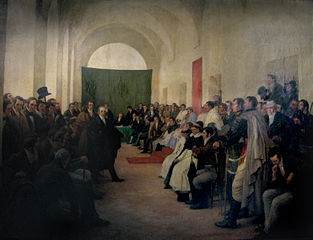
Un Regard Fugitif, Bluemenschein, 1900
A couple of recent "gaffes" in the presidential campaign highlight key differences in political philosophy of the candidates.

Obama got into trouble when he made the case that businesses rely on government infrastructure for their success.  This is obvious, especially if you imagine a country without a healthy, educated workforce, functioning roads, contract enforcement, etc.
“If you were successful, somebody along the line gave you some help. There was a great teacher somewhere in your life. Somebody helped to create this unbelievable American system that we have that allowed you to thrive. Somebody invested in roads and bridges. If you’ve got a business — you didn’t build that. Somebody else made that happen.”

Romney more recently got in trouble when he attributed the relative economic success of Israel compare to Palestine to superior culture of the former.
Culture makes all the difference. And as I come here and I look out over this city and consider the accomplishments of the people of this nation, I recognize the power of at least culture and a few other things. One, I recognize the hand of providence in selecting this place.
There is a sense in which the remark was not intended to refer to ethnicity, and refer narrowly instead to a kind of culture which arises purely from human capital.  Yet even here we are stretching things absurdly.  If not ethnicity, nor societal capital that facilitates the creation of human capital through infrastructure (which Israel clearly enjoys in far greater levels), then to what are we appealing as culture?  As one commenter I heard put it quite nicely, what if instead Romney had been singing the praises of the superior culture of Manhattan as opposed to Long Island?  Offensive, surely.

The positions these two candidates are taking, in terms of what to emphasize in outlining a framework of social success, are rooted in fundamentally different ways of understanding human agency.

The progressive view is one that sees success (or failure) as determined by an interplay between the individual and society.  Basic human equality of talent is assumed, roughly believing that anyone can be highly intelligent and accomplished, given the properly nurturing environment.  This view is backed up not only by endless volumes of research, but as well by common sense.  Any parent can tell you that children are largely products of your own investment and teaching.  We speak of children "raised well", and from "good homes".

The conservative view is one that sees success (or failure) less as a product of the interplay between the individual and society, but rather as ultimately the product of the individual's free choice.  Basic human talent is not assumed, but rather there are those who have been clearly endowed with superior mental and behavioral faculties.  Environment is not the ultimate determinant, but rather it is the pure strength of individual free will that allows him the agency to rise above whatever circumstance life throws his way.  This view is supported by a troubling lack of research.  There are occasional outliers, but evidence shows again and again not only that individuals are determined by their environment in the aggregate, but that countless specific pathways to skill-building exist in which it is not individual choice but social exchange that fosters specific agency.

However, there is a sense in which this conservative view appeals to common sense.  Individuals do make decisions, and each of us clearly feel as though we are the agents of this process.  If I do not get up and exercise at dawn, who is there to blame but myself?  Conservative rhetoric is very concerned with the emphasis of personal responsibility, and sees progressive claims to the contrary as morally bankrupt.  Indeed, in our everyday lives, the concept of individual responsibility is quite useful.

Yet, how to rectify this sense that we have free will and individual responsibility with the enormous quantity of research seeming to prove otherwise?  How to rectify it with the understanding all parents have that they are largely responsible for their children's development into successful adults?

It might be helpful here to think about the small child, at the tender age of five.  While still young, she clearly is quite developed emotionally and behaviorally.  Her cognitive skills are very advanced, capable not only of speaking with an extensive vocabulary, but able as well to learn to read, write, count and do basic mathematics.  She is capable of knowing right from wrong, even if her emotions sometimes get the best of her.  And yet, when she errs, we recognize her actions as not entirely her own.  That is, after a long day, when she throws a tantrum when asked to clean her room, we understand that she is likely tired, and thus less in command of her impulses.  If it has been discovered that she has stolen a piece of candy from the grocery store, we realize it inappropriate to send her to jail.  The more thoughtful among us might take the opportunity to reflect on whether deeper psychological issues might be at work, such as resentment of authority or a lack of self-esteem that might be inhibiting the development of personal integrity.

In short, there is nothing in her behavior that we can truly call free will; every action she takes can be traced to her development in relation to her socialization.  Children are not automatons.  They are often quite ponderous and reflective.  Yet even though they make choices, children's decision making process is clearly rooted in their relative development.  However, having only been on the Earth a short period of time, it is much easier to trace their thought process back to their cognitive development over time.  Epistemologically, the problem is relatively simple; there are fewer variables from which to draw causal conclusions.

In adults, there is no reason to think the same developmental dynamic does not exist.  However, because of the much greater time spans involved, the epistemological problem of trying to tease out causality from their thought process to their development as humans is far greater.  We can, through reflection, get some sense of why we make the decisions we do.  But it is very difficult and imprecise.  This epistemological imprecision is responsible for the useful illusion that our choices are caused not by our extensive lifelong development as humans, but rather by what is commonly referred to as "free will", or the ability to make decisions unfettered by developmental growth.

As dynamic organisms with the capacity for incalculably complex organization and processing of external stimulus, the positing of autonomy in the form of a "self" is enormously handy.  Thinking of a child first learning to talk, it is not uncommon to hear them refer to themselves in the third person.  Their knowledge of self is quite accurately based in an understanding of their developmental powers as identified and posited by their parent.  They have basic desires, emotions and thoughts, and quickly learn that they as well have agency.

Yet who are they?  From where does this agency come?  It comes from something that we can call a "self", and helpfully assign a name to further designate it as something different and autonomous from its environment.  However, as anyone familiar with small infants can attest, their agency is still quite limited, and in most ways they are entirely dependent on both the physical and mental capacities of their parent.  As they develop, they develop more autonomy and agency, and learn to think of all this as their "self".

As they grow older and more sophisticated, as their powers of agency grow, it becomes more and more useful to think of themselves as "selves".  As teenagers, their powers of self-reflection and group awareness reach the point where they are able to truly transcend their immediate home culture and begin to imagine other world views and forms of living, and even incorporate them into their growing capacity for self-identity and conception.  By the time they reach adults, any single decision they make seems entirely removed from any cognitive, emotional or behavioral development they have thus far experienced.  In the abstract, it might make some sense, but in any given situation, there is only so much one can epistemologically know about why one is making a particular decision.  To the extent that it can be known, it might be useful, but it can also be a hindrance, as time is often of the essence and too much navel-gazing can become a liability.

And so we move through the world, live our lives as if we are autonomous selves.  We feel proud of our accomplishments.  We feel shame for our failures.  But even the most stubbornly convinced among us that we indeed possess a free will that originates entirely within ourselves realize that the degree of credit we can take for our actions, the degree of personal responsibility we feel, is in some proportion to the degree to which our actions were not determined by external causes.  The concept of the "self-made man" is defined by the extent to which one's actions are divorced from external determination.  For instance, as successful as one is in business, if that business was built and handed to him from his father he cannot take full credit for it.  He was not self-made.

Returning to the research, it is rare to find anyone who can be described in any sense as "self-made".  Whether the privileges are obvious, such as family inheritance, or more subtle, such as the commitment, support and love of a parent, there is almost always a rather clear causality involved in human development and success.  This is just as true for those who lives lives of desperation and tragedy.  A lack of privilege, or outright misfortune almost always colors the lives of those who society would term failures, such as drug dealers, criminals, or just your average, everyday jerk.  Poor role-models, abusive parents, or an otherwise unloving or unsupportive environment is almost always the story of the lives of these individuals.

Of course it is possible for individuals to overcome circumstance.  However, contrary to the popular myth of the self-made man, or he who by the boot-straps pulls himself up, this can only take place in an environment in which he has been able to both develop the skills within himself that allow him to triumph, as well as take advantage of structural leverages afforded him by the society in which he lives.  Both of these - the skill building and societal leverage - fall under the rubric of societal capital, an external resource.  The former requires an environment in which he is able to develop the proper behaviors, attitudes, habits, knowledge, etc. that allow him agency.  The latter is, of course, the environment itself which affords him opportunities to apply his amassed stores of human capital.

This is the larger narrative behind the respective ideologies that Barack Obama and Mitt Romney represent, the assumptions about how agency is developed and applied in society.  Obama, representing the progressive view, emphasizes the degree of social determinism in the development of every citizen.  Romney, representing the classical liberal and modern conservative view, emphasizes the degree to which individuals are able to transcend society and freely make of themselves what they eventually become.  Strange as though it may be to believe, the Romney tradition is highly allergic to the concepts of societal and human capital as dynamic, reinforcing aspects of human development and realization.  The Romney view would deny much of the extent to which human capital is dependent on societal capital, instead viewing it as something that an individual is able to manufacture from whole cloth.  Societal capital itself is likewise seen with diminished import, either in many cases its dismissed entirely as a factor, or its valance downplayed.

To Obama, the successful business man is not really self-made at all, but rather is privileged to have enjoyed environmental privileges - societal capital -  that have allowed him to experience success.  Obama would no doubt view inequality between Israel and Palestine and look for imbalances in things like education, roads, access to water, occupation, etc. to explain such disparity.  To Romney, a businessman is in most ways an island of self-determination, free from the constraints of both human and societal capital.  Thus his reference to Israeli culture itself seems a contradiction - would not culture be a clear description of the interplay between human and societal capital?  Yet in the Romney framework, culture, to the extent that we are not simply arguing ethnocentric bigotry, is not so much viewed as a causal factor, but a description of things as they are, the way one might look at a flower and describe it's beauty.  However, while the flower's beauty has a clear evolutionary purpose, its cause entirely traceable to its genetics, the Romney view of culture is owed to a profound faith in the free will of man, and therefor outside the ordinary realm of natural causality and the physical universe.  This was actually illustrated rather well in Romney's follow-up allusion to "providence" as having played a role in Israel's relative affluence. 

In the November presidential election, we face two competing visions not only of policy and values, but of deeper assumptions about the nature of human development and agency.

In Obama, we have the belief represented that a free citizenry, one with an equal chance at life success, depends on individuals having equal access to the societal capital that will allow them to build and then leverage their own human capital.  While this project is no where near finished, and will likely never be, government can play a highly effective role in guaranteeing access to at least minimum levels of required societal capital.

In Romney, we have the belief that a free citizenry depends only marginally on individuals having access to societal capital, that they are each perfectly capable of developing and finding ways to leverage their own human capital.  Government has grown much too large and invasive, and needs to do much less in the way of ensuring societal capital to individuals.

Ultimately, the vote will largely be about whether you believe that human and societal capital are highly dependent, as research has proven again and again, or that human agency is something that individuals can create from nothing, likely even more so when their faith is placed in the Christian God, a view for which there exists not a shred of evidence, and is counter to our most basic understanding of the laws of the universe.





Saturday, August 4, 2012

A Definition of Societal Capital

As I originally discussed here, when I discovered my usage of the term social capital was incorrect, I decided to try an coin a new term to better describe my intended meaning.

Societal Capital (n): the stock of resources a society provides a developing human so as to further their development of human capital, either through physical, cognitive or emotional nourishment, as well as bodily safety.  

Beginning in utero, and continuing through adolescence and adulthood, negative as well as positive factors can serve to promote or inhibit human capital growth, and societal capital represents the net of this developmental leverage.  Societal capital can be highly direct, such as specific vitamins and minerals that stimulate tissue development, or the presence of cognitively stimulating language and activities in the home.  It can also be more indirect and abstract, such as social services, access to libraries, neighborhood safety, or employment opportunities.

Friday, July 20, 2012

Voices of Crowds

Political gaffes are interesting less because of what is said, but by how their interpretation on both sides of the aisle illustrates larger political themes.  When Romney said "corporations are people too", he was likely talking about the shareholders and workers, who deserved to be included in the conversation.  But this mattered less than the way it seemed to succinctly illustrate the left's perception of conservatives caring more about the profits of big business than their negative, corrupting effects in society.

Obama's recent gaffe about what small businesses - taken out of context to mean that small businesses are wholly reliant on government, likely in fact meaning that they are not wholly unreliant (two quite different claims) - illustrate what different political sides want to focus on.

In much of our political discourse, we have arguments over gut feelings, or larger narratives with implicit assumptions, not by debating those grand philosophical ideals, but rather by quibbling with details by proxy - raising anecdotes, emphasizing facts that support our side, etc.

Romney/conservatives think liberals over-emphasize the importance of government.  Obama/liberals think conservatives underestimate importance of government.

I suppose in the end all of this stuff, marginal as it appears at the time, nibbles away into the formation of political movements over the decades.  But in the moment, it all feels a bit too much like we're all caught in a sort of molasses-like political ether in which much of what we communicate to one another is merely an expression of larger, intangible forces.

Tuesday, July 17, 2012

Towards An Optimistic Determinism

The Gilded Cage, Morgan (1919)
In debates over free will, the determinist position, even when accepted, is often met with a sense of begrudging despair, as if, upon seeing the wizard behind the curtain of reality, life suddenly loses much of its luster and charm.

(For those unfamiliar with the debate: libertarian free will posits we are the original cause of our choices', and thus ultimately responsible; compatibilists and determinists acknowledge that we make choices, and feel as though we are free in doing so, we cannot actually "choose to choose" our choices, thus our will not originating within our consciousness.)

In a recent review of Sam Harris', Free Will, the reviewer - having largely ceded the determinist case - expresses an all-too common sentiment.
Couldn’t it be that we need the experience of what Wegner and others call “perceived control,” at least as a model of voluntary behavior, to get on with our lives and to have our achievements recognized and to be instructed by our failures? (Doesn’t Harris enjoy his success? I bet he does.) Finally, what happens to traditional qualities of character like courage, villainy, leadership? Poof! However correct Harris’s position may be — and I believe that his basic thesis must indeed be correct — it seems to me a sadder truth than he wants to realize.

So, why all the pessimism?

Rather than seeing determinism as a cold, subtractive, fatalism, I would argue the opposite – that current society is generally opposed to a determinist model, with some terrible policy implications. For starters, our criminal justice system is highly retributionist, terrorizing hundreds of thousands (with not only moral but practical implications – the almost complete lack of rehabilitative thinking). Understanding people as fully-caused would promote not only compassion, but an embrace of the science behind rehabilitation measures.

Income inequality is another. Too many currently feel that people are responsible, original causes of their successes or failures, leading to an acceptance of dire poverty and decadent wealth. Accepting determinism means acknowledging that biological and social privilege, combined with extant social structures are the original causes. This makes a moral case against inequality, as opposed to the notion of free will that apologizes for it.
At the very least, the notion of contra-causal free will overstates the case for reward and punishment. For while determinists much acknowledge the positive import of behavioral triggers like deterrence and success, they are in the end not only limited in their ability to drive behavior – only one factor among many others – but to the extent that they contribute to inequality, are immoral.

Finally, in terms of personal interactions and conscious development of self, determinism provides an enormous amount of grace and forgiveness. The more we are able to see one another as caused, the more we are able to accept each other as we are, not who we pretend to be, over-imagining agency where it does not exist. Often, the mere remembering of determinism is enough to occasion a soothing sigh and reminder to be compassionate and empathetic.

In the end, it seems much more liberating, if we must live caged, to do so fully aware of our humble position, rather than pretending to enjoy freedoms that do not exist.

Monday, July 16, 2012

God = Ego = Death, p.2

James Wimberly responds to my analogy of the ego as a dog in a rooftop crate on a car.
“Only along for the ride?” My image for this hypothesis is looking out of the rear window of the bus. The main objection to it is Darwinism. The brain we have is enormously expensive metabolically – and creates SFIK the most dangerous childbirth in nature. It would be contrary to everything we know about evolution to think that such consequential and high-priced developments as the self-aware, reflective brain come about for no adaptive reason.

I see the point, and I'm not saying it isn't enormously useful.  The angst alone has resulted in plenty of remarkable achievements.  But as a part of a feedback loop, it's hard to think of anything as a driver - even self-awareness.  With  a lower animal, the stimulus is unreflective and external, and easy to think of as automatic.  With humans, it's partly reflective, the stimulus being regurgitated through higher-order thinking processes such as compare/contrast, ordering, mathematics, prediction, etc.  We facilitate in our young the development of highly complex identities that integrate all of these skills into an amazingly efficient and sophisticated platform for stimuli interaction.  (You should see the way I interact with my children!  I kid.  I realize this all sounds absurdly cold.  But it's only a framework for understanding.) 

And yet, sophisticated as it is, there seems no reason to think of it as other than a feedback loop, operating according to laws of cause and effect, constrained by time itself, flowing from past to future.  We learn from our past and the future is changed.  Our agency in all of this seems entirely dependent upon past events, how our biological systems have integrated external stimuli.  The idea of the ego as crate, as I have described it, is an attempt to get at this transcendent notion of the self not as superfluous, or useless - indeed it is the greatest thing ever created in the universe.  But rather that it seems, as a thing *of* the universe, a mistake to assume that it is somehow a thing apart. 

I'm reminded of the notion that, as creatures of a particular time, space and scale, we are biased to view the universe from a very particular perspective.  We see a limited spectrum of light.  We feel a particular gravity.  We have a particular relationship with atomic particles.  Yet, there exists a great range of electromagnetic waves we can't see directly.  If we were 100th of our size, our weight would feel very different.  If we could experience atoms at the atomic level, we would see a particles made up mostly of space.  Our "common sense" experience would be completely different.  An everyday example of this is how we still talk about the sun rising and falling, because it makes more *sense* to think of it that way.  Relative only to us, it actually is rising and falling.

In this way, it seems we are trapped in a common sense view of consciousness in which we are the final agents of our agency.  Yet clearly, we are highly developed beings that have spent years achieving this particular state of agency.  And still, there are God knows how many forces (emergent or otherwise) at work on our every thought, pulling strings from deep within our psyche, like the dark matter of space, creating the context within which our thoughts enter our awareness.  So how is it that our agency is not simply a manifestation of everything that has thus far come? 

But now that we are here, in this final platform configuration, one might ask, are we not free then to go forward, to use all of this sophisticated mental equipment to do our bidding?  My response would be: but from where does that "bidding" come?  Again, we face the dark matter problem.  Any bidding we would seem to choose has to arise from somewhere.  And unlike galaxies that appear to have nothing around them, yet seem to exist in some miraculously ordered context, our bidding - our desire to choose - is surrounded not by nothing, but rather embedded deeply within an organic mechanism highly ordered and designed by the complex history of the individual, highly traceable and quantifiable - even to some extent predictable.

But not enough, right?  This is the rub.  The resolution on consciousness fantastically dim.  In theory, by knowing every possible angle and trajectory of every particle one could determine the exact thoughts that might arise.  But then you get into quantum problems and problems in constructing a model of emergence itself and it all seems so.. well, hopeless.  But in the aggregate, people are incredibly predictable.  Psychology, sociology and economics for instance tell us an enormous amount about human behavior.  Animal behavior is even easier, right?  When specific molecules attach to certain smell receptors, huge arrays of neuronal networks become very predictable.  Just because we can't yet make the physical models for this process, can't we pretty safely assume there is a purely physical mechanism at work.

And much of this can be applied to humans.  Place a bacon molecule in my nose and I will salivate.  So far so mechanistic.  Ditto for pornographic imagery.  Violence.  Food, sex, fear - all pretty simple, so to speak. 

And then comes reflection.  Consciousness.  Higher-order thinking, memory, emotional regulation.  While we can measure some of this stuff, the paths become infinitely more complex.  Add to this the very real sense we have that we design our own thoughts.  However, just because the sun comes up, it does not follow that the sun spins around the Earth.  When I eat someone's sandwich from the lounge refrigerator and they get mad at me, I feel guilty.  I feel like "I" did something wrong.  "I" made a mistake.  "I" am useful to myself as a thing, a thing to mold and correct, to improve upon going forward in the world.  But whether a dog in a crate, or a spinning gyroscope, am "I" more than a device useful to the platform that is me, yet still utterly dependent on contextual forces that imprint memories?  Neuroscience describes the way in which myelin sheaths around neurons serve to reinforce pathways of thought.  Apparently they are underdeveloped when we are young, so as to facilitate creative thinking and the laying down of new avenues of thought.  Yet as we age patterns become ingrained, and the sheaths thicken.  Arterials become freeways.  Rudimentary, but another piece of evidence towards a mechanistic understanding of conscious thought.