By now it's an old story to talk about the death of American manufacturing and our losing economic war with a third world more than happy to slave away for an existence we couldn't even dream of. Automaticity and new technologies have allowed us much greater efficiency and productivity. But it doesn't seem to be trickling down much, aside from fancier consumer electronics and discounts off bulk purchases. We've seen the rich get richer, the poor get poorer, and the middle class lose whatever sense of job security it once thought it had. As New Jersey Governor Chris Christie famously asked, "Who gets pensions any more?"
The whole field has indeed changed, and I'm not sure we can
cope as a culture/society. In the past a blue-collar family
could count on a simple high school education providing entrance and
exit into a stable income. This essentially took care of a pretty vast
swath of American humanity.
But the kind of economy we're seeing pan out is pretty brutal to these
kind of family traditions. Essentially, the bar for human and social
capital has been raised significantly higher than it ever was. It's all
too common for commenters to make vague proclamations about needing to
"fix" education, as if the problem was output. But the truth is that it
is input. We simply don't have the capacity of quality families that can produce children that can excel in academics.
Now, as a teacher, don't believe for a second I'm not trying. And I
honestly don't think I'm saying today's generation is any worse than it
was in the past. We've always had these families, and their kids didn't
need degrees to find quality careers. But it is as if we are trying to
cram a square peg into a round hole. Sure, you can always tweak the
education model. But the margin of improvement has far less to do with
what you can do in the classroom compared with the reality of where
society simply is at.
The term "class warfare", as a rhetorical device, has been in the news lately. But a real class war has been raging for decades. Having lost the battle long ago to smart machines and overseas labor, blue collar American families found themselves forced to compete with the well-read and groomed upper socio-economic classes, despite a severe disadvantage in human and social capital. Without an academic culture and strong support at home, preparing for college isn't something most can do completely on their own. Those eventually managing to find "the world of the mind", and then going on to graduate, have found an over-saturated job market without enough supply to meet demand.
Despite the many shiny new trinkets that globalization has placed upon our shelves and inside our screens, we seem to be taking two steps back for every one forward. Add to this our ideological spectrum bending relentlessly rightward, and our government expenditures on things that used to take the rough edges off an unforgiving economic platform - like roads, schools, police and health care, and the future looks bleak indeed.
A bastard's take on human behavior, politics, religion, social justice, family, race, pain, free will, and trees
Tuesday, October 18, 2011
Monday, October 10, 2011
A Real Parent Revolution
Diane Ravitch weighs in on the "Parent Trigger",
A controversy erupted earlier this year when the charter-school affiliated group "Parent Revolution" tried to shit down a school in Compton, gathering parent signatures. The charter school movement, like the voucher movement before it, seeks to transcend the public education system, yet ultimately undermines it. Schools are a socialist enterprise, in that they are built on the belief that every citizen deserves a good education, funded by the state. Citizens with access to wealth and privilege, human and social capital, have never had to worry about educating their children. It is the poor and ignorant who must receive this social help from the rest of us.
And so, these reforms miss the real problem: "Bad" schools overwhelmingly align with poverty, not with bad teaching or administration.
I'm sure you've heard this line before. But it is still true. Just because we don't have a good solution to poverty doesn't mean we don't try. But nor does it mean that we can pretend it isn't the major factor in the education gap, and one which teachers are given little in the way of resources to attend to.
The bottom line is that one thing could make these parents' school better: them. If their community was capable of raising its children right, then their student's achievement would be through the roof.
Now, this sounds terrible, right? The truth is painful. But you know what is more painful? Being unwilling to face the truth and to face it head on.
This community is busting its ass, for low pay, crappy work, suffering more than anyone else. It is poorly educated, and lacks access to the social capital necessary to pull itself out. Its problems are compounded geographically, as the entire neighborhood is populated with people lacking in social and human capital. Its kids are likewise shoved into schools filled with others just like them. Teachers - often those with the least experience and lowest on the totem-pole, having not had a chance to transfer to an easier population - are being asked to teach the same classroom numbers as more affluent neighborhood schools, whose kids' combined human and social capital is exponentially greater.
So instead of truly targeting these communities for intervention that takes their challenges into account, giving them access to services that other neighborhoods don't need or take for granted, providing support that they need, we ignore all of this and tell ourselves - and them - that it's all the teacher's fault. We simply pretend that these huge social problems don't exist. We pretend that we can have entire sectors of the economy built upon the backs of the working poor, who then get funneled into geographically isolated and capital-incapacitating neighborhoods, and expect our meager poor schools - affording little more (if even) than the same resources than wealthy schools - to close the gap.
This is the real tragedy, and one that education "reformers" continue to ignore, even after their many failures to make even a dent in the problem, and who ultimately are doing these communities a disservice by not addressing real needs, giving cover to those who still won't face the enormity of the social problem eating away at our core. A real revolution in education would be to finally take our social responsibility seriously, and reach out helping and supportive hands to these parents, not offer them imaginary hopes based on little more than resentment and victimhood.
It is another one of those deceptive schemes that comes packaged with an alluring name, but whose true purpose is to undermine public education....In early 2010, when Arnold Schwarzenegger was governor of California, the state legislature passed the "Parent Empowerment Act." This law is commonly known as the Parent Trigger. It allows a majority of parents in a low-performing school to sign a petition that leads to various sanctions for the school: firing all or some of the staff, turning the school over to charter management, or closing the school. These are similar to the options in the U.S. Department of Education's School Improvement Grant program. All of them are punitive, none is supportive of changing the school for the better, and none has a shred of evidence to show that it will improve the school. Neither the Parent Trigger nor the federal SIG program offers any constructive alternatives to unhappy parents, only ways to punish the school for low scores.
A controversy erupted earlier this year when the charter-school affiliated group "Parent Revolution" tried to shit down a school in Compton, gathering parent signatures. The charter school movement, like the voucher movement before it, seeks to transcend the public education system, yet ultimately undermines it. Schools are a socialist enterprise, in that they are built on the belief that every citizen deserves a good education, funded by the state. Citizens with access to wealth and privilege, human and social capital, have never had to worry about educating their children. It is the poor and ignorant who must receive this social help from the rest of us.
And so, these reforms miss the real problem: "Bad" schools overwhelmingly align with poverty, not with bad teaching or administration.
I'm sure you've heard this line before. But it is still true. Just because we don't have a good solution to poverty doesn't mean we don't try. But nor does it mean that we can pretend it isn't the major factor in the education gap, and one which teachers are given little in the way of resources to attend to.
The bottom line is that one thing could make these parents' school better: them. If their community was capable of raising its children right, then their student's achievement would be through the roof.
Now, this sounds terrible, right? The truth is painful. But you know what is more painful? Being unwilling to face the truth and to face it head on.
This community is busting its ass, for low pay, crappy work, suffering more than anyone else. It is poorly educated, and lacks access to the social capital necessary to pull itself out. Its problems are compounded geographically, as the entire neighborhood is populated with people lacking in social and human capital. Its kids are likewise shoved into schools filled with others just like them. Teachers - often those with the least experience and lowest on the totem-pole, having not had a chance to transfer to an easier population - are being asked to teach the same classroom numbers as more affluent neighborhood schools, whose kids' combined human and social capital is exponentially greater.
So instead of truly targeting these communities for intervention that takes their challenges into account, giving them access to services that other neighborhoods don't need or take for granted, providing support that they need, we ignore all of this and tell ourselves - and them - that it's all the teacher's fault. We simply pretend that these huge social problems don't exist. We pretend that we can have entire sectors of the economy built upon the backs of the working poor, who then get funneled into geographically isolated and capital-incapacitating neighborhoods, and expect our meager poor schools - affording little more (if even) than the same resources than wealthy schools - to close the gap.
This is the real tragedy, and one that education "reformers" continue to ignore, even after their many failures to make even a dent in the problem, and who ultimately are doing these communities a disservice by not addressing real needs, giving cover to those who still won't face the enormity of the social problem eating away at our core. A real revolution in education would be to finally take our social responsibility seriously, and reach out helping and supportive hands to these parents, not offer them imaginary hopes based on little more than resentment and victimhood.
Saturday, October 8, 2011
Indulging Hypocrisy
It seems to me that there is a huge gulf between the radical right, who
truly believe the anti-all-government crap that seems the lifeblood of contemporary right-wing rhetoric, and the mainstream right,
who enjoy the same rhetoric, while not actually believing it. They
actually believe in libraries, schools, medicare, social security, etc.
But the radical right is so energetic and passionate... here's the
question: why do moderates let them get away it, why do they pretend to
agree?
On the left, there doesn't seem to be at all this kind of schism. You rarely hear for the outright abolishment of business. And if you did, the rest of the left wouldn't dream of pretending to agree.
I tend to think this is historical. Communism as a politically correct philosophy died a long time ago. Total free marketism is alive and well, despite routinely demonstrating massive failings. Reasonable people understand this, and advocate a mixed economy. So again, why does the right allow radical idiocy to invade their rhetoric?
I'm reminded of the radio right, in which half-truths are routinely bandied about, with a sort of wink-and-nod - we don't really think that (or do we)? It's a comfort with factual relativism that seems to baffle the left.
On the left, there doesn't seem to be at all this kind of schism. You rarely hear for the outright abolishment of business. And if you did, the rest of the left wouldn't dream of pretending to agree.
I tend to think this is historical. Communism as a politically correct philosophy died a long time ago. Total free marketism is alive and well, despite routinely demonstrating massive failings. Reasonable people understand this, and advocate a mixed economy. So again, why does the right allow radical idiocy to invade their rhetoric?
I'm reminded of the radio right, in which half-truths are routinely bandied about, with a sort of wink-and-nod - we don't really think that (or do we)? It's a comfort with factual relativism that seems to baffle the left.
To Be Aware
What is the difference between
the experience of consciousness, and the awareness of consciousness?
For instance, a blue jay can be said to be conscious in the sense that it feels hunger, analyses its environment, becomes excited as it sees a worm, chooses what it feels is its best path, becomes excited as it sees a worm, and then experiences the pleasure of having its desire satiated. (Of course, no one has spoken with a bluejay, but I see no reason to think that through behavioral observations and knowledge of brain function, we can't reasonably assume that these feelings are occurring).
However, the blue jay is doubtless unaware of its consciousness - that it is experiencing hunger, excitement, pleasure, etc. In this way, it can maybe be said to be unconscious, just as we are when we go about our daily business by habit, simply responding to the environment and making choices that we are unaware we are making. These habitual decisions are certainly more complex, but are they not just as unconscious as the bluejay? For instance, driving a car, parking it, locking the doors, etc. The spiritual tradition of "mindfulness" is explicitly about raising just this sort of consciousness, so that even in these smaller actions, there is a sort of memory we learn to engage that adds an extra layer of consciousness to simple daily activity. There is certainly an argument to be made for this, given the human tendency to allow our unconscious behaviors - and thoughts, even - to get the better of us, leading us into what are ultimately poor decisions. So, the lesson learned is to be more mindful, to develop a sort of leverage point – some trigger – in our daily experiences by which we can shift one level out in our perspective, towards some broader context.
A key detail in the debate over free will, I think, is the degree to which this leveraging actually defines what we mean by free will. What is it to be conscious? I once checked a book out from the library on lucid dreaming. The idea was to take advantage of the cyclical nature of sleep, where we spend ever longer periods of time in deep, REM sleep, yet then wake briefly between cycles. The instructions were to begin a dream journal, and to develop a habit of jotting down our most recent dreams immediately upon these awakenings. By beginning to become more aware of our dreams just after having had them, this habit would help trigger lucidity in the dream state.
The book also recommended the mindfulness I spoke of previously. Throughout the day, if one developed the habit of mindfulness – a higher level of awareness of one’s own consciousness – this would translate into the habit activating in dreams, leveraging lucidity. I spent a little over a week practicing these techniques, and low and behold – I had my first lucid dream. Unfortunately, not only did I become aware that I was dreaming within the dream, but I became aware too that I was aware that I was aware! This seemed to stumble me right awake. By this point, I wasn’t sleeping very well – what with all the waking and writing. And I decided to give up on the whole project.
So, this concept of lucidity in dreaming seems a strong parallel to, shall we say, meta-consciousness in waking. Can this delineation give us any traction in the free will debate? Can we argue that of these two forms of consciousness, the mindful, meta-consciousness presents more freedom? This is certainly the form of consciousness that we all try to imagine when questioning whether we make conscious choices: we are conscious that we are choosing. This, as opposed to the choice we make when putting sugar into our coffee.
In fact, it may also be of importance to place any given state of consciousness on a spectrum of meta-consciousness. At one end, we are almost blindly reacting to the world – when dodging a flying object, say. And at the other, a state of super consciousness in which we are greatly aware both of our external and internal stimuli, but also of our awareness of our awareness. Maybe we could place all other mammals below some maximum level of meta-consciousness, and below that all other creatures capable of thought, ending who knows where – in single-celled creatures little more advanced than any of our individual cells, “thoughts” consisting literally of groups of molecules creating chemical reactions.
What does all of this mean for the term choice? A choice can be as simple as a series of binary responses to stimulus (i.e. too hot = pain, move hand). But it can also be an infinitely complex calculation of multiple competing values, involving in no small part the “gut”, as well as the brain’s calculations. At what point do we describe choice as conscious? At what point do we describe it as free? Can part of choice be not-free, while part of it free? Anyone who has endured suffering in order to receive reward would seem to have made such a choice.
And yet, is it possible to make a choice in which the risk outweighs the reward, yet it is still made? Surely such a choice would be stupid. In fact, is that not the definition of stupidity? No matter what choice we make, there is always something that occurs to us as – that we are conscious of as being – more rewarding than the alternative. The reward may not be to our person, but to another, for whom we have great compassion, and wish to help because it pleases us to do so. It seems that when it does not please us, we are seen as somehow corrupt – if not biologically so.
For instance, a blue jay can be said to be conscious in the sense that it feels hunger, analyses its environment, becomes excited as it sees a worm, chooses what it feels is its best path, becomes excited as it sees a worm, and then experiences the pleasure of having its desire satiated. (Of course, no one has spoken with a bluejay, but I see no reason to think that through behavioral observations and knowledge of brain function, we can't reasonably assume that these feelings are occurring).
However, the blue jay is doubtless unaware of its consciousness - that it is experiencing hunger, excitement, pleasure, etc. In this way, it can maybe be said to be unconscious, just as we are when we go about our daily business by habit, simply responding to the environment and making choices that we are unaware we are making. These habitual decisions are certainly more complex, but are they not just as unconscious as the bluejay? For instance, driving a car, parking it, locking the doors, etc. The spiritual tradition of "mindfulness" is explicitly about raising just this sort of consciousness, so that even in these smaller actions, there is a sort of memory we learn to engage that adds an extra layer of consciousness to simple daily activity. There is certainly an argument to be made for this, given the human tendency to allow our unconscious behaviors - and thoughts, even - to get the better of us, leading us into what are ultimately poor decisions. So, the lesson learned is to be more mindful, to develop a sort of leverage point – some trigger – in our daily experiences by which we can shift one level out in our perspective, towards some broader context.
A key detail in the debate over free will, I think, is the degree to which this leveraging actually defines what we mean by free will. What is it to be conscious? I once checked a book out from the library on lucid dreaming. The idea was to take advantage of the cyclical nature of sleep, where we spend ever longer periods of time in deep, REM sleep, yet then wake briefly between cycles. The instructions were to begin a dream journal, and to develop a habit of jotting down our most recent dreams immediately upon these awakenings. By beginning to become more aware of our dreams just after having had them, this habit would help trigger lucidity in the dream state.
The book also recommended the mindfulness I spoke of previously. Throughout the day, if one developed the habit of mindfulness – a higher level of awareness of one’s own consciousness – this would translate into the habit activating in dreams, leveraging lucidity. I spent a little over a week practicing these techniques, and low and behold – I had my first lucid dream. Unfortunately, not only did I become aware that I was dreaming within the dream, but I became aware too that I was aware that I was aware! This seemed to stumble me right awake. By this point, I wasn’t sleeping very well – what with all the waking and writing. And I decided to give up on the whole project.
So, this concept of lucidity in dreaming seems a strong parallel to, shall we say, meta-consciousness in waking. Can this delineation give us any traction in the free will debate? Can we argue that of these two forms of consciousness, the mindful, meta-consciousness presents more freedom? This is certainly the form of consciousness that we all try to imagine when questioning whether we make conscious choices: we are conscious that we are choosing. This, as opposed to the choice we make when putting sugar into our coffee.
In fact, it may also be of importance to place any given state of consciousness on a spectrum of meta-consciousness. At one end, we are almost blindly reacting to the world – when dodging a flying object, say. And at the other, a state of super consciousness in which we are greatly aware both of our external and internal stimuli, but also of our awareness of our awareness. Maybe we could place all other mammals below some maximum level of meta-consciousness, and below that all other creatures capable of thought, ending who knows where – in single-celled creatures little more advanced than any of our individual cells, “thoughts” consisting literally of groups of molecules creating chemical reactions.
What does all of this mean for the term choice? A choice can be as simple as a series of binary responses to stimulus (i.e. too hot = pain, move hand). But it can also be an infinitely complex calculation of multiple competing values, involving in no small part the “gut”, as well as the brain’s calculations. At what point do we describe choice as conscious? At what point do we describe it as free? Can part of choice be not-free, while part of it free? Anyone who has endured suffering in order to receive reward would seem to have made such a choice.
And yet, is it possible to make a choice in which the risk outweighs the reward, yet it is still made? Surely such a choice would be stupid. In fact, is that not the definition of stupidity? No matter what choice we make, there is always something that occurs to us as – that we are conscious of as being – more rewarding than the alternative. The reward may not be to our person, but to another, for whom we have great compassion, and wish to help because it pleases us to do so. It seems that when it does not please us, we are seen as somehow corrupt – if not biologically so.
Thursday, October 6, 2011
Hidden Privilege
| The Trusty Servant |
“The hircocervus (Latin: hircus, "billy goat" + cervus, "stag") or tragelaph (Greek: τράγος, tragos, "billy goat" + έλαφος, elaphos, "stag"), also known as a goat-stag or horse-stag, was a legendary creature imagined to be half-goat, half-stag. Plato utilized the idea of a fabulous goat-stag to express the philosophical concept of something that is knowable even though it does not really exist.”
This article in the NY Times points out a tragic flaw in our economy. Farmers trying to find labor can't find Americans to do the work. Picking crops is exhausting, back-breaking work, and people won't even do it at $11 an hour. At what price would they do it? How much would we pay for food? On a recent Daily Show skit, Jason Jones couldn't even find Mexicans to do it.
| The Daily Show With Jon Stewart | Mon - Thurs 11p / 10c | |||
| Mexed Out | ||||
| www.thedailyshow.com | ||||
| ||||
The excellent, heart-wrenching documentary Last Train Home recently aired on PBS followed the story of a Chinese couple's tribulations as they sacrificed everything to move from their rural village to a big city in order to work 7 days a week in a sweatshop. They had moved fifteen years earlier, when their daughter was barely one year old. They come home for one week, once a year, along with the rest of the migrant city workers wishing to celebrate Chinese New Year with loved ones. The stations are packed by the tens of thousands, all scrambling madly, dangerously to escape the thriving smog for the impoverished, bucolic countryside.
They live in bunk beds at what appears to be the factory, or some nearby squalor, and wash from a bucket. They send everything home, so that their daughter might have a chance to go to college and have a better life. Yet now a teenager, their daughter barely knows them, and resent their visits. To rebel, she flees school and finds her own job at a factory in the city.
The product of their labor appears to be designer jeans. But it could be any product really, that we in America consume so readily and purchase so cheaply from Chinese and other foreign labor markets.
A case might be made that this is improvement for China. It certainly is for American migrant farm workers, in the sense that they are making ten times what they might have made in Latin America.
Yet what a convenient scheme for us. Their servitude is our gain. Unless of course we see a lack of jobs to replace those we have lost through efficiency. In theory, the cheaper prices and increased productivity of business investment is channeled back into the economy where it can hire new employees for new types of production. In theory. I can't claim to understand economics well enough to make a claim either way.
The American job market doesn't seem to be what it once was. Today a high school diploma, hands and a strong back won't get you as far as it once did. You can still do pretty well for yourself by going to college and taking a degree in math or science, to do the labor that American businesses will still pay top dollar for. But that's a selective portion of American society. It requires a level of human and social capital that many American families don't possess - that for many was never possessed. The difference is that in the past, you could stumble out of high school and find a cozy middle class life for yourself. No longer.
This seems a question for American civilization: can we as a people raise the bar enough for the average American family that even the lowest rungs - those for whom - for whatever reason - the rigor of high school and college or technical school wasn't enough? Is this economic and social requirement too much to ask? We've still certainly the need for low-skill, tedious labor. Who will perform these jobs?
You can't outsource crops. Not at least to the extent that the land itself is a natural resource. We've done a pretty swell job sneaking in illegal labor for now. Our obedience to the siren song of low prices and hidden externalities has enabled a robust market for low-wage earners. People are being taken advantage of, as they must be. They are working in shitty conditions for compensation we would not stoop to accept.
And yet anti-illegal sentiment seems to be reaching historic proportions. We have the gall to pretend that these people are somehow leeching off us - expecting health care and public education. Not In My Backyard (well, unless you're here for the lawn trimmings).
Everyone wants the brainwork. No one wants to swab the decks. Unless the price is right. Which it isn't. How much would they have to pay before your daughter or son making a career out of picking lettuce, washing dishes or sewing garments seems admirable?
Someone has to do it.
"A trusty servant's picture would you see,
This figure well survey, who'ever you be.
The porker's snout not nice in diet shows;
The padlock shut, no secret he'll disclose;
Patient, to angry lords the ass gives ear;
Swiftness on errand, the stag's feet declare;
Laden his left hand, apt to labour saith;
The coat his neatness; the open hand his faith;
Girt with his sword, his shield upon his arm,
Himself and master he'll protect from harm."
- Arthur Cleveland Coxe
Saturday, October 1, 2011
The Cognition Trap
A man named Dan called about the apartment for rent. I told him my wife would call him back. She then told me it had been rented. I wanted her to call Dan and tell him. Why couldn't I have called him myself?
I might have simply been worried about talking on the phone. More likely, I was consciously worried he might feel like he was dealing with confused, or untrustworthy people. Surely, people should be organized and know whether an apartment was still available. Did I not have a good communicating relationship with my wife? What did this say about me?
My wife thought I was being ridiculous. Why would Dan think any of this? And if he did, why would I care what he thought, a complete stranger? Most likely, he wouldn't think this at all. Who is so skeptical and judgmental, paranoid about of the motives of others?
I realized this is a pattern with me. Very often, I am overly concerned about what people might be thinking of me. I often shrink from conflict in order to avoid the possibility that they might think poorly of my character. I might be blind to some true failing in myself, one they of course can sniff out from the slightest trace of weakness. I find myself assuming a sort of game face, afraid of tipping my hand, tipping them off that I am indeed weak and vulnerable, morally conspicuous and lacking in integrity.
Yet all of this presumes that I might be interpreted this way. Likely, I am not. Why would I assume such motives in others? From where does this insecurity come? Is it a false concept of myself, that I fear is true and will be found out? Or is it a false conception of others, that they would be prone to harbor such sentiments?
I suppose both could be to some degree true. Yet both also influence each other: if I assume problems in myself, I'll likely assume others will see them. If I assume others will perceive flaws in me, I may see this as a pattern that implies some truth about myself.
I do often assume that others have found flaws in me and then spend lengthy amounts of time going over the situation in my head, wondering whether or not it is really true. Do I really do X? Am I really like Y? Introspection is important; we need to be aware of who we truly are and what we do. But one can also be overly introspective, looking for trouble where none exists.
At the macro level, we face many risks in our day to day life, yet would be crippled if we attended to them in improper proportion to their probability. Sure, driving a car is dangerous, but to worry that other cars might all suddenly slam in to us would prohibit driving. Likewise, we may come off as rude to someone, yet what is the probability? Must we analyze every word we speak in the context of a likelihood that we were indeed rude? Is there a pattern?
This is an issue of cognition. We all develop a framework of self with which we assume ourselves to be functioning in the world. When we drive, this framework entails our past experiences driving, and we project the likelihood that we and others will drive safely. In interpersonal relations, so too do we have a framework. It entails our past experiences interacting with others, and we project the likelihood of how we and others will behave, feel and respond a given way.
Of course, our experiences driving a car are much more limited, and our interactions concrete. Usually, our cognition is sound. However, one might imagine that after some traumatic incident, this cognition might become impaired, and faulty predictions might be made based on unconscious anxieties. Interpersonal relationships are infinitely more complex, and the cognitive framework is enormous, encompassing vast stretches of one's life, one's varied relationships with others, as well as one's understanding of one's self in multiple contexts.
The cognitive framework is partially biological, based in temperament and predisposition to a variety of conscious states, not the least of which being manifestations of mood. But it is also of course environmental, or learned. Cognitive patterns begin to be laid down from birth, as the ways in which we begin to interact with the world begin to build a framework of consciousness - ultimately what we perceive as the self and the other.
Sorting out what one's cognitive framework consists of, assuming much of it is unconscious - learned and temperamental, is a monumental task. Yet through this sort of meta-analysis, trying to find patterns in how we tend to perceive ourselves and others, can at least give us a way of framing our behavior. That is, we may never know why we feel and respond the way we do, or what an other is thinking or feeling, but we can at least attempt to find an objective understanding of what we think and fell, and what they say and do in response.
To someone such as myself, who tends to enjoy thinking and critically examining himself and the world around him, a dangerous trap can be found in introspection. The very bravado that comes from having sorted out many intellectual dilemmas, or at least the sense of accomplishment in sorting them out to a satisfactory degree through pure intellect, can impart a seductive sense that all problems can be sorted out by analysis. Yet reason, especially when directed at the self (or at others via the self) cannot be decoupled from feeling. Thus, pure intellect is inevitably insufficient. And when faced with this challenge, the belief that what is always required is more reason can result in unremittant perseveration.
So what the meta-cognitive model allows is a sort of escape valve: allow the intellect to continue, yet confine it to only limited examination of interactions between self and others, and task it instead with a more prominent engaging of one's cognitive framework as a whole, allowing it to create, in a sense, a framework for your cognitive framework. In my case, what might be more meaningful than dwelling on specific, situational interactions, is doing so in limited fashion, while at the same time keeping an eye out for larger patterns throughout my interactions and subsequent thought processes.
So, why was I worrying what Dan might have thought of me? This is the interesting question, not whether what I said or did was correct. It was after all, a brief and inconsequential interaction. Why do I have a pattern of assuming that others will spot weaknesses in me, think poorly of me? Have I learned to see this is in people's nature? Have I learned to see weakness in myself? What does this say about my father and mother, my family and friends? Surely at least some temperament as well as attitudinal relationship must exist. These are the important things to ponder, and likely what will ultimately help me understand my true self.

I might have simply been worried about talking on the phone. More likely, I was consciously worried he might feel like he was dealing with confused, or untrustworthy people. Surely, people should be organized and know whether an apartment was still available. Did I not have a good communicating relationship with my wife? What did this say about me?
My wife thought I was being ridiculous. Why would Dan think any of this? And if he did, why would I care what he thought, a complete stranger? Most likely, he wouldn't think this at all. Who is so skeptical and judgmental, paranoid about of the motives of others?
I realized this is a pattern with me. Very often, I am overly concerned about what people might be thinking of me. I often shrink from conflict in order to avoid the possibility that they might think poorly of my character. I might be blind to some true failing in myself, one they of course can sniff out from the slightest trace of weakness. I find myself assuming a sort of game face, afraid of tipping my hand, tipping them off that I am indeed weak and vulnerable, morally conspicuous and lacking in integrity.
Yet all of this presumes that I might be interpreted this way. Likely, I am not. Why would I assume such motives in others? From where does this insecurity come? Is it a false concept of myself, that I fear is true and will be found out? Or is it a false conception of others, that they would be prone to harbor such sentiments?
I suppose both could be to some degree true. Yet both also influence each other: if I assume problems in myself, I'll likely assume others will see them. If I assume others will perceive flaws in me, I may see this as a pattern that implies some truth about myself.
I do often assume that others have found flaws in me and then spend lengthy amounts of time going over the situation in my head, wondering whether or not it is really true. Do I really do X? Am I really like Y? Introspection is important; we need to be aware of who we truly are and what we do. But one can also be overly introspective, looking for trouble where none exists.
At the macro level, we face many risks in our day to day life, yet would be crippled if we attended to them in improper proportion to their probability. Sure, driving a car is dangerous, but to worry that other cars might all suddenly slam in to us would prohibit driving. Likewise, we may come off as rude to someone, yet what is the probability? Must we analyze every word we speak in the context of a likelihood that we were indeed rude? Is there a pattern?
This is an issue of cognition. We all develop a framework of self with which we assume ourselves to be functioning in the world. When we drive, this framework entails our past experiences driving, and we project the likelihood that we and others will drive safely. In interpersonal relations, so too do we have a framework. It entails our past experiences interacting with others, and we project the likelihood of how we and others will behave, feel and respond a given way.
Of course, our experiences driving a car are much more limited, and our interactions concrete. Usually, our cognition is sound. However, one might imagine that after some traumatic incident, this cognition might become impaired, and faulty predictions might be made based on unconscious anxieties. Interpersonal relationships are infinitely more complex, and the cognitive framework is enormous, encompassing vast stretches of one's life, one's varied relationships with others, as well as one's understanding of one's self in multiple contexts.
The cognitive framework is partially biological, based in temperament and predisposition to a variety of conscious states, not the least of which being manifestations of mood. But it is also of course environmental, or learned. Cognitive patterns begin to be laid down from birth, as the ways in which we begin to interact with the world begin to build a framework of consciousness - ultimately what we perceive as the self and the other.
Sorting out what one's cognitive framework consists of, assuming much of it is unconscious - learned and temperamental, is a monumental task. Yet through this sort of meta-analysis, trying to find patterns in how we tend to perceive ourselves and others, can at least give us a way of framing our behavior. That is, we may never know why we feel and respond the way we do, or what an other is thinking or feeling, but we can at least attempt to find an objective understanding of what we think and fell, and what they say and do in response.
To someone such as myself, who tends to enjoy thinking and critically examining himself and the world around him, a dangerous trap can be found in introspection. The very bravado that comes from having sorted out many intellectual dilemmas, or at least the sense of accomplishment in sorting them out to a satisfactory degree through pure intellect, can impart a seductive sense that all problems can be sorted out by analysis. Yet reason, especially when directed at the self (or at others via the self) cannot be decoupled from feeling. Thus, pure intellect is inevitably insufficient. And when faced with this challenge, the belief that what is always required is more reason can result in unremittant perseveration.
So what the meta-cognitive model allows is a sort of escape valve: allow the intellect to continue, yet confine it to only limited examination of interactions between self and others, and task it instead with a more prominent engaging of one's cognitive framework as a whole, allowing it to create, in a sense, a framework for your cognitive framework. In my case, what might be more meaningful than dwelling on specific, situational interactions, is doing so in limited fashion, while at the same time keeping an eye out for larger patterns throughout my interactions and subsequent thought processes.
So, why was I worrying what Dan might have thought of me? This is the interesting question, not whether what I said or did was correct. It was after all, a brief and inconsequential interaction. Why do I have a pattern of assuming that others will spot weaknesses in me, think poorly of me? Have I learned to see this is in people's nature? Have I learned to see weakness in myself? What does this say about my father and mother, my family and friends? Surely at least some temperament as well as attitudinal relationship must exist. These are the important things to ponder, and likely what will ultimately help me understand my true self.
Probabilistic Determinism
| Probability pattern for a single electron |
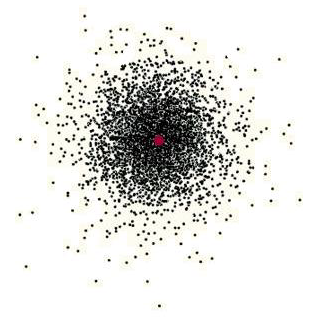
One of the major critiques of determinism as a theory of mind, is that because all matter can only ever be explained by probabilities of quantum states, that it is thus impossible to claim that there is a direct causality between the atomic structure of neurons in the brain and conscious thought. Because conscious thought is a much larger, emergent phenomenon, this sort of reductionist determinism can't possibly account for the richness of human thought.
But I don't think that reductionist determinism is trying to explain all of consciousness. It is only claiming that consciousness is rooted in structures of atoms, just like anything else in the universe, from a hammer, to a computer program, to a hurricane. It doesn't pretend to explain something like qualia, or what a fish feels when it bites a worm. But it reasonably assumes that such states of mind exist because of particular states of matter, arranged as they are in specific ways so that these states of mind may emerge. We have direct evidence that thoughts are rooted in atomic structures because we know that neurons fire when brains think, and specific kinds of thinking are confined to certain structures of the brain. We have even measured specific thoughts as consistent patterns of electrical energy.
And determinism is evidenced by more than reductionism. It takes into consideration other forms of understanding, forms that we are presently far from being able to trace to a specific set of atoms, and possibly never will be able to, due to physical, and possibly conceptual limitations. (After all, we're dealing with trillions of neurons firing in coordination.) There are many ways in which human consciousness can be partially explained, that point to determinism. By analyzing behavior, patterns of learning and thought, and the physiological mechanisms underlying many emotional states, we derive insight into the mind. For example, we can study memory formation, and the brain's ability to learn when subjected to stress. That is a deterministic process. We can study cognition and frameworks within which ideas are formed, and trace their logic to prior knowledge and learning. That is deterministic.
The key question of free will involves why we make one choice over another. Proponents of free will say we freely consider the options and then choose. The reductionist framework simply argues that this can't be so, because if thoughts are structures of atoms, then there must be causality. Even if we are talking not about perfect causality but probabilities of quantum states, we are still talking about a rough determinacy, a range of probabilities, that seems more than adequate to imply direct causality between the goings on of atoms in our brains.
Stephen Hawking describes black holes as the ultimate example of the indeterminacy of the universe. He describes them as acting on particles such that the causal links between time and space are at some point ultimately severed. Yet he reminds us that this is only an incredibly extreme example, implying that it does little to alter what we ought to expect of the observable world.
One might not think it mattered very much, if determinism broke down near black holes. We are almost certainly at least a few light years, from a black hole of any size. But, the Uncertainty Principle implies that every region of space should be full of tiny virtual black holes, which appear and disappear again. One would think that particles and information could fall into these black holes, and be lost. Because these virtual black holes are so small, a hundred billion billion times smaller than the nucleus of an atom, the rate at which information would be lost would be very low. That is why the laws of science appear deterministic, to a very good approximation.
So even if I feel like I am freely choosing whether to put one lump or two of sugar in my coffee, there must be still something structural in my brain that is causing me to make one or the other choice, even if that something is operating within a range of probabilities at the quantum level. A better way of thinking about this might be to say that when I reach for the spoon, it most certainly will be there, even if not entirely certainly.
Now, we don't know what that the structure of the brain that gives rise to consciousness looks like - it is likely an insanely complex string of neural interactions firing in fractions of a second. But we know that it requires a great deal of prior knowledge - sugar, spoons, coffee, balance, predicted taste, health concerns, etc., all in coordinated calculation. We also know that there are many unconscious pressures at work, even if we couldn't begin to account for them all. (Unconscious thought is the least understood aspect of consciousness, yet probably the most powerful evidence for determinism, as it constitutes an essential element of thought, yet is by definition outside the realm of choice, and actively shaping thought in ways we can never be certain of. At the very least, it is a severe limiter of freedom).
Subscribe to:
Posts (Atom)