Sunday, February 20, 2011

Too Elite, or Not Too Elite?

With the latest budget squabbles, we've been hearing a bit about government arts funding.  And again, we hear complaints of arts funding as somehow elitist - presumably because of art's history as a fancy of the upper classes.  I think that's less true than it has been at many times in the past.  More on that in a bit.  But first, let's take on the allegation of "elitism" being deployed with such fervor by the contemporary right.

Let me start with socioeconomics.  I've been lower-middle class all my life, as measured by income.  But both my parents were college educated, and I grew up in a very "rich" cultural environment (arts, philosophy, history, world religions, politics, etc. all discussed regularly).  That puts me in an upper class percentile.  My wife and I now both have graduate degrees, and our daughters are being raised in a similarly culturally rich environment.  Yet we have generally lower-middle class incomes. 

So when my daughter goes to school, she'll no doubt encounter other children whose parents were not college educated, and do not have highly intellectual discussions at home, yet are upper-middle class income-wise.  Thus they are in a lower cultural percentile, yet higher income percentile.  They'll tell her that abstract art is stupid, "as any kid could do that".  They'll tell her that her challenging of dominant social norms is "weird".  She'll tell them their unquestioning embrace of popular art is predictable.  She'll accuse them of being provincial.

Of course, they can all be quite civil about it.  While the town can certainly be snobbish, the gown - at least in my experience - can be just as cruel, expressing an "elitism" of their own.  Just go to any gay ghetto and ask how many people had fled the persecution of small-town norms.  I'm always struck by the tone-deafness of those who would accuse liberals, or the educated, of snobbery, while failing to see how oppressive conservatives, or the uneducated can be.

While the arts have sometimes been used as a cudgel with which to clobber the townies, they have also been used as a sort of cultural escape-hatch, through which those who don't fit in, or just see things a tad differently, might find transcendence.  Furthermore, art appreciation has looked quite differently through the ages.  I'm no art historian, but it seems to me that "the arts" today is wide-ranging and diverse.  There is an irony in those who would disdain the arts as elitist, in many ways actually making the arts more elitist, by dismantling the very supports that have allowed the arts to thrive in ways that a purely privatized field would not have. 

I'm very uncomfortable with the increasingly tired conservative anti-elitist rhetoric.  Especially when coming from millionaires.  Just because George W. Bush, a trust fund baby, legacy education at Yale, talks with a twang, rides horses and likes Toby Keith, he's somehow not an elitist, while the vegan kid behind the coffee counter who goes to a state college, listens to indie rock, and likely has socialist sympathies is an elitist.

Are we not just really talking about the power of knowledge?  I mean, this isn't really about liberal elitists "looking down" on the townies.  It is about the dismissal of their special knowledge, in the sense that they know something about comparative religion, world music, the history of cinema, philosophical discourse, and the subtleties of cuisine. 

And yet, is it even about their knowledge of these things?  Most so-called "elitists" I know are actually quite uniformed in many areas.  Imagine!  So are we then really talking about the knowledge itself - the mere idea that someone, somewhere, thinks your mustache is stupid?  That you can't enjoy a good cheap beer anymore without the idea that there was a "fancy" one on the shelf above it?  Or that you went to see Transformers instead of some foreign documentary about foreign films?  Isn't this why Professor Glenn Beck gave a rave review of Spiderman?

Honestly, it feels like "The Republican War on Science" should more accurately be described as "The Republican war on Knowledge".  You there, with your fancy glasses! 

How much of this sort of cultural self-pity is being hyped up for political if not financial gain?  Everyday.  Millions of listeners tune in to Rush Limbaugh and others who tell them that the "elites" are looking down their noses at them.  Yet are they?  Or is this trumped up paranoia, digging in to people's deep-seated fears about themselves, much in the way hypnotists plant false memories?  The classic demogogic  ploy.

Because yeah - you don't have the most fashionable clothes.  You didn't go to university.  You enjoy cheesy television.  You really like Applebees.  You feel comfortable with traditional cultural roles. You don't "get" modern art.

But so what?  Your clothes are really boring and you didn't put much thought into their meaning.  People are going to sing the praises of university because it is a temple of the human mind.  People are going to rag on television because it is overly commercial and filled with cynicism and cliché.  Traditional cultural roles are often really terrible and we all need to think critically, taking nothing for granted.  Modern art is, well, it's complicated, and it's OK to admit you don't understand it. 

These are objective realities.  It is just as true that "elites" are just as lacking in numerous areas of their lives.  Yet those areas tend to not have the same sort of "status" associations (although ask a redneck if knowing how to change a tire is as important as the difference between modernism and post-modernism and he'll laugh in your face).

In the end, the two forms of knowledge have different uses.  As we move further into an information based world, abstract thought will likely become more important than mechanical thought.  And what is ultimately important is not whether one has a mustache or eats arugulla, but how much human, social and political capital one possesses.  It is in all of our interests to set aside petty bickering and focus on the project of equality and empowerment of humanity as a whole.

Saturday, February 19, 2011

Distractions

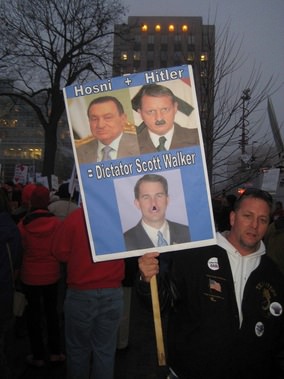
Matt Welch at Reason finds a distasteful sign at the Wisconsin rally and has this to say about public sector unions in general:
I have written in the past about how libertarians are pretty lonely in the political scheme of things in terms of constantly being challenged to defend themselves against the "logical conclusion" of their philosophy. But I think it's time to amend that. We are witnessing the logical conclusion of the Democratic Party's philosophy, and it is this: Your tax dollars exist to make public sector unions happy. When we run out of other people's money to pay for those contracts and promises (most of which are negotiated outside of public view, often between union officials and the politicians that union officials helped elect), then we just need to raise taxes to cover a shortfall that is obviously Wall Street's fault. Anyone who doesn't agree is a bully, and might just bear an uncanny resemblance to Hitler.
This is an object lesson in cherry picking problematic elements of the rhetoric used by those with whom you disagree, in order to create a straw man.

That was a terrible sign.  But is there much evidence of that type of rhetoric elsewhere on the left?  With the Tea Party, as with right wing radio and television in general, there seems to be a definite trend.  What is more, there is a longstanding tradition on the right of a narrative that literally worries that liberalism is inherently fascistic and will lead to tyranny.  That said, it is an important reminder of how muddled thinking cripples debate.  More than anything, what the above sign did was to distract from real engagement.

Welch also makes some more serious points.  There are a couple of assumptions implicit in Welch's commentary.
1 - Because few private pensions exist, public pensions shouldn't either.
2 - Public workers shouldn't be allowed to unionize, because they'll end up capturing politicians and getting paid too much.

1 - Should private pensions not exist?  It would seem that pensions are a form of compensation set up in an environment of job stability.  For a number of reasons, they couldn't be maintained.  But does that necessarily apply in public sector work, which is almost by definition a very stable industry (we'll always need cops, teachers, firefighters, etc.)?

2 - Public workers have the same needs as private workers.  Aside from basic questions of labor rights, unions can be an invaluable way for an organization to get objective input from its "members on the ground" - middle managers are just as interested in preserving a status quo that makes themselves look good at the expense of larger truths.  (Our teachers union is greatly interested in best-practices and is often the only bottom-up link politicians and administrators have with what is really going on in the classroom.  To the extent that they are receiving information they otherwise could not that affects students, it is a structure that ultimately benefits student learning).  Any large organization is fooling themselves if they think that workers won't rationally choose to protect their jobs to avoid rocking the boat.  Often, the channels for constructive criticism simply don't exist.  (The popular television show Undercover Boss illustrated this point again and again).

The argument against political capture is valid as far as it goes.  But if you accept the argument that all workers ought to have organized advocacy, not only to benefit themselves, but to benefit the larger organization, this weighs against it.  And if you look at union-backed public compensation in general, it isn't terrible out-of-control at all.  Obviously there will be debate, but if you think public workers are living high on the hog you're sorely mistaken.  The compensation I see seems perfectly reasonable.

Welch is making a slippery slope argument when he says worries that the democratic position on public unions will lead to a political capture that will spiral out of control.  The problem with slippery slopes is that they aren't logically predictive.  Just because something could, in some perfect scenario, happen, it doesn't mean it will.   This is why we don't have speed limits of 150mph - or 10 mph for that matter.  Other pressures come to bear.  With public sector unions, that pressure has kept compensation pretty reasonable, and is certainly coming to bear now.

Yet what to make of Welch's claim that the current situation is proof that public workers will always require an increase in taxes - if tax rates were sufficient to cover compensation before, why are they inadequate now?  A picture is painted in which closed-door negotiations conspire to grab ever-more of public coffers.  Yet the public consistently supports services they are unwilling to pay for.  This schizophrenia pits public confusion (manipulated in no small part by ideologues and politicians) against sound fiscal policy.  What's more, the electoral reality is that this also reflects a bitter split between competing visions of what public services should exist to being with.

Furthermore, while the recession has hit all states, each fiscal situation is different.  It is simply not the case that state deficits can all be pinned on compensation negotiated by public unions.  Frequently, pension coffers are drawn from to finance other areas government.  To blame pensioners now is not only an unfair breach of contract, but it is a dishonest manipulation of fact.

Friday, February 18, 2011

Making Culture

 From the Wikipedia entry Culture Industry:
Culture industry is a term coined by critical theorists Theodor Adorno (1903–1969) and Max Horkheimer (1895–1973), who argued in the final chapter of their book Dialectic of Enlightenment, 'The Culture Industry: Enlightenment as Mass Deception' ; that popular culture is akin to a factory producing standardized cultural goods – through film, radio and magazines – to manipulate the masses into passivity; the easy pleasures available through consumption of popular culture make people docile and content, no matter how difficult their economic circumstances.

Adorno and Horkheimer saw this mass-produced culture as a danger to the more difficult high arts. Culture industries may cultivate false needs; that is, needs created and satisfied by capitalism. True needs, in contrast, are freedom, creativity, or genuine happiness. This was reference to an earlier demarcation in needs by Herbert Marcuse (see Eros and Civilization (1955))

I'm not sure if I'm so skeptical of these lines of reasoning because I misunderstand them, or because they are very flawed. I certainly haven't them, so that's that. But it does strike me as part of a much older leftist story that is kind of right, but feels really ham-fisted and often plain wrong.

What first occurred to me that it is rather puritanical. I mean, replace "freedom, creativity, or genuine happiness" with something more religious and you've got a paraphrasing of Islamist cultural critique.

Yet there is an obvious truth to it. No matter why they are doing it, much of American behavior and attitudes are terrible. The question is kind of chicken/egg: do we buy it because we want it or because we've been told to want it? And how much of this is a feedback loop anyway? You've got those in power positions leveraging this stuff, and so their hand is at least partly behind the wheel. But they're also often "following the money".

And how much of this is really "false contentment"? I'm reminded of the old TV vs. non-TV watchers debate. Although, let's be honest, it's mainly the non-TV guys standing there with their noses in the air, trying to absorb as much of the erudition and sophisticate status as possible, almost as if applying salve to their wounds-of-penance, lying on their uncomfortable futons, drinking bitter wine and cursing reality television. But there are obviously incredibly redeeming qualities to mass culture, often ones that far surpass what careless observers might consider "higher art".

I'm entirely open to being disabused of my notions. But as it stands, this sort of thinking can get tendentious rather quick.

Thursday, February 17, 2011

Ice Floes

Today I was pointed towards this column on the effects of climate change in the San Diego Union-Tribune.  More specifically, the comments section, and how decisively conservative they were.

Interestingly, the comments vacillate between denial, and spiteful joy in the possibility that the sea might be rising - "what great fishing opportunities!"  I can't help but think that the former is the same old hand-waving-as-a-smokescreen-for-true-rightwing-perspective found in the latter.  You can't generally come right out and say you don't give a shit about the earth or most of its (brown) people, so you come up with one elaborate ideological scheme after another. 

This sort of callous "political incorrectness" is widespread on the right.  So much so that it seems to go to a more fundamental issue of temperament.  It's an attitude that takes an almost gratuitous pleasure in human frailty.  I work with a woman, for instance, who routinely jokes that the poor, emotionally-damaged children she teaches "ought to be rounded up and shot".  Understand, she has a dark sense of humor, and this is gallows humor at its finest.  But the attitude comes directly from a larger worldview that is often very conservative (she claims to be a moderate, despite her husband's devotion to Rush Limbaugh in the car).  And the right is filled with just this sort of quasi-humorous social-Darwinist commentary.  Tune in to AM radio for an instant and you're thrust right into a cauldron of anger, disgust and open hostility towards the "weak". 

To the extent that conservatives hate liberalism, it seems largely due to liberals' unending devotion to the plight of the "weak".  This is what they cannot stand.  Whether it is blacks, women, gays, Muslims, or owls - this "concern" continually expressed absolutely drives them mad.  Obviously, the implication is that they, due to a lack of expressed empathy, are callous, greedy bastards.  Yet maybe they are?

Of course, there are the polls that find conservatives give at least as much on average to charity as liberals.  And as generally very church-going folk, I have no doubt this is true.  But one cannot help but notice their general air of righteous individualism: "I got mine, get your own - dammit!"  The term "politically correct" itself seems to define a de facto stance of humility and charity in communication that conservatives would simply not abide - at least in all but the most racially offensive situations (a barrier straining at the edges after the Obama presidency).

This is all very ad hominem, I guess.  But it isn't something I take lightly.  I tend to think of myself as generally nauseatingly moderate and wiling to crawl inside the mind of my fellow man.  Yet at the end of the day, I keep returning to the question of liberalism and conservatism as fundamentally character and temperament-based (the former largely learned, the latter not).  Is my character attack on the right simply a principled reaction - that which I feel in my gut?  Why is my accusation of "greedy" or "callous" necessarily different than their principled position of "individualism" and "freedom"?  Conversely, is their accusation of my being a "bleeding heart" or "tree-hugger" necessarily different than my principled position of empathy or naturalism?

We can of course from here concoct elaborate ideological and philosophical arguments for our positions, underpinned with facts and evidence, reasoning and logic, yet how much of the cart is being pushed before the horse?  How much, in the end, are we all just hand-waving in front of deeply-felt and generally intransigent "emotions" (for lack of a better word). 

And maybe a good deal of the problem is just that - our lack of a vocabulary, our lack of a meaning for words to describe.  Neither by neuroscience, nor psychology alone do we have more than a very incomplete picture of what is driving these deep-seated responses to the world.  The tantalizing question remains: how much of our feeling is being driven by ideas, and how many of our ideas are being driven by emotion?  And what is it that we are really feeling?  Anger seems one of the most triumphant emotions in politics, yet does not anger always have a source in another emotion.  What are we afraid of?  What are we mournful of?  What has been offended in us?

Through understanding the roots of our own feelings, the original causes of why we feel the way we do about an aspect of the external world, hopefully we will come to know better why we hold the beliefs we do.  Because what are our beliefs, but the codification of how we have chosen to interpret our response to external events?  All of which is nothing less than humankind's eternal struggle to know itself.  And in this we continue forever onwards.

Tuesday, February 15, 2011

My Achy Economics Bone

It's just a hunch, but something tells me Mark Kleiman just finished Tyler Cowan's book, The Great Stagnation.  (David Brooks essentially used it to fill his column today, in which he spun this really odd tale about a man born in 1900 vs. a man born in 1973, and how the former "built wealth" while the latter shuffled his ipod.)  Kleiman worries that something called the Baumal Effect necessitates an increase in teacher productivity.  From Wikipedia, the Baumal Effect:
involves a rise of salaries in jobs that have experienced no increase of labor productivity in response to rising salaries in other jobs which did experience such labor productivity growth.
Kleiman's solution?  Video-screens! No, seriously.

This crap makes my economics bone hurt.  I would ask this question: where is the morality of shared interest in this economic equation? There are plenty of things in life that are good, valuable services yet which will likely, in 1000 years, be about as productive. Like parenting, for instance. The husband or wife who chooses to stay home and raise the babies is doing something invaluable. So how do we value it? Mark might suggest we find ways of increasing the productivity of parenting – maybe involving videoscreens?


We’ve become so used to business-speak about “growth” being this magic genie that grants all things good, that we have lost sight of what really matters in society. Once we discovered that there were millions of starving people in the 3rd world willing to live on slave wages (because at least slaves get to eat), we sold our neighbors out faster than you can get to page 6 of the WSJ.

Now, I’m not suggesting I have any grand answer to trade and productivity. But I do think that we’ve bent so far over the altar of *quantified productivity* and *growth outcomes*, that we’re forgetting the real value of the real work that real people do. Just because Mark Zuckerburg figured out how to print gold, it doesn’t mean that schoolteachers, firefighters, waiters, taxi drivers, professors, mechanics, cashiers and the rest of us now have to have our god-damned stock diluted.

OK, I took a breath. You want productivity? A school teacher who turns out good students prints gold. A taxi driver who can drive you home from a bar at 2am prints gold. A plumber who can fix the gushing pipe in your basement prints gold.  Since when have we become so blind to the value we bring to each other that quarterly growth and performance targets have come to define us?

Monday, February 14, 2011

Shoveling Towards Consciousness

I've been reading Richard Dawkins', The Greatest Show On Earth.  In a playful and joyous manner, he does an excellent job explaining the nuanced brilliance of natural selection.

A particular point he spends time on is the differences between artificial and natural selection.  Or rather, the lack of differences.  He notes that when the horticulturalist or pet breeder selects for some desirable characteristic, he is simply doing consciously what natural selection does unconsciously.  He points to the fact that certain flowers have been bred relentlessly, owing to some natural beauty or perfume the strength of which can be heightened by selection.  Yet other flowers, such as the corpse flower, which smell like rotting flesh in order to attract the flies and carrion beetles which are their pollinators, are of obvious disinterest to horticulturists.

He gives numerous other examples of the ways in which natural selection in nature is driven by a continuous, back-and-forth relationship among organisms, each placing what is ultimately reproductive pressure on one another.  When a flower grows brighter or more nectarous to attract a particular bird (those mutations leading to brighter colors or sweeter nectar being pollinated further), the bird is actively selecting for those characteristics which please it most: color and taste/caloric content.

I haven't finished the book.  And for all I know Dawkins has already or will make this next point.  But it occurred to me while reading about this similarity between natural and artificial selection, that there is no small degree of anthropocentrism going on here.  Because, aren't we all simply selecting for the things which please us?  Or to go further, aren't we being selected for by the things which would please us?

A man wants to plant a tomato plant, so he digs a hole.  The soil is firm, and so he devises a tool to make the job easier: a shovel.  As shovels don't generally exist in nature, you might say that he selected for, or designed the shovel.  Yet could you not also say that his shovel was designed by the firm soil into which the hole must be dug?  Just like the hole itself was designed by the tomato plant?  And the tomato plant having been designed by the man's desire for tomatoes?

So now we come to the classic creationist argument for an intelligent designer: does not a watch need a watchmaker; does Mt. Rushmore not need a sculptor?  Just like shovels, neither occur naturally in nature. 

Yet is man not nature?  When man selects for a particular trait that pleases him, he is behaving just like the bee that selects for the tastiest nectar.  The only difference, it seems to me, is that man's brain is considerably larger, and thus is able to have something called "consciousness" about the whole thing.  Although, as any post-modern deconstructionist will tell you, man is often quite unconscious of what he is - knowingly or not - selecting for.

Now, consciousness is certainly an amazing process.  It is likely one of the most amazing things we know of existing in the universe.  But the actual act of consciousness is largely unconscious (just ask yourself how you thought what you just thought!).  And while the conscious mind can do some pretty amazing things - the Parthenon, the Mahabharata, Hamlet - these are but child's play compared to the staggering complexity of the eukaryotic cell, or the eyeball, both of which were selected for and "designed" over the course of millennia.

At this point it might also be fun to observe that consciousness itself has evolved by a process of natural selection.  Our ancestors a million years ago likely could not have dreamed of the Labradoodle.  Yet the structures in their brains responsible for the inevitable desire to breed such a creature were well under developmental way.

Sunday, February 13, 2011

Round We Go

Obama's getting ready to present his new budget proposal.  Conservatives are already saying it its cuts don't go far enough.  Liberals just want their social programs.

You know, is it really so complicated?  Won't there just always be ghettos, wherein most of the crime will occur? Hasn't this always been the case?

Or at least whenever there has been some semblance of property rights. Because you have the haves living together in one area, the have-nots living together in another area. This creates very different normative behaviors which have their own inertia. Broken windows theory.

It seems to me a simple pragmatism that says, OK, we're not going to have perfect egalitarianism any time soon. So let's take a bunch of our resources and target the inner-city/ghetto/etc. We'll do our best to provide a safety net, and put out some scaffolding so as many people can climb out as possible.  It won't break the bank.  We'll spend maybe, 5-10% of our wealth on helping them out.

But the reservoir is going to keep filling with spill-over from other areas of society - those who for whatever reason found themselves failing. Maybe they had bad luck. Maybe they're lazy (I hate that word, as it's meaningless, but it does at least describe a general behavior). Maybe they have issues. Maybe they don't know how to make the system work for them. Etc.

They'll find the cheapest part of town to live in. They'll have children. Those children will go to school with a high percentage of kids from similarly failing backgrounds.

I don't see what the big deal is. There are a lot of things we do that work to help change lives. There's stuff that doesn't. But we learn from it, and design better and better systems of dealing with this problem that seems kind of built in to modern social and economic systems. But the Wax/Mac Donald idea of "waiting for culture to change" just seems, well, idiotic. This problem has been around since biblical times - and long before. Jesus wasn't talking about some different, special kind of "poor". This is just life. It's being human. I won't give up on Utopian fantasies of true egalitarianism. But I realize we need to be practical.